
Appalachian History Series – Wheelwright Lodge No. 889: Freemasonry in a Floyd County Coal Town
In 1946, photographer Russell Lee visited Wheelwright, Kentucky, as part of a federal photographic survey of the American bituminous coal industry. Among the mines, company houses, streets, stores, and families he encountered was a quieter scene that revealed another side of life in the Floyd County coal town. Members of the Order of the Eastern Star had prepared a buffet supper for local Masons who were gathering for a lodge meeting.
The photograph is valuable because it captures something that official records and architectural surveys cannot quite reproduce. Wheelwright Lodge No. 889 was not simply a number on the rolls of the Grand Lodge of Kentucky, nor was its brick hall merely another building in the planned company town. By the middle of the twentieth century, the lodge had become part of a network of social gatherings, ritual, fellowship, funerals, honors, and community relationships that extended beyond the mine itself. The surviving federal caption explicitly connects the Eastern Star supper with local members attending a Masonic lodge meeting, providing a rare visual record of fraternal life in Wheelwright during the height of the Inland Steel era.
The story of Wheelwright Lodge, however, began almost three decades before Lee arrived with his camera. It began when Wheelwright itself was still a remarkably young place.
A Lodge Born with the Coal Town
Before the coal companies arrived, the future site of Wheelwright was an isolated section of southern Floyd County near the confluence of Hall and Branham branches on Otter Creek. The Elk Horn Coal Company established its mining town there in 1916. The earliest settlement began with temporary accommodations, but houses and commercial buildings followed as the company expanded operations and transportation connections improved. The National Register nomination for the Wheelwright Commercial District notes that many of the major commercial structures were erected between 1916 and 1920.
Wheelwright Lodge developed almost simultaneously with that first period of town building. In 1918, only about two years after the coal camp had been established, the Grand Lodge of Kentucky granted a dispensation allowing a group at Wheelwright to begin operating as a lodge under dispensation.
The institutional history of Kentucky Freemasonry, compiled from the original Grand Lodge proceedings, records that dispensations were granted for new lodges at Mowbray and Robinson at Quicksand, Dripping Springs, Wheelwright, Stone, Equality, and Gleanings. Wheelwright therefore entered the Masonic record at a moment when the community around it was still taking shape.
The timing is especially striking. Kentucky’s 1918 Grand Lodge communication itself had to be postponed from October until December because of the influenza epidemic, while the country was still involved in the First World War. The same records that mention the new Wheelwright lodge describe the Grand Lodge participating in Liberty Loan efforts and dealing with requests involving Masons serving in the military. Wheelwright Lodge was therefore organized during a year of national disruption, epidemic disease, wartime mobilization, and extraordinary industrial demand.
The surviving published sources do not yet establish where Wheelwright’s first Masons met during this earliest period. The present brick lodge building did not exist, and the young coal town was still being constructed around them. What the records do establish is that an organized Masonic presence appeared almost as soon as Wheelwright itself became a permanent community.
From Dispensation to Wheelwright Lodge No. 889
Operating under dispensation was only the beginning. A new lodge still had to demonstrate that it could function according to the requirements of the Grand Lodge before receiving a permanent charter.
At the 1918 communication, the Committee on Lodges Under Dispensation considered Wheelwright along with Stone, Mowbray and Robinson, Dripping Springs, Equality, and Gleanings. The following year brought the decisive step. The official charter table of the Grand Lodge of Kentucky records Wheelwright as Lodge No. 889 and gives its charter date as October 22, 1919. In one surviving edition the name appears as “Wheelright,” but its number, location, and position among the other 1919 lodges leave no doubt that the entry refers to Wheelwright.
The charter date places the formal creation of Lodge No. 889 within the first generation of Wheelwright’s existence. The coal town and the lodge grew together.
Grand Lodge records from the following period add another piece to the story. A later institutional digest reported that Wheelwright was among several lodges established by proxy during the administration of Grand Master Proctor Knott McElroy. Wheelwright appeared alongside Quicksand, Dripping Springs, Stone, Equality, Blue Diamond, Ewings Creek, and Eli, illustrating how rapidly organized Masonry was spreading into the expanding communities of Eastern Kentucky during the coal boom.
This growth was not happening independently of industrial development. New rail lines, mines, company stores, schools, churches, and houses were drawing thousands of people into previously isolated valleys. Fraternal organizations followed those populations. In Wheelwright, Lodge No. 889 became one of the community institutions that survived long after the first rough structures of the coal camp disappeared.
Inland Steel and the Transformation of Wheelwright
The Wheelwright known to later generations took shape most dramatically after the Inland Steel Company acquired the mining operation and town in 1930. The National Register nomination records that Inland purchased not only mining equipment but roughly 1,500 acres and the buildings located upon that property, while leasing thousands of additional acres nearby. A broad rehabilitation program soon followed.
Inland Steel improved the mine complex, paved streets, expanded utilities, provided natural gas and telephone service, installed water and sanitation systems, and reshaped the appearance of the town. During 1940 and 1941, the company undertook an especially intensive modernization campaign. The theater was remodeled, the clubhouse was constructed, the community building was renovated, commercial spaces were improved, and recreational facilities were developed. Architects including Albert Franklin Tucker and Leland Becker played important roles in the physical transformation of Wheelwright.
It was immediately after this period of modernization that the surviving Wheelwright Masonic Lodge building appeared.
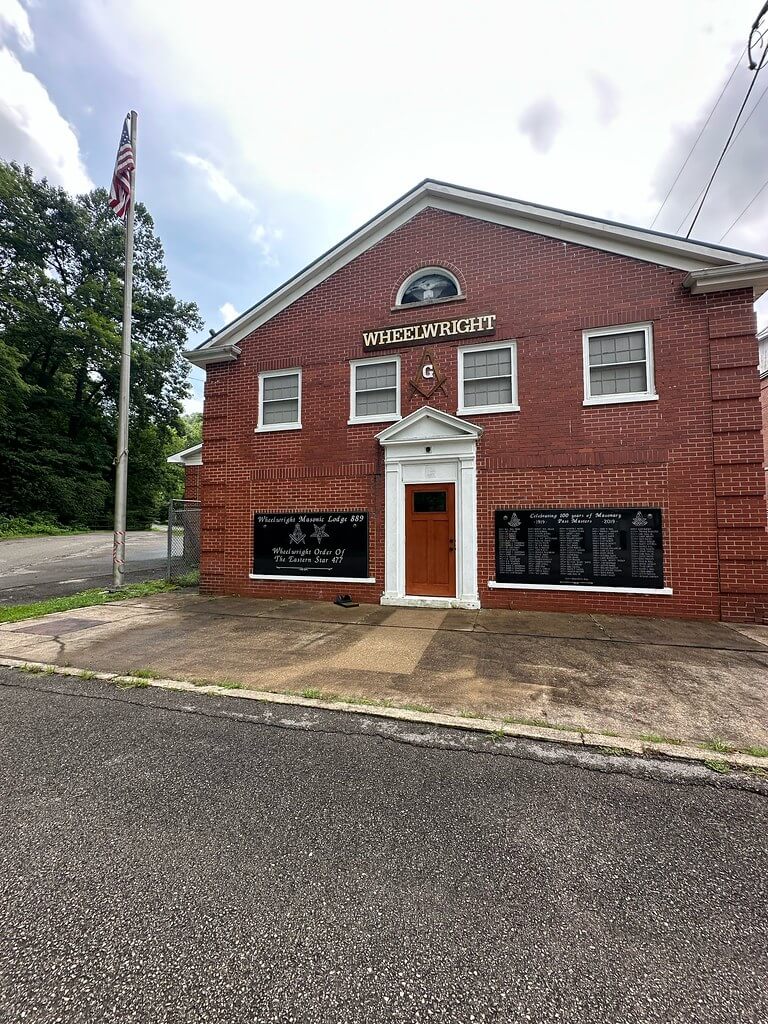
The National Register documentation dates the lodge building to 1942 and identifies Leland Becker as its designer. This connection is significant because Becker was also involved in other elements of Wheelwright’s redevelopment. The lodge therefore belongs architecturally to the same period that gave much of central Wheelwright its recognizable mid-century appearance, although the surviving nomination does not establish who financed the lodge’s construction or the precise arrangement between the Masons and the company.
The 1942 Masonic Lodge
The lodge was not built as an anonymous meeting hall. Its architecture gave it a distinct place within Wheelwright’s planned commercial landscape.
The National Register survey describes a brick building with a pedimented entrance, a semicircular window above the doorway, and quoins at the corners. These classical elements connected it visually to a broader architectural language that appeared throughout Wheelwright’s commercial district. The National Register nomination noted that many of the downtown buildings incorporated classical details, creating a degree of visual unity associated with the concentrated ownership and planning of the coal town.
The lodge stood near Hall Hollow at the northern portion of the commercial center. When the boundaries of the Wheelwright Commercial District were drawn for National Register consideration in 1980, the description specifically extended the district so that it encompassed the Masonic Lodge building. The federal survey listed it as one of the contributing structures making up Wheelwright’s unusually intact historic commercial core.
That physical setting matters. The Masonic hall belonged to a downtown that contained a company office, stores, a theater, community building, clubhouse, church, municipal building, recreational facilities, and other institutions intended to make Wheelwright a largely self-contained community. The National Register nomination described the commercial district as the focal point through which residents could meet commercial, governmental, educational, religious, recreational, and other needs.
The lodge added another need to that landscape: association.
It offered a place where men from the community could gather according to traditions that did not begin with the coal company and were not limited to the mine. That distinction gave the lodge a different kind of permanence. Coal companies could be purchased, mines could close, and company property could change hands, but the fraternal institution had a history and identity of its own.
An Evening at the Lodge in 1946
Russell Lee’s 1946 photograph gives perhaps the best surviving glimpse of what that institutional life looked like after the new building opened.
Lee’s work at Wheelwright belonged to a much larger federal study of the bituminous coal industry. Rather than concentrating exclusively on miners underground, the photographic survey documented families, houses, recreation, medical care, commercial activity, and community organizations. Wheelwright received unusually extensive coverage.
Among those images was the photograph whose original federal caption identifies a buffet supper prepared by members of the Eastern Star for local members of a Masonic lodge meeting at Inland Steel Company’s Wheelwright No. 1 and No. 2 mines community.
It is an ordinary event, and that is precisely what makes it important.
No cornerstone ceremony or visiting dignitary was required for the lodge to matter. A supper before a meeting tells us that the institution had become woven into the regular social calendar of Wheelwright. Food, conversation, ritual, friendship, and family connections surrounded the formal business of the lodge. The Eastern Star’s involvement also shows that the social world surrounding Masonry extended beyond the men who entered the lodge room itself.
Only four years had passed since the new hall was built. By 1946, it was already part of the ordinary rhythm of life in one of Eastern Kentucky’s most highly developed coal towns.
Robert M. Sirkle and Wheelwright’s Place in Kentucky Masonry
Wheelwright Lodge eventually produced a Mason whose influence extended well beyond Floyd County.
Robert M. Sirkle belonged to Wheelwright Lodge No. 889 and rose through the leadership of Kentucky Masonry during the years after the Second World War. Grand Lodge records show him progressing through the senior offices before becoming Grand Master of the Grand Lodge of Kentucky for the 1952 to 1953 Masonic year. The official list identifies him directly with Lodge No. 889.
For a lodge created in a young mountain coal camp in 1918, Sirkle’s election was an important achievement. Little more than three decades after Wheelwright’s Masons had begun working under dispensation, one of their own had reached the highest elected Masonic office in Kentucky.
Sirkle’s name endured within Kentucky Freemasonry. Robert M. Sirkle Lodge No. 954 in Lexington, chartered in 1964, bears his name. The Grand Lodge’s official charter records identify that lodge separately while continuing to list Wheelwright as No. 889 in Floyd County.
His career also provides a reminder that the small communities of Appalachian Kentucky were not isolated from statewide institutions. Men who lived and worked in the coalfields could participate in organizations whose networks stretched across the Commonwealth.
A Lodge of Miners, Professionals, and Community Leaders
The surviving record repeatedly connects Lodge No. 889 with the men who made Wheelwright function.
Obituaries and biographical notices published in regional newspapers identify Inland Steel employees, mine workers, inspectors, civic officials, and other local residents as members of Wheelwright Lodge. A 1963 obituary for retired Inland Steel employee Temus E. Sullivan, for example, identified him as a Mason associated with Wheelwright Lodge No. 889. Other notices from later decades similarly connected lodge membership with employment in the coal industry, labor organizations, and local civic life.
This does not mean that every important employee in Wheelwright was a Mason, nor do the surviving records justify treating the lodge as an extension of Inland Steel. What they show instead is considerable overlap between the lodge and the human network that sustained the town.
The mine brought people to Wheelwright. The lodge provided some of those people with another form of community.
That distinction became increasingly important as the ownership and economic structure of Wheelwright changed.
Elections, Degrees, Suppers, and Lodge Work
Local newspapers preserve the everyday history that official Grand Lodge tables often miss. Through small announcements scattered across decades, Wheelwright Lodge emerges not merely as an organization that existed on paper but as a functioning local institution.
The Floyd County Times carried notices for Wheelwright Lodge No. 889 by at least 1950, with additional references appearing in 1952 and 1953. A January 1964 notice reported that the lodge had held its annual election of officers in December. Such notices offer one of the best surviving methods for reconstructing the lodge’s leadership from year to year.
The pattern continued into the 1970s and 1980s. In early 1979 the lodge announced Master Mason degree work accompanied by a potluck supper. In August 1982, it prepared to honor Clarence W. King. In May 1984, the lodge again announced degree work and invited Master Masons to attend. These brief newspaper items recorded an institution continuing the rituals, meals, honors, and gatherings that had characterized its earlier decades.
The combination of degree work and food is particularly reminiscent of Russell Lee’s 1946 photograph. More than thirty years separated Lee’s Eastern Star supper from the 1979 potluck, yet the surviving records suggest continuity in the way ritual and fellowship existed alongside one another.
Masonry at Death as Well as in Life
One of the clearest examples of the lodge’s community role appeared in 1994.
That November, the Floyd County Times reported that Wheelwright Lodge No. 889 planned a service for deceased members who had not received Masonic funeral rites. Other Floyd County obituary records document occasions when the lodge conducted Masonic funeral services for individual members.
Such records reveal why a local lodge can matter to the history of a town even when its internal minutes remain unavailable. Membership followed individuals beyond the lodge meeting itself. It could appear in an obituary beside military service, employment in the mines, union membership, church affiliation, public office, and family relationships.
For historians, these notices also provide a way to reconstruct a membership that otherwise risks disappearing. Taken together across many decades, obituaries, election announcements, degree notices, and memorial services can identify the men who passed through Lodge No. 889 and connect them with the wider history of Wheelwright.
Surviving the End of the Company Town
The world surrounding the Masonic hall changed dramatically after its construction.
Inland Steel sold its Wheelwright mining complex to Island Creek Coal Company in 1966. Mountain Investment acquired the town in 1969, and by the end of the 1970s the Kentucky Housing Corporation had become involved in acquiring significant portions of the former company property. The transition represented the gradual dismantling of the old system in which a single industrial corporation owned much of the community around the mine.
Wheelwright Lodge endured through that transition.
The significance of that endurance becomes clearer when considered against the physical history of the community. Company ownership had once created much of Wheelwright’s built environment. As ownership fragmented and the coal economy changed, many institutions associated exclusively with the company lost their original purposes.
The lodge was different. Its reason for existing did not depend on which corporation owned the mine.
Newspaper notices from the 1970s, 1980s, and 1990s demonstrate continued elections, degree work, honors, memorial services, and membership long after Inland Steel had departed. The lodge had begun in the first years of the coal town, but it had developed an institutional life capable of extending beyond the classic company-town era.
Ernest C. Jackson and the Lodge in a New Century
Wheelwright Lodge’s connection with the leadership of Kentucky Freemasonry did not end with Robert M. Sirkle.
Ernest C. Jackson, an Eastern Kentucky native with a career that included work in the mining industry, affiliated with Wheelwright Lodge No. 889 by dual membership on May 27, 2009. According to his official Grand Lodge biography, he later served as Master of Wheelwright Lodge during the 2012 to 2013 Masonic year before demitting in July 2015.
Jackson continued through the leadership ranks of the Grand Lodge and was elected Grand Master of Kentucky for 2020 to 2021. His biography therefore gives Wheelwright No. 889 a second documented connection with a man who eventually occupied Kentucky Masonry’s highest office, although Jackson’s principal Masonic affiliations extended to other Eastern Kentucky lodges as well.
Separated by nearly seventy years, the careers of Sirkle and Jackson link a lodge founded during the First World War with Kentucky Masonry in the twenty-first century.
The Building as a Record of Wheelwright
The physical Masonic hall remains one of the clearest pieces of evidence for this longer story.
When the Wheelwright Commercial District was nominated to the National Register of Historic Places, preservationists regarded the town as one of the most intact surviving coal camps in Floyd County and among the significant surviving examples in Eastern Kentucky. The district’s buildings illustrated how coal companies once planned not merely mines but whole communities, incorporating housing, commerce, recreation, religion, administration, and social facilities into the landscape.
The Masonic Lodge deserves attention within that landscape precisely because it tells a story that company offices and mine structures cannot tell alone.
Coal explains why Wheelwright grew where it did. Inland Steel explains much of the town’s surviving architecture. The lodge helps explain how residents created relationships within that industrial setting.
Its pedimented entrance and semicircular window belong to the architectural story of the town, but what happened inside belonged to another history. Men elected officers, learned ritual, conferred degrees, ate together, honored longtime members, buried their dead, and participated in a fraternity that connected a narrow Floyd County valley with lodges across Kentucky.
Why Wheelwright Lodge No. 889 Matters
Wheelwright Lodge No. 889 is easy to overlook when compared with the enormous industrial operations that once surrounded it. The tipples, mines, company stores, and machinery appear to represent the larger forces that transformed Eastern Kentucky in the twentieth century.
Yet coal towns were never only industrial systems.
They were communities of people who built institutions around work, family, religion, recreation, mutual obligation, and friendship. Wheelwright’s Masons organized their lodge while the town itself was still young, received their charter on October 22, 1919, built a permanent brick hall in 1942, gathered with members of the Eastern Star in the 1940s, produced a Grand Master of Kentucky in the 1950s, continued holding elections and degree work through later decades, honored their members, conducted funeral rites, and maintained a connection with Kentucky Masonry into the twenty-first century.
The lodge therefore offers something rare in the history of Appalachian coal towns: a thread that can be followed from the first years of the mining camp, through the height of company ownership, and into the world that followed the company’s departure.
Russell Lee caught one moment of that story in 1946. A supper was waiting. Local Masons were coming to the lodge. Somewhere beyond the walls stood the mines, company houses, and machinery that made Wheelwright possible.
Inside, another kind of community was gathering.
Sources & Further Reading
Freemasons. Grand Lodge of Kentucky. Proceedings of the Grand Lodge of Kentucky, F. & A.M., One Hundred and Eighteenth Annual Communication. Louisville, KY: Masonic Home Printing Office, 1918. This is the key contemporary source for Wheelwright beginning work under dispensation. https://catalog.hathitrust.org/Record/012100446
Freemasons. Grand Lodge of Kentucky. Proceedings of the Grand Lodge of Kentucky, F. & A.M., One Hundred and Nineteenth Annual Communication. Louisville, KY: Grand Lodge of Kentucky, 1919. Especially important for the period surrounding Wheelwright Lodge No. 889 receiving its permanent charter. https://catalog.hathitrust.org/Record/012100446
Freemasons. Grand Lodge of Kentucky. Proceedings of the Grand Lodge of Kentucky, F. & A.M., One Hundred and Twentieth Annual Communication. Louisville, KY: Grand Lodge of Kentucky, 1920. Useful for the lodge’s establishment immediately following its 1919 charter. https://catalog.hathitrust.org/Record/012100446
George Washington Masonic National Memorial. “Kentucky Proceedings.” Masonic Digital Archives. The collection provides digitized Grand Lodge of Kentucky proceedings from 1800 through 2013 and is one of the best places to continue year-by-year research on Lodge No. 889. https://gwmemorial.org/pages/kentucky-proceedings
Grand Lodge of Kentucky, F. & A.M. Book of Constitutions. Louisville: Grand Lodge of Kentucky, 2018–2019. The official lodge tables identify Wheelwright No. 889 in Floyd County and preserve the lodge’s official standing in Kentucky Masonry. https://glky.org/member/asset/constitution/Book_of_Constitutions_2018-2019_Rev_2_web.pdf
Grand Lodge of Kentucky, F. & A.M. Constitution of the Grand Lodge of Kentucky. Louisville: Grand Lodge of Kentucky, 2014. The county listing places Wheelwright No. 889 alongside the other Floyd County lodges. https://glky.org/wp-content/uploads/2013/06/Updated-_Constitution_Jan_2014.pdf
Moore, H. H., and E. D. Swimme. History of Freemasonry in Kentucky from 1900 to 1935. Louisville: Masonic Home Printing Office, 1935. Compiled from Grand Lodge proceedings, this institutional history is particularly valuable for Wheelwright’s 1918 dispensation and early lodge history. https://archive.org/stream/historyoffreemas00maso/historyoffreemas00maso_djvu.txt
National Park Service. “Wheelwright Commercial District.” National Register of Historic Places Inventory-Nomination Form. 1980. This is the essential architectural source for the lodge building, identifying the Masonic Lodge as a 1942 structure designed by Leland Becker and including it within the historic district. https://npgallery.nps.gov/GetAsset/640379e5-3775-4094-ab9d-80873bdfbe0c
National Park Service. “Wheelwright Commercial District, Wheelwright, Kentucky.” National Register of Historic Places. The federal listing confirms the district’s 1980 National Register status. https://www.nps.gov/state/ky/list.htm?program=all
Lee, Russell. “Wheelwright #1 & 2 Mines, Wheelwright, Floyd County, Kentucky.” September 1946. Records of the Solid Fuels Administration for War, National Archives and Records Administration. Lee’s federal series provides extraordinary primary visual documentation of Wheelwright during the lodge’s early years in its 1942 building. https://visit.archives.gov/galleries/russell-lee-mines
National Archives and Records Administration. Photographs of the Medical Survey of the Bituminous Coal Industry, 1946–1947. Record Group 245. The Wheelwright photographs include community, mining, religious, social, and civic scenes surrounding Lodge No. 889. https://visit.archives.gov/galleries/russell-lee-mines
University of Kentucky Libraries Special Collections Research Center. Wheelwright Collection, 1916–1979. Collection 88M6. Lexington: University of Kentucky. The enormous archival collection contains Inland Steel, Island Creek Coal, Mountain Investment Company, property, town-development, and blueprint records and may contain additional records concerning construction or maintenance of the Masonic hall. https://exploreuk.uky.edu/catalog/xt7qnk361p0s/guide
Bryant, Geneva T. “Floyd County-Wheelwright: A Community Study on Wheelwright, Kentucky.” 1950. County Histories of Kentucky, no. 24. Morehead State University. A valuable near-contemporary community study prepared only eight years after construction of the Masonic Lodge building. https://scholarworks.moreheadstate.edu/kentucky_county_histories/24/
Inland Steel Company. Wheelwright News. Wheelwright, KY: Inland Steel Company, various issues. This company-produced newspaper or newsletter is an important primary source for community organizations, social activities, employees, and town life during the lodge’s mid-century period. https://exploreuk.uky.edu/catalog/xt7qnk361p0s/guide
Williams, Lewis M. The Transformation of a Coal Mining Town. Chicago: Inland Steel Company, ca. 1940s. A contemporary corporate account of Inland Steel’s transformation of Wheelwright during the same period in which the 1942 Masonic Lodge building was erected. https://link.springer.com/chapter/10.1057/9781137024671_9
Floyd County Times. “Wheelwright Lodge No. 889.” July 6, 1950. A contemporary local newspaper notice establishing the lodge’s public presence in Wheelwright during the early postwar period. https://fclib.org/Floyd%20County%20Times/The_Floyd_County_Times_1950/07-06-1950.pdf
Floyd County Times. “Wheelwright Lodge No. 889, F. & A.M.” March 15, 1951. The notice records the lodge’s regular second- and fourth-Wednesday meeting schedule. https://fclib.org/Floyd%20County%20Times/The_Floyd_County_Times_1951/03-15-1951.pdf
Floyd County Times. “Wheelwright Lodge No. 889, F. & A.M.” January 17, 1963. Contemporary notice concerning activity at the Wheelwright lodge hall. https://fclib.org/Floyd%20County%20Times/The_Floyd_County_Times_1963/01-17-1963.pdf
Floyd County Times. “Wheelwright Lodge No. 889 Election of Officers.” January 17, 1979. Reports the lodge’s December 17 election and identifies the officers chosen to serve during 1979. https://papers.fclib.org/Floyd%20County%20Times%20%28renamed%29/The_Floyd_County_Times_1979/January%2017%2C%201979.pdf
Floyd County Times. “Wheelwright Lodge To Honor Mr. King.” August 11, 1982. Documents Lodge No. 889 honoring Clarence W. King and provides evidence of the lodge’s continuing community functions. https://fclib.org/Floyd%20County%20Times/The_Floyd_County_Times_1982/08-11-1982.pdf
Floyd County Times. “Wheelwright Masonic Lodge To Conduct Degree Work.” May 16, 1984. Reports planned Masonic degree work and the invitation of area Master Masons. https://fclib.org/Floyd%20County%20Times/The_Floyd_County_Times_1984/05-16-1984.pdf
Floyd County Times. “Wheelwright Lodge No. 889 Memorial Service.” November 16, 1994. Reports the lodge’s planned service for deceased members who had not received Masonic funeral rites. https://fclib.org/Floyd%20County%20Times/The_Floyd_County_Times_1994/11-16-1994.pdf
Floyd County Times. December 6, 1991. Includes discussion of Kentucky Masonry and Wheelwright Lodge No. 889, useful for understanding the lodge’s charitable and institutional role late in the twentieth century. https://fclib.org/Floyd%20County%20Times%20%28renamed%29/The_Floyd_County_Times_1991/December%2006%2C%201991.pdf
Floyd County Times. September 16, 1992. Biographical notice identifying a 1989 Past Master of Wheelwright Lodge No. 889 and recording his other Masonic affiliations. https://fclib.org/Floyd%20County%20Times/The_Floyd_County_Times_1992/09-16-1992.pdf
Robert M. Sirkle Lodge No. 954, F. & A.M. “History.” Lexington, Kentucky. The lodge’s institutional history records Robert M. Sirkle as having been raised in Wheelwright Lodge No. 889 and becoming Grand Master of Kentucky in 1952–53. https://robertmsirkle954.org/history.htm
King, Stephen Clark. Wheelwright, Kentucky: Community in Transition. Lexington: University of Kentucky Appalachian Center, 1982. A major scholarly study of Wheelwright based on community research and interviews and an important contextual source for the town surrounding Lodge No. 889. https://link.springer.com/chapter/10.1057/9781137024671_9
Perry, Lisa Renee. “Memory, Identity, and Paternalism: Creating an Appalachian Camelot.” PhD diss., Arkansas State University, 2011. A major scholarly study of Wheelwright’s company-town culture, paternalism, memory, and social institutions. https://wvrhc.lib.wvu.edu/collections/appalachian-collection/appalachian-studies-bibliography-1994-2012/appalachian-studies-bibliography/dissertations
Perry, Lisa. “Reflections on an Appalachian Camelot: Place, Memory, and Identity in the Former Company Town of Wheelwright, Kentucky, USA.” In Company Towns: Labor, Space, and Power Relations across Time and Continents, edited by Marcelo J. Borges and Susana B. Torres, 227–250. New York: Palgrave Macmillan, 2012. https://doi.org/10.1057/9781137024671_9. https://link.springer.com/chapter/10.1057/9781137024671_9
Perry, Lisa, and Wheelwright Historical Society. Floyd County. Images of America. Charleston, SC: Arcadia Publishing, 2010. A photographic history with substantial material on Wheelwright and southern Floyd County. https://bookshop.org/p/books/floyd-county/9a54c44620c0c2b0?ean=9780738585727
Torok, George D. A Guide to Historic Coal Towns of the Big Sandy River Valley. Knoxville: University of Tennessee Press, 2004. Provides architectural and historical context for Wheelwright and neighboring Eastern Kentucky coal communities. https://books.google.com/books?id=qrXkqj7T7u8C
Wheelwright High School. Hall Hollow Oral History Project. 1985–1988. Oral-history interviews documenting Black and white life, mining, family, segregation, religion, and community institutions in and around Wheelwright. https://researchworks.oclc.org/archivegrid/collection/data/85763039
Author Note: As you read the history of Wheelwright Lodge No. 889, I hope you see the coal town not simply as a place of mines and company buildings, but as a community shaped by organizations and relationships that endured across generations. The lodge’s history offers another way to understand how people built fellowship, tradition, and civic life in the coalfields of Eastern Kentucky.