
Abandoned Appalachia Series – Wayland High School and Gym
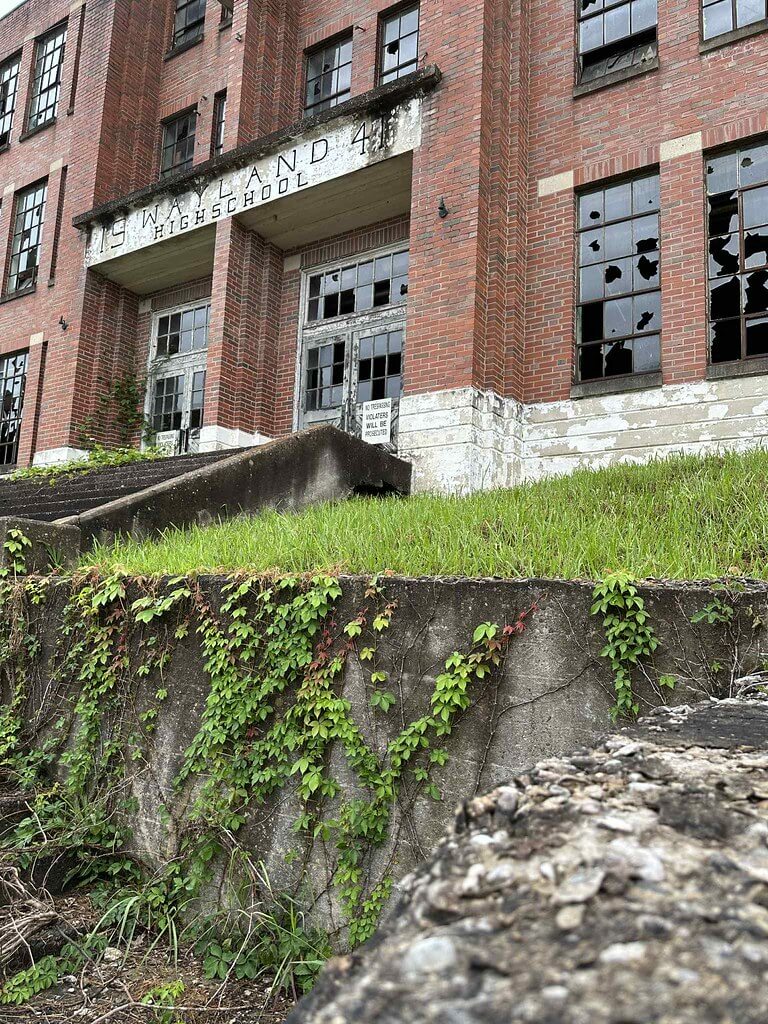
Where Beaver Creek bends around the foot of the hills in southern Floyd County, the town of Wayland grew up as a classic coal camp. In 1911 the Elk Horn Coal Company opened a camp at the mouth of Steele Creek, laying out company houses, a company store, and the industrial plant that would feed the Elkhorn coalfield. A few years later the place was renamed for company president Clarence Wayland Watson, and by 1923 the camp had incorporated as the city of Wayland.
Before World War II the town was a booming coal center on Kentucky Route 7, its streets and rail sidings lined with miners’ houses and tipples. Families who came to work the Elkhorn seams needed something more than a payroll. They needed schools, gyms, and ball courts where children could grow up with a different set of possibilities than the drift mouth and the company store. Out of that need came Wayland High School and its now legendary gymnasium.
Today the brick shell of the high school and the white clapboard gym still sit on the narrow bottom beside the highway. In photographs and local memory the campus is not just another coal camp school. It is the place where a small town built its public square around classrooms and a basketball floor.
Building a modern campus
The gym came first. In 1937 Floyd County joined a regional wave of school construction that stretched across eastern Kentucky and neighboring West Virginia. Records preserved in the National Register of Historic Places nomination for the R. T. Price House in Williamson list the “Wayland Gymnasium – Wayland, Ky.” among a long portfolio of schools and gymnasiums designed by Huntington architect Levi J. Dean. The same continuation sheet also notes “Additions to Wayland Grade, McDowell Grade & High School,” tying Wayland’s campus to a broader program of upgraded school facilities for coalfield communities.
A later television piece about the building, and a 2019 report on the Mountain Sports Hall of Fame project, describe the former Wayland High School Gymnasium as an eighty two year old structure built in 1937. The gym’s heavy timber trusses, high windows, and end galleries fit neatly with Dean’s other work, which often combined revival details with practical, modern school planning.
The main high school came a few years later. A widely circulated photograph in the Wikimedia Commons collection, taken from Kentucky Route 7, identifies the brick building as the former Wayland High School and notes that it was built in 1941. Public domain photographs on Picryl show the same façade and student athletic teams, documenting the campus in its working years.
Together the 1937 gym and the 1941 classroom building gave Wayland a modern, unified campus at a time when the mines still promised work and the population was large enough to fill the bleachers.
Everyday life at Wayland High
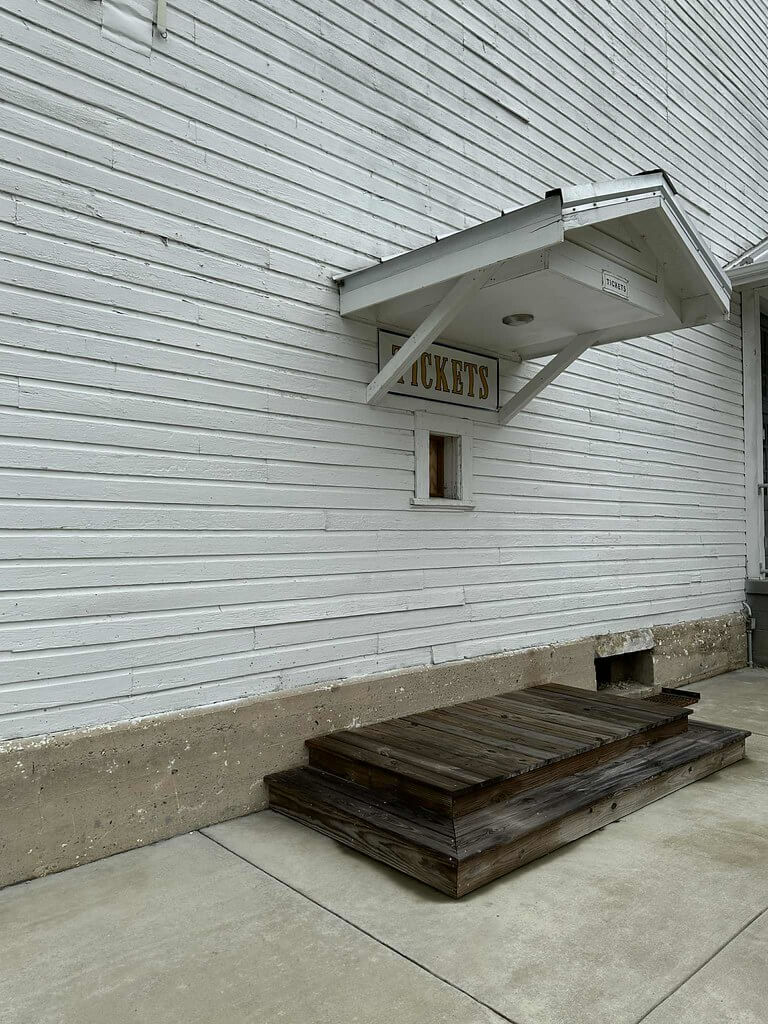
Much of what we know about daily life at Wayland High School comes from paper traces that seldom make the headlines. The Floyd County Times, digitized by the Floyd County Public Library, carries dozens of references to Wayland’s teams, school programs, and fundraising drives from the 1930s through the last graduating class. Sports previews and game write ups treated the gym as a regular stop in the county schedule, while school notes columns recorded plays, debates, and band performances that filled the building on non game nights.
A March 1993 article, for example, promoted an event at the old Wayland gym and mentioned its recognition on the National Register of Historic Places. In the process the story talked about historic school buildings as community assets, using Wayland as a local example of how a former high school gym could anchor preservation and new community use.
The school’s own publications deepen that picture. LDSGenealogy’s index for Floyd County lists Wayland High School yearbooks for the 1950s through the early 1970s, often under titles like The Wasp, with images of the gym floor, pep rallies, and senior nights. These annuals, available through commercial databases such as Ancestry, MyHeritage, and Classmates.com, capture the faces of players and cheerleaders beneath the scoreboard, record the names of teachers and coaches, and freeze the building’s interior before later deterioration.
The Wayland Historical Society’s newsletter, Turntable, adds another layer. The Periodical Source Index lists numerous Turntable entries that reproduce class photographs from 1933 through the early 1960s, debate team snapshots from the late 1930s, football and basketball team portraits from the 1940s and 1950s, and even the lyrics to the Wayland High School song. More recent issues document gym renovation work in 2019 and trace how the society purchased the old school property. These near primary sources, built from alumni donations and local scrapbooks, show the gym as a living space that contained senior plays, state tournament send off parties at the town fountain, and everyday rituals of mountain school life.
“King” Kelly Coleman and the golden age of Wayland basketball
If Wayland High School anchored the coal camp’s educational life, the gym became famous far beyond Beaver Creek because of one player. In the mid 1950s a lanky forward named Kelly Coleman put the town on the statewide basketball map.
KHSAA record books and Sweet Sixteen statistics still list Coleman at the top of several state tournament scoring categories. In 1956 he scored 185 points over four games at the boys’ Sweet Sixteen, a tournament record that has never been matched. A Kentucky High School Athletic Association profile, “Kelly Coleman still the ‘King’ of Kentucky high school basketball,” emphasizes that dominance and notes his status as Kentucky’s first Mr. Basketball. Contemporary coverage in the Lexington Herald Leader and later retrospectives point out that he once poured in 68 points in a single Sweet Sixteen game, setting another enduring mark.
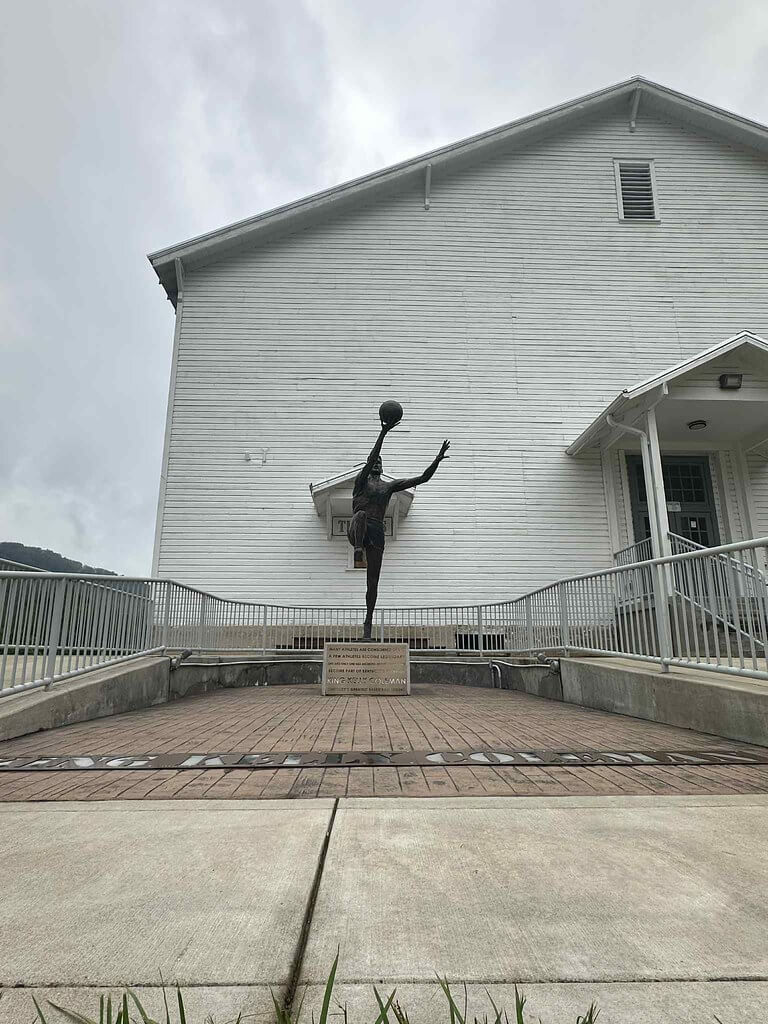
Those numbers did not come on a neutral floor. Coleman honed his game on the tight wooden court of the Wayland gym, playing in front of packed stands where miners and their families turned out in force. A Stateline Sports Network feature on the Kentucky High School Basketball Hall of Fame’s “Glory Road Project” describes the old Wayland Gym as one of three mountain gyms honored as shrines of high school basketball. The article calls it the “palace” of King Kelly Coleman, notes that it was built in 1937, and records that it hosted district tournaments in 1938, 1944, and 1953.
Turntable entries gather photographs of Wayland’s regional championship teams, including a 1956 Wasps squad portrait, and document later reunions where former players returned to the gym floor. Those images, paired with KHSAA statistics, make the gym a physical shrine to a particular era when a coal camp high school could stand on equal footing with any program in the state.
Coal decline, consolidation, and an empty building
While the teams were winning, the economic foundation beneath the town was already beginning to erode. The Elkhorn Coal Corporation mines at Wayland closed in the mid 1950s, part of a broader contraction in deep coal mining along the Right Fork of Beaver Creek. Housing remained occupied and the school stayed open, but over time population loss and school reorganization began to catch up.
Modern accounts compiled by local researchers and blogs focusing on abandoned places agree that Wayland High School operated as a high school from its 1941 completion until the spring of 1972, when Floyd County consolidated several small schools into Allen Central High School. The Wayland building then served as Wayland Grade School from 1973 to 1990, after which regular classes ceased.
Yearbook runs that once extended into the early 1970s stopped. New class photographs shifted to the elementary grades. Floyd County Times articles from the 1970s and 1980s refer to the building primarily as a grade school and community center rather than as a high school. When the grade school finally closed around 1990, the gym and classroom building suddenly belonged to no active school community.
In the early twenty first century, photographers and urban exploration bloggers began to document the abandoned campus. A 2016 Jamie in Wanderland post, illustrated with interior and exterior photographs, shows broken windows, peeling paint, and stacked desks inside the main building. The writer notes that the gym still stands in the parking lot and comments on the building’s years as both high school and grade school.
By that point the gym’s structure and floor remained sound enough to imagine a new purpose, even as the main school building slipped further into disrepair.
From old gym to Mountain Sports Hall of Fame
The effort to save the Wayland gym did not begin as a statewide initiative. It grew out of local alumni, sports fans, and preservationists who saw the building as both a community center and a tangible link to eastern Kentucky’s basketball heritage.
The Wayland Historical Society, headquartered in city hall, assembled a small museum that includes Elkhorn Coal Company personnel files and artifacts related to the coal camp and its schools. The society’s Turntable newsletter published updates on gym renovation work in 2019 and publicized events in the building.
Around the same time, a broader vision coalesced. In 2017 Kentucky Humanities highlighted the grand opening of the Mountain Sports Hall of Fame in Wayland, noting a March 25 ceremony and the hall’s goal of preserving the region’s sports history. A 2019 television story from WCHS in Charleston described crews working inside the former Wayland High School Gymnasium, built in 1937, to convert it into a community center and permanent home of the Hall of Fame. The piece emphasized that the upper walls would carry displays of sports memorabilia from thirty five eastern Kentucky counties.
Public broadcasting added another layer of recognition. A widely shared feature on KET’s Kentucky Life, cited in coverage of a 2023 throwback game, spotlighted the Wayland gym and the Mountain Sports Hall of Fame, using interviews and archival footage to walk viewers through the building’s history and restoration.
Local and regional news outlets have followed the story of the gym’s revival. WSAZ and WYMT have both profiled the restoration work and the return of KHSAA sanctioned basketball games to the floor. The Mountain Sports Hall of Fame and its partners organized throwback doubleheaders in which modern teams play under the old Wayland name or in vintage uniforms, reconnecting present day athletes to Coleman’s era. A 2023 feature on Lyon County star Travis Perry, for instance, described him playing in the “venerable Wayland Gymnasium,” using his appearance to link the state’s new scoring record holder with the building where Kelly Coleman set his own marks in 1956.
The gym has also become a venue for broader cultural programming. Accounts from visitors describe a Smithsonian traveling exhibition hosted on the former school grounds, with the gym and adjacent museum used to display panels and artifacts about American history and local identity.
Funding followed recognition. Local radio coverage and community press reported that the historic Wayland Gymnasium received several hundred thousand dollars in state community facilities grants to support new additions and improvements, confirming that the building is now seen as an asset in regional tourism and heritage development rather than as a liability.
A coal camp story that keeps unfolding
Wayland’s high school and gym tell several stories at once. At the most basic level they illustrate how coal companies and county school boards built substantial public schools for camp families, especially in the years between the First World War and the postwar coal decline. The R. T. Price House documents show that the same architect and contractors who designed courthouse additions and substantial high schools across West Virginia and Kentucky also produced Wayland’s gym and school additions, giving a company town a campus that matched contemporary standards for design and safety.
At the same time, yearbooks, Turntable issues, and Floyd County Times clippings ground those buildings in the lived experience of students who filled the classrooms, took class trips, and walked into the gym under Wasps banners. The KHSAA records and sports journalism add a dramatic overlay in the figure of Kelly Coleman, whose scoring feats fixed “Wayland” in statewide basketball memory.
Finally, the story of the old gym’s abandonment and rebirth connects Wayland to wider conversations about what coalfield communities do with their historic structures once the mines and schools close. Kentucky Coal Heritage surveys of eastern Kentucky company towns highlight Wayland as one of several places where buildings retain good integrity, even as their original function has changed or ended. The Mountain Sports Hall of Fame project, coupled with local museum work and new investment, shows one model for how a single building can hold together athletic pride, community memory, and new economic possibilities.
On a winter evening when a throwback doubleheader fills the bleachers, the old gym feels closer to 1956 than to the years when its floor sat quiet. The scoreboard lights, the sound of the ball on the boards, and the photographs on the walls all point back to a coal camp high school whose influence far exceeded its enrollment.
Sources & Further Reading
Floyd County Times. Floyd County Times [digital archive]. Floyd County Public Library. Accessed December 31, 2025. https://fclib.org
LDSGenealogy.com. “Wayland Genealogy (in Floyd County, Kentucky).” LDSGenealogy. Accessed December 31, 2025. https://ldsgenealogy.com/KY/Wayland.htm
LDSGenealogy.com. “Floyd County, Kentucky School Records.” LDSGenealogy. Accessed December 31, 2025. https://ldsgenealogy.com/KY/Floyd-County-School-Records.htm
Gioulis, Michael. “National Register of Historic Places Nomination Form: R. T. Price House.” National Park Service, 1990. PDF. Accessed December 31, 2025. https://npgallery.nps.gov/GetAsset/8769fbe4-98ea-4eb3-b84d-c73e2ee8ee21
Thornton, Isabel. “National Register of Historic Places Nomination Form: Fort Gay High School.” West Virginia State Historic Preservation Office and National Park Service, 2017. PDF. Accessed December 31, 2025. https://wvculture.org/wp-content/uploads/2021/03/Fort-gay-high-school.pdf
Kentucky Coal Heritage. “Reconnaissance Field Work in Eastern Kentucky Coal Towns.” Kentucky Coal Heritage. Accessed December 31, 2025. https://www.coaleducation.org/coalhistory/coaltowns/reconnaissance_field_work.htm
Kentucky Coal Heritage. “Wayland.” Kentucky Coal Heritage. Accessed December 31, 2025. https://www.coaleducation.org/coalhistory/coaltowns/wayland.htm
“Wayland, Kentucky.” Wikipedia. Accessed December 31, 2025. https://en.wikipedia.org/wiki/Wayland%2C_Kentucky
Jamie in Wanderland. “Wayland High School — Floyd County, Kentucky.” Jamie in Wanderland (blog), January 14, 2016. Accessed December 31, 2025. https://jamieinwanderland.wordpress.com/2016/01/14/wayland-high-school-floyd-county-kentucky
Hicks, Roger D. “Wayland Kentucky Historical Society Trip and Research.” My Appalachian Life (blog), February 28, 2019. Accessed December 31, 2025. https://myappalachianlife.blogspot.com/2019/02/wayland-kentucky-historical-society.html
“Bringing the Wayland Gym back to life.” WSAZ News, August 3, 2020. Accessed December 31, 2025. https://www.wsaz.com/2020/08/03/bringing-the-wayland-gym-back-to-life
Hausberger, Audrey. “Bringing new life to Wayland Gymnasium: Floyd Central welcomes Lyon County for throwback double-header.” WYMT Mountain News, December 15, 2023. Accessed December 31, 2025. https://www.wymt.com/2023/12/16/bringing-new-life-wayland-gymnasium-floyd-central-welcomes-lyon-county-throwback-double-header
Big Sandy Community & Technical College. “Mountain Sports Hall of Fame and Big Sandy Community & Technical College Host Throwback Basketball at the Historic Wayland Gymnasium.” News release, 2023. Accessed December 31, 2025. https://bigsandy.kctcs.edu/newsroom/news/2023/mshf-and-bsctc-host-throwback-basketball.aspx
KET – Kentucky Educational Television. “Mountain Sports Hall of Fame: The Wayland Gym (Wayland, KY) | Kentucky Life.” YouTube video. Accessed December 31, 2025. https://www.youtube.com/watch?v=9Xn140NYFaQ
Mountain Association. “Wayland Residents Gather to Plan Their Recovery.” Mountain Association, April 4, 2023. Accessed December 31, 2025. https://mtassociation.org/flood/wayland-residents-gather-to-plan-their-recovery
Kentucky Coal Heritage. “Coal Camps and Communities.” Kentucky Coal Heritage. Accessed December 31, 2025. https://www.coaleducation.org/coalhistory/coaltowns/coal_towns.htm
https://doi.org/10.59350/tfvxk-3y166
Author Note: Wayland High School was never just a building beside Beaver Creek, but a place where coal camp families sent their children to chase something larger than the seams under the mountain. On the floor of its little gym, Kelly Coleman turned a small town into a statewide story, proving that basketball greatness could rise from a coal camp just as surely as from any city. This article is offered as a small tribute to the school, the “palace” where King Kelly played, and to everyone who ever sat in those bleachers or laced up their shoes on that floor.