
Abandoned Appalachia Series – M.C. Napier High School of Perry County
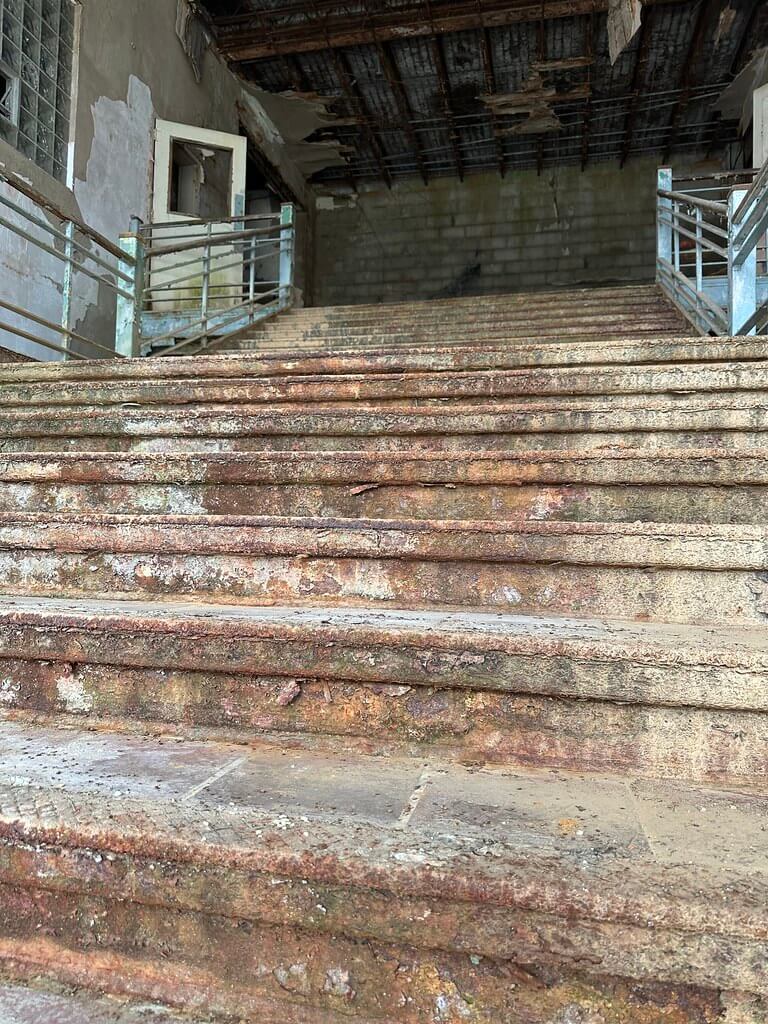
High above the North Fork of the Kentucky River, on a bend locals still call Indian Bend, a blocky red brick schoolhouse looks out over Hazard. Windows are broken, glass blocks are clouded with grime, and classroom ceilings sag over scattered desks. It is hard to imagine that for most of the second half of the twentieth century this building was one of Perry County’s proudest investments, home of the Napier Navajos and a symbol of what a modern mountain high school could be.
Today the old M.C. Napier High School stands empty, but the paper trail, photographs, and memories that surround it tell a story about education, basketball, and community change in Eastern Kentucky.
A School Named For A Superintendent
The school that became M.C. Napier High grew out of a long campaign to pull Perry County’s scattered one and two room schools into a more centralized system. Mitchell Campbell “M. C.” Napier was at the center of that push. Born in Leslie County and raised in Perry County, he became a teacher, then a principal, and eventually superintendent of Perry County Schools.
During his tenure the county built new consolidated schools, extended terms, and brought more children into classrooms. Hazard Herald coverage in the 1950s shows Napier’s name attached to school construction debates, bus contracts, and even disputes over how the board bought fuel for its vehicles. Federal programs of the New Deal and World War II era, especially Works Progress Administration projects, helped fund a generation of school buildings. Later local recollections credit Napier with working those channels so that Perry County could take advantage of WPA money and similar funding streams.
When a new high school was completed above the river in the early 1950s, the county board chose to name it for the superintendent who had shepherded the system through those changes. Napier High School opened in 1953, a three story red brick building paired with its “twin,” Dilce Combs High School, on the other side of the county.
From the start the campus was meant as more than a simple replacement for the older hill schools. It had broad halls, a real library, a band room, and enough classroom space to handle several hundred students. By mid decade Napier’s enrollment was large enough that county and state reports routinely listed it alongside much older institutions like Hazard High.
Classrooms Beside The River
Archival glimpses help us reconstruct what daily life inside Napier looked like. The KHSAA High School Records Collection at Eastern Kentucky University preserves folders of clippings, rosters, and programs on M.C. Napier covering the 1950s through 1990. Early Hazard Herald stories announce school board motions to reimburse the band for uniforms or to pay milk bills and janitorial supplies, underscoring how cafeteria lunches, music, and clean corridors were part of the new educational package.
A 1959 M.C. Napier yearbook advertised in the antique trade hints at the way the school marketed itself to the community: senior portraits in cap and gown, sports teams posed proudly in uniforms, ads from local businesses reminding students to “Think of us when you think of home.” Alumni comments on both AbandonedOnline and the school’s Facebook alumni page remember favorite teachers, yearbook staffs, and the excitement of getting a new annual every spring.
Napier’s student body was large enough to make the school a political and cultural force. In April 1956, more than seven hundred students walked out in protest when rumors spread that principal Walter Martin Jr. might be removed, a story recently retold by alumni administrators who still mark that date every spring. That kind of walkout only made sense in a county where the high school had become a true center of teenage life.
Classrooms were also tied into national history. In one WSGS oral history about John F. Kennedy’s assassination, a former student remembers sitting in Edda K. Smith’s history class at M.C. Napier when word came over the radio that the president had been shot. The memory anchors the school not only in local life but in the shared emotional landscape of the 1960s.
Teachers stayed long enough to shape generations. Obituaries for educators such as Nancy Sharon Sutton, who began teaching at M.C. Napier in 1975, and longtime county teachers like Alex G. Eversole and Newton Combs, note their work at the school and sketch careers that ran through its halls.
Memorial Gym And The Basketball Circuit
Before Napier and Dilce Combs had gyms of their own, basketball teams from across Perry County played in Hazard’s Memorial Gym, a towering stone arena financed through war bond drives and built as a tribute to local service members lost in World War II. The facility’s National Register nomination and later Kentucky High School Basketball Hall of Fame “Glory Road” recognition describe how boys and girls from Hazard, M.C. Napier, Dilce Combs, and Buckhorn all shared the floor there during the 1950s and 1960s.
That shared court meant constant contact among communities that might otherwise have stayed in their own hollows. It also gave Napier students early experience with integrated crowds and rising expectations for modern athletics. By the late 1981, Shermon Neace Athletic Center rose beside the main Napier building, and big games shifted from downtown Hazard back to the Indian Bend campus.
Navajo Pride On The Hardwood
Kentucky has always measured a high school’s stature in part by what happens on the basketball floor. M.C. Napier built a reputation as a program that could hold its own in the 14th Region and beyond.
On the boys side, KHSAA tournament records and period sports coverage show the Navajos taking regional titles and making deep state tournament runs, including a trip to the boys Sweet 16 semifinals in 1984. Alumni reminisce about those games in online forums and Facebook groups that rank the fiercest rivalries in Kentucky high school basketball, with Hazard vs. Napier filling out many short lists.
The school’s most famous athletic chapter belongs to the girls program. In 1994, under head coach Randy Napier, the Lady Navajos stormed through the KHSAA Girls Sweet 16 tournament. Official KHSAA records list M.C. Napier as the 14th Region’s state champion that year, the program’s first and only girls title. Tournament statistics from The Kentucky High School Athlete and later media guides show the team beating Henderson County in the semifinals, then overwhelming Fort Thomas Highlands 88 to 56 in the championship game, with star guard Kristie Combs named most valuable player.
In a recent Kentucky Sports Memories podcast episode marking the 30th anniversary of that title, host Gary Fogle interviewed Coach Randy Napier along with players Misty McAlarnis and Kristie Combs. They recalled packed student sections, radio broadcasts that carried Napier games across Eastern Kentucky, and the complicated emotions of winning a state championship for a school that would soon close.
Randy Napier went on to become the winningest girls coach in Kentucky high school history, collecting more than 800 victories with M.C. Napier and Perry County Central teams, a record documented by the Kentucky High School Basketball Hall of Fame and celebrated in statewide press. Yet his coaching story began in the Sherman Neace Athletic Center, where Lady Navajos banners hung from the rafters and players shot free throws with the river running silently beyond the parking lot.
Teachers, Students, And Everyday Life
Not everyone in Napier lore is a hall of fame coach or a state tournament hero. Obituaries, alumni posts, and oral histories remind us that most of what mattered at the school was ordinary life.
Local death notices and tributes mention band directors who hauled instruments to Memorial Gym for half time shows, English teachers who introduced students to Alfred Hitchcock and classic novels, and principals who knew every family in their district. Alumni comments collected by AbandonedOnline include custodians who swept the halls in the early 1990s, principals like Richard Russell, and long time staff who watched their own children enroll at Napier.
The M.C. Napier High School Alumni Facebook page, Navajos4Life, now functions as a kind of digital yearbook. It shares scanned class photos, football and basketball lineups, and reunion invitations. One recent post features the 1980 Lady Navajos, line by line with names and numbers. Another asks simply, “What are some of your favorite memories of Napier,” and fills with stories about first cars in the parking lot, band trips, senior skip days, and the smell of fresh wax on the gym floor.
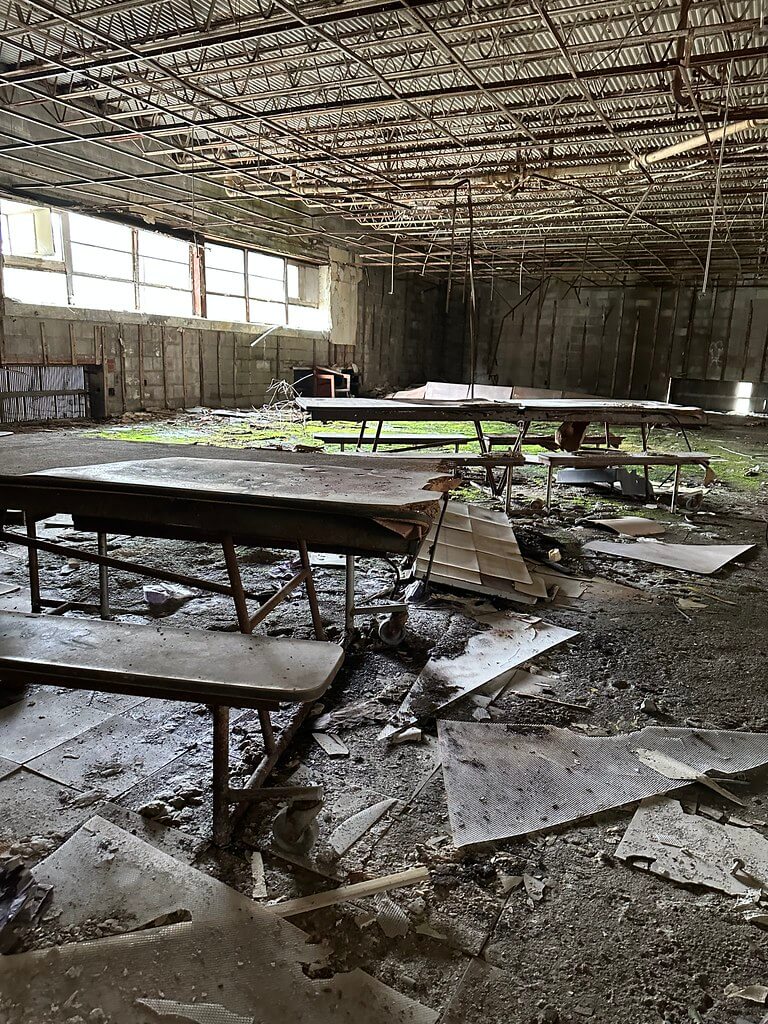
These memories match what scattered documents show. National School Lunch Act hearings from the 1970s list M.C. Napier among schools participating in the federal lunch program, reminding us of cafeteria trays, free and reduced price meals, and the daily ritual of lining up for food. A Kentucky Department of Education study on school facilities notes Napier among districts with newer consolidated high schools, a sign that for a time the building represented progress in Frankfort’s eyes as well as Hazard’s.
Consolidation And The Final Seasons
By the early 1990s that sense of modernity had faded. Falling coal employment, population shifts, and the rising cost of maintaining several high schools pushed Perry County toward consolidation. Board minutes, local coverage, and the later AbandonedOnline history agree that the decision was to merge M.C. Napier and Dilce Combs into a single county high school, Perry County Central, which opened in the mid 1990s.
Cris Ritchie’s reporting in the Hazard Herald, later cited in AbandonedOnline’s bibliography, captured the emotional tone of the last years. One article on the “final game” at Napier’s football field describes former players on the sidelines struggling to imagine a fall without Navajo blue on the gridiron. Another piece covers the county’s plans to auction the campus and move on, while alumni insisted that the building had too much history to be treated like any other surplus property.
Napier closed as a regular high school after the 1994 to 1995 school year. Students who would have been future Navajos instead enrolled at the new Perry County Central, where Napier and Dilce Combs trophies, banners, and memorabilia lined the halls as a kind of merged heritage display.
After The Bell: Surplus And Abandonment
The story did not end with that last graduation. For roughly a decade the old building continued to serve as a site for alternative education programs. AbandonedOnline notes that classes were held there until about 2005, extending the building’s functional life even as its glory years receded.
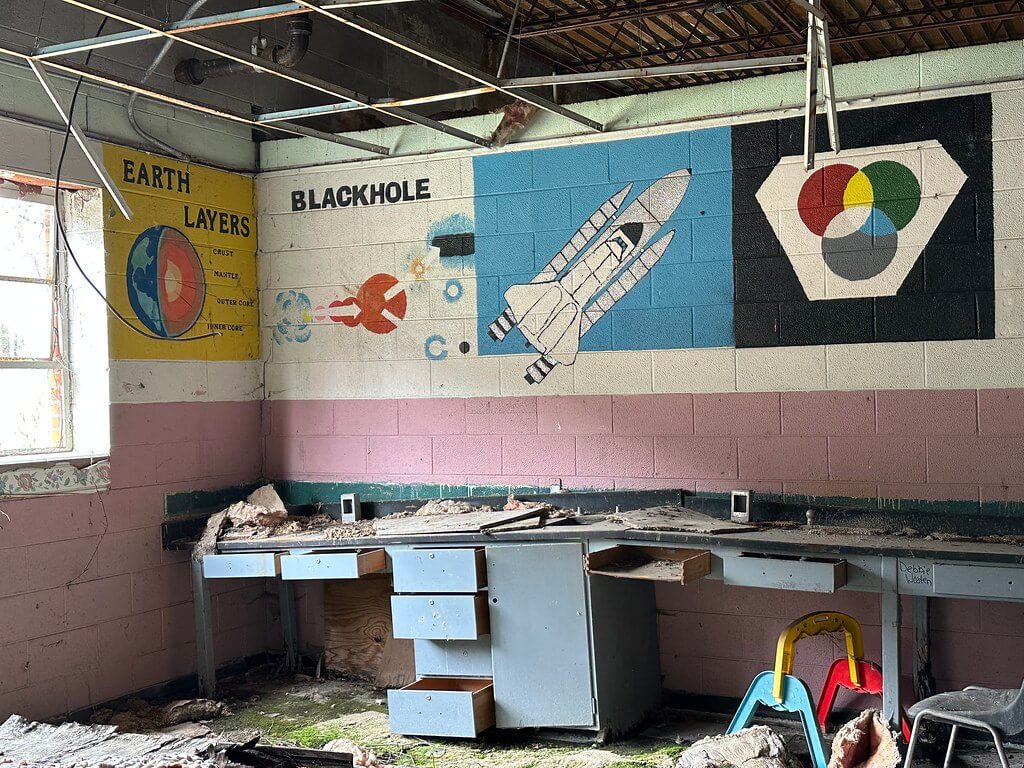
In 2007 the property was auctioned to a private buyer, a sale covered in the Hazard Herald and now regularly referenced when people ask who owns the school. Since then the campus has entered a long twilight. Urban exploration photos on AbandonedOnline, Jamie in Wanderland, and social media show collapsed ceilings, ruined laboratories, graffiti on classroom walls, and textbooks moldering on the floor.
Even in this post-school phase the campus keeps showing up in public records. Perry County Board of Education minutes from 2018 onward discuss surplus property and auctions involving facilities on the old Napier site. In 2024 the board formally declared the former band building at M.C. Napier surplus and voted to sell it by sealed bid, one more step in breaking up what had once been a single integrated campus.
Private auctioneers have also advertised sales of “surplus properties of the Perry County Board of Education,” listing the old Napier property in the same breath as other closed schools. For longtime Navajos, those notices sting. Online comments under auction flyers and photography blogs ask whether the building could be turned into a museum, a community center, or at least stabilized so that it does not simply rot away.
A Living Legacy In Perry County
Walk or drive past the old campus today and you see a shell, but the institution it represents is still very much alive in Perry County life. Perry County Central’s official history explains that the school opened in 1995 through the consolidation of M.C. Napier and Dilce Combs, and that it inherited their students, some of their staff, and their athletic traditions. In the Sherman Neace Center, which remains in use as a gym, you can still spot traces of Napier colors and logos if you know where to look.
The Kentucky High School Basketball Hall of Fame biography of Coach Randy Napier ties his statewide record directly back to those Napier years in the 1980s and 1990s, and KHSAA record books preserve the 1994 girls state title run on the same pages as the great Lexington and Louisville programs. Politicians and professionals like Chester Jones, whose obituary and Wikipedia entry mention his education at M.C. Napier and later service in the Kentucky House of Representatives and as circuit clerk, carry the school’s name into broader state history.
For families, the legacy is more personal. Alumni still organize reunions at places like Buckhorn State Resort Park, just as they did in the 1950s and 1960s. They keep Navajo shirts, class rings, and yearbooks, and they use the Navajos4Life page as a bulletin board whenever a former teacher or coach passes away.
Visiting The Site
If you decide to seek out the old Napier campus, remember that the building is on private property and is in very poor condition. Urban exploration photos show exposed wiring, unstable floors, mold, and other hazards that make entering the structure dangerous. Respect “No Trespassing” signs, stay on public rights of way, and consider photographing the building from a safe distance along the road or riverbank instead.
Like many sites in the Abandoned Appalachia series, M.C. Napier High School is significant not only because of its haunting present but because of what it represented when it was new. It tells a story about how Perry County invested in education, how basketball became a common language across class and creek lines, and how demographic and economic shifts reshaped the map of Eastern Kentucky schools.
The building at Indian Bend will not stand forever. The paper trail in archives and the stories in alumni voices may last a bit longer. Taken together they preserve the memory of a place where thousands of mountain students walked into a modern high school, put on Navajo colors, and stepped out into the wider world with a diploma that read “M.C. Napier High School, Perry County, Kentucky.”
Sources & Further Reading
Kentucky High School Athletic Association. “Kentucky High School Athletic Association (KHSAA) Records, 1917–2004.” Finding aid, Eastern Kentucky University Special Collections and Archives.
Kentucky High School Athletic Association. “The Kentucky High School Athlete, March 1962.” The Kentucky High School Athlete, no. 78. Encompass, Eastern Kentucky University. https://encompass.eku.edu/athlete/78
Kentucky High School Athletic Association. “KHSAA Basketball Record Book: Girls’ Basketball Coaching Records.” Kentucky High School Athletic Association. https://khsaa.org/records/basketball/gbk-recordbook_coaches.pdf
Kentucky High School Athletic Association. “Archives and History.” Kentucky High School Athletic Association. https://khsaa.org/general/resources/archives-and-history
Perry County Board of Education. “Perry County Board of Education Meeting Minutes, July 16, 2024.” Order 205 declaring former M. C. Napier band building surplus property. MyConnectSuite. https://content.myconnectsuite.com/api/documents/c6d964ec44774e6bbd487e10601d0031.pdf
Perry County Board of Education. “Perry County Board of Education Meeting Minutes” (regarding disposition of M. C. Napier High School property). MyConnectSuite. https://content.myconnectsuite.com/api/documents/47f92df9e7094e81878a1ca4c5a68466.pdf
Kentucky Heritage Council. “Memorial Gymnasium, Hazard, Perry County, Kentucky.” National Register of Historic Places Registration Form. Kentucky Heritage Council. https://heritage.ky.gov/historic-places/national-register/Documents/Perry%20County%2C%20Memorial%20Gym%2C%20FINAL.pdf
“The Hazard Herald.” July 16, 1964. Internet Archive. https://archive.org/download/kd9gq6qz2b2r/kd9gq6qz2b2r_text.pdf
“The Hazard Herald.” ca. 1960s issue with Perry County Board of Education statements including M. C. Napier High School. Internet Archive. https://archive.org/download/kd9jd4pk0h7s/kd9jd4pk0h7s_text.pdf
Kentucky Sports Memories. “Remembering MC Napier High School’s Girls Basketball Success.” Kentucky Sports Memories, March 15, 2024. https://www.kentuckysportsmemories.com/post/remembering-mc-napier-high-school-s-girls-basketball-success
WSGS. “M. C. Napier High School band in front of the WSGS Radio Building in 1974. Who can identify the band members?” Facebook, photo post. https://www.facebook.com/100058506286437/posts/m-c-napier-high-school-band-in-front-of-the-wsgs-radio-building-in-1974-who-can-/820735899886612
WSGS. “WSGS History: Perry County was celebrating the opening of two new high schools on August 26, 1953…” Facebook, historical note on M. C. Napier and Dilce Combs. https://www.facebook.com/100058506286437/posts/wsgs-history-perry-county-was-celebrating-the-opening-of-two-new-high-schools-on/1131085885518277
Hazard KY – M. C. Napier High School Alumni (Navajos4Life). Facebook alumni community. https://m.facebook.com/navajos4life
Hazard KY – M. C. Napier High School Alumni (Navajos4Life). “WSGS History: 68 years ago today, April 3, 1956 – more than 700 students walked out of M. C. Napier High School…” Facebook repost. https://www.facebook.com/navajos4life/posts/929236295871972
WSGS. “M. C. Napier Navajos Band 1978 – ‘I’ll Be Home for Christmas.’” YouTube playlist “M. C. Napier High School.” https://www.youtube.com/playlist?list=PLTvGcGJM2PD-zXFcn_OkKvaBKFmDYWbae
Mountain Sports Hall of Fame. “This M.C. Napier Navajos team page is from the 1982 state tournament program…” Facebook post. https://www.facebook.com/MtnSportsHoF/posts/this-mc-napier-navajos-team-page-is-from-the-1982-state-tournament-program-won-t/944929877669755
Lees Junior College. Leesonian yearbooks, 1939–1988. Kentucky Digital Library. Example 1972 volume: https://kdl.kyvl.org/digital/collection/hazard-llyc/id/12 and 1981 volume: https://kdl.kyvl.org/digital/collection/hazard-llyc/id/11
“Mitchell Campbell ‘M. C.’ Napier.” Find a Grave.
Martin, E. P. “The Story of Hazard, Ky. – The Pearl of the Mountains.” Perry County, Kentucky, RootsWeb genealogy site. https://sites.rootsweb.com/~kyperry3/Pearl_ofthe_Mountains.html
“Obituary information for Newton Combs.” Maggard Funeral Homes, Hazard, Kentucky. https://www.maggardfuneralhomes.com/obituaries/Newton-Combs?obId=1671904
“Newton Combs Obituary.” The Hazard Herald, via Legacy.com.
“Obituary information for Nancy Sharon Sutton.” Maggard Funeral Homes, Hazard, Kentucky. https://www.maggardfuneralhomes.com/obituaries/Nancy-Sharon-Sutton?obId=33689798
Sizemore, Anthony. “Well-known EKY educator dies.” WYMT Mountain News, November 12, 2024. https://www.wymt.com/2024/11/12/well-known-eky-educator-dies
“Alex G. Eversole.” Obituary, Altogether Funeral Home (Frankfort, Kentucky), July 11, 2025. https://www.altogetherfuneral.com/obituaries/d-20484156/frankfort-kentucky/alex-g-eversole/july-2025
“Alex Eversole Obituary and Online Memorial (2025).” Legacy.com. https://www.legacy.com/us/obituaries/name/alex-eversole-memorial?id=58939686
“M.C. Napier High School.” AbandonedOnline. https://abandonedonline.net/location/m-c-napier-high-school
“A Trip Through Eastern Kentucky.” AbandonedOnline, January 5, 2010. https://abandonedonline.net/a-trip-through-eastern-kentucky
Jamie in Wanderland. “MC Napier High School – Perry County, Kentucky.” Jamie in Wanderland (blog), July 8, 2016. https://jamieinwanderland.wordpress.com/2016/07/08/mc-napier-high-school-perry-county-kentucky
Jamie in Wanderland. “Eastern Kentucky.” Jamie in Wanderland (blog), January 22, 2017. https://jamieinwanderland.wordpress.com/tag/eastern-kentucky
Perry County Central High School. “About the School.” Perry County Schools. https://pcchs.perry.kyschools.us/about
Kentucky High School Basketball Hall of Fame. “Randy Napier.” Kentucky High School Basketball Hall of Fame. https://khsbhf.com/randy-napier
Kentucky High School Athletic Association. “Name of Person Being Nominated: Randy Napier.” KHSAA Hall of Fame nomination form. https://khsaa.org/httpdocs/hof/docs.php?filename=nom1144file1.pdf
Long, Josh. “From Las Vegas to Hindman, Kentucky’s smallest titan proved again that it belongs.” Lexington Herald-Leader (Kentucky.com), March 24, 2020. https://www.kentucky.com/sports/high-school/prep-basketball/article241256951.html
Estep, Billy. “‘The kids carried me to all this.’ Girls’ basketball’s all-time winningest coach reflects on career.” Lexington Herald-Leader (Kentucky.com), July 12, 2019. https://www.kentucky.com/sports/high-school/prep-basketball/article232590707.html
Estep, Billy. “Perry Central’s Napier reflects on becoming Kentucky’s winningest girls’ basketball coach.” Lexington Herald-Leader (Kentucky.com), December 12, 2013. https://www.kentucky.com/sports/high-school/prep-basketball/article44458833.html
WYMT. “Former MC Napier coach, Hazard Athletic Director Bill Dixon dies at age 79.” WYMT Mountain News, June 17, 2020. https://www.wymt.com/2020/06/17/former-mc-napier-coach-hazard-athletic-director-bill-dixon-dies-at-age-79
WYMT. “Longtime MC Napier, Perry Central girls’ basketball coach Randy Napier retires.” WYMT Mountain News, May 23, 2019. https://www.wymt.com/content/sports/Longtime-MC-Napier-Perry-Central-coach-Randy-Napier-retires-510358781.html
WYMT. “Three Eastern Kentucky basketball legends named KHSAA Hall of Fame.” WYMT Mountain News, January 20, 2023. https://www.wymt.com/2023/01/20/three-eastern-kentucky-basketball-legends-named-khsaa-hall-fame
“The Hazard Herald.” Wikipedia. https://en.wikipedia.org/wiki/The_Hazard_Herald
Author’s Note: The former M. C. Napier High School building is no longer safe to enter. Floors, ceilings, and stairwells have deteriorated, and the property is privately owned. Please respect posted signs and treat the site as off limits for exploring. It is, however, a powerful drive by location. From the public road along the North Fork you can still see the main façade against the mountains and get a sense of what the campus once meant to Perry County without putting yourself or anyone else at risk.