
Appalachian History
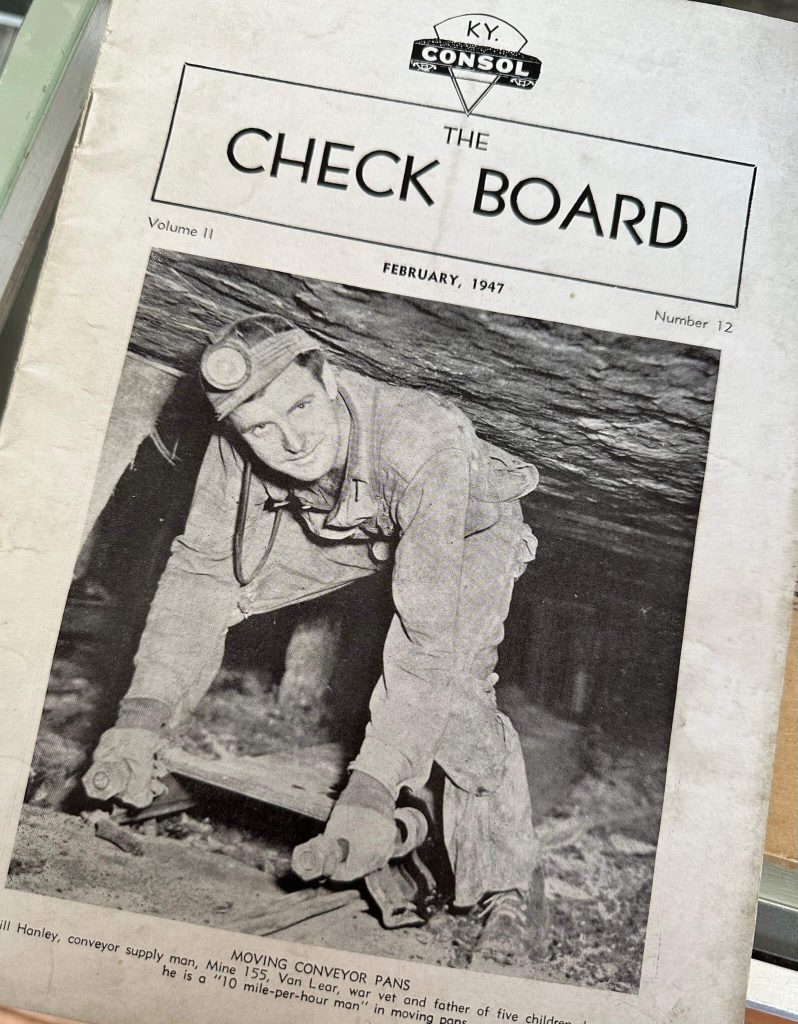
On a February evening in 1948, nearly fifteen hundred people streamed into a freshly remodeled storefront on Main Street in Jenkins. The Champion Dairy Bar offered bright red-and-cream décor, ice cream, and a free carnation to every woman who walked through the door. The only reason we know so much about that opening day is because the company magazine, the Check Board, covered it in detail for Consolidation Coal workers and their families.
The Check Board is mostly forgotten outside the coal camps it served, but for a brief window after the Second World War it was the house magazine of Consolidation Coal Company’s Jenkins Division. In its pages, the company narrated life in Jenkins, McRoberts, Dunham, Burdine, and Marshall’s Branch: new businesses, mine safety awards, high school sports, even National Coal Association trips to Washington. It was “a magazine produced by Consolidation Coal Company for and about employees and their families,” as one later Mountain Eagle article put it.
This article looks at the Check Board and its cousins as historical sources. It also follows the paper trail outward, into photographs, maps, and oral histories that capture the same company town the magazine tried to describe, and sometimes to sanitize.
Company Town on the Page
To understand the Check Board you have to start with Jenkins itself. In 1911, Consolidation Coal Company bought roughly 100,000 acres of coal land in Pike, Letcher, and Floyd counties and chose a site on Elkhorn Creek for a planned town that would bear the name of Baltimore businessman and Consol director George C. Jenkins. By the time Jenkins incorporated in 1912, the company had already built a bank, stores, brick yards, a power plant, and a reservoir at Elkhorn Lake to provide water and electricity for the mines and for the town.
The History of Jenkins, Kentucky, compiled for the town’s sixtieth anniversary in 1973, stresses how unusual this development was. Jenkins was not a crossroads that grew slowly around a post office or courthouse. It was planned and built in one rapid push for the purpose of mining coal, with a company railroad under construction at the same time as fourteen separate mines.
In the words of local resident B. H. Crase, Jenkins of the 1930s “was a mining camp owned by the Consolidation Coal Company. Each home, each business and even the schools was connected to the parent company.” This was a world where workers often lived in company houses, bought food with company scrip at company stores, and were born in a company hospital. That same company also published the magazines that told them who they were.
From Mutual Magazine to the Check Board
Consolidation’s habit of writing about its own towns did not begin in the 1940s. As early as the 1920s, the firm used house organs to circulate news and shape opinion.
The History of Jenkins preserves a series of short items reprinted from Mutual Magazine, a Consolidation publication, and from a title simply called The Recorder. From Mutual we get stories about Elkhorn Division workers, including a dramatic account of a boy nearly electrocuted when his kite string, made of wire, struck a 2,300-volt power line. A quick-thinking miner used a wooden cane to knock the wire free and carry the unconscious child to safety, and the article closes with a pointed warning about the dangers of electricity and “kites near any kind of wire.”
An August 1922 piece from The Recorder reports on the new road between Jenkins and Pound, Virginia. The writer notes that one can finally cross Pound Gap “with all ease” by automobile and predicts that once the work is finished “the whole country” will progress. Other snippets celebrate tennis trophies and high school openings, all presented with a tone of orderly improvement under company guidance.
These early magazines set the pattern. They treated the coal camp as a modern, progressive community and highlighted safety, recreation, and infrastructure, even as the company retained tight control over housing, wages, and law enforcement.
Launching the Check Board
After the upheavals of the 1930s and the Second World War, Consolidation revived and localized its house-magazine tradition. Mountain Eagle coverage and local memory place the Check Board’s run roughly between 1945 and 1952, published by Consolidation Coal Company for the Jenkins Division.
A Mountain Eagle sports column on the Jenkins High School Cavaliers notes that its account of the 1949 to 1950 basketball season comes “from the March April, 1950 Check Board Magazine,” which it describes as a magazine produced by Consol for and about its workers and their families. Letcher Heritage News, published by the county historical and genealogical society, indexes at least one 1949 piece simply as “Check Board, 1949 (Pub. of Cons. Coal Co.),” confirming both the title and the company connection.
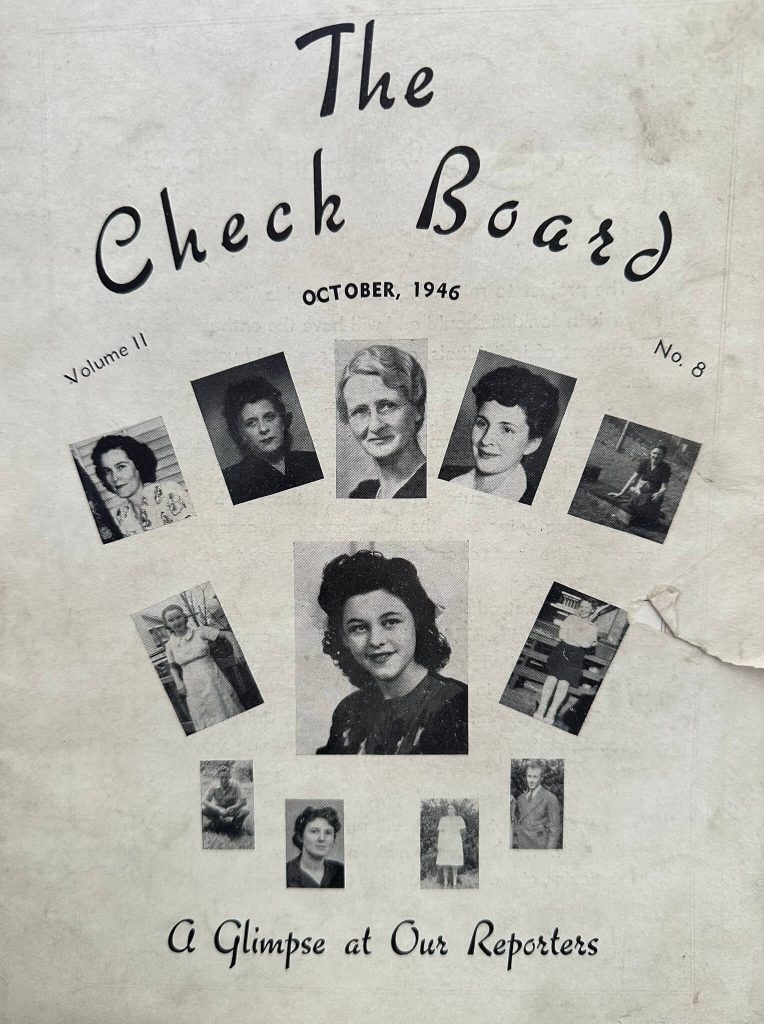
The name itself shifted between “Check Board” and “Checkboard” in local usage, echoing both the company’s payroll checks and the visual layout of the magazine. Whatever the spelling, it circulated across the Jenkins camps and even into other Consol operations like Van Lear, where the Van Lear Historical Society’s newsletter Bankmule later published “Check Board, Consolidation Coal Co. magazine excerpts” featuring a group photograph of Van Lear High School graduates from June 1946.
What the Check Board Covered
We do not yet have a full digital run of the Check Board, but surviving excerpts and reprints give a good sense of its world.
The 1973 Jenkins history quotes a March 1948 Checkboard article announcing the opening of the Champion Dairy Bar on Main Street. The piece emphasizes bright new décor, a modernized building, and customer service. It notes that an estimated fifteen hundred people visited on opening day and praises the Dairy Bar as filling a “definite need in the community,” complete with named local employees.
Elsewhere in the same community history, the editors mine Check Board issues for items about Kiwanis Club swimming-pool dedications, retirements on the C&O and B&O railroads, honor rolls of mine workers recognized by the National Coal Association in Washington, and the relocation of Consol’s general offices in 1950 to a new air-conditioned, fireproof building that also housed a theater, jewelry store, and five-and-ten.
By the late 1940s the magazine was also documenting the transformation of Jenkins from pure company town to mixed ownership. A 2012 article by Rosalind Shipley on Consolidation’s photograph collection cites a Check Board piece titled “Goodbye, Company Town,” published in March 1949, which chronicled Consol’s sale of houses and businesses to residents after decades of corporate control.
Social media has become an unexpected extension of that archive. In Letcher County genealogy groups, locals share scanned Check Board clippings, including Jan-Feb 1950 pieces from the “Consolidation Coal Company Employee Magazine,” preserving photos and captions that might otherwise stay in shoeboxes.
Taken together, these fragments suggest a magazine that blended feel-good corporate messaging with genuine community news. It celebrated new amenities, spotlighted workers by name, and offered a curated vision of life in the camps.
Maps, Mines, and the Shape of Jenkins
The Check Board was not only about stories and photos. It also carried maps. A Phase I archaeological survey along Kentucky 805 notes that one of its base maps was a “Check Board 1950, Map of Jenkins,” indicating that the magazine printed a detailed town plan useful enough for highway archaeologists decades later.
That map would have sat alongside other technical views of Jenkins. The United States Geological Survey published a Jenkins West topographic quadrangle in 1954 that captured the town’s ridges, mines, and rail lines. The Historic American Buildings Survey recorded the Jenkins Central Power Plant, producing measured drawings and photographs that show how Consolidation engineered electricity for the entire Elkhorn Division.
Company and railroad photographers also documented individual facilities. The Kentucky Historical Society’s “Graphic 22: Consolidation Coal Company Collection” holds images of the tipple at Mine 214 and the company hospital, both in Jenkins. The West Virginia and Regional History Center preserves a 1944 photograph of a Consolidation tipple at Jenkins from the Chesapeake and Ohio Railway files.
All of these visual and cartographic records help put Check Board stories in place. When the magazine mentions Mines 201 through 208, the Champion Dairy Bar on Main Street, or the Elkhorn Country Club, we can use maps and photographs to locate those sites in the physical landscape of the town.
Photography and the Company Image
Long before the Check Board, Consolidation’s photographers had already covered Jenkins from nearly every angle.
The Jenkins, Kentucky Photographic Collection, held by the University of Kentucky Special Collections Research Center and highlighted in a 2014 “History in Photos” blog post, consists of 204 images originally shot for Consolidation Coal between 1911 and 1930. Those photographs show everything from home life and Emancipation Day parades to mine accidents and kindergarten classes.
One image, featured in a University of Kentucky Black History Month exhibit, shows schoolchildren at Burdine Colored School in 1921. The curator notes that almost all of the children were sons and daughters of Consolidation miners and emphasizes that the town itself was created by the company, which owned most houses and public buildings.
Beyond Kentucky, the Smithsonian’s National Museum of American History holds the Pittsburgh Consolidation Coal Company photographs and other materials, a collection of roughly twenty-three cubic feet of negatives and prints dating from the 1880s through the 1940s. Many of these images, including general views of Jenkins streets, numbered mines, tramways, and reservoir construction, match the world later celebrated in the Check Board.
Historian Rosalind Shipley argues in “The Town That Photography Built” that these photographs did more than document coal towns. They helped create a particular image of them, an image reinforced by textual pieces like “Goodbye, Company Town” in the Check Board. Together, the photos and the magazine framed Jenkins as a modern, orderly place where corporate decision makers and workers moved through the same carefully planned spaces.
Voices from the Town
Because the Check Board was a company product, it naturally leaned toward flattering portrayals of Consolidation’s decisions. To balance that view, historians lean heavily on interviews and community histories.
The History of Jenkins, Kentucky devotes an entire section to oral histories gathered from residents in the early 1970s. In his “Social and Economic Study of Jenkins,” Wendell D. Boggs explains that the biggest social change came in 1947, when Consolidation announced that the entire town was on the market. For decades, miners had lived rent-free in company houses and paid little for utilities, with part of their wages issued in scrip spendable only at company businesses. Sale of the town brought relief for some, anxiety for others, and marked the beginning of the end of total corporate control.
Interviews with residents such as Roy Fleming and B. H. Crase describe how Consol acquired coal rights, built the four component communities of Jenkins, Dunham, Burdine, and McRoberts, and enforced rules through company marshals and police judges. They also remember the pride people felt in schools, churches, and clubs that the company helped fund yet which residents made their own.
When you read those testimonies alongside Check Board items about company swimming pools, Dairy Bars, or award banquets in Washington, you get a richer sense of how residents navigated a company town that was both home and workplace, both generous and controlling.
Where to Find the Check Board Today
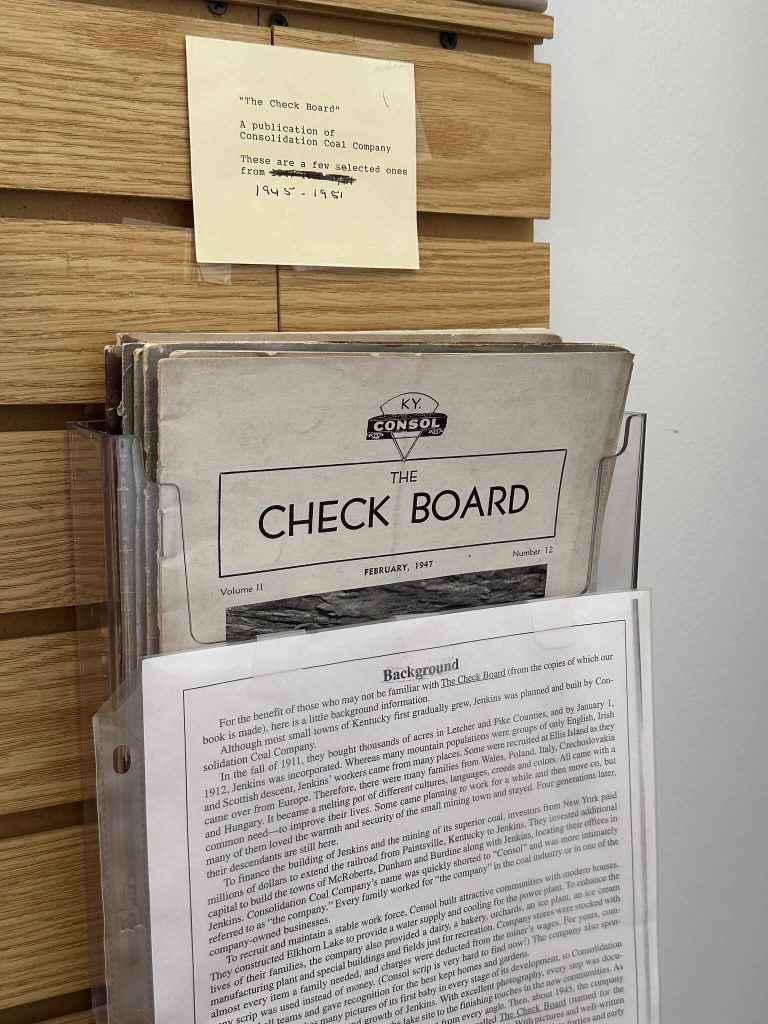
If you want to work with the Check Board itself, the search can feel like a scavenger hunt. No full run is known to be online. Instead, researchers piece together the magazine from scattered issues and reprints.
Local institutions are the best starting point. The David A. Zegeer Coal-Railroad Museum, housed in the restored Jenkins depot, preserves photographs, artifacts, and documents from a century of mining history in Jenkins. A Mountain Eagle feature on the museum notes that it is “a good place to begin” for anyone trying to understand the town’s story, and locals frequently mention Check Board issues among the materials preserved there.
The Old Jenkins School Renovation Committee published a book “taken from excerpts from the ‘Check Board’,” according to a 2019 Mountain Eagle article, covering life in the camps between 1945 and 1952. The Letcher County Historical and Genealogical Society’s Letcher Heritage News lists a “Check Board, 1949 (Pub. of Cons. Coal Co.)” item in its index.
Beyond Letcher County, the Van Lear Historical Society’s award winning newsletter Bankmule has printed “Check Board, Consolidation Coal Co. magazine excerpts” in at least one issue, including a June 1946 photograph of Van Lear High School graduates originally published in the magazine. The Allen County Public Library’s Periodical Source Index (PERSI) catalogs that item under Kentucky, confirming how Consol’s internal culture tied Miller’s Creek and Jenkins divisions together.
Finally, a surprising amount of Check Board material now circulates in private collections and on Facebook genealogy pages, where families share scans of articles that mention their relatives by name. These digital fragments may never make their way into formal archives, but they remain vital clues to the everyday reach of the magazine.
Why the Check Board Matters
At first glance, the Check Board looks like corporate fluff: smiling workers, new ice cream counters, and ceremonial first dives into Kiwanis swimming pools. It was absolutely a vehicle for company messaging. Yet that is precisely what makes it so valuable.
Read alongside Mutual Magazine, The Recorder, the Jenkins photographic collections, maps, and oral histories, the Check Board shows how a major coal operator tried to narrate the life of its camps and manage the story of a town it had built from scratch. It is also one of the few sources that names ordinary miners, clerks, students, and club members as they moved through their daily routines in the late 1940s and early 1950s.
For Appalachian historians and genealogists, that combination of corporate voice and community detail is gold. The magazine allows us to see Jenkins not only as “a mining camp owned by the Consolidation Coal Company,” but also as a place where people opened Dairy Bars, cheered Cavaliers basketball, organized talent shows, and watched helicopters land on the Elkhorn Country Club fairway. In other words, a company town with a human heart, preserved in its own words on the pages of the Check Board.
Sources & Further Reading
Mutual Magazine (Consolidation Coal Company, early 1920s). Reprinted stories in History of Jenkins, Kentuckyinclude safety anecdotes, worker profiles, and local news from the Elkhorn Division. Penelope
The Recorder (Consolidation Coal Company, 1922). Articles on the Jenkins to Pound road project and local sports, also preserved via the Jenkins community history. Penelope
The Check Board / Checkboard (Consolidation Coal Company employee magazine, Jenkins Division, c. 1945 to 1952). Survives in excerpts quoted in History of Jenkins, Kentucky, Letcher Heritage News, Bankmule, and Mountain Eagle pieces. The Mountain Eagle+3Penelope +3RootsWeb+3
“Check Board 1950, Map of Jenkins.” Company town map cited as a primary historic base map in the Kentucky Transportation Cabinet’s Phase I Archaeological Survey along KY 805 in Letcher County. Kentucky Transportation Cabinet
Jenkins, Kentucky Photographic Collection, 1911 to 1930 (University of Kentucky Special Collections Research Center). Company photographs documenting early Jenkins, highlighted in History in Photos and UK Black History Month exhibits. History in Photos+1
Pittsburgh Consolidation Coal Company photographs and other materials (NMAH.AC.1007), National Museum of American History. Large photographic collection including views of Jenkins mines, streets, and industrial sites. National Museum of American History
“Consolidation Coal Company Tipple at Jenkins, Ky.” and related images in “Graphic 22: Consolidation Coal Company Collection (Jenkins, Ky.),” Kentucky Historical Society. kyhistory.com+1
Historic American Buildings Survey. “Jenkins Central Power Plant, near U.S. Highway 23, Jenkins, Kentucky.” Photographs, drawings, and written historical narrative. kyhistory.com
History of Jenkins, Kentucky, Jenkins Area Jaycees, 1973. Especially “They Built a Town,” “The Social and Economic Study of Jenkins,” and “Odds and Ends” sections, which preserve Mutual Magazine, Recorder, and Check Board excerpts along with oral histories. Penelope +1
Rosalind Shipley, “The Town That Photography Built: Images from the Consolidation Coal Company Photograph Collection, 1911 to 1946.” Analyzes Consol’s photographs and cites the Check Board article “Goodbye, Company Town” (March 1949). JSTOR
Kentucky Transportation Cabinet, Phase I Archaeological Survey Along KY 805 in Letcher County, Kentucky, which uses the 1950 Check Board map and USGS topographic sheets to reconstruct Jenkins’s historic layout. Kentucky Transportation Cabinet
Marcie Crim, “100 years of mining history displayed at Jenkins museum,” The Mountain Eagle, reprinted in the Congressional Record, highlighting the history and collections of the David A. Zegeer Coal-Railroad Museum. GovInfo+1
“New book by D. Charles Dixon is in the works,” The Mountain Eagle, noting that the Old Jenkins School Renovation Committee published a book drawn from Check Board excerpts, 1945 to 1952. The Mountain Eagle
ACPL Genealogy Center, Periodical Source Index (PERSI), entry for Bankmule 29 1 (2012): “Check Board, Consolidation Coal Co. magazine excerpts, Van Lear H.S. graduates photo, June 1946.” Genealogy Center
CoalCampUSA, “Jenkins, Dunham, and Burdine, Kentucky,” overview of the Elkhorn Division’s planned towns, mines 201 to 215, and surviving company structures. Coal Camp USA