
Repurposed Appalachia Series – Little Shepherd Amphitheater of Jenkins
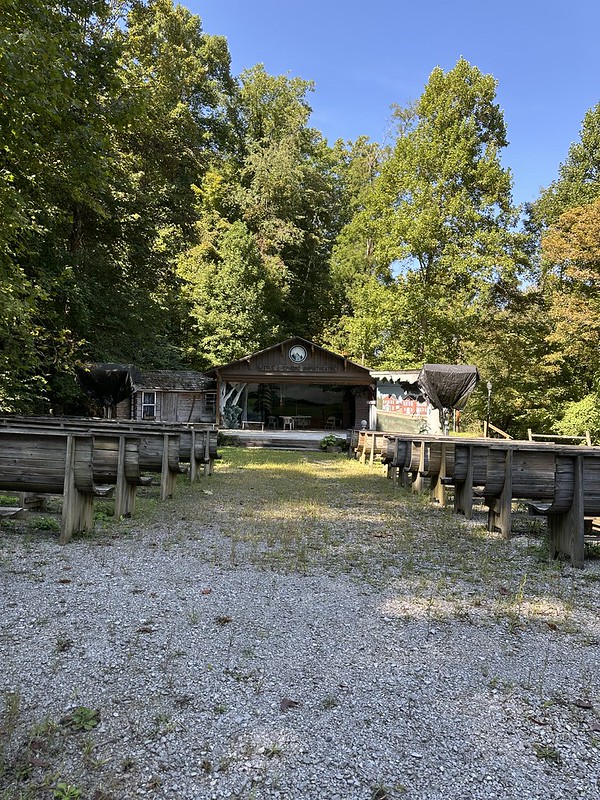
On a summer evening in Jenkins, headlights snake up Amphitheater Road as families ease their cars onto the gravel lot beneath Pine Mountain. Crickets tune up in the tree line. Down in the bowl of earth and timber, stage lights splash against a backdrop of split-rail fences and mock cabin walls while a narrator begins to tell the story of Chad Buford, the “little shepherd” who must choose sides when the Civil War reaches Kentucky.
It looks like pure nostalgia: a Civil War drama under the stars in the shadow of Pound Gap. But the Little Shepherd Amphitheater is also something newer. It rises on reclaimed coal company ground, built through a patchwork of state grants, donated industrial land, and volunteer labor. It sits along a future trail that planners hope will draw hikers, bikers, and heritage tourists to an old coal camp that refuses to stay frozen in time.
This is the story of how a best-selling 1903 novel, a coal town carefully carved into the mountains, and a small nonprofit called the Cumberland Mountain Arts & Crafts Council all converged to create one of eastern Kentucky’s most ambitious outdoor stages.
From Coal Company Town to Creative Corridor
Long before anyone stacked bleachers into the slope above Jenkins, a different kind of construction transformed this valley. A 1928 feature in the Hazard Herald, reprinted by historian Brandon Ray Kirk, described Jenkins as “one of the few great mining towns of the world,” laid out by Consolidation Coal Company in the valley of Little Elkhorn Creek within “a stone’s throw” of Pound Gap.
The article marveled at how, only a few decades earlier, the site had been a wild mountain farm owned by John W. Wright. By the late 1910s those fields had given way to paved streets, electric lights, a man-made lake, and company houses designed with health and sanitation in mind. Jenkins was not treated as a temporary camp. It was a model city that showcased what a coal corporation could build when profit and paternalism marched hand in hand.
After Consolidation’s heyday, the property changed hands. Tampa Electric Company (TECO) eventually took over area mining operations. When local leaders began dreaming of an outdoor theater in the 1990s, TECO played a quiet but crucial role. According to a Kentucky Living feature, the company donated roughly fifteen acres on the side of Pine Mountain for the project, giving Jenkins a dramatic hillside site that could look down toward town and out toward Pound Gap.
Today that slope anchors more than a stage. The amphitheater sits near the “Jenkins: Past, Present, and Future” mural created through the National Endowment for the Arts’ Our Town program, which turned a blank downtown wall into a panorama of coal camp scenes and community landmarks. Regional mapping projects like Our Creative Promise and the Letcher County Culture Hub profile now treat the Little Shepherd site as a flagship in a broader arts corridor linking museums, community centers, and public art across the county.
The Story Behind the Stage: The Little Shepherd of Kingdom Come
The drama that gives the amphitheater its name traces back to John Fox Jr., a Kentucky-born novelist who split his life between the Bluegrass and the Cumberland Mountains. In 1903 he published The Little Shepherd of Kingdom Come, a serialized story in Scribner’s Magazine that quickly became a publishing phenomenon, often cited as the first American novel to sell more than one million copies.
Fox’s tale follows Chad Buford, an orphaned mountain boy raised in a fictional “Kingdom Come” valley who discovers new worlds in the Bluegrass just as sectional tensions boil over into war. When conflict finally reaches Kentucky, Chad must decide between local loyalties and his own emerging convictions. Fox uses that choice to explore the divided nature of a border state where families and communities split between Union and Confederate sympathies.
The novel’s popularity produced a long performance afterlife. It was adapted as a silent film in 1920, remade in 1928, and brought to the screen again in 1961, each version reworking Fox’s mountain imagery for new audiences. The state of Kentucky even named Kingdom Come State Park in neighboring Harlan County after the book, tying its sandstone outcrops and overlooks, including a striking Raven Rock, to Fox’s imagined landscape.
For people in and around Jenkins, the story has always felt local. Fox drew on real places around Pound Gap and the upper Kentucky River when he wrote about “Kingdom Come,” and later commentators often placed his fictional valleys in the same mountainous belt that runs from Harlan north toward Letcher County.
Before Jenkins: An Itinerant Outdoor Drama
By the 1970s, Kentucky had embraced outdoor historical drama as both entertainment and economic development. At Van, in Letcher County’s neighbor to the west, the Council of the Southern Mountains helped stage an early Little Shepherd outdoor production. Archival finding aids from East Carolina University’s Institute of Outdoor Theatre and Berea College’s special collections list programs and festival files for Little Shepherd performances at Van around 1979 and 1980, placing Fox’s story firmly within a regional “theater under the stars” movement.
Closer to home, Kentucky tourism materials recall that The Little Shepherd of Kingdom Come was staged in Letcher County in the 1970s as part of a broader outdoor drama initiative. When that original venue was lost, however, the production went dark for decades even as other sites such as Bardstown’s Stephen Foster Story continued to draw summer crowds.
The idea of reviving Little Shepherd never quite disappeared. It simply waited for a hill, a nonprofit, and a determined producer.
Don Amburgey’s Vision and the Birth of a Hillside Theater
In 1997, Letcher County educator and theater producer Don Amburgey took the first legal step toward bringing Little Shepherd back. He incorporated the Cumberland Mountain Arts & Crafts Council, Inc. (CMACC) as a nonprofit with a tightly focused mission: to promote regional arts and music by producing an outdoor drama based on Fox’s novel in eastern Kentucky, and in the process to support sustainable, heritage-based tourism.
A profile on the Letcher County Culture Hub site lays out the essentials. Amburgey and CMACC worked with the Letcher County Fiscal Court, TECO, and the City of Jenkins to secure a location on the slope of Pine Mountain, envisioning an amphitheater that could host the drama and other community events. The all-volunteer cast became a point of pride, and the production eventually secured membership in the Institute of Outdoor Drama, placing Jenkins alongside established venues across the South and Midwest.
State budgets confirm that Frankfort invested real money in the dream. In the early 2000s, Kentucky appropriation bills such as Senate Bill 100 and House Bill 395 included a “Little Shepherd Amphitheater Project,” assigning restricted funds to help build out the facility. A later budget act, House Bill 406 for the 2008 regular session, listed “Letcher County Fiscal Court – Little Shepherd’s Amphitheater – Upgrades” alongside a separate line item for “Raven Rock – Purchase and Upgrades,” indicating that state lawmakers already viewed the amphitheater and nearby Raven Rock area as intertwined tourism investments.
Local papers tracked the project’s progress. A 2007 issue of the Letcher County Community News-Press reported county plans to bring the Little Shepherd outdoor drama to the new amphitheater and quoted officials who expected the site to become a major tourism development. Not long after, a Mountain Eagle notice titled “Little Shepherd to open” announced that a revival of the drama would debut June 18 at the “newly built Little Shepherd Amphitheatre in Jenkins.”
The Play Returns Home
When Little Shepherd finally returned to the mountains under Amburgey’s direction, it did so with a script by Appalachian playwright Fern Overbey Hilton, who adapted Fox’s sprawling novel for the hillside stage. Kentucky Living’s 2017 feature on outdoor theater described the Jenkins production as a journey from Antebellum hollows to battlefields, with the amphitheater itself perched on or near a documented Civil War site at Pound Gap.
Audiences drove up Highway 23 and 119 to find what the magazine called “theater under the stars.” The stage’s natural backdrop, with pine silhouettes and distant ridges, did some of the scenic work for free. According to the Culture Hub profile, every actor on that stage volunteered their time, making the show one of only a handful of outdoor dramas in the nation with a completely volunteer cast.
Coverage in The Mountain Eagle adds texture. A 2010 piece titled “Teens assume major roles in ‘Little Shepherd’ production” described a season in which local teenagers stepped into lead parts while performances ran at 8 p.m. every Saturday night through early September. For many young people in Jenkins, the hillside stage became their first sustained experience with theater, blocking scenes and memorizing lines between school, sports, and summer jobs.
Social media posts from the “Little Shepherd Outdoor Drama” and “The Little Shepherd Amphitheatre” Facebook pages show that the productions had the feel of extended family reunions. Cast lists span multiple generations. Photos capture homemade props, borrowed uniforms, and musical numbers belted toward the treeline. A brief YouTube clip from 2016, shot by Eastern Kentucky Heritage & History, pans across a performance where Union and Confederate soldiers trade lines under the lights while the audience huddles on wooden benches.
More Than One Story on the Stage
The amphitheater quickly grew beyond its founding play. A Mountain Eagle article headlined “Arts festival in Jenkins was a success” reported that the annual Indian Summer Folk Arts & Crafts Festival took place at the amphitheater, organized by CMACC and drawing vendors, musicians, and visitors from around the region.
Another notice announced a Civil War reenactment scheduled for August 6 and 7 at the Little Shepherd Amphitheater, turning the grounds into a temporary encampment complete with tents and costumed soldiers. The choice of site made sense. Pound Gap, just above Jenkins, had seen real skirmishing in 1862. Using the amphitheater bowl as a landscape of memory gave those reenactments a layered meaning, blending play and commemoration.
Music found its way onto the hillside as well. A column by KED Sanders in the Mountain Eagle previewed a bluegrass gospel festival where the Wells Family would appear at the amphitheater, another sign that by the late 2000s the venue had become Jenkins’s go-to spot for big outdoor events.
Venue directories and tourism sites now echo that shift. TripAdvisor lists the Little Shepherd Outdoor Amphitheatre as a local attraction at 255 Amphitheater Road, quoting CMACC’s mission statement to “provide regional opportunities to enhance cultural enrichment” and noting its role as a site for community events and seasonal dramas.
Floods, Waste, and the Costs of Reuse
Repurposing industrial land rarely comes without complications, and Jenkins has had to reckon with both the environmental legacy of coal and the new realities of climate-driven flooding.
In March 2012, The Mountain Eagle ran an investigative story under the stark headline “Ex-mayor, others say site in Jenkins full of toxic waste.” Community members interviewed in the piece argued that the amphitheater property, identified by the shorthand LSAT, lay atop buried industrial waste tied to earlier railroad and coal operations, and they raised concerns about contamination and long-term stewardship. The article did not resolve those claims but highlighted the tangle of responsibility that often emerges when former industrial lands become parks or cultural sites.
A decade later, disaster came from above rather than below. In July 2022, catastrophic flooding swept through eastern Kentucky. A Kentucky Lantern article on the state’s outdoor theaters reported that runoff “swallowed the amphitheater” at Jenkins, quoting Amburgey’s description of water more than ten feet deep in the bowl and noting severe damage to the stage and seating. Photos shared on the amphitheater’s Facebook page show bleachers coated in mud and debris piled along Amphitheater Road, a reminder that even hillside venues are not immune when rainfall overwhelms mountain watersheds.
As of the mid-2020s, Amburgey and CMACC have talked publicly about their hopes to rebuild the site and restart the drama, but funding and recovery have been slow, especially in a small city juggling housing, infrastructure, and flood-mitigation needs alongside cultural projects.
Trails, Raven Rock, and a Creative-Economy Future
If Little Shepherd Amphitheater’s past has been bound up with coal and community theater, its future is increasingly tied to trails and ridge-top views.
In June 2023, Lieutenant Governor Jacqueline Coleman announced that the City of Jenkins had been selected to receive $100,000 from the federal Recreational Trails Program to design and develop a multi-use trail from the Little Shepherd Amphitheater to the Jenkins-Combs Overlook. State planning documents describe the route as following the path of an old wagon road and promise interpretive signs about pioneers crossing the mountain, Civil War movements through Pound Gap, and local moonshining traditions, with a panoramic view of the gap from the top.
Jenkins Mayor Todd DePriest has framed the trail as both a health amenity and a history lesson, telling state officials that the project will “make Jenkins a healthier place to live” while educating visitors about the community’s past.
At the same time, city leaders are pinning hopes on the Raven Rock project, a proposed resort and recreation complex near the existing Raven Rock Golf Course. A 2023 Mountain Eagle article titled “Jenkins has high hopes for Raven Rock project” outlined plans for cabins, expanded outdoor recreation, and a trail system that would tie Raven Rock to downtown Jenkins. The same 2008 state budget act that funded upgrades at the amphitheater also earmarked restricted funds for “Raven Rock – Purchase and Upgrades,” illustrating how these projects have been linked in Frankfort’s eyes for nearly two decades.
Regional economic-development reports now routinely mention the Little Shepherd site alongside the David A. Zegeer Coal-Railroad Museum, the downtown mural, and Raven Rock as part of a diversified tourism portfolio. Meanwhile, updated comprehensive-development plans and trail master plans envision Jenkins as a node in a wider network of scenic drives and multi-use paths stretching into Virginia and deeper into the Kentucky River watershed.
Layered on top of all this is the question of where people will live. After the 2022 floods, a “high-ground” housing initiative known as the Jenkins Grand View project began moving forward on land above the city, with The Mountain Eagle and Kentucky Lantern both framing it as part of a broader push to get homes out of harm’s way across eastern Kentucky. The same slopes that once held company houses, then a theater, and now a promised trail are becoming contested spaces in the conversation about how to rebuild mountain towns in an era of heavier rains.
Why the Little Shepherd Amphitheater Matters
From a distance, Little Shepherd Amphitheater can look like a simple community playhouse, another venue where locals put on costumes and retell a century-old story. Up close, its history reveals a far more complex script.
Here is a coal company town deliberately engineered for comfort and control, reimagined by later generations as a place for art and heritage tourism. Here is a novel that once sold over a million copies, refracted through outdoor dramas in Van and Letcher County and finally anchored to a specific hillside above Jenkins. Here are budget lines in Frankfort and grant announcements from the Lieutenant Governor’s office that treat art, trails, and resort development as tools for rebuilding a post-coal economy.
The amphitheater also embodies the ambiguities of repurposed Appalachia. It sits on land shaped by extraction, shadowed by allegations of buried waste, and battered by climate-fueled floods. Yet it keeps drawing volunteers who are willing to memorize lines, tune instruments, and rake mud off bleacher seats for the chance to see their neighbors’ names in a program.
When the trail from the amphitheater to the Jenkins-Combs Overlook is complete, visitors will walk past interpretive signs about pioneers, soldiers, and moonshiners. They will climb through a landscape that has witnessed all of those stories plus one more: the story of how a coal camp tried to write itself a new role using a hillside stage, a famous novel, and a community that still wants to gather under the stars.
Sources & Further Reading
Letcher County Culture Hub. “Little Shepherd Amphitheatre / Cumberland Mountain Arts & Crafts Council.” Letcher County Culture Hub. Accessed January 3, 2026. https://www.letcherculture.org/little-shepherd Letcher County Culture Hub
Kirk, Brandon Ray. “History for Jenkins, KY (1928).” Brandon Ray Kirk (blog), December 4, 2018. https://brandonraykirk.com/2018/12/04/history-for-jenkins-ky-1928/ Brandon Ray Kirk
The Mountain Eagle (Whitesburg, KY). “‘Little Shepherd’ to Open”; “Teens Assume Major Roles in ‘Little Shepherd’ Production”; “Arts Festival in Jenkins Was a Success”; “Civil War Reenactment August 6–7”; “Jenkins Has High Hopes for Raven Rock Project”; “Ex-mayor, Others Say Site in Jenkins Full of Toxic Waste”; “Infrastructure Was Topic at Jenkins”; “‘High-ground’ Housing Plan Advances in Jenkins.” Various issues, 2007–2025. https://www.themountaineagle.com themountaineagle.com+1
Letcher County Community News-Press. Coverage of Little Shepherd outdoor drama and amphitheater planning, including county tourism-development discussions (January 24, 2007; July 16, 2014). Letcher County Community News-Press. https://www.lcnews.press
Moore, Susan L. “Acting Out(doors).” Kentucky Living, 2017. https://www.kentuckyliving.com Kentucky Living
Horsley, McKenna. “Summer Raises the Curtain on Kentucky’s Outdoor Theaters. Could This Be Their Final Act?” Kentucky Lantern, June 7, 2024. https://kentuckylantern.com/2024/06/07/summer-raises-the-curtain-on-kentuckys-outdoor-theaters-could-this-be-their-final-act/ Kentucky Lantern
“Little Shepherd Outdoor Drama.” Kentucky Tourism. Accessed January 3, 2026. https://www.kentuckytourism.com/explore/little-shepherd-outdoor-drama-637 Kentucky Tourism
“Little Shepherd Outdoor Amphitheatre (Jenkins, KY): Address, Phone Number.” TripAdvisor. Accessed January 3, 2026. https://www.tripadvisor.com/Attraction_Review-g39547-d23001175-Reviews-Little_Shepherd_Outdoor_Amphitheatre-Jenkins_Kentucky.html Tripadvisor
“THE 5 BEST Things to Do in Jenkins (2026).” TripAdvisor. Accessed January 3, 2026. https://www.tripadvisor.com/Attractions-g39547-Activities-Jenkins_Kentucky.html Tripadvisor
“Combs Overlook (Jenkins, KY): Address, Phone Number.” TripAdvisor. Accessed January 3, 2026. https://www.tripadvisor.com/Attraction_Review-g39547-d22834169-Reviews-Combs_Overlook-Jenkins_Kentucky.html Tripadvisor
“Raven Rock Golf Course (Jenkins, KY).” TripAdvisor. Accessed January 3, 2026. https://www.tripadvisor.com/Attraction_Review-g39547-d22834147-Reviews-Raven_Rock_Golf_Course-Jenkins_Kentucky.html Tripadvisor
“Little Shepherd Outdoor Drama Snippet Jenkins Kentucky 2016.” Eastern Kentucky Heritage & History, YouTube video, 2016. Accessed January 3, 2026. https://www.youtube.com ProPublica
“Letcher County to Receive Nearly $170,000 for Outdoor Recreation.” WYMT, April 18, 2023. https://www.wymt.com kydlgweb.ky.gov
“Little Shepherd of Kingdom Come Plays in Jenkins.” WYMT, c. 2010s. https://www.wymt.com Facebook
Kentucky Transportation Cabinet. “Recreational Trails Program Projects as of July 2024.” Kentucky Transportation Cabinet, 2024. https://transportation.ky.gov Kentucky Transportation Cabinet
Kentucky Transportation Cabinet. Statewide Transportation Improvement Program (STIP) amendments describing “Jenkins Trail Development: Little Shepherd Amphitheater to Jenkins-Combs Overlook.” Kentucky Transportation Cabinet, 2023–2024. https://transportation.ky.gov Legislative Research Commission
Kentucky General Assembly. Senate Bill 100, 2004 Regular Session (capital projects appropriations including “Little Shepherd Amphitheater Project”). 2004. https://apps.legislature.ky.gov/record/04rs/SB100.html Legislative Research Commission
Kentucky General Assembly. House Bill 395, 2004 Regular Session (executive branch budget with restricted funds for Little Shepherd Amphitheater). 2004. https://apps.legislature.ky.gov/record/04rs/HB395.html Legislative Research Commission
Kentucky General Assembly. House Bill 406, 2008 Regular Session (budget act listing “Little Shepherd’s Amphitheater – Upgrades” and “Raven Rock – Purchase and Upgrades”). 2008. https://apps.legislature.ky.gov/record/08rs/HB406.html Appalachianhistorian.org
Lieutenant Governor Jacqueline Coleman and Kentucky Department for Local Government. “Lt. Gov. Coleman Announces Land & Water Conservation Fund and Recreational Trails Program Awards, Including Jenkins Trail Development.” Press release, 2023. https://kydlgweb.ky.gov Our Creative Promise
“Our Creative Promise: Jenkins, Letcher County.” Our Creative Promise (regional creative-economy mapping project). Accessed January 3, 2026. https://www.ourcreativepromise.com
Fox, John Jr. The Little Shepherd of Kingdom Come. New York: Charles Scribner’s Sons, 1903. Digital edition, Internet Archive. https://archive.org/details/littleshepherdof00foxj Internet Archive
“The Little Shepherd of Kingdom Come (1920 film).” Wikipedia, last modified 2025. https://en.wikipedia.org/wiki/The_Little_Shepherd_of_Kingdom_Come_(1920_film) Wikipedia
“The Little Shepherd of Kingdom Come (1928 film).” Wikipedia, last modified 2025. https://en.wikipedia.org/wiki/The_Little_Shepherd_of_Kingdom_Come_(1928_film) Wikipedia
“The Little Shepherd of Kingdom Come (1961 film).” Wikipedia, last modified 2025. https://en.wikipedia.org/wiki/The_Little_Shepherd_of_Kingdom_Come_(1961_film) Wikipedia
“The Little Shepherd of Kingdom Come (novel).” Wikipedia. Accessed January 3, 2026. https://en.wikipedia.org/wiki/The_Little_Shepherd_of_Kingdom_Come_(novel) Wikipedia
Author Note: I wrote this piece as part of my Repurposed Appalachia series to trace how an old company hillside became a place for stories, music, and community. If you ever find yourself driving up Amphitheater Road on a summer night, I hope this history is somewhere in the back of your mind while the lights come up on the hillside stage.