
Abandoned Appalachia Series – The Kingdom Come School of Linefork, Letcher County
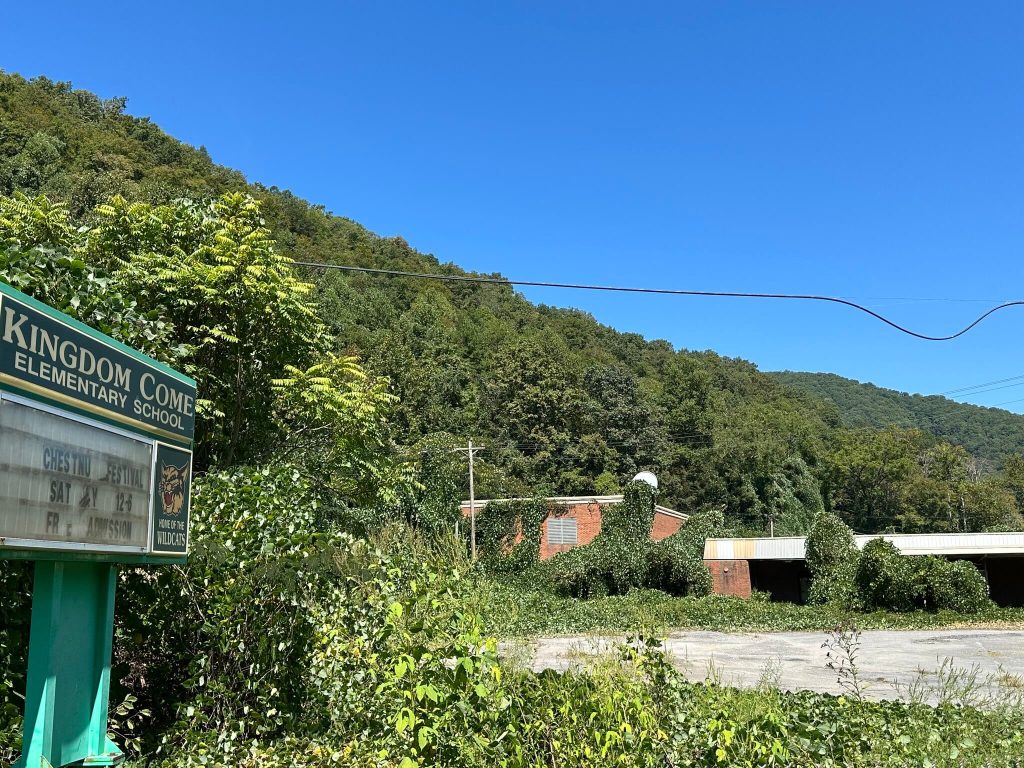
On a clear day at Kingdom Come State Park the overlooks pull your eyes outward to black bear country and the sawtooth ridges of Letcher and Harlan counties. Look long enough down into the Linefork valley though and another landmark begins to stand out. In the bottom, beside Highway 160, the roofline of a brick school building breaks the tree line. For nearly a century that site has carried a charged name in mountain education. Kingdom Come Settlement School began there as a Methodist mission in the 1920s, evolved into a public elementary and high school, and ended its long run as one of Kentucky’s smallest P–8 schools before reemerging as a community center.
The story of Kingdom Come School ties together a valley named from a prayer, the ambitions of outside reformers, the daily lives of Letcher County families, and a surprising afterlife in photography and documentary film.
A valley that gave a school its name
Long before anyone hung a bell at Kingdom Come School the valley already carried the words that would end up on the building. Early settlers arrived here in the 1810s, naming the creek and hollow Kingdom Come from the Lord’s Prayer. A Kentucky Historical Society marker at Linefork later fixed that choice in bronze and connected it to John Fox Jr.’s bestselling novel The Little Shepherd of Kingdom Come, which carried the valley’s name far beyond the Cumberland range.
By the twentieth century “Kingdom Come” meant more than a creek on a surveyor’s plat. It was a religious phrase, a literary setting, and a shorthand for a whole community spread along Line Fork. When Methodist mission workers and educational reformers looked for a name for their new school in the 1920s they drew from the geography and the hymnbook at the same time. The institution that emerged would shape how outsiders pictured the valley and how local people remembered their youth.
A Methodist mission on Line Fork
Kingdom Come Settlement School opened in 1924 on Kentucky Route 160 at Linefork as part of the wider settlement school movement in the southern mountains. Like Hindman, Pine Mountain, and Henderson Settlement, it took cues from urban settlement houses but adapted them to an isolated rural valley. The school combined formal classes with social work, religious outreach, and practical training in domestic and farm skills.
Archival summaries preserved by the D. H. Ramsey Library and later echoed by local historians describe Kingdom Come as a Methodist mission project that operated a school and a companion settlement house. In 1942 the school enrolled 76 high school students and 65 grade school pupils under principal Samuel Quigley. Two women teachers, C. Lois Rea and Ruth Lamdin, lived in the settlement house where they ran community programs and religious activities. Rea had previously served as a missionary in British Malaya and escaped from Singapore at the beginning of the Pacific war, while Lamdin came from work at Henderson Settlement School in Bell County.
The mission’s presence literally reshaped the Linefork landscape. The school campus, associated houses, and outbuildings stood close to the Linefork post office. Postal historian R. M. Rennick later noted that the office sat “just below” the Four Square Church, the settlement school, and Kingdom Come State Park’s access road, tying the institution directly into the daily flow of letters, money orders, and parcel deliveries that connected the hollow to the outside world.
Photographs of labor and learning
Even in its mission years Kingdom Come drew photographers who were interested in the look and feel of Appalachian schools. Around 1931 the portrait photographer Doris Ulmann visited the area and made a platinum print titled “Laborers, Kingdom Come School House,” a quietly composed scene that shows workers at the edge of the campus and has since appeared in studies of her Appalachian work. Her camera turned the school grounds into a backdrop for thinking about class, labor, and the material setting of mountain education.
Later in the mid twentieth century the photographer Earl Palmer documented life at Appalachian institutions ranging from Hindman to Kingdom Come. His published collection includes images of Kingdom Come’s students and buildings, glimpses of lined up children, classrooms, and the school’s relationship to the steep hills that surrounded it. Although these photographs were made to satisfy funders and denominational audiences as much as local families, they now serve as an important visual record of the institution at work.
Student cameras added their own angle. In one photo project described in later accounts of Linefork, pupils from Kingdom Come and Cowan schools photographed local mining scenes, including a striking interior coal mine shot by a sixth grader. Those images, taken with borrowed cameras and little training, show coal seams, timbers, and miners from the students’ own eye level. Together with the professional work of Ulmann and Palmer they make Kingdom Come one of the best photographed small schools in Letcher County.
From mission campus to consolidated school
Until the mid 1960s Kingdom Come Settlement School operated as a combined elementary and high school, serving young people from the Linefork valley and from outlying one room schools. Then the Letcher County Board of Education began a program of consolidation and modernization. A plan circulated that would send high school students from Kingdom Come to Whitesburg High School and convert the Linefork campus into a kindergarten through eighth grade facility. Small schools at Bear Branch, Coyes Gap, and Hurricane Gap were slated to close, with their students bused to a new, larger Kingdom Come Elementary.
Construction on the new building finally began in the fall of 1971. The resulting brick school and its long driveway are what visitors see today from the heights of Kingdom Come State Park. It stood virtually across the road from the older mission era structures and carried the name “Kingdom Come Elementary” or “Kingdom Come Settlement Elementary,” depending on which state document you read. When a 1949 Mountain Eagle advertisement invited bids for the “old Kingdom Come school,” the paper was documenting the formal handoff between the original mission building and the consolidated public facility that replaced it.
This change did not erase the mission legacy. Former students who had boarded at the campus, attended church services in its chapel, or learned in classes that mixed Bible stories with algebra now sent their children to a school where the Letcher County Board of Education signed the checks and the curriculum followed state guidelines. Yet the word settlement persisted in many official listings and in the way locals talked about the place. Even into the 2000s state programs and education reports referred to “Kingdom Come Settlement Elementary School,” bridging the eras of mission and public school.
A one room school on film
While the consolidated Kingdom Come Elementary was taking shape, another branch of the Kingdom Come story was being captured on film up the road. In 1973 Appalshop released The Kingdom Come School, a twenty minute color documentary about Harding Ison and his twenty two pupils at a one room schoolhouse in the last days before consolidation. The film follows Ison and his students through a typical day of multi grade teaching, cross age tutoring, and shared chores. It also juxtaposes the teacher’s defense of small schools with the county superintendent’s arguments for larger, more efficient facilities.
Educational guides soon flagged The Kingdom Come School as a powerful classroom resource. An ERIC guide to film and videotape for social and cultural anthropology recommended it for studies of school culture and open education models, noting that it portrayed one of the few remaining one room schools in the country. Another ERIC bibliography on classroom media described it as a case for preserving a disappearing institution. In the 1990s Morehead State University advertised public screenings of the film alongside other Appalshop titles, evidence that, long after closure, the Kingdom Come classroom still provoked conversations about rural schooling and education policy.
The one room school in the film was not the mission campus at Linefork, and the movie never pretended to be a comprehensive institutional history. Yet for many viewers around the country the words Kingdom Come became synonymous with a small Letcher County school where children cooked their own lunch, helped younger classmates read, and walked home past coal tipples. That cinematic image of mountain education has shadowed the real Kingdom Come Elementary ever since.
A tiny P–8 school in the age of accountability
By the early 2000s Kingdom Come Settlement Elementary appeared regularly in state and national data tables as one of Kentucky’s smallest schools. A 2006 report from the Kentucky Legislative Research Commission on school size and student outcomes listed Kingdom Come Settlement Elementary in Letcher County as a P–8 school with an enrollment of ninety eight pupils.
Other statistical profiles filled in the picture. PublicSchoolReview and City Data entries drawn from National Center for Education Statistics datasets showed slow enrollment decline from the late 1980s through 2007, a student teacher ratio tighter than the state average, and a very high share of pupils qualifying for free or reduced price lunch. The school took part in state math initiatives and outreach programs. The Kentucky Early Mathematics Testing Program lists both “Kingdom Come Elementary” and “Kingdom Come Settlement Elementary,” suggesting overlapping usage of the two names. The Kentucky Higher Education Assistance Authority’s outreach reports name Kingdom Come among its Letcher County sites for college aid counseling, a reminder that even a tiny P–8 school sat inside statewide conversations about college readiness.
Newspaper columns from The Mountain Eagle add texture to the data. In one “Way We Were” piece, parents fret over discipline problems and call for better facilities, while in another a community fire prevention meeting takes place at the school building, treating it as the obvious gathering place for the Linefork valley. Later news coverage of Letcher County school board meetings quotes Superintendent Archie Cornett reflecting that Kingdom Come Elementary at Gordon and Campbell’s Branch at Hallie had both been closed during his tenure, a sign that even by the early twenty first century small, outlying schools remained risky in a shrinking tax base.
Closing the school, saving the building
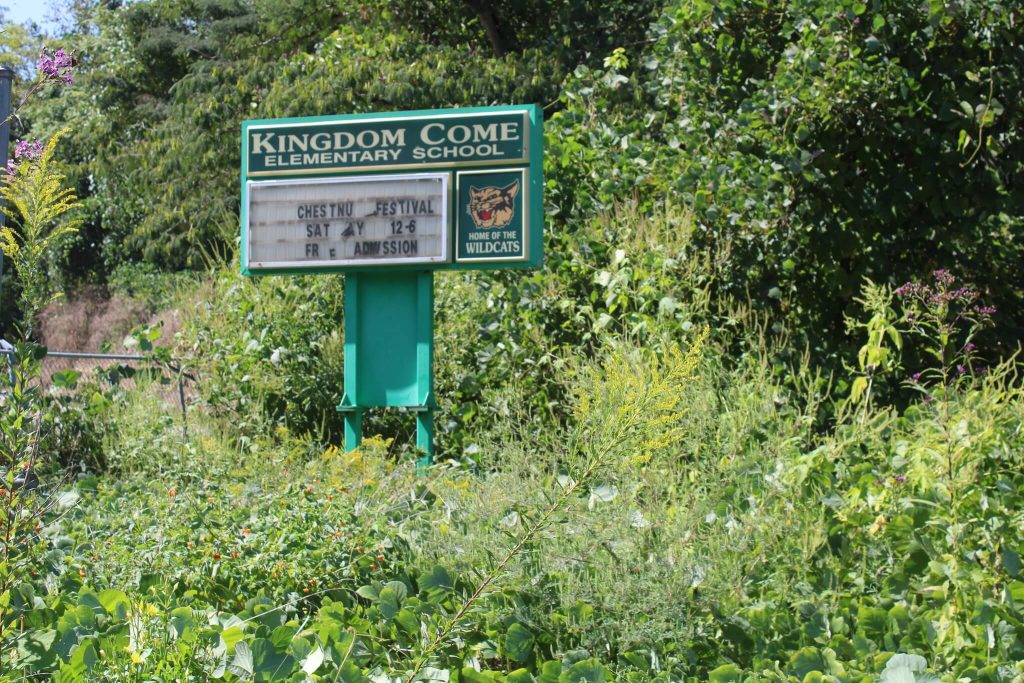
Budget pressures eventually caught up with Kingdom Come. By the mid 2000s the P–8 school had fewer than one hundred students. WalkerHomeschoolBlog and Jamie in Wanderland, two local history blogs that document abandoned schools, note that Kingdom Come Elementary closed around 2007 or 2008 with an enrollment of roughly eighty five pupils. State documents and education websites list the school as closed in 2008.
The building did not sit idle for long. Kentucky budget and appropriations acts in the early 2000s had already earmarked modest sums for Kingdom Come’s arts programs. One line item directed support for “Kingdom Come Elementary – Support for Arts in Quiltmaking,” a telling pairing of traditional craft and school based arts education. Later appropriations mentioned “Kingdom Come School – Kingdom Come Friends – Purchase and Renovations,” channeling one hundred thousand dollars through the Letcher County Board of Education and later the fiscal court for community center projects.
Those entries hint at what local residents and former students had already decided informally. Even if tax supported classes stopped, the building itself would continue to anchor community life. Today business directories list a “Kingdom Come Grade School” site at the same Linefork address, tagged as closed for educational purposes but available for gatherings and events. Facebook pages and groups devoted to the school share photographs of the roof under fresh snow, class pictures in front of the stone walls, and snapshots of reunions that bring scattered alumni home.
Memory, mission, and the meaning of Kingdom Come
The story of Kingdom Come School does not fit neatly into a single narrative of uplift or decline. It began as a mission for Methodist reformers who hoped to evangelize and modernize the mountain South. It became a combined elementary and high school where local teenagers studied algebra and Latin, played basketball in green and white, and learned to navigate a changing coal economy. It contributed to the wave of consolidation that swept away one room schools in the 1960s and 1970s, even as Appalshop’s The Kingdom Come School gave one of those tiny institutions a national audience.
Through the late twentieth century Kingdom Come continued to serve as a community school in a poorer, more regulated Appalachia, where standardized tests and accountability reports sat alongside porch sales, PTA meetings, and volunteer repaired playgrounds. Even in closure it gave birth to a new institution, the Kingdom Come community center, which kept one piece of public infrastructure in the valley under local control.
Scholarship on settlement schools has asked hard questions about paternalism, cultural appropriation, and the ways outside elites used mountain communities as laboratories for reform. Writers like David Whisnant have argued that institutions such as Kingdom Come simultaneously preserved and reshaped “all that is native and fine” in Appalachia, putting selected songs, crafts, and customs on display while discouraging others. The specific history of Kingdom Come bears out those tensions. Missionaries brought new opportunities as well as new constraints. County officials saw modern buildings as promises of equal education, but they also centralized power away from holler residents.
For people who grew up in the Linefork valley though, the meaning of Kingdom Come School has often been simpler and more personal. In obituaries, church minutes, and reunion booklets, men and women who left the valley decades ago still name Kingdom Come Settlement School as their eighth grade or high school alma mater. One obituary for a woman who later taught in Ohio describes her as a graduate of a “Methodist Mission School, Kingdom Come Settlement School in Linefork,” a phrase that compresses a whole set of experiences into one line. Church records from the Indian Bottom Association of Old Regular Baptists remember another member who finished eighth grade at Kingdom Come in 1963.
Viewed from the heights of Kingdom Come State Park, the school buildings are small details in a big landscape. Down on the ground they have been, for nearly a century, one of the main stages where the people of Linefork learned to read, argued about school policy, watched films in the gym, and gathered for funerals and reunions. That is why the words Kingdom Come on the brick face along Highway 160 carry so much weight. They mark not only a valley and a novel but also a long lived institution that helped shape what education, community, and faith looked like in one corner of Letcher County, Kentucky.
Sources & Further Reading
Appalshop. Kingdom Come School. Directed by Diana Ott. 16 mm film. Whitesburg, KY: Appalshop, 1973. https://www.youtube.com/watch?v=j65K0y8d5G0 YouTube+1
Doris Ulmann. “Laborers, Kingdom Come School House.” Platinum print, ca. 1931. High Museum of Art, Atlanta. https://high.org/collections/laborers-kingdom-come-school-house walkerhomeschoolblog
Speer, Jean Haskell. The Appalachian Photographs of Earl Palmer. Lexington: University Press of Kentucky, 1990. https://www.amazon.com/Appalachian-Photographs-Palmer-Haskell-1990-01-23/dp/B01FELZASG Amazon+1
Virginia Tech Special Collections and University Archives. Earl Palmer Appalachian Photograph and Artifact Collection, 1880–1989. Collection guide. https://ead.lib.virginia.edu/vivaxtf/view?docId=vt/viblbv00814.xml Reddit
Wikimedia Commons. “Kingdom Come Settlement School.” Photograph, front view, Linefork, Kentucky. https://commons.wikimedia.org/wiki/File:Kingdom_Come_Settlement_School.jpg Facebook
Jamie in Wanderland. “Kingdom Come Settlement School — Letcher County, Kentucky.” Jamie in Wanderland (blog), November 10, 2015. https://jamieinwanderland.wordpress.com/2015/11/10/kingdom-come-settlement-school-letcher-county-kentucky Jamie in Wanderland
Jamie in Wanderland. “Bear Branch One Room School — Letcher County, Kentucky.” Jamie in Wanderland (blog), November 9, 2015. https://jamieinwanderland.wordpress.com/2015/11/09/bear-branch-one-room-school-letcher-county-kentucky Jamie in Wanderland
Lost & Abandoned Adventures. “Kingdom Come Settlement School in Linefork, Letcher County, Kentucky, Was a Settlement School Founded as a Methodist Mission in 1924.” Facebook post. https://www.facebook.com/lostandabandonedadventures/posts/kingdom-come-settlement-school-in-linefork-letcher-county-kentucky-was-a-settlem/979969544163077 Facebook
“Kingdom Come Settlement School.” Kingdom Come Settlement School (Wikipedia). https://en.wikipedia.org/wiki/Kingdom_Come_Settlement_School Wikipedia
“Kingdom Come, Kentucky.” Kingdom Come, Kentucky (Wikipedia). https://en.wikipedia.org/wiki/Kingdom_Come,_Kentucky Wikipedia
ExploreKYHistory. “Kingdom Come.” Kentucky Historical Marker #1294, Letcher County. Kentucky Historical Society. https://explorekyhistory.ky.gov/items/show/232 Explore Kentucky History+1
Topozone. “Partridge, KY: Nearby Schools – Kingdom Come School.” TopoQuest / TopoZone Place Detail. https://topoquest.com/place-detail.php?id=508781 TopoQuest
ExpertGPS. “Schools and Universities in Kentucky – Kingdom Come School.” ExpertGPS Data for KY Schools. https://www.expertgps.com/data/ky/schools-and-universities.asp ExpertGPS
USGenWeb / RootsWeb. “Letcher County, Kentucky GNIS Features.” Letcher County, Kentucky GNIS Features List. https://usgenwebsites.org/KYLetcher/let_gnis.htm USGenWebsites+1
Mielke, Donald N., ed. A Guide to Film and Videotape for Research in Social and Cultural Anthropology. Washington, DC: ERIC Clearinghouse on Audio-Visual Materials, 1978. ERIC document ED170090. https://files.eric.ed.gov/fulltext/ED170090.pdf ERIC
Kentucky Higher Education Assistance Authority. FY04 Outreach Report. Frankfort: KHEAA, 2004. https://www.kheaa.com/pdf/reports/outreach_fy04.pdf KHEAA
Legislative Research Commission. Greg Hager and Mike Clark. School Size and Student Outcomes in Kentucky’s Public Schools. Research Report 334. Frankfort: Kentucky Legislative Research Commission, 2006. https://apps.legislature.ky.gov/lrc/publications/ResearchReports/RR334.pdf Legislative Research Commission
Kentucky General Assembly. HB 395 (2004 Regular Session) – An Act Relating to Appropriations for the Operations, Maintenance, Support, and Functioning of the Government of the Commonwealth of Kentucky. Appropriation line: “Letcher County School Board – Kingdom Come Elementary – Support for Arts in Quiltmaking.” https://apps.legislature.ky.gov/record/04rs/HB395/bill.doc Legislative Research Commission
Public School Review. “Kingdom Come Settlement Elementary School (Closed 2008) – Linefork, Kentucky.” PublicSchoolReview.com. https://www.publicschoolreview.com/kingdom-come-settlement-elementary-school-profile Math Class
City-Data. “Kingdom Come Settlement Elementary School, Linefork, Kentucky.” City-Data.com School Information. http://www.city-data.com/school/kingdom-come-settlement-elementary-school-ky.html Legislative Research Commission
The Mountain Eagle. “The Way We Were.” The Mountain Eagle (Whitesburg, KY), retrospective column mentioning Kingdom Come School and Halloween pranks between Kingdom Come School and Gordon. https://www.themountaineagle.com/articles/the-way-we-were-324 The Mountain Eagle
Mindat.org. “Cadmium (Commodity) from Ole Boy Mine, Humboldt County, Nevada.” Note on student photography project including Kingdom Come School and Cowan School students documenting coal mining. https://zh.mindat.org/locentry-1547639.html Mindat
TopoQuest. “Kingdom Come School, School, N37.0190° W82.9621°.” Feature listing within Letcher County, Kentucky. https://topoquest.com/place-detail.php?id=508781 TopoQuest
Pine Mountain Settlement School. “Line Fork Settlement.” Historical overview of the Line Fork extension center in the Kingdom Come / Linefork area. https://pinemountainsettlement.net/built-environment/line-fork-settlement/ Pine Mountain Collections
Morehead State University, ScholarWorks. “Kingdom Come School, Harding Ison and Appalshop, Inc.” Appalachian Kentucky Video Archives record. https://scholarworks.moreheadstate.edu/2018.2.html ScholarWorks
Kentucky Atlas and Gazetteer. “Letcher County, Kentucky.” Note on the county’s association with The Little Shepherd of Kingdom Come and location of Kingdom Come State Park. https://www.kyatlas.com/21133d.html Kentucky Atlas+1
Author Note: As a historian rooted in the central Appalachian region, I am drawn to small schools that carried whole communities on their shoulders. I hope this look at Kingdom Come School helps you see Linefork’s classrooms, teachers, and students as part of a larger story about education, faith, and endurance in the mountains.