
Appalachian History Series – The Story of the Elkhorn City Railroad Museum
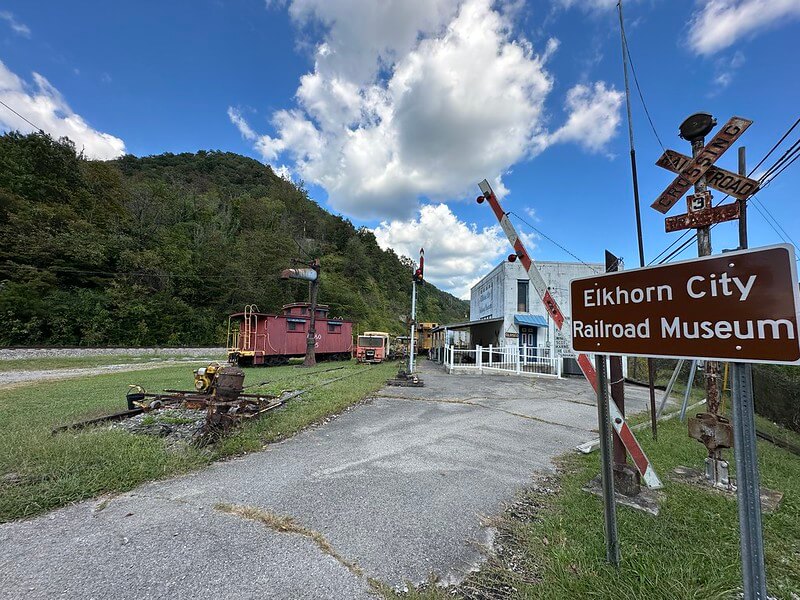
On the edge of the Kentucky Virginia line, Elkhorn City sits where the Russell Fork cuts out of the Breaks of the Sandy. It looks like a small river town at first glance, but for most of the twentieth century it was also a hinge in the railroad map of Appalachia. Here the Chesapeake and Ohio came down from the north and the Clinchfield came up from the south, tying the coalfields to distant markets.
Kentucky Historical Marker 2130 on Pine Street, a few steps from the Elkhorn City Railroad Museum, sums up what that junction meant. It notes that the C and O and Clinchfield met at Elkhorn City on February 8, 1915, and that this link opened trade between the Ohio Valley and the South Atlantic while turning the town into an important railroad community with trains passing several times a day and hauling out coal and timber from the surrounding hills.
A companion essay from the Kentucky Historical Society’s ExploreKYHistory project adds detail that you can still see in the landscape today. It explains how the connection brought regular freight and passenger traffic through town and shows period photographs of steam engines and C and O equipment in the yard. When you stand at 100 Pine Street and look toward the tracks, you stand where the maps and timetables once converged. The Elkhorn City Railroad Museum exists to make that paper record feel real again.
From Junction to Yard Town
The railroad story that ends at the museum begins far to the south. The Clinchfield Railroad, formally the Carolina, Clinchfield and Ohio, built north from the Carolina Piedmont and Virginia coalfields toward Kentucky. It was one of the last major railroads driven through the Appalachian mountains, famous among engineers and railfans for its tunnels and looping grades. The thirty five mile segment from Dante, Virginia, to Elkhorn City, completed in 1915, opened coal lands north of Sandy Ridge and formed a direct connection with the C and O at Elkhorn City.
That connection turned the valley into a working railroad yard. Mid twentieth century C and O employee timetables list Elkhorn City as a station and terminal on the Ashland Division, while freight train books show schedules from Elkhorn City to Toledo and other northern destinations. These dry columns of mileposts and departure times confirm what local people knew from experience. Cars of Pike County coal rolled out behind big road engines, were sorted in the yard, and then disappeared up the line toward the Ohio River and beyond.
On the Clinchfield side, track charts from the 1960s show the Elkhorn City yard laid out in careful pencil: sidings, leads, capacities, and grades, all squeezed between the river and the hillside. Elkhorn City was the northern end of the Clinchfield and the place where crews turned, made set outs, and handed trains over to the C and O. To the outside world it was a dot on a system map. To the people who worked there it was a maze of rails, lantern signals, and hard won knowledge of how to keep freight moving in tight mountain country.
Chick Spradlin and the Birth of a Museum
By the late twentieth century that working railroad world was fading. New operating patterns and the shift of interchange traffic to nearby Shelbiana reduced the role of Elkhorn City. The yard that had once been the bustling northern terminus of the Clinchfield quieted, and in 1981 the Clinchfield side closed.
Edward “Chick” Spradlin had spent most of his forty year railroad career in that yard. He had watched trains come and go in all weather, seen the Santa Train glide in with holiday crowds, and learned how much of local life depended on the rails that hemmed the town. As the traffic thinned, he worried that the story of Elkhorn City’s railroads would thin with it.
Spradlin and a small group of fellow railroaders began collecting what others were throwing away. Station signs, lanterns, timetables, photographs, and tools all found their way into their hands. With help from local supporters they secured a former coal company office on Pine Street that had been donated for preservation work. In 1990 they opened the Elkhorn City Railroad Museum in that building, just a short walk from the very tracks where they had spent their working lives.
From the beginning the museum had a wider mission than nostalgia. The founders framed it as a place to educate visitors about the history of railroads in Kentucky’s Eastern Mountain Coal Fields and about the coal, timber, and timber cutting that went hand in hand with the trains. The region’s story could be told through a caboose ladder or a dispatcher’s phone as easily as through a photograph of a tipple.
When Chick Spradlin died in 1999, stewardship of the museum passed to the Elkhorn City Area Heritage Council, a nonprofit created to preserve and promote the history of the town. The Heritage Council kept the museum open as a volunteer effort, and many of the volunteers were themselves retired railroad workers who could explain not just what an artifact was, but how it was used on a dark winter night in the yard.
Walking the Yard Inside the Museum
Today the small white building on Pine Street holds more than one thousand pieces of railroad history that span from the nineteenth century to the modern diesel era. Inside, visitors walk through a stitched together version of the yard and the division office. There are lanterns and oil cans lined up on shelves, telegraph keys and signal relays in glass cases, and detailed maps and timetables on the walls.
Two cabooses sit outside, along with maintenance of way equipment like velocipedes and motor cars. These modest pieces of rolling stock are not just curiosities. They speak to the countless hours that brakemen, track crews, and section hands spent on the line between Elkhorn City and points south and north. Stepping up into a caboose or looking down the frame of a track speeder gives visitors a sense of the scale of the work that kept trains moving.
One of the most eye catching items inside the museum is a seat from the private railcar of President James Garfield. The provenance of the piece is part of the lore that grew up around the museum, and it reminds visitors that even in a small Appalachian yard national stories have a way of passing through.
Wall displays combine local photographs with system level documents. Historic pictures show the yard full of steam and early diesel power, while framed diagrams and timetables help explain how those trains were scheduled and routed. Some of these images also appear on the Pike County Historical Society’s online gallery, which credits the Elkhorn City Railroad Museum and Heritage Council as partners in preserving the visual record of the Clinchfield and C and O.
The museum also interprets the story of the Clinchfield route itself. Exhibits explain how surveyors puzzled over the ridges and gaps between Virginia and Kentucky and how the final line, with its tunnels and bridges, became known as a marvel of early twentieth century railroad engineering. For visitors who want to dig deeper, the displays point toward more technical resources, such as track charts and corporate records preserved in rail archives and at institutions like the Archives of Appalachia at East Tennessee State University.

Voices from the Yard and the River
Artifacts and photographs only tell part of the story. Oral histories give the place a voice. The Elkhorn City River Oral History Project at the Kentucky Oral History Commission includes interviews with former railroad workers such as Morris Wallace and Roy Owens, who talk about everyday life in the yard, the arrival of the Santa Train, and the way the railroad shaped both the town and the nearby river corridor.
In those interviews, railroad men remember Elkhorn City as a hub of movement. Crews cycled in and out, coal and lumber flowed through, and on weekends and holidays the Santa Train brought crowds of children to the yard for gifts and spectacle. The museum makes frequent reference to that continuing tradition. As a regular stop on CSX’s annual Santa Train, Elkhorn City still sees one special train come in each November to deliver toys, food, and clothing along the old Clinchfield line.
The oral histories also capture the transition from railroad economy to tourism and recreation. Interviewees talk about the rise of river running on the Russell Fork, the designation of Elkhorn City as a trailhead for Breaks Interstate Park, and early efforts to think of railroad heritage as part of a broader eco tourism plan.
Floodwater, Closure, and Community Work
Like many small museums in old buildings, the Elkhorn City Railroad Museum has been vulnerable to the everyday hazards of aging infrastructure. In 2016 a water line broke and flooded the main building, damaging exhibits and forcing the museum to close. Volunteers and members of the Heritage Council hauled out soaked artifacts, assessed what could be conserved, and began planning for long term repairs.
A 2019 report by WYMT Mountain News highlighted how local people refused to give up on the museum after the flood. It described volunteers patching walls, reorganizing displays, and seeking grants and donations to rebuild the collection and improve the building. That work overlapped with a partnership between the museum and the University of Kentucky described in KyForward, where students helped create a mobile exhibit that could travel to schools and festivals and keep the museum’s story in circulation even when the building was closed.
The COVID 19 pandemic added another layer of disruption, causing another temporary closure in 2020. By 2022, however, local coverage in the Appalachian News Express reported that the museum had reopened to visitors and that it was once again serving as a stop for railfans, families, and people exploring Pike County’s heritage trails.
A Small Museum in a Larger Heritage Network
The museum does not stand alone. It is part of a web of efforts to reinterpret Elkhorn City as a gateway community for both rail and river tourism. An Appalshop affiliated story on Making Connections News from 2015 profiles the Elkhorn City Area Heritage Council and other partners who see eco tourism, arts, and history as intertwined strategies for rebuilding the town’s economy. In that piece, local leaders talk about the transition from a company town feel to a place that welcomes paddlers, hikers, and heritage travelers, and they point to the railroad museum as one of the anchors of that work.
Regional tourism promoters echo that message. The Southeast Kentucky Chamber of Commerce’s visitor guide lists visits to the Elkhorn City Railroad Museum alongside the Hatfield and McCoy driving tour, the Breaks Interstate Park, and Dils Cemetery as part of what the county has to offer travelers interested in history. Pikeville and Pike County planning documents also highlight the museum as a transportation heritage site, noting its sizable collection of railroad equipment and artifacts.
In this way a single repurposed coal company office and its cabooses connect with much larger conversations about how Appalachian communities can leverage their past for a different economic future. The museum’s photographs and oral histories invite visitors to imagine the yard at full capacity. The rafting outfitters on the Russell Fork invite them to imagine the river differently. Together, they sketch a town that remembers its industrial roots while leaning into new identities.
Why the Elkhorn City Railroad Museum Matters
The Elkhorn City Railroad Museum preserves more than curiosities from a vanished era. It holds evidence of how a small mountain town became a crucial link in a continental trade route that connected Kentucky’s coalfields to factories and ports hundreds of miles away. It shows how national scale engineering projects like the Clinchfield did not just cross the mountains, but reshaped the daily life of the people who lived in their shadow.
At the same time, the museum centers the people who worked the line. Wherever you turn inside, handwritten brass nameplates, framed crew photos, and oral history quotes remind you that the story of Elkhorn City’s railroads is really a story about labor, community, and adaptation. The volunteers who saved artifacts from a flooded building and reopened the doors after years of disruption are direct heirs of that tradition of persistence.
For students of Appalachian history, the museum is a compact archive that complements formal records such as timetables, corporate files, and state planning reports. For families passing through on their way to Breaks Interstate Park or on a Hatfield and McCoy driving tour, it is a place where a child can climb into a caboose, hear about the Santa Train, and see how Elkhorn City once pulsed with the movement of coal and timber.
Most of all, the Elkhorn City Railroad Museum matters because it insists that a yard at the end of the line is still a place where stories begin. In a town now known as the Gateway to the Breaks, the rails and the river meet at Pine Street, and the museum stands at that crossroads, keeping the memory of trains, crews, and a coalfield junction alive for the next generation.
Sources & Further Reading
Elkhorn City Railroad Museum. “Elkhorn City Railroad Museum.” Elkhorn City Railroad Museum. Accessed January 1, 2026. https://elkhorncityrrm.tripod.com. Elkhorn City Railroad Museum
Elkhorn City Railroad Museum. “A Brief History of Elkhorn City Railroad Museum.” Elkhorn City Railroad Museum. Accessed January 1, 2026. https://elkhorncityrrm.tripod.com. Wikipedia
Kentucky Historical Society. “Elkhorn City’s Railroads (Marker Number 2130).” Kentucky Historical Marker Database. Accessed January 1, 2026. https://history.ky.gov/markers/elkhorn-citys-railroads. Kentucky Historical Society
Prats, J. J. “Elkhorn City’s Railroads.” Historical Marker Database, October 20, 2015. Accessed January 1, 2026. https://www.hmdb.org/m.asp?m=89778. HMDB
ExploreKYHistory. “Elkhorn City’s Railroads.” Kentucky Historical Society. Accessed January 1, 2026. https://explorekyhistory.ky.gov. Explore Kentucky History
Louie B. Nunn Center for Oral History. “Interview with Morris Wallace, Roy Owens, April 11, 2015.” Elkhorn City River Oral History Project. University of Kentucky Libraries. Accessed January 1, 2026. https://www.kentuckyoralhistory.org. Kentucky Oral History
Pike County Historical Society. “Elkhorn City Railroad Museum.” Pike County Museums. Accessed January 1, 2026. https://pikecountykyhistoricalsociety.com/museums. Pike County Historical Society
Kentucky Heritage Council. National Register of Historic Places Registration Form: Elkhorn City School, Pike County, Kentucky. March 17, 2014. PDF. Accessed January 1, 2026. https://heritage.ky.gov/historic-places/national-register/Property%20Listings/Pike_ElkhornCitySchool.pdf. Kentucky Heritage Council
City of Pikeville. Pikeville Comprehensive Plan Appendices. Pikeville, Kentucky, 2021. PDF section referencing Elkhorn City Railroad Museum. Accessed January 1, 2026. https://pikevilleky.gov/wp-content/uploads/2021/04/Pikeville-Comp.-Plan-Appendices-1.22.21.pdf. City of Pikeville, KY
Kentucky Legislative Research Commission. Acts of the 2008 Regular Session, Chapter 123. Frankfort, Kentucky, 2008. Line item “City of Elkhorn City – Elkhorn City Railroad Museum – Equipment, Operating, and Improvements.” PDF. Accessed January 1, 2026. https://apps.legislature.ky.gov/law/acts/08RS/documents/0123.pdf. Legislative Research Commission
“Elkhorn City Railroad Museum.” Wikipedia: The Free Encyclopedia. Accessed January 1, 2026. https://en.wikipedia.org/wiki/Elkhorn_City_Railroad_Museum. Wikipedia
WhichMuseum. “Elkhorn City Railroad Museum.” WhichMuseum. Accessed January 1, 2026. https://whichmuseum.com/museum/elkhorn-city-railroad-museum-36554. WhichMuseum
Kiddle Encyclopedia. “Elkhorn City Railroad Museum Facts for Kids.” Kiddle. Accessed January 1, 2026. https://kids.kiddle.co/Elkhorn_City_Railroad_Museum. Kiddle
Chesapeake and Ohio Railway. Ashland Division – Big Sandy Sub-division Time Table No. 133. May 6, 1945. PDF scan, Wx4.org. Accessed January 1, 2026. https://wx4.org/to/foam/maps/2-Zukas/10/C_O/1945-05-06C%26O_Ashland133-Zukas.pdf. Wx4
Chesapeake and Ohio Railway. Ashland, Russell and Hocking Divisions Employes Timetable No. 153. April 24, 1966. PDF, Multimodalways. Accessed January 1, 2026. https://www.multimodalways.org/docs/railroads/companies/C%26O/C%26O%20ETTs/C%26O%20Ashland%20Russell%20%26%20Hocking%20Divs%20ETT%20%23153%204-24-1966.pdf. Multimodalways
Chesapeake and Ohio Railway. Time Freight Train Book No. 12. June 15, 1941. PDF, Moving the Freight. Accessed January 1, 2026. https://movingthefreight.com/wp-content/uploads/2020/03/co-time-freight-train-book-12-6-15-1941.pdf. Moving the Freight
Clinchfield Railroad Company. Employees Time Table No. 21. July 27, 1941. PDF, WX4.org. Accessed January 1, 2026. https://wx4.org/to/foam/maps/2-Zukas/12/CL/1941-07-27Clinchfield21-Zukas.pdf. Wx4
Clinchfield.org. “Elkhorn City, Kentucky.” Destinations Along the Clinchfield Railroad. Accessed January 1, 2026. https://www.clinchfield.org/clinchfield-railroad/destinations/elkhorn-city-kentucky. Clinchfield Railroad
Clinchfield.org. “Yards of the Clinchfield Railroad – Elkhorn City Yard.” Accessed January 1, 2026. https://www.clinchfield.org/clinchfield-railroad/yards-of-the-clinchfield-railroad. Clinchfield Railroad
Clinchfield.org. “Clinchfield Railroad History Timeline.” Accessed January 1, 2026. https://www.clinchfield.org/clinchfield-railroad/history-of-the-clinchfield-railroad/clinchfield-railroad-history-timeline. Clinchfield Railroad
Clinchfield.org. “Railroad Battles for the River Valleys: Battle of the Breaks.” Accessed January 1, 2026. https://www.clinchfield.org/clinchfield-railroad/history-of-the-clinchfield-railroad/battle-of-the-breaks. Clinchfield Railroad
Clinchfield.org. “History of the Clinchfield Railroad.” Accessed January 1, 2026. https://www.clinchfield.org/clinchfield-railroad/history-of-the-clinchfield-railroad. Clinchfield Railroad
Archives of Appalachia, East Tennessee State University. “Carolina, Clinchfield and Ohio Railway Records.” In Fifty Years on the Clinchfield: ‘Captain Tom’ Goodin exhibit notes. Accessed January 1, 2026. https://archivesofappalachia.omeka.net/exhibits/show/goodin/notes. Archives of Appalachia
“Archives of Appalachia.” Wikipedia: The Free Encyclopedia. Accessed January 1, 2026. https://en.wikipedia.org/wiki/Archives_of_Appalachia. Wikipedia
Way, William Jr. The Clinchfield Railroad: The Story of a Trade Route Across the Blue Ridge Mountains. Chapel Hill, NC: University of North Carolina Press, 1931. https://books.google.com/books/about/The_Clinchfield_Railroad.html?id=b4LVAAAAMAAJ. Google Books
Goforth, James A. Building the Clinchfield: A Construction History of America’s Most Unusual Railroad. Johnson City, TN: Overmountain Press, 1989. https://books.google.com/books/about/Building_the_Clinchfield.html?id=IJogvQseFS4C. Google Books
Goforth, James A. When Steam Ran the Clinchfield. Johnson City, TN: Overmountain Press, 1998. https://books.google.com/books/about/When_Steam_Ran_the_Clinchfield.html?id=dNQc0OzLDrUC. Google Books
Ropp, Greg. “Elkhorn City Yard Office.” RR Picture Archives, photograph dated May 1, 1992. Accessed January 1, 2026. https://www.rrpicturearchives.net/showPicture.aspx?id=1962250. Railroad Picture Archives
“An Acquaintance with the Clinchfield.” Wearerailfans.com, April 15, 2021. Accessed January 1, 2026. https://wearerailfans.com/c/article/an-acquaintance-with-the-clinchfield. wearerailfans.com
DPSimulation. “Train Simulator: Clinchfield Railroad – Elkhorn City to St. Paul Route Add-On.” DPSimulation.org. Accessed January 1, 2026. https://www.dpsimulation.org.uk/train-simulator-clinchfield-railroad-elkhorn-city-st-paul-route-add-on.html. dpsimulation.org.uk
Sneider, Julie. “Railroads’ Holiday Trains Deliver Gifts, Food and Joy.” Progressive Railroading, November 2017. Accessed January 1, 2026. https://www.progressiverailroading.com/safety/article/Railroads-holiday-trains-deliver-gifts-food-and-joy–53265. progressiverailroading.com
Appalachian Railroads. “Searching for the 3Cs by Scott Jessee.” Appalachian-Railroads.org. Accessed January 1, 2026. https://appalachian-railroads.org/homepage/charleston-cincinnati-and-chicago-railroad/searching-for-the-ccc-3cs-by-scott-jessee. appalachian-railroads.org
Author Note: Thank you for spending time with this story of Elkhorn City’s railroads and the people who keep their memory alive. I hope it helps you see how a small mountain yard shaped regional history and why preserving places like this still matters.