
Appalachian History Series – The Campbell Building of Middlesboro: An 1890 Cornerstone of Cumberland Avenue
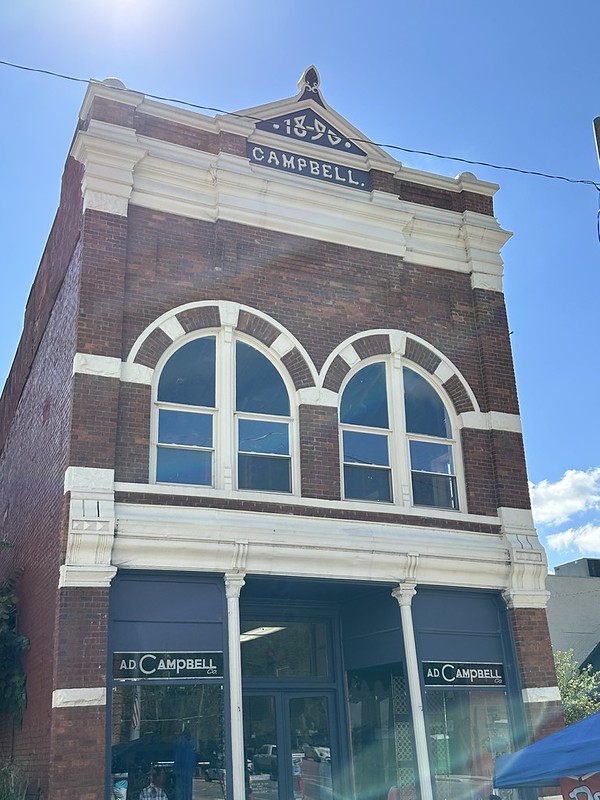
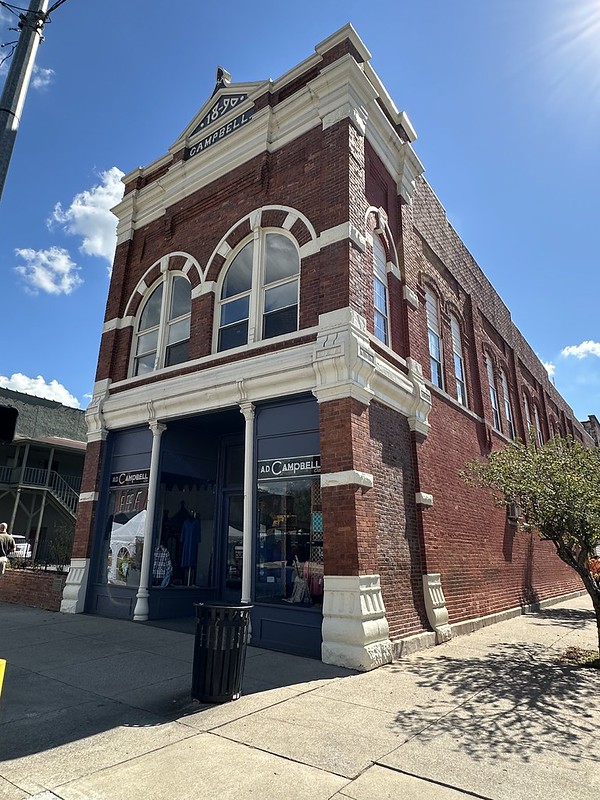
The Campbell Building rises at the corner of Cumberland Avenue and 21st Street in downtown Middlesboro, where three states almost meet and the Cumberland Gap opens like a doorway in the mountains. It is an old corner in a relatively young town. Red brick piers frame tall upper windows, a gabled parapet steps above the roofline, and a long rear wing stretches back toward the alley. At street level a women’s clothing store still occupies the first floor, just as it did in the nineteenth century.
From a preservation standpoint, the building is not just another Main Street storefront. In the National Register nomination for the Middlesboro Downtown Commercial District, the Campbell Building is singled out as one of the oldest surviving buildings on Cumberland Avenue, built in 1890 and described as an especially good late nineteenth century commercial structure that uniquely keeps its original storefront intact. Modern architectural notes call it a Romanesque Revival influenced corner block, finished in red brick with stone trim, brick piers, a simple cornice, a gabled front parapet, and a taller four story rear wing. In other words, it looks like what the 1890s promised this planned boomtown would become, and somehow it still does.
A planned city at the foot of the Gap
Middlesboro did not grow up slowly along a wagon road or river ford the way many Appalachian towns did. It was laid out in 1888 as a fully planned industrial city in the broad basin just west of Cumberland Gap. Investor and promoter Alexander Arthur believed that Bell County’s coal and iron could sustain a city to rival Birmingham or Pittsburgh, and he persuaded British backers to organize the American Association, Limited, to make that vision real.
The result was unusual for the eastern Kentucky coalfields. The downtown that grew along Cumberland Avenue had wide streets, formal plazas, and a tightly packed grid of masonry commercial blocks. When the downtown district was nominated to the National Register, the Kentucky Heritage Council stressed how different it looked from the narrow, low scale streetscapes that typified most county seats in the region. The Campbell Building stands near the western end of that original core, part of a run of two and three story brick buildings that turned Arthur’s plan from a paper map into a real town.
On that stage, A.D. Campbell’s clothing business found a permanent home. The city’s First Presbyterian Church remembers Mr. and Mrs. A.D. Campbell among its charter members in 1889, a sign that the family sat near the center of the new community from the very beginning of its civic and religious life.
From frame store to brick landmark
Before the 1890 brick building went up, the Campbell firm traded in a simpler setting. An early photograph on the old “Middlesborough History” website shows a frame front labelled “A.D. Campbell Wooden Structure,” one of several images documenting the town’s storefronts in the 1890s. Another Wayback Wednesday post from the City of Middlesboro shares an even earlier view of “T.H. Campbell & Bros. Toggery Shop,” recalling a time when the family name was already tied to clothing on Cumberland Avenue.
By 1890, the Campbells were ready for something more substantial. A modern “This Week in Local History” column in the Middlesboro News reaches back into the Daily News files and notes that in that year the city council granted a building permit to A.D. Campbell for what the paper called their second building at the current site on Cumberland Avenue. That permit lines up with the 1890 construction date given in the National Register file and later architectural descriptions.
The Sanborn fire insurance map for June 1891 captures downtown Middlesboro only a year later. In that map series, the Campbell premises appear along the main commercial spine, part of a growing ribbon of brick businesses facing Cumberland Avenue, with building materials, heights, and uses carefully recorded for fire risk. Later Sanborn sets from 1901, 1907, 1913, and 1923 let historians watch changes to the block over time, following how the Campbell corner remained a stable piece of the streetscape even as neighboring buildings and rear additions shifted around it.
City directories fill in the human side of those footprints. Listings in the 1912, 1926, and 1934 Middlesborough city directories show the A.D. Campbell name continuing in the downtown business ranks as a clothing firm, with consolidated access today through the Middlesboro genealogy guide at LDSGenealogy. Through directories and maps, the picture that emerges is of a single family business growing with the town and investing early in a brick corner building meant to last.
Brick arches and a corner presence
Seen from the street today, the Campbell Building reads as a compact but assertive late nineteenth century commercial block. Modern documentation on Wikimedia Commons and Flickr describes it as being built in 1890 with a Romanesque Revival flavor. The façade is organized by brick piers that rise the full height of the front, separating window bays and emphasizing vertical lines, while stone trim at sills and lintels provides contrast against the red brick. A modest cornice caps the wall, and a gabled parapet gives the corner its distinctive profile.
From the side and alley, a taller rear wing rises four stories, making clear that the building’s working space extends far beyond the show windows on Cumberland Avenue. That depth would have given the Campbells room for stock rooms, alteration and work areas, and possibly offices above, even while the street façade remained carefully scaled to match its neighbors in the district.
The National Register nomination emphasizes how unusual it is for a Middlesboro storefront of this age to survive with its original configuration at street level. Where many buildings on Cumberland Avenue acquired modern aluminum and glass fronts in the twentieth century, the Campbell Building still retains the essential organization of its nineteenth century storefront. That intactness is a major part of why the building is singled out in the district documentation as a textbook example of its era.
Snapshots from sidewalk sales and Main Street life
If maps and nominations tell one kind of story, photographs tell another. The J.T. Hurst collection of Middlesboro images, assembled on the “Middlesborough History” site, includes several mid twentieth century scenes of A.D. Campbell’s, including a view labelled “A.D. Campbell’s Sidewalk Sale.” Racks of dresses and sale tables spill out onto the sidewalk while crowds thread their way past, turning the Campbell corner into a temporary open air market. Other Hurst photographs of early Campbell storefronts show earlier signs and window displays, tracking the evolution of the façade and the fashions it advertised.
The City of Middlesboro’s Wayback Wednesday posts draw on some of the same images. One widely shared post calls the A.D. Campbell Co. store “one of the most historic businesses in town” and reminds readers that it is still located on the corner of Cumberland Avenue and 21st Street. Comments on those posts chatter about how the old photograph makes the building look like it is leaning, how long particular family members worked there, and how people remember shopping there as children and teenagers.
Those memories are echoed in smaller ways in local architectural writing. The Gardens to Gables project, which highlights interesting Kentucky buildings on social media, has featured the Campbell Building as a “historic commercial building” and drawn responses from people who recognize it as A.D. Campbell’s women’s clothing store. In each case, the photographs do more than document brick and stone. They show the building as a setting for community life, where sidewalk sales, holiday crowds, and everyday errands all played out beneath the same parapet.
Serving women since the nineteenth century
The continuity of the business inside the Campbell Building may be as remarkable as the survival of the brick shell itself. Modern promotional material for A.D. Campbell Co. describes the shop as “Distinctive Clothes for Women” and proudly notes that it has been serving local women since 1889. A regional tourism feature in the Claiborne Progress goes even further, stating that A.D. Campbell’s clothing store has been in business at this location since 1889 and highlighting the building as an outstanding example of Victorian commercial architecture along Cumberland Avenue.
That continuity fits the impressions reported in Main Street program newsletters. In a 2020 “Main Street Monday” update, the Kentucky Heritage Council singled out the A.D. Campbell building as one of their favorite structures along Cumberland Avenue. They described the current first floor business as having operated for more than fifty years and noted that stepping inside feels like traveling back into an old department store, complete with a layout and atmosphere that belong to an earlier retail era.
Taken together, city directories, tourism guides, Main Street features, and the store’s own social media presence all point to the same conclusion. On a street where banks have changed names and many old firms have passed into history, the Campbell corner has remained a clothing store for women for well over a century, bridging the gap between the speculative boomtown of the 1890s and the small city of the twenty first century.
Restoration and recognition
Like much of downtown Middlesboro, the Campbell Building has also had to weather the later twentieth century. Economic shifts, highway relocation, and the rise of shopping centers all drew energy away from Cumberland Avenue. Yet the building survived those lean years, still occupied and still recognizable, and eventually became a focus for preservation and reinvestment.
In 2019 and 2020, Kentucky Heritage Council’s Main Street Monday newsletters shared photographs of scaffolding around the building and expressed excitement about its restoration, noting that the project was being shepherded locally by Middlesboro Main Street volunteers. Preservation Kentucky later recognized the work more formally, naming the restoration of the A.D. Campbell Building among the honorees for its Linda Bruckheimer Excellence in Rural Preservation Award.
Those honors treat the building not just as an attractive storefront but as a key piece of a wider historic district. The Campbell corner sits within a commercial landscape that still includes the Coal House, the old Carnegie Library, the post office, and other landmarks named in the downtown district listing, all of them contributing to what the National Register nomination calls one of the best preserved town centers in eastern Kentucky.
Heritage tourism scholarship has picked up on that potential. In a 1991 thesis at the University of Tennessee, Rebecca Vial examined how Middlesboro and other communities along the Wilderness Road have used historic downtowns and gateway images to build local identity and attract visitors. Buildings like the Campbell serve as both everyday places of business and visual anchors for that kind of downtown storytelling.
The Campbell corner in the long story of Middlesboro
Today, if you stand on the opposite sidewalk and look across at the Campbell Building, it is easy to imagine how many different eras that façade has watched pass by. In the 1890s it greeted investors, surveyors, and speculators who believed the new city at the Gap might become an industrial giant. In the early twentieth century it served the families of miners, railroaders, and merchants, fitting school dresses and Sunday clothes as the coal economy rose and fell. Midcentury photographs show sidewalk sales, parades, and the quiet bustle of a county seat that had survived flood and fire.
The Sanborn maps and city directories that document the Campbell Building’s footprint and business listings are sterile on the surface, little more than rectangles and columns of type. Yet when those technical sources are combined with photographs, local newspaper snippets, and social media memories, they reveal a remarkably consistent presence on a single corner.
That is what makes the Campbell Building important in the history of Appalachian downtowns. It is not a courthouse or a bank, and it was never the tallest or most lavish structure in Middlesboro. Instead, it has been something more ordinary and in some ways more revealing, a long running women’s clothing store in a well designed brick shell that outlived the speculative company that first imagined the town.
For people interested in Appalachian history and preservation, the Campbell Building offers both a research anchor and a tangible place to visit. Its story can be followed through Sanborn maps, city directories, scattered advertisements in early Middlesboro newspapers, photographic collections like J.T. Hurst’s, and modern preservation files. On the ground, though, it is as simple as stepping off Cumberland Avenue into a shop that has dressed the town’s women since the nineteenth century and realizing that the doorway, the brick piers, and the corner itself have been doing the same quiet work for well over one hundred thirty years.
Sources & Further Reading
Sanborn Map Company. Sanborn Fire Insurance Map from Middlesboro, Bell County, Kentucky [June 1891]. New York: Sanborn Map Co., 1891. Map. Library of Congress. https://www.loc.gov/collections/sanborn-maps
Sanborn Map Company. Sanborn Fire Insurance Map from Middlesboro, Bell County, Kentucky [1901]. New York: Sanborn Map Co., 1901. Map. Library of Congress. https://www.loc.gov/collections/sanborn-maps Library of Congress
Sanborn Map Company. Sanborn Fire Insurance Map from Middlesboro, Bell County, Kentucky [1907]. New York: Sanborn Map Co., 1907. Map. Library of Congress. https://www.loc.gov/collections/sanborn-maps
Sanborn Map Company. Sanborn Fire Insurance Map from Middlesboro, Bell County, Kentucky [1913]. New York: Sanborn Map Co., 1913. Map. Library of Congress. https://www.loc.gov/collections/sanborn-maps
Sanborn Map Company. Sanborn Fire Insurance Map from Middlesboro, Bell County, Kentucky [1923]. New York: Sanborn Map Co., 1923. Map. Library of Congress. https://www.loc.gov/collections/sanborn-maps
“Middlesborough, Kentucky, City Directory, 1912; Middlesboro City Directory, 1926; Middlesboro City Directory, 1934.” Various publishers. Digital images via Ancestry, MyHeritage, Allen County Public Library, and FamilySearch; indexed at “Bell County City Directories.” LDSGenealogy. https://ldsgenealogy.com/KY/Bell-County-City-Directories.htm
“Bell County KY Newspapers and Obituaries” (section “Middlesboro Newspapers and Obituaries,” including Daily News, Middlesborough News, and Middlesboro Daily News runs). LDSGenealogy. https://ldsgenealogy.com/KY/Bell-County-Newspapers-and-Obituaries.htm
“Middlesboro Genealogy (in Bell County, KY).” LDSGenealogy. Overview of census, city directories, and newspapers for Middlesboro. https://ldsgenealogy.com/KY/Middlesboro.htm
Morgan, David. National Register of Historic Places Inventory–Nomination: Middlesboro Downtown Commercial District. Frankfort: Kentucky Heritage Council, 1982. National Park Service, NPGallery. https://npgallery.nps.gov/NRHP
“Middlesboro Downtown Commercial District.” Wikipedia. Accessed 2026. https://en.wikipedia.org/wiki/Middlesboro_Downtown_Commercial_District
“Kentucky Heritage Council: Main Street Monday! November 18, 2019.” Kentucky Heritage Council (Kentucky Main Street Program newsletter), featuring restoration work on the A.D. Campbell Building, Middlesboro. PDF. https://heritage.ky.gov
“Kentucky Heritage Council: Main Street Monday! April 27, 2020.” Kentucky Heritage Council (Kentucky Main Street Program newsletter), describing the A.D. Campbell building and long-running retail use. PDF. https://heritage.ky.gov
“INSIDER GUIDE 2021: Historic Downtown Middlesboro.” Claiborne Progress (Tazewell, TN), September 29, 2021. https://claiborneprogress.net/2021/09/29/insider-guide-2021historic-downtown-middlesboro
“This Week in Local History.” Middlesboro News, August 13, 2018. Column noting that in 1890 the Middlesboro council issued a building permit to A.D. Campbell. https://middlesboronews.com/2018/08/13/this-week-in-local-history-26
“This Week in Local History.” Middlesboro News, September 3, 2018. Column referencing A.D. Campbell’s store as still in existence. https://middlesboronews.com/2018/09/03/this-week-in-local-history-29
“Historic Commercial Building (photograph 2018), Middlesboro, Kentucky.” Gardens to Gables (Facebook photo post with comments identifying the A.D. Campbell storefront). November 29, 2018.
“A.D. Campbell Co.” Official Facebook page for A.D. Campbell Co., women’s clothing store, 2031 Cumberland Avenue, Middlesboro, Kentucky, with business history notes and photographs. https://www.facebook.com/adcampbellco
“About.” First Presbyterian Church of Middlesboro. Congregational history page noting Mr. and Mrs. A. D. Campbell among charter members in 1889. https://www.fpc4me.org/about.html
“Campbell Building, Cumberland Avenue and 21st Street, Middlesboro, KY – 53662241481.jpg.” Wikimedia Commons, description and metadata for 2013–2023 photograph of the Campbell Building.
Warren LeMay. “Campbell Building, Cumberland Avenue and 21st Street, Middlesboro, KY.” Photograph and description, July 1, 2023. Flickr. https://www.flickr.com/photos/warrenlemay/53662716990
The City of Middlesboro, Kentucky. “Wayback Wednesday” historic photo post featuring A.D. Campbell Co. and its building facade, January 4, 2023. Facebook.
The City of Middlesboro, Kentucky. December holiday greetings post including historic downtown image identified in comments as the A.D. Campbell building. Facebook.
Preservation Kentucky. “Linda Bruckheimer Excellence in Rural Preservation Award – A.D. Campbell Building, Middlesboro, renovated by Jay and Kelly Shoffner.” Facebook award announcement, 2023.
“Middlesboro – Explore.” Kentucky Department of Tourism. Short community profile noting Middlesboro’s planned-city origins and setting in a meteorite impact crater. https://www.kentuckytourism.com/explore/middlesboro-1478
Vial, Rebecca. “Cumberland Gap, Tennessee: Building Community Identity along the Wilderness Road, 1880–1929.” M.A. thesis, University of Tennessee, 1991. TRACE: Tennessee Research and Creative Exchange. https://trace.tennessee.edu/utk_gradthes/5827
Bell County Centennial Commission. The Bell County Story, 1867–1967: The Unfolding of a Century. Pineville, KY: Sun Publishing Co., 1967. Described in Kentucky Heritage Council context bibliography and in bookseller listings.
Author Note: I have always been drawn to Main Street buildings that manage to stay useful without losing their history. I hope this look at the Campbell Building helps you see Cumberland Avenue as a place where everyday shopping and deep local memory share the same doorway.