
Repurposed Appalachia Series – Benham City Hall of Harlan County
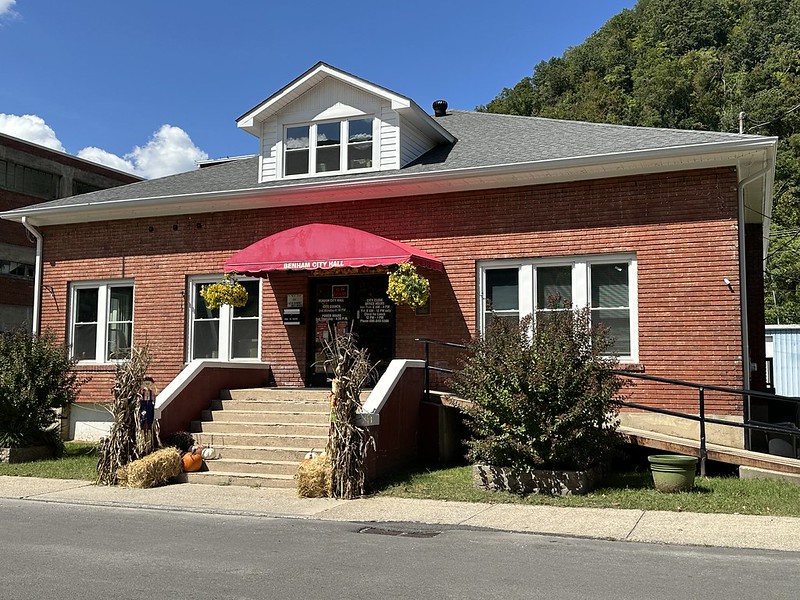
In the middle of Benham, Kentucky, where Looney Creek bends through a narrow valley below Black Mountain, the city hall does not look like a grand marble temple of government. It is a compact red brick office building, one of a ring of matching structures that frame a small park. Coal trucks once rattled past just outside its doors. Miners lined up under its west facing windows on pay day. Today visitors push open the same doors to pay water bills, attend meetings, or walk through a new exhibit about the town’s past.
Benham City Hall is not just a local government building. It began its life as the Wisconsin Steel Company office for a model coal town and later became the seat of a community that fought to keep its history and its water supply intact. Its story ties together corporate planning, coal camp life, and grassroots preservation in one brick structure.
A company town at the foot of Black Mountain
Benham was created in the 1910s by Wisconsin Steel, a subsidiary of International Harvester. Company engineers laid out a planned coal town along Looney Creek, with a central park ringed by public buildings and commercial blocks. The mines fed steel works in South Chicago, and the town was designed to be efficient, modern, and orderly rather than a haphazard cluster of cabins.
By the time the development reached its peak, the cluster around the park included a company store, office building, post office, hospital, theater, school, church, firehouse, jail, meat market, and other service buildings. These structures formed what is now the Benham Historic District, a three acre core that still preserves the early twentieth century town plan and its brick architecture.
The buildings share common commercial design features of the 1920s. The National Register nomination notes their brick walls, decorative stone and brickwork, metal cornices, and patterned panels that gave the small town an appearance of sturdy modernity. Coal camp residents walked past this ring of brick every day on their way to work, the store, school, or church, with the company office sitting in the heart of it all.
Building the Wisconsin Steel office in 1919
The building that would become Benham City Hall went up in 1919 along what is now Kentucky Route 160 at the edge of the park. Contemporary descriptions and later walking tour materials identify it as the International Harvester or Wisconsin Steel company office, built to house the local coal operation’s management.
From the street it presented itself as a practical, confident structure. Historic photographs and recent images show a one and a half story brick building with a raised basement, a broad hipped roof, and symmetrical banks of windows to light the offices inside. A central entrance faces the street, flanked by concrete steps and later accessibility ramps, while the surrounding ridge tops rise steeply behind it.
Although the interior has changed over time, the building was conceived as a working nerve center. Company officials, engineers, and clerks needed office space close to the mine tipples and rail lines, yet just far enough away to sit within the tidy civic core of the town rather than among the dust and noise at the portals.
Sanborn fire insurance maps for Benham recorded this part of town in the 1920s and 1930s, showing the brick office building nestled among the store, post office, and other service structures around the park. The maps captured not only its footprint and materials but also its role as an administrative hub within the company town landscape.
Pay windows and power in a coal camp
During the coal camp years the office building was a place where power was exercised and pay envelopes were handed out. The Kentucky Coal Museum’s historic downtown walking tour describes how the building housed company engineers, managers, and superintendents on its main level, while the upper floor served for a time as the police department.
One detail from the walking tour map hints at how many miners experienced the building. Large windows on its west side served as pay windows. On designated days workers came off shift, lined up outside, and stepped up to the glass where clerks inside slid wages across the sill. For the men who mined the coal and their families who depended on that money, the office building was where the abstract power of Wisconsin Steel became tangible. It was where company decisions about hours, rates, and discipline translated into the contents of an envelope.
Inside, the office recorded the rhythms of the camp: payroll ledgers, production figures, maps and reports, accident notices, and correspondence between Benham and corporate headquarters. Most of those records now survive, if at all, in scattered manuscript collections and municipal files, but the building itself remains as a material record of company administration.
From company office to city hall
Benham remained under company control for decades. When mining declined in the mid twentieth century and ownership shifted, the community had to decide whether it would carry on as an independent town or fade as a coal camp that had outlived its original purpose. By the time Benham incorporated as a city in 1961, the company office building had already stood for more than forty years and was a familiar landmark.
Local histories, the museum’s walking tour, and interpretive materials agree that when the community took on formal municipal status, Wisconsin Steel’s former office was presented to the newly incorporated city for use as city hall. Municipal records from the early 1960s, housed today in Benham City Hall and Harlan County offices, document the transfer and the ordinances that followed as the city established police, utility, and administrative functions inside the old corporate headquarters.
The change symbolized a wider shift in power. The brick building that had once represented a distant corporation now housed elected officials and public servants chosen by Benham residents. The physical structure remained the same, but the decisions made inside it were increasingly local rather than corporate.
Heart of the Benham Historic District
As coal employment faltered during the Great Depression and later decades, Benham’s built core changed less than its payrolls. The ensemble of brick public and commercial buildings around the park still anchored the town. When preservationists and local leaders sought National Register of Historic Places recognition in the early 1980s, the former company office now city hall was one of ten contributing buildings in what became the Benham Historic District.
The district, roughly bounded by KY 160, Central Avenue, McKnight Street, and Cypress Street, encompasses about three acres and includes the old company store, post office, school, hospital, theater, firehouse, meat market, and other structures alongside the park. The National Register listing describes the area’s significance in community planning, development, and industry for the period from about 1900 to 1924, capturing Benham’s years as an exemplar of a planned coal community.
The Kentucky Coal Museum, located in the former company store just down the street from city hall, echoes and reinforces that recognition. Museum interpretive materials and a summary of National Register properties on its website highlight the city hall as a key component of the historic district, noting its 1919 construction as the Wisconsin Steel office and its later adaptation for municipal use.
Preservation, water, and the fight for recognition
In the early twenty first century Benham and neighboring Lynch drew attention from environmental and heritage advocates who argued that their historic character and public water supplies deserved protection from surface mining and other industrial threats. An influential petition filed by Kentuckians for the Commonwealth described the Benham Historic District as a nationally recognized historic and cultural resource, citing its National Register status, boundaries, and period of significance.
For Benham City Hall this meant more than a plaque on the wall. The building functioned as a meeting place where residents, city officials, and outside advocates gathered to discuss land use, water quality, tourism, and economic diversification. The same structure that once housed company executives making decisions about coal now hosted citizens debating how to live with coal’s legacy.
Regional heritage planning efforts, including feasibility studies for a Kentucky Wildlands National Heritage Area, have pointed to Benham and its historic downtown as key examples of coalfield communities with intact early twentieth century architecture and interpretive potential. These studies often mention the downtown walking tour that links the Kentucky Coal Museum, city hall, and other landmarks, encouraging visitors to experience the district as a cohesive landscape.
Telling “The Story of Benham” inside city hall
In recent years the building’s role as a keeper of local memory has grown even stronger. A multi year oral history and exhibit project, spearheaded in part by a former University of Kentucky trustee and her husband, culminated in a permanent installation titled “The Story of Benham” inside city hall.
Coverage by WUKY and regional outlets describes how the exhibit, unveiled in September 2025, fills the interior with interpretive panels, photographs, artifacts, and recorded voices from past and present residents. Visitors can follow a chronological narrative that traces Benham from its founding by Wisconsin Steel through boom years, strikes and shutdowns, school days, and the long process of community survival after the coal company left.
In this way city hall has become a hybrid space. It is still where people come to take care of everyday business, but it is also a museum of sorts where the walls themselves are part of the exhibit. The choice to place “The Story of Benham” in city hall rather than in a separate gallery underscores how closely civic life and historical memory are intertwined in the town.
Reading the building today
To stand on the sidewalk outside Benham City Hall is to look at a century of Appalachian industrial and community history in brick form. Across the park the company store houses the Kentucky Coal Museum. Up the street the former school is now an inn that welcomes heritage tourists. Around the corner, houses built for miners still line the narrow streets. The office that once oversaw a corporate coal operation now holds city records, council minutes, and an exhibit curated by local people who wanted their own version of the story preserved.
Primary sources such as the 1983 National Register nomination, Sanborn fire insurance maps, municipal records, and the Kentucky Coal Museum’s walking tour map fix the basic facts of the building’s chronology and function. Oral histories, contemporary news coverage, and the exhibit inside the building itself add the voices of those who lived and worked in its shadow. Together they show how a simple brick office in a coal camp could become a city hall, a community archive, and a symbol of both the power that built Benham and the people who claimed it as their own.
Sources & Further Reading
Thomason, Philip. “Benham Historic District.” National Register of Historic Places Inventory–Nomination Form. Washington, DC: National Park Service, April 14, 1983. PDF, NPGallery Digital Asset Management System. https://npgallery.nps.gov/GetAsset/cb3927ea-5def-4e52-99d2-d7b29bfccc1a
Kentucky Coal Mining Museum. Historic Downtown Benham Walking Tour Map. Benham, KY: Kentucky Coal Mining Museum, ca. 1990s. PDF brochure. https://kycoalmuseum.southeast.kctcs.edu/media/other/historic-downtown-benham-walking-tour-map.pdf
Kentucky Coal Mining Museum. “Register of Historic Places.” Kentucky Coal Mining Museum website. Excerpts from the 1983 National Register nomination with building descriptions for Benham, including city hall. https://kycoalmuseum.southeast.kctcs.edu/explore/national_register.aspx
Sanborn Map Company. Sanborn Fire Insurance Maps: Kentucky (including sheets for Benham and Lynch, Harlan County), ca. 1920s–1940s. Library of Congress, Geography and Map Division. https://www.loc.gov/collections/sanborn-maps
Kentuckians for the Commonwealth. Petition to Designate the Historic Districts within the Cities of Benham and Lynch and the Viewshed from Those Districts, and the Watersheds that Provide the Water Supply for Those Cities, as Areas Unsuitable for Mining. Ca. 2010s. PDF. https://kftc.org/sites/default/files/docs/resources/harlanlumfinal.pdf
Advisory Council on Historic Preservation. “Benham, Kentucky.” Preserve America Community profile. https://www.achp.gov/preserve-america/community/benham-kentucky
Moore, Sam. “The Town International Harvester Built.” Farm and Dairy, October 20, 2016. https://www.farmanddairy.com/columns/the-town-international-harvester-built/375249.html
McDaniels, Jennifer. “Former UK Trustee and Her Husband Spearhead Benham Coal Camp History Project.” WUKY, October 25, 2025. https://www.wuky.org/wuky-news/2025-10-25/former-uk-trustee-and-her-husband-spearhead-benham-coal-camp-history-project
Author Note: I wrote this piece as part of an ongoing effort to document how Appalachian coal camps turned into lasting communities, one building at a time. My hope is that Benham City Hall’s story helps readers see how a simple brick office can become both a city hall and a keeper of local memory.