
Appalachian Figures Series – The Story of Wallace Jones of Harlan, Kentucky
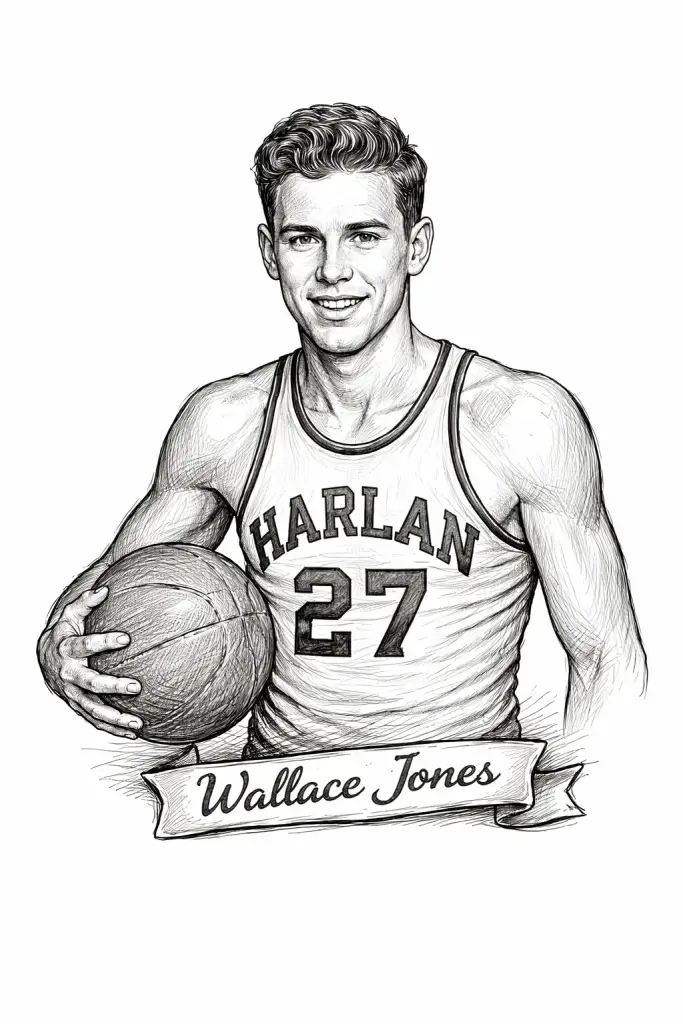
Wallace Clayton “Wah Wah” Jones grew up in a coalfield county seat where the Clover Fork bends under steep hillsides and trains rattled past brick storefronts. In Harlan, Kentucky, he was first a son, brother, and helper in his parents’ boarding house and restaurant before he ever became a legend in green and white or blue and white. By the time his life closed in Lexington in 2014, he had carried Harlan’s name to a state high school title, two NCAA championships, an Olympic gold medal, and a long career in public service and business.
This is the story of how a boy from a mountain restaurant at the edge of a coal town became, in the words of one Kentucky coach, perhaps “UK’s greatest athlete ever,” and how his hometown has kept his name alive on the gym floor and in community memory.
Harlan roots and the nickname “Wah Wah”
Jones was born in Harlan on July 14, 1926, to Hugh and Faye Jones. An obituary written at his death remembers him as “born and raised in Harlan” and notes that as a youngster he helped with chores in his parents’ restaurant and boarding house, which took in boarders under the same roof as the family.
He was not yet “Wah Wah.” Family and friends called him Wallace until his younger sister Jackie, just learning to talk, struggled with his name. The sound she made instead stuck. Local sportswriters and later state sports pages picked up the family nickname, and “Wah Wah” followed him from the Harlan Daily Enterprise box scores to radio broadcasts and national writeups.
Census work and local history show the Jones household as crowded and lively. An article on the family’s older son, Hugh Jr., notes that the 1930 enumeration caught Hugh Sr. managing a restaurant, with Faye, the children, and several boarders under the same roof. Wah Wah grew up in that mix of work, noise, and company, a setting that helps explain why teammates and fans remembered him as a naturally outgoing presence.
Green Dragon glory and a national scoring record
At Harlan High School, Jones became the sort of all-around athlete that small towns talk about for generations. Later summaries of his prep career agree on the broad outlines. He played football, basketball, and baseball for the Harlan Green Dragons and led the school to four consecutive trips to the boys Sweet Sixteen tournament.
Harlan reached the state title game in 1942, falling to Lafayette, then returned in 1944 and finally broke through. Tournament records confirm that Harlan defeated Dayton 40 to 28 in the 1944 championship game at Alumni Gym in Lexington, a win that gave a mountain town its first boys state basketball crown.
Local sportswriters and later historians agree that the centerpiece of that run was the tall junior wearing Green Dragon green. In a retrospective originally written for the fiftieth anniversary of the title team, Harlan County Sports called Jones “a high school legend” and described the 1944 squad as a storybook group that rose from relative obscurity to the top of Kentucky prep basketball.
The numbers bear that out. The Mr. and Miss Kentucky Basketball organization’s Wah Wah Jones Award history credits him with scoring 73 points across four games in the 1944 state tournament, then returning as a senior to push Harlan back to the semifinals. Over his full high school career he amassed 2,398 points, at that time the highest total recorded for a high school player in the nation.
He was not just a scorer. Contemporary accounts and later biographies emphasize that he was all-state in football, basketball, and baseball, a three-sport standout whose recruiting trail ran through more than one coaching office. Tennessee coaches saw an end for their football team. Adolph Rupp saw a forward for his rising Kentucky program. Wah Wah himself later joked that he sometimes was not sure which sport schools were chasing him for.
Choosing Kentucky and playing for Rupp and Bryant
Jones enrolled at the University of Kentucky in 1945. There he became one of the very few athletes in school history to earn varsity letters in football, basketball, and baseball. An overview of his career on Wikipedia and Kentucky record books describes him as twice an All-SEC selection in football, a three-time All-American and four-time All-SEC selection in basketball, and a regular pitcher and first baseman on the baseball team.
He also holds a distinction that will be hard to match. University and award-committee summaries note that he is the only Kentucky player to have his jersey retired in both basketball and football, and that within the Southeastern Conference he stands alone as a recipient of “living legend” honors in both sports.
In later reminiscences, Jones spoke about walking a line between the wishes of his coaches and the pull of the football field. Sports columnist Jamie Vaught recalled him saying that Adolph Rupp would have preferred he focus solely on basketball, while Bear Bryant welcomed him as an end on the football team. The public, Jones suggested, wanted him to play both, and that public pressure helped keep him on the gridiron.
The cumulative record of Kentucky basketball during his four seasons speaks for itself. From 1945 to 1949, the Wildcats went 130 wins against only 10 losses, won the Southeastern Conference each year, and established the foundation of what the university later marketed as “The Greatest Tradition in the History of College Basketball.”
The Fabulous Five, London gold, and the Olympians
Jones is most often pictured in a Kentucky number 27 jersey, standing alongside Ralph Beard, Alex Groza, Cliff Barker, and Kenny Rollins. Together they became known as the Fabulous Five, the core that carried Kentucky to the 1948 NCAA championship and then, with the help of AAU standouts, formed the spine of the United States Olympic team at the London Games.
Olympic histories and basketball references list him as a forward on the American squad that dominated the 1948 tournament, playing most of its games at Harringay Arena, and returned home with gold medals.
He came back to Kentucky and helped Rupp’s Wildcats repeat as NCAA champions in 1949. In all he scored 1,511 points in a Kentucky uniform and averaged roughly nine points per game in college play, strong numbers in an era before the three-point line and modern pace of play.
In 1949, the Washington Capitols selected Jones with the eighth pick in the draft of what was then the Basketball Association of America, soon to merge into the National Basketball Association. Although drafted by Washington, he played his professional career with the Indianapolis Olympians. Basketball-Reference credits him with 1,428 points over three NBA seasons, averaging 10.2 points, 5.1 rebounds, and 3.1 assists per game.
Sheriff, candidate, and charter-bus businessman
Jones returned to Kentucky after his playing days and stepped into public life. An Associated Press obituary and later biographical notes agree that he was elected sheriff of Fayette County in the mid-1950s, remembered as the first Republican to hold that post, serving from 1954 to 1958.
He did not stop at county office. Election returns and biographical sketches note that in 1956 he ran as the Republican nominee for Kentucky’s Sixth District seat in the United States House of Representatives. He lost that race to Democrat John C. Watts, but the campaign marked another way Harlan’s most famous athlete stepped into civic life.
By the late 1970s he had founded Blue Grass Tours, a Lexington-based charter and tour-bus company. His obituary identifies him as its president and notes that former employees remembered him as a hands-on boss. ESPN’s summary of his life points out that Blue Grass Tours became deeply intertwined with Kentucky basketball, transporting Wildcat teams to games and practices long after the player who founded the company had retired from the court.
Family members and friends remembered him as a public figure who still found time for family gatherings, children’s and grandchildren’s games, golf rounds, and church activities at Immanuel Baptist Church in Lexington.
“UK’s greatest athlete ever” and a Harlan ambassador
Jones died in Lexington on July 27, 2014, at age eighty-eight after a fall and short illness. Obituaries in the Harlan Daily Enterprise, Lexington Herald-Leader, and national outlets all stressed the same themes: his Harlan upbringing, his dual All-America status under Rupp and Bryant, his Olympic gold medal, and his reputation as one of Kentucky’s greatest all-around athletes.
Kentucky coach John Calipari publicly called him “arguably the greatest UK athlete,” a phrase that echoed through later tributes and local reminiscences.
Back in Harlan, writers and fans remembered not only the banners, but the way he carried the town’s name into rooms where coalfield counties were often stereotyped or dismissed. One Harlan Daily Enterprise remembrance called him “a proud Harlan County native,” while comments on his obituary recalled that he brought “pride and dignity back to our county” at a time when outside writers and broadcasters dwelled on the worst stories of the coalfields.
That local pride became visible again in early 2022, when Harlan High School dedicated its gym floor in his honor. WYMT reported on the ceremony, noting that school leaders formally named the court the Wallace “Wah Wah” Jones Gymnasium and that his children and other family members joined the crowd. The district superintendent told the audience that one could argue Jones’s multi-sport career would never be matched, and cited John Calipari’s description of him as UK’s greatest athlete. Jones’s son, also named Wallace, emphasized that his father remained deeply proud of his Harlan County roots and served as an ambassador for the county wherever he went.
Listening to Wah Wah himself
For historians, some of the richest sources on Jones’s life are recordings where he speaks in his own voice. The Louie B. Nunn Center for Oral History at the University of Kentucky holds at least two interviews with him, including a 2009 session in the “Men’s Basketball Oral History Project” and a later interview in the Claude Sullivan project.
In those and in other interviews, such as one sportswriter Jamie Vaught conducted for his book “Crazy About the Cats,” Jones looked back on his Harlan childhood, his parents’ boarding house, the choice between Kentucky and Tennessee, and life under coaches Rupp and Bryant. He talked about the strain of playing multiple sports at a time when practice and travel demands were growing, and about the support he received from fans and family as he juggled it all.
For researchers, those recordings are primary sources in the strongest sense: we hear his cadence, his jokes, and his own assessment of a life that stretched from Depression-era Harlan to the age of televised Kentucky basketball and modern college athletics.
Legacy in the mountains and beyond
Wallace “Wah Wah” Jones today stands at the intersection of several traditions. In Harlan he is the boy who once broke his older brother’s scoring records, led the Dragons to a state championship, and appeared in four Sweet Sixteens. In Lexington he is the only Wildcat with jerseys retired in both football and basketball, a forward on the Fabulous Five teams that opened Kentucky’s string of national titles, and a charter-bus owner who kept turning up around the program decades after his last game.
At the statewide level, he is now the namesake of the Wah Wah Jones Award, presented annually to a Kentucky high school senior who excels in multiple sports and embodies the traits of an all-around student-athlete. The award’s own biography of Jones reminds nominees that he once held the national high school scoring record, played three varsity sports at Kentucky, and remained widely respected for his sportsmanship.
For Appalachian historians, he offers a different sort of figure than the familiar miner, ballad singer, or labor organizer. Jones was a coalfield son who carried the name of Harlan into Olympic arenas, NBA box scores, sheriff’s offices, and tourism brochures. His life invites questions about mobility, class, and regional identity in the twentieth century: what did it mean for a Harlan boy to become a national star yet keep returning to the town and county that shaped him.
Those questions are best explored with the primary sources in hand: oral history recordings at the Nunn Center, the 1940 census and Harlan vital records, school yearbooks and state tournament programs, photographs in the Kentucky Photo Archive and local newspapers, and the election returns and business records that followed his public career. Taken together, they show a life that connected a crowded mountain boarding house, a roaring London arena, and a hometown gym floor that now carries his name.
Sources & Further Reading
University of Kentucky Louie B. Nunn Center for Oral History. “Interview with Wallace Clayton ‘Wah Wah’ Jones, September 30, 2009.” University of Kentucky Athletics: Men’s Basketball Oral History Project. Interview by Arthur Rouse. Lexington, KY. Audio and transcript. Accessed December 27, 2025. https://kentuckyoralhistory.org/ark:/16417/xt72jm23f50j
University of Kentucky Louie B. Nunn Center for Oral History. “Interview with Wallace Clayton ‘Wah Wah’ Jones, November 30, 2010.” Claude Sullivan Oral History Project. Lexington, KY. Audio and transcript, accession 2011oh171_cs003. Accessed December 27, 2025. http://kentuckyoralhistory.net/ark:/16417/xt716d71hrh2q
FamilySearch. “Wallace Clayton Jones (1926–2014).” FamilySearch Family Tree. Accessed December 27, 2025. https://www.familysearch.org
WikiTree. “Wallace Clayton ‘Wah-Wah’ Jones (1926–2014).” WikiTree: The Free Family Tree. Accessed December 27, 2025. https://www.wikitree.com/wiki/Jones-134895
Find a Grave. “Wallace Clayton ‘Wah Wah’ Jones.” Find a Grave Memorial. Created 2014. Accessed December 27, 2025. https://www.findagrave.com
“Wallace ‘Wah Wah’ Jones.” Legacy.com (Lexington Herald-Leader obituary), July 30, 2014. Accessed December 27, 2025. https://www.legacy.com/us/obituaries/kentucky/name/wallace-jones-obituary?pid=171883730
Anderson-Laws & Jones Funeral Home. “Wallace ‘Wah Wah’ Clayton Jones Obituary.” Anderson-Laws & Jones Funeral Home, Harlan, Kentucky, July 27, 2014. Accessed December 27, 2025. https://www.aljfh.com/obituaries/wallacewahwah-jones
Tipton, Jerry, and Beth Musgrave. “Legendary UK Basketball and Football Star ‘Wah Wah’ Jones Dies.” Lexington Herald-Leader, July 27, 2014. Accessed December 27, 2025. https://www.kentucky.com/sports/college/mens-basketball/article44499756.html
“ ‘Wah Wah’ Jones Passes Away.” UKAthletics.com. University of Kentucky Athletics, July 28, 2014. Accessed December 27, 2025. https://ukathletics.com/news/2014/07/28/55aeeeffe4b05936b846d8ea-131467908249058430
“Kentucky Legend Wallace ‘Wah Wah’ Jones Dies at 88 Years Old.” NCAA.com, July 29, 2014. Accessed December 27, 2025. https://www.ncaa.com/news/basketball-men/article/2014-07-28/kentucky-legend-wallace-wah-wah-jones-dies-88-years-old
“Wallace ‘Wah Wah’ Jones Dies.” ESPN.com, July 29, 2014. Accessed December 27, 2025. https://www.espn.com/mens-college-basketball/story/_/id/11281579/kentucky-wildcats-great-wallace-wah-wah-jones-dies-88
Martin, Douglas. “Wah Wah Jones, Versatile Kentucky Athlete, Dies at 88.” The New York Times, July 28, 2014. Accessed December 27, 2025. https://www.nytimes.com/2014/07/29/sports/basketball/wah-wah-jones-versatile-kentucky-athlete-dies-at-88.html
“ ‘His Life Was UK’: Friends, Fans Pay Tribute to ‘Wah Wah’ Jones.” Lexington Herald-Leader, August 1, 2014. Accessed December 27, 2025. https://www.kentucky.com/sports/college/kentucky-sports/uk-basketball-men/article44500539.html
“Wallace Jones.” Basketball-Reference.com. Sports Reference LLC. Accessed December 27, 2025. https://www.basketball-reference.com/players/j/joneswa01.html
“UK Career Statistics and Bio for Wallace Jones.” BigBlueHistory.net. Accessed December 27, 2025. https://www.bigbluehistory.net/bb/statistics/Players/Jones_Wallace.html
“27 Wallace Jones.” WildcatWorld.com. Accessed December 27, 2025. https://www.wildcatworld.com/player/wallace-jones/
“Awards and Honors: Olympic Gold Medal Winners.” WildcatWorld.com. Accessed December 27, 2025. https://www.wildcatworld.com/kentucky-basketball-history/awards-and-honors/
“Wallace Jones.” Wikipedia. Last modified 2024. Accessed December 27, 2025. https://en.wikipedia.org/wiki/Wallace_Jones
“List of Olympic Medalists in Basketball.” Wikipedia. Accessed December 27, 2025. https://en.wikipedia.org/wiki/List_of_Olympic_medalists_in_basketball
“Wallace Jones – United States of America.” FIBA.basketball, Men’s Olympic Basketball Tournament 1948 player profile. Accessed December 27, 2025. https://www.fiba.basketball/history/playerprofile/Wallace-Jones
“Competition Stats – Olympic Games: Tournament for Men (London 1948).” FIBA.basketball. Accessed December 27, 2025. https://www.fiba.basketball/history/metro/320-mens-olympic-basketball-tournament/2528/stats
“USA Men’s Olympic Basketball Jersey Numbers and Players.” Sportskeeda, January 4, 2025. Accessed December 27, 2025. https://www.sportskeeda.com/basketball/usa-olympic-basketball-jersey-numbers
Office of the Clerk, U.S. House of Representatives. Statistics of the Congressional Election of November 6, 1956.Washington, DC: U.S. Government Printing Office, 1957. PDF. Accessed December 27, 2025. https://clerk.house.gov/member_info/electionInfo/1956election.pdf
“1956 United States House of Representatives Elections – Kentucky 6th District.” Wikipedia. Accessed December 27, 2025. https://en.wikipedia.org/wiki/1956_United_States_House_of_Representatives_elections
“1958 United States House of Representatives Elections – Kentucky 6th District.” Wikipedia. Accessed December 27, 2025. https://en.wikipedia.org/wiki/1958_United_States_House_of_Representatives_elections
“1958 U.S. House Election Results for Kentucky (District 06).” RightDataUSA.com. Accessed December 27, 2025. https://rightdatausa.com/election_results?d=06&s=KY&t=H&y=1958
“1956 House Candidates Get 2.5 Million, Spend 2.9 Million.” CQ Almanac 1957. Washington, DC: CQ Press, 1958. CQ Press Library. Accessed December 27, 2025. https://library.cqpress.com/cqalmanac/document.php?id=cqal57-1347162
“Wildcat Legend: Wah Wah Jones.” Harlan Enterprise, June 11, 2020. Accessed December 27, 2025. https://www.harlanenterprise.net
Vaught, Jamie H. “Jones Remembered as Three-Sports Standout at UK.” Harlan County Sports, May 31, 2020. Accessed December 27, 2025. https://harlancountysports.com/1099/harlan-county-history/jones-remembered-as-three-sports-standout-at-uk/
“Harlan High’s Gymnasium Pays Tribute to School’s Most Decorated Athlete.” Winchester Sun, February 15, 2022. Accessed December 27, 2025. https://winchestersun.com/2022/02/15/harlan-highs-gymnasium-pays-tribute-to-schools-most-decorated-athlete/
“Harlan, Kentucky’s, Wallace ‘Wah Wah’ Jones (07/14/1926–07/27/2014).” WildcatCountry Big Blue Nation. Facebook post. Accessed December 27, 2025. https://www.facebook.com/WildcatCountryBigBlueNation/posts/1169116695258824/
Author Note: As a Kentucky historian and lifelong fan of mountain basketball, I grew up knowing the name Wallace “Wah Wah” Jones almost before I understood the game itself. I always heard stories of Wah Wah from my father, who loves high school hoops and talked about that 1944 Harlan team the way other dads talk about the ’96 Wildcats. Writing this piece is my way of putting those family stories in conversation with the archival record, so that Harlan’s greatest Dragon is remembered on the page as well as in the gym.