
Appalachian Figures Series – The Story of Bob Wright of Pike, Kentucky
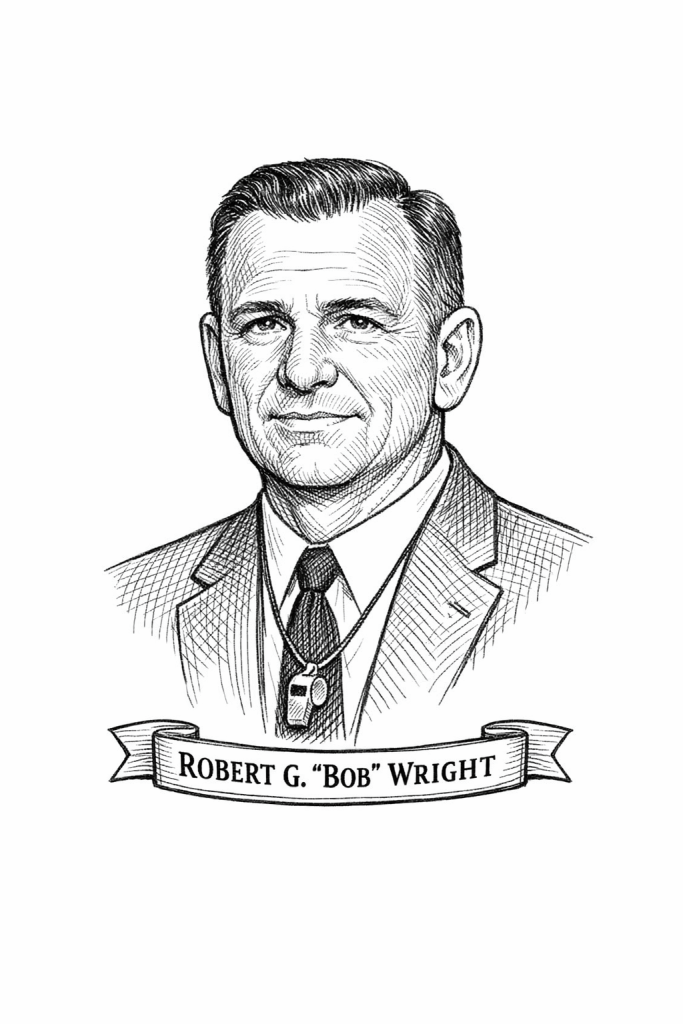
Robert G. “Bob” Wright spent much of his life moving between the classrooms and basketball courts of Appalachia, but the places attached to his story stretched across several distinct chapters of Kentucky and West Virginia sports history. He played championship basketball at Marshall University, built his coaching reputation at Vanceburg, led Ashland to one of the finest seasons in Kentucky high school basketball history, and took Morehead State to a share of an Ohio Valley Conference championship. Later, he returned to the work of education and became principal of Millard High School in Pike County.
When Wright died at Pikeville Medical Center on April 15, 2012, at the age of eighty-six, his funeral was held five days later at the old Millard High School. It was a fitting setting for a man whose life had been shaped by schools, gymnasiums, players, and communities. His obituary remembered him not only for the family he left behind and his service in the United States Navy, but also simply as the retired principal of Millard High School.
From Elkhorn City to a World at War
Wright belonged to a generation of Appalachian athletes whose young lives were interrupted by World War II. He was born on March 31, 1926, to Daniel Wright and Adeline Johnson Wright, and his early basketball years were connected to Elkhorn City in Pike County. The Kentucky High School Athletic Association records Elkhorn City as the champion of the 15th Region in 1944, placing the school among Kentucky’s sixteen regional winners and sending it to the state tournament.
Elkhorn City defeated McHenry 48-40 in the opening round of the 1944 state tournament before meeting a powerful Harlan team in the quarterfinals. Harlan defeated Elkhorn City 37-27 and went on to win the state championship, beating Dayton 40-28 in the final. The appearance placed Wright’s high school career within a particularly strong era of mountain basketball, when schools such as Elkhorn City, Harlan, Hindman, Inez, and other small Appalachian programs regularly competed on the statewide stage.
Soon afterward, basketball gave way to military service. Wright served in the United States Navy from 1944 until 1946, with contemporary Morehead State biographical material later noting that he saw duty in both the Atlantic and Pacific. His obituary likewise recorded his honorable Navy service during World War II.
A National Championship at Marshall
When Wright returned from military service, his basketball career carried him across the Tug Fork and into Huntington, West Virginia, where he joined Marshall College and played for the legendary Cam Henderson. He was talented enough to participate in both football and basketball, but it was on the basketball floor that he became part of one of the great teams in Marshall history.
As a freshman, Wright helped Marshall win the 1947 NAIB National Tournament. Marshall’s Hall of Fame records state that he appeared in all five tournament games during a demanding six-day championship run. The following season, Wright helped the team win the Helms Foundation Los Angeles Invitational with a victory over Syracuse and return to the national tournament, where Marshall again reached the quarterfinals.
After his sophomore year, Wright gave up football and concentrated on basketball. His role continued to grow until he became a team captain, and by the end of his Marshall career he had scored 1,019 points. During his senior season he averaged 19.5 points per game, led the Thundering Herd in scoring, and was selected as Marshall’s outstanding athlete for 1949-50. He earned his bachelor’s degree from Marshall in 1950. Decades later, Marshall formally recognized that career by inducting him into its Athletic Hall of Fame in 2010.
The Marshall years mattered for more than Wright’s statistics. He had played for Henderson, one of the most influential coaches in the region, and he had experienced championship basketball firsthand. By the time Wright entered coaching, he understood both the demands of high-level competition and the possibilities that basketball could create for young people coming from Appalachian communities.
Building a Coaching Career at Vanceburg
Wright’s first long chapter as a head coach came at Vanceburg High School in Lewis County, Kentucky. The surviving season-by-season records maintained by Lewis County Schools provide an unusually detailed picture of those years. Wright coached Vanceburg to a 19-15 record in 1950-51 and a 17-16 record the following season, with both teams finishing as district runners-up. In 1952-53, his team improved to 26-11 and advanced all the way to the 16th Region championship game.
That regional runner-up finish was an important step in Wright’s development as a coach. He remained at Vanceburg for the 1953-54 season, then returned to the program for three more seasons beginning in 1956-57. His 1957-58 team finished 21-9, while the 1958-59 club went 21-6 and again finished as a district runner-up. The record shows a coach steadily building experience in the small-school basketball culture that defined much of Kentucky at the time.
There was also an interesting connection between Vanceburg and what came next. Wright’s 1952-53 team had reached the 16th Region final but failed to advance to the state tournament. Within several years he would be coaching Ashland, one of the region’s traditional powers, and the lessons accumulated at Vanceburg would be carried onto a much larger stage.
Ashland and the Road to the 1961 State Championship
Wright’s move to Paul G. Blazer High School in Ashland transformed his reputation from that of a successful regional coach into that of a state champion. Morehead State later credited him with a remarkable 168-29 record during five seasons at Ashland. His teams were not simply winning games. They became part of a basketball tradition that had already made Ashland one of Kentucky’s best-known high school programs.
The defining season came in 1960-61. Ashland entered the state tournament with one of Kentucky’s strongest teams and completed the year with a 36-1 record. The KHSAA tournament records preserve the path through Lexington. Wright’s Tomcats defeated Covington Grant 83-66 in the opening round, then overwhelmed Seneca 77-51 in the quarterfinals.
The semifinal matched Ashland with Wheelwright, another eastern Kentucky program and the champion of the 15th Region. The result was one of the highest-scoring games of the tournament, with Ashland prevailing 91-80. That victory placed Wright and the Tomcats opposite Lexington Dunbar in the championship game at Memorial Coliseum.
Ashland won the state championship decisively, defeating Dunbar 69-50. The victory completed the 36-1 season and placed Wright permanently within the history of Kentucky high school basketball. Contemporary KHSAA publications celebrated the Ashland team immediately afterward, while later official tournament records continued to identify Wright alongside the school’s 1961 championship.
Wright’s Ashland program did not disappear after the championship celebration. In 1962, the Tomcats returned to the state tournament and again advanced to the championship game. They defeated Newport 61-57, Earlington 68-64, and Caneyville 73-49 before meeting St. Xavier in the final at Freedom Hall. St. Xavier won 62-58, leaving Ashland as state runner-up only a year after Wright had taken the school to the title.
Among the players Wright helped develop at Ashland was Harold Sergent, who later became an All-American and Morehead State Athletic Hall of Fame member. Wright was therefore doing more than accumulating victories. His high school program was preparing players for college basketball, just as his own years in Pike County had once opened the road toward Marshall.
Morehead State Comes Calling
By the middle of the 1960s, Wright had little left to prove as a high school basketball coach. Morehead State College turned to him in 1965, giving him the opportunity to move into NCAA basketball while remaining in eastern Kentucky. A Morehead State press release from that summer identified Robert Wright as an instructor in physical education and the institution’s head basketball coach. He already had a connection to the college, having earned his master’s degree from Morehead in 1961.
Morehead’s own publications treated the hiring as significant. The Morehead Alumnus described Wright as one of the most successful young high school coaches in Kentucky history, while the student newspaper, The Trail Blazer, introduced a coach who made clear that he intended to approach the new job with the same competitive expectations that had marked his high school career. The university’s 1965-66 basketball publication supplied reporters and supporters with an extensive biography of the new coach, preserving information about his playing career, military service, and rise through Kentucky basketball.
The move placed Wright in a different basketball world. At Ashland, he had been responsible for one of Kentucky’s most celebrated high school programs. At Morehead, he had to recruit college players, compete throughout the Ohio Valley Conference, and build a team capable of contending against established university programs.
The Eagles and the 1969 OVC Championship
Wright coached Morehead State for four seasons, beginning with the 1965-66 campaign and continuing through 1968-69. Across those four years, his teams compiled a 58-38 record. The strongest season came at the end, when the 1968-69 Eagles finished 18-9 and earned a share of the Ohio Valley Conference championship.
Those Eagles were also remembered for the pace at which they played. Morehead State reports that Wright’s final team averaged more than ninety points per game. During his four seasons as head coach, Morehead surpassed 100 points fourteen times. It was an aggressive offensive identity that stood in contrast to the lower-scoring basketball of the era in which Wright himself had first reached the Kentucky state tournament.
Wright also coached a notable collection of Morehead players. The group included Lamar Green, Willie “Hobo” Jackson, Howard Smith, and Bruce King, remembered collectively in Morehead basketball history as the “Birmingham Four.” He also coached Ron Gathright and two-time All-OVC selection Jerry Conley. Several of Wright’s players remained prominent in Morehead’s historical rebounding records decades afterward.
The 1969 conference title gave Wright a second major championship accomplishment as a head coach. Eight years after Ashland had stood atop Kentucky high school basketball, Wright had guided a university team to the top of the Ohio Valley Conference standings.
Leaving the Sideline Without Leaving Education
The end of Wright’s tenure as Morehead State’s head coach did not mean an immediate end to his career in education. The surviving university records help clarify what happened next. Minutes of the Morehead State University Board of Regents from September 11, 1969, identify Robert Wright as an assistant professor of Health, Physical Education and Recreation, effective September 1 of that year.
That record is important because Wright’s life can easily be reduced to a sequence of basketball achievements: national champion as a Marshall player, Kentucky champion at Ashland, and OVC co-champion at Morehead State. His career, however, remained tied to education after his days as a college head coach ended.
The surviving sources are much less detailed about the chronology of Wright’s later administrative career than they are about his basketball years. What can be established firmly is that he eventually became principal of Millard High School in Pike County and retired from that position. His obituary identified him specifically as the retired Millard High School principal, bringing his public career back to the part of eastern Kentucky closely associated with his earlier life.
Back in Pike County at Millard
Millard gave Wright’s story a final Appalachian setting far removed from the national tournament at Marshall or the championship floor at Memorial Coliseum. Here he was remembered not primarily as the coach standing beside a college bench, but as an educator and school administrator.
That distinction matters because schools in eastern Kentucky have historically served as far more than places where classes were held. Their gymnasiums were gathering places, basketball teams became sources of community identity, and teachers, coaches, and principals often occupied overlapping roles in local life. Wright’s own career crossed all of those worlds.
His family life was also rooted in the region. Wright was married to Barbara Thornbury Wright and was a member of the Zebulon Church of Christ. His obituary recorded family connections extending through Pike County and eastern Kentucky, including a sister living in Elkhorn City and a brother in Mouthcard.
On April 15, 2012, Wright died at Pikeville Medical Center. His funeral was scheduled for April 20 at the old Millard High School, the building that represented the final major chapter of his professional life.
A Career That Connected Appalachian Basketball
It is difficult to place Bob Wright’s life within only one community because his career connected so many of them. Elkhorn City represented his early eastern Kentucky basketball world. Huntington gave him a national championship and a place in Marshall’s athletic history. Vanceburg gave him the opportunity to learn the demands of head coaching. Ashland made him a Kentucky state champion. Morehead State made him an Ohio Valley Conference champion. Millard brought him back into the daily work of educating young people in Pike County.
His achievements were significant even when separated from one another. Playing in every game of Marshall’s 1947 national tournament championship run would have been enough to secure a place in the history of that program. Coaching a 36-1 Ashland team to the 1961 Kentucky championship would have been enough to make him a notable figure in the state’s basketball history. Guiding Morehead State to the 1969 OVC co-championship added another achievement that few coaches could match.
Taken together, however, those accomplishments tell a broader Appalachian story. Wright belonged to an era when basketball connected small mountain schools to larger institutions and when a player from an eastern Kentucky high school could move through military service, college athletics, public education, and major coaching positions without ever becoming completely separated from the region that had shaped him.
Marshall recognized that legacy by inducting Wright into its Athletic Hall of Fame in 2010. Two years later, when his life ended, the final gathering was not held at a college arena or one of the famous courts on which he had coached. It was held at the old Millard High School in Pike County. For a man who had spent so much of his life in schools and gymnasiums, the location quietly completed the journey.
Sources & Further Reading
Lucas & Son Funeral Home. “Robert G. (Bob) Wright Obituary.” April 15, 2012. https://www.lucasandsonfh.com/obituaries/1455990.
Kentucky High School Athletic Association. The Kentucky High School Athlete. April 1961. Lexington, KY: Kentucky High School Athletic Association, 1961. https://khsaa.org/media-reports-stats-pubs/publications/athlete-magazine/.
Kentucky High School Athletic Association. The Kentucky High School Athlete. May 1961. Lexington, KY: Kentucky High School Athletic Association, 1961. https://encompass.eku.edu/cgi/viewcontent.cgi?article=1068&context=athlete.
Kentucky High School Athletic Association. The Kentucky High School Athlete. April 1962. Lexington, KY: Kentucky High School Athletic Association, 1962. https://khsaa.org/media-reports-stats-pubs/publications/athlete-magazine/.
Kentucky High School Athletic Association. The Kentucky High School Athlete. May 1962. Lexington, KY: Kentucky High School Athletic Association, 1962. https://khsaa.org/media-reports-stats-pubs/publications/athlete-magazine/.
Kentucky High School Athletic Association. 2011 PNC/KHSAA Boys’ Sweet Sixteen Media Notes. Lexington, KY: Kentucky High School Athletic Association, 2011. https://khsaa.org/basketball/boys/sweet16/2011/medianotes.pdf.
Kentucky High School Athletic Association. KHSAA Boys’ Sweet 16 Basketball Record Book. Lexington, KY: Kentucky High School Athletic Association. https://khsaa.org/records/basketball/bbk-recordbook_sweet16records.pdf.
Fields, Mike. “Ashland Tomcats Basketball ‘Is Our Community.’” Kentucky High School Athletic Association, January 8, 2020. https://khsaa.org/ashland-tomcats-basketball-is-our-community/.
Lewis County Schools. “Boys Basketball Season by Season.” Vanceburg, KY: Lewis County Schools. https://www.lewis.kyschools.us/Downloads/Boys_Basetball-season-by-season.pdf?v=-8.
Morehead State College. The Trail Blazer. Vol. 33, no. 15. May 18, 1965. Morehead, KY: Morehead State College. https://scholarworks.moreheadstate.edu/context/trail_blazer/article/1690/viewcontent/1965_5_18.pdf.
Morehead State College. Morehead Alumnus. Fall 1965. Morehead, KY: Morehead State College, 1965. https://scholarworks.moreheadstate.edu/context/msu_alumni_association/article/1008/viewcontent/1965_v3_1.pdf.
Morehead State University. “1965 July.” Morehead State University Press Release Archive. July 1965. https://scholarworks.moreheadstate.edu/cgi/viewcontent.cgi?article=1049&context=msu_press_release_archive.
Morehead State University, Office of Athletics. 1965-66 Basketball at Morehead State College. Morehead, KY: Morehead State College, 1965. https://scholarworks.moreheadstate.edu/cgi/viewcontent.cgi?article=1185&context=msu_sports_programs.
Ohio Valley Conference. 1965-66 Basketball Ohio Valley Conference. 1965. Morehead State University ScholarWorks. https://scholarworks.moreheadstate.edu/msu_sports_programs/.
Morehead State University, Office of Athletics. 1966-67 Basketball Morehead State University. Morehead, KY: Morehead State University, 1966. https://scholarworks.moreheadstate.edu/msu_sports_programs/188/.
Morehead State University, Office of Athletics. MSU vs. Rio Grande College. Official basketball program, December 8, 1966. Morehead State University Special Collections and Archives. https://scholarworks.moreheadstate.edu/cgi/viewcontent.cgi?article=1135&context=msu_sports_programs.
Morehead State University, Office of Athletics. MSU vs. Middle Tennessee. Official basketball program, February 20, 1967. https://scholarworks.moreheadstate.edu/cgi/viewcontent.cgi?article=1138&context=msu_sports_programs.
Morehead State University, Office of Athletics. MSU vs. Tennessee Tech. Official basketball program, February 25, 1967. https://scholarworks.moreheadstate.edu/cgi/viewcontent.cgi?article=1139&context=msu_sports_programs.
Morehead State University, Office of Athletics. 1967-68 Basketball at Morehead State University. Morehead, KY: Morehead State University, 1967. https://scholarworks.moreheadstate.edu/msu_sports_programs/423/.
Morehead State University, Office of Athletics. 1968-1969 Morehead State Basketball. Morehead, KY: Morehead State University, 1969. https://scholarworks.moreheadstate.edu/msu_sports_programs/396/.
Morehead State University Board of Regents. “Minutes of the Board of Regents, September 11, 1969.” Morehead, KY: Morehead State University, 1969. https://scholarworks.moreheadstate.edu/cgi/viewcontent.cgi?article=1238&context=msu_board_of_regents_minutes.
Morehead State University, Office of Athletics. 1972-73 Basketball Morehead State University. Morehead, KY: Morehead State University, 1972. https://scholarworks.moreheadstate.edu/context/msu_sports_programs/article/1201/viewcontent/1972_1973_Basketball.pdf.
Morehead State University Athletics. “Former Eagle Men’s Basketball Coach Bob Wright Passes Away.” April 17, 2012. https://msueagles.com/news/2012/4/17/MBB_0417124926.aspx.
Marshall University Athletics. “Bob Wright.” Marshall Athletics Hall of Fame. Class of 2010. https://herdzone.com/honors/marshall-athletics-hall-of-fame/bob-wright/248.
Marshall University Athletics. “Marshall Athletic Hall of Fame to Induct Nine New Members.” May 10, 2010. https://herdzone.com/news/2010/5/10/Marshall_Athletic_Hall_Of_Fame_To_Induct_Nine_New_Members.
Burns, Fred. “Marshall Championship Team at Kansas City, 1947.” Photograph. Eli Camden Henderson Papers, Marshall University Archives and Special Collections, 1947. https://mds.marshall.edu/cam_henderson_papers/118/.
Marshall University Archives and Special Collections. “Team Autographed Photo of National Championship Marshall Team, 1947.” Eli Camden Henderson Papers, 1947. https://mds.marshall.edu/cam_henderson_papers/116/.
Marshall University Athletics. Marshall Men’s Basketball Fact Book. Huntington, WV: Marshall University. https://s3.us-east-2.amazonaws.com/sidearm.nextgen.sites/herdzone.com/documents/2021/11/15/MBBFactBook_2021_22_UPDATED.pdf.
Maynard, Mark. Teamwork: Ashland’s 1961 Championship Basketball Season. Ashland, KY: Jesse Stuart Foundation, 2011. https://jsfbooks.com/product/teamwork-ashlands-1961-championship-basketball-season/.
Author Note: Bob Wright’s career connected some of the most important basketball communities in Appalachia, from Pike County and Marshall to Ashland and Morehead. I hope this article helps preserve not only his championships, but also his long service to the schools and communities of the region.