
Appalachian Churches Series – Pikeville United Methodist Church: Faith, Division, Reunion, and a Main Street Landmark
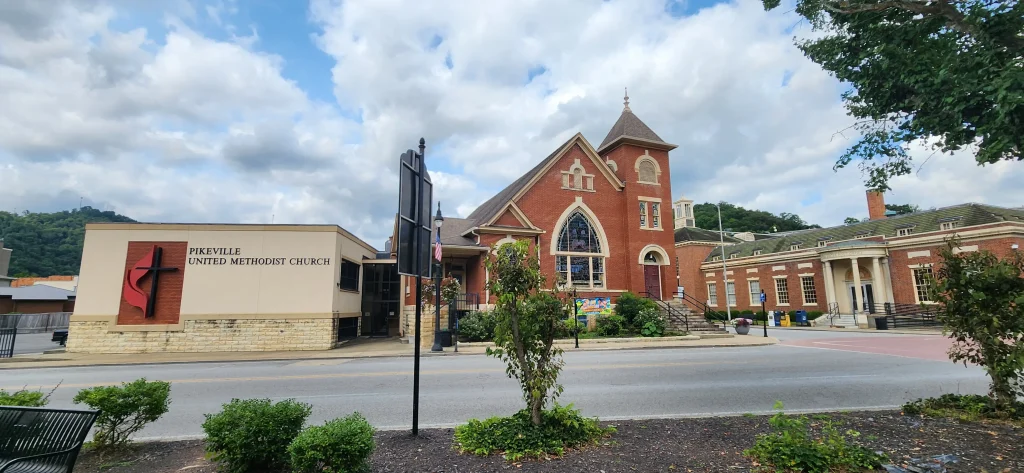
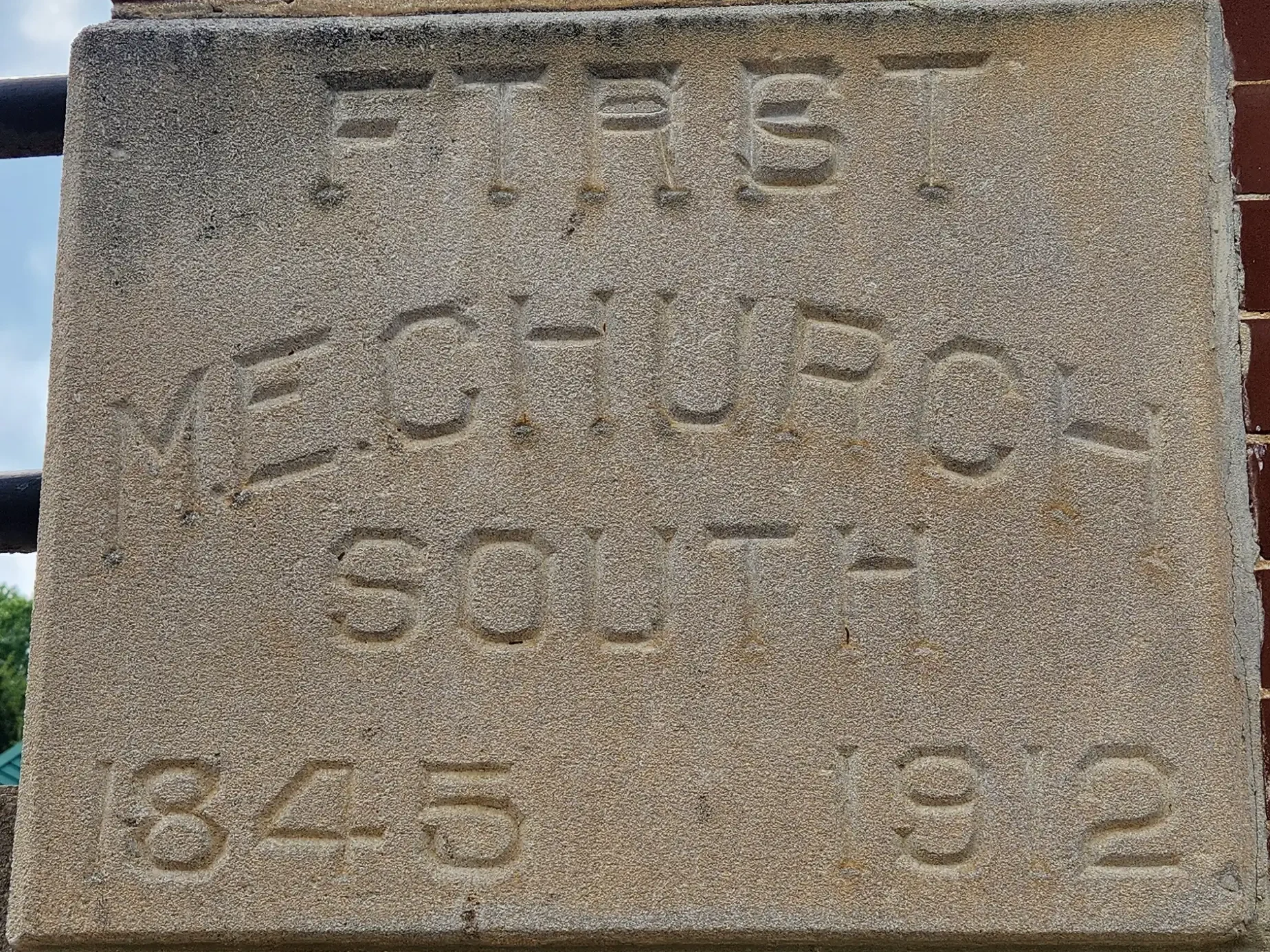
In the middle of downtown Pikeville, where Main Street passes the courthouse and the buildings of the modern city rise against the surrounding hills, one of the clearest surviving records of nineteenth-century Methodism in eastern Kentucky is written directly into stone. At the base of Pikeville United Methodist Church, a weathered cornerstone reads, “FIRST METHODIST CHURCH SOUTH,” followed by two dates, 1845 and 1912.
Those dates tell only part of the story. Behind them is a congregation born during one of the great divisions in American Methodism, an unusual church building once shared with Pikeville’s Masonic lodge, a preacher who spent years helping complete that earlier house of worship, an old sanctuary that was even remembered as serving temporarily as a courthouse, and a surprisingly early effort by Pikeville Methodists to heal the division between northern and southern branches of the denomination.
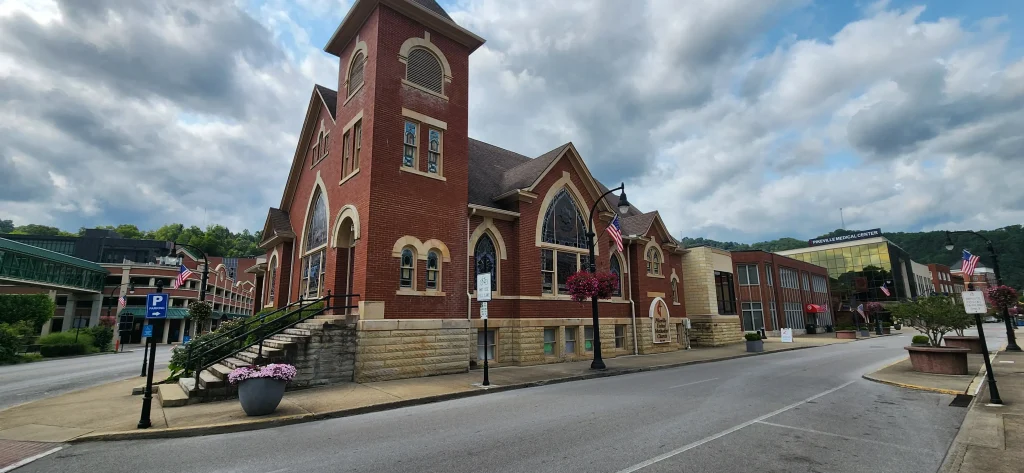
The present red brick sanctuary, now incorporated into Pikeville United Methodist Church at 107 Main Street, has stood since 1912 and was formally dedicated in 1913. Its Gothic windows and square tower have watched downtown Pikeville change around it for more than a century, but documentary records reach considerably farther back. They place the beginning of the congregation in the middle of the 1840s, when the Methodist Episcopal Church itself had fractured over slavery and sectional conflict.
A Church Born from the Methodist Division
The year 1845 carved into the Pikeville cornerstone was a significant one for American Methodism. At the Methodist Episcopal Church’s General Conference of 1844, conflict concerning slavery and the role of slaveholding Bishop James Osgood Andrew contributed to a sectional break. Southern Methodists moved toward a separate organization, the Methodist Episcopal Church, South, which became the denomination represented for decades by the Pikeville congregation.
A historical inventory prepared for Pikeville’s National Register documentation gives 1845 as the founding date of Pikeville United Methodist Church. That date is supported physically by the cornerstone that remains on the sanctuary today. A much earlier description, published in The Big Sandy News in 1913, did not give an exact year but stated that the Methodist Episcopal Church, South had been organized in Pikeville “soon after” the Methodist division of 1844. Taken together, the cornerstone, the preservation record, and the contemporary newspaper account make 1845 a strong date for the beginning of the congregation.
The 1913 account looked back on the church’s first generations with a mixture of pride and realism. Not every period had been prosperous, the pastor acknowledged. There had nevertheless been conversions, generations of members had worshiped and died within the congregation, and what the newspaper called the “faithful few” had kept the church alive until better days arrived. By 1913, the pastor could describe a healthy membership, an active Sunday school, and considerable opportunity for continued work in Pikeville.
That language is particularly valuable because it came from the congregation itself rather than from a later commemorative history. It suggests that the church’s nineteenth-century survival was not a simple story of uninterrupted growth. Like many Appalachian congregations, it depended upon relatively small groups of committed members who continued meeting, raising money, receiving itinerant ministers, and rebuilding institutional strength across several decades.
The Methodist Church and the Masons
One of the most unusual chapters in Pikeville Methodist history concerns the building that preceded the present sanctuary.
The Kentucky Historic Resources Inventory identifies a structure on Main Street as Site PiP 20, historically known as both the Masonic Building and Methodist Church. According to the preservation survey, trustees of the Methodist Episcopal Church, South and representatives of Masonic Lodge No. 375 acquired a new brick building from W. M. Connally in 1885. The Methodists occupied the first floor while the Masonic lodge used the second.
The arrangement was substantial enough that the preservation survey described the property as Pikeville’s first “condominium.” More importantly, the survey states that the 1885 deed protected both organizations’ rights to the property, giving them freedom of access and making provisions for rebuilding should the structure be lost. The records name Methodist trustees including J. M. Fiddler, C. M. Parsons, and Thomas O. Marrs, with Thomas C. Cecil acting for the Masonic lodge.
This was more than a convenient rental arrangement. Church and lodge had legally intertwined interests in the same downtown building. In a small Appalachian county seat where money, building materials, and suitable town lots could all be difficult to secure, cooperation allowed two important local institutions to occupy a substantial brick structure on Main Street.
The old building was still sufficiently significant decades later to be separately documented during Pikeville’s historic preservation surveys. In the early 1980s it had become a commercial property and its Main Street front had been greatly altered, but preservation workers could still recognize evidence of its earlier form. The survey noted round-arched windows on the north side and the line of the original gable roof, while Sanborn maps showed that the facade had been extended approximately ten feet sometime between 1910 and 1920.
National Register documentation places PiP 20 at 339 and 341 Main Street, providing an unusually precise location for the building associated with the earlier Methodist congregation.
The Puzzle of 1878, 1885, and 1889
There is, however, a problem with the chronology, and it is one worth preserving rather than smoothing over.
When the new church was dedicated in 1913, The Big Sandy News reported that construction of the previous Methodist building had begun in 1878 and that it was not completed until 1889. The article credited its completion to the pastorate of Rev. J. W. Glover.
The later Kentucky preservation survey gives a different sequence. It dates the PiP 20 building to 1885 and reports that the Methodist Church South and the Masonic lodge acquired the brick property that year.
The two accounts do not fit perfectly together. It is possible that the congregation’s building effort began in 1878, reached an important legal or construction stage with the 1885 transaction, and was not considered fully completed until 1889. It is also possible that later memories combined different phases of construction or improvement. Without examining the underlying Pike County deed and financial records, it would be unwise to force the dates into an artificial agreement.
What can be said confidently is that the years between 1878 and 1889 represented an important period in the creation of Pikeville’s earlier Methodist home, and that 1885 was specifically tied to the joint Methodist and Masonic property arrangement documented in the historic resources survey. The conflicting dates are themselves useful evidence of how long and complicated nineteenth-century church-building projects could become. The research compiled for this history likewise identifies Pike County deed books as one of the best remaining ways to resolve the question.
Rev. J. W. Glover and the Earlier Church
The 1913 dedication account singled out Rev. J. W. Glover as the minister under whom the earlier building was finally completed in 1889. Glover was more than a name attached to a construction project. Surviving newspaper references show that he remained a recognizable Methodist figure in eastern Kentucky for years afterward.
An August 1886 notice in The Big Sandy News announced that Glover was expected at a camp meeting. In 1894 the paper advertised a public debate on baptism between Glover, identified as a Southern Methodist, and Baptist minister G. R. Justice. The subject was whether immersion was the only valid form of baptism, the kind of public theological debate that could attract considerable interest in nineteenth-century Appalachian communities.
Glover eventually became known both as a physician and as a traveling minister in the Western Conference of the Methodist Episcopal Church, South. When he died in 1903, newspaper reports stated that he had collapsed while conducting a religious meeting at Farmington, West Virginia. His obituary remembered him as a man well known throughout eastern Kentucky.
His association with Pikeville also illustrates something that can be confusing when researching eastern Kentucky Methodism. Pikeville’s Methodist Episcopal Church, South was connected with the Western Virginia Conference, despite being located in Kentucky. Conference geography did not always follow state boundaries, and Methodist circuits and districts could stretch across the mountains and river valleys of Kentucky and what became West Virginia.
By 1908, the published minutes of the Western Virginia Conference listed Pikeville Station with 153 members. In the same statistical table, Pikeville appeared alongside Paintsville, Prestonsburg, Louisa, Catlettsburg, Ashland, and other communities connected through the conference structure.
That figure provides a rare numerical glimpse of the congregation only a few years before it abandoned its nineteenth-century building and began constructing the sanctuary that survives today.
The Old Church Becomes a Courthouse
The 1913 dedication article preserves another remarkable detail about the earlier church. It states that the old Methodist building was used as a courthouse during a period of construction. The surviving newspaper transcription is awkward about precisely which building project required the temporary arrangement, but it plainly remembers the Methodist structure performing civic as well as religious service.
That detail makes sense within the geography of old Pikeville. The church was not isolated in a rural hollow but stood along Main Street in the county seat, close to the institutions of law, commerce, fraternal life, and government. Its shared use by Methodists and Masons had already made it a building with more than one public function. Temporary courthouse use added still another role.
The story also hints at how fluid public space could be in a growing Appalachian town. Before purpose-built institutional complexes became common, churches, schools, lodge halls, and court facilities frequently stood within the same compact town center. Buildings could be adapted when circumstances demanded it.
For Pikeville Methodists, however, the old structure eventually ceased to be sufficient. The twentieth century had arrived, the congregation was established, and the church began looking toward another home.
“Speedily Unite Both Methodisms”
One of the most surprising discoveries in the surviving records comes from 1911, just before construction of the present sanctuary.
The minutes of the Kentucky Conference of the Methodist Episcopal Church, the northern branch of Methodism, record a petition from Methodist Episcopal trustees in Pikeville. They asked the conference to take steps that would “speedily unite both Methodisms.” The conference responded that the matter was beyond its own jurisdiction because the General Conferences of the two denominations had already appointed commissions to consider the subject.
That small entry is historically significant.
The Methodist Episcopal Church and Methodist Episcopal Church, South had been separated since the sectional crisis of the 1840s. Yet in Pikeville, trustees were formally asking about reunion in 1911, nearly three decades before the major Methodist branches finally reunited nationally in 1939.
The record does not tell us everything about the relationship between Pikeville’s northern and southern Methodists, nor should it be stretched beyond what the minutes actually say. It does show, however, that local Methodists were thinking seriously about denominational reunion at exactly the moment when the old Methodist Church South property was being abandoned and the surviving sanctuary was about to rise.
There is a certain historical symmetry in that. The congregation whose cornerstone preserved the words “Methodist Church South” was entering a new building era while some Methodists in the same town were already looking beyond the old sectional division.
Leaving the Old Main Street Church
The Kentucky Historic Resources Inventory states that the Methodist congregation used the older North Main Street property until 1911. The building was then sold, and the proceeds helped purchase the site on which the present sanctuary was constructed.
The move placed the church within what became the Huffman Avenue Historic District, a compact group of religious and governmental buildings in central Pikeville. National Register documentation specifically notes that the Methodists left their original Main Street property and established the present church in 1912.
The date is still visible on the building itself.
The cornerstone photographed at the church reads 1912 beneath the earlier date of 1845. The pairing was deliberate. One date represented the congregation, the other the new sanctuary. By setting both into the stone, Pikeville Methodists linked the new building to nearly seventy years of earlier institutional memory.
Building the 1912 Sanctuary
Construction moved rapidly enough that the cornerstone ceremony was held on June 24, 1912. According to the contemporary dedication notice published the following year, the Masonic fraternity laid the cornerstone, continuing the long relationship between the lodge and the Methodist congregation. Bishop James H. McCoy and Frank Hopkins delivered the principal addresses.
The presence of the Masons at the cornerstone ceremony is especially fitting considering their history with the congregation. For decades, Methodists and Lodge No. 375 had literally occupied different floors of the same building. Even after the congregation left that structure, the Masonic connection remained visible at one of the defining ceremonies of the new church.
A year of work followed. The pastor later described those months as a period of great concern for both minister and congregation as they brought the building to completion and equipped it for the work of the church.
The result was substantially more ambitious than the congregation’s previous home.
The Kentucky Historic Resources Inventory describes the 1912 sanctuary as a two-story Gothic Revival brick church raised on a sandstone basement. Rusticated stone provides a heavy visual foundation, while decorative stained glass appears within both Gothic pointed arches and rounded compositions. A square tower rises above the Main Street corner beneath a pyramidal roof.
National Register evaluators considered the Methodist church and nearby Presbyterian church to be Pikeville’s best surviving examples of early twentieth-century ecclesiastical architecture, specifically noting their stained glass and stonework.
The historic sanctuary therefore documents more than religious history. It marks a period when Pikeville congregations were erecting permanent, architecturally ambitious buildings that reflected the growing importance of the county seat.
Dedication Day, June 22, 1913
The completed First Methodist Episcopal Church South was formally dedicated on Sunday, June 22, 1913.
The announcement in The Big Sandy News named Rev. W. F. McMurry of Louisville as the minister responsible for the dedication. Rev. W. B. Corder of Ashland was placed in charge of the music, Gertrude Wilhoit of Louisville was to preside at the organ, and Rev. O. F. Williams was also expected to be present.
For the congregation, the ceremony represented far more than completion of another building. The pastor used the occasion to look backward over the church’s history, remembering its organization after the Methodist division, the difficult years, the earlier sanctuary, the converts who had passed through its altars, and the members who had died.
The language has the character of a congregation conscious of having survived.
The Pikeville church of 1913 was no longer simply a small foothold of southern Methodism in the mountains. Western Virginia Conference statistics already showed a substantial membership before construction began, and the new building gave that congregation one of the more prominent church homes in downtown Pikeville.
From Methodist Church South to United Methodist
The name carved into the cornerstone eventually became historical.
In 1939, the Methodist Episcopal Church, the Methodist Episcopal Church, South, and Methodist Protestant Church reunited to form The Methodist Church. The national merger finally accomplished the sort of reunion that Pikeville Methodists had been discussing at least as early as the 1911 petition.
Another denominational change came in 1968, when The Methodist Church united with the Evangelical United Brethren Church and created The United Methodist Church. The Pikeville congregation consequently passed through three names while remaining connected to the same long local history: Methodist Episcopal Church, South, then The Methodist Church, and finally the United Methodist Church.
Today the congregation continues at 107 Main Street. Its own website still distinguishes its 11:00 a.m. worship service as the “Traditional Historic Sanctuary Service,” confirming that the 1912 building remains an active place of worship rather than simply an architectural remnant.
Modern additions have expanded the church complex, but the old sanctuary remains immediately recognizable. The red brick walls, stone foundation, tower, pointed stained-glass windows, and 1912 cornerstone continue to face the streets of downtown Pikeville.
A Building That Holds Several Pikevilles
Pikeville United Methodist Church is easy to interpret simply as an old church building, but its history is richer than that.
Its earliest date belongs to the sectional crisis that split American Methodism. Its nineteenth-century story includes a congregation building slowly across years and a minister, J. W. Glover, whose work carried him throughout eastern Kentucky and West Virginia. Its former home was shared floor by floor with a Masonic lodge, creating one of Pikeville’s more unusual institutional arrangements. The old building even entered local civic history through its remembered use as a courthouse.
Then, in 1911, just as another chapter was beginning, Pikeville Methodist trustees were already talking about reuniting branches of Methodism that had been separated since the 1840s. One year later the cornerstone of the surviving sanctuary was laid, and in June 1913 the congregation dedicated the building that still stands.
There are unanswered questions. Most importantly, the 1878, 1885, and 1889 dates attached to the earlier church need to be tested against the original Pike County deeds and perhaps conference financial records. Other surviving annual conference journals may eventually allow the pastors, membership, Sunday schools, property values, and finances of the congregation to be reconstructed almost year by year.
Even without those final pieces, the documentary record is unusually strong.
The cornerstone gives 1845 and 1912. The 1885 deed history preserves the partnership between church and lodge. The conference journals provide statistics. The 1911 minutes capture Methodists discussing reunion. The 1913 newspaper preserves the congregation’s own memory of where it had come from. And the sanctuary itself remains where Pikeville Methodists placed it more than a century ago.
In a downtown transformed repeatedly by commerce, government, medicine, transportation, and redevelopment, the church remains a visible line connecting modern Pikeville to the religious world of the nineteenth-century Big Sandy Valley.
Sources & Further Reading
The Big Sandy News (Louisa, KY). “Church Dedication.” June 20, 1913. Library of Congress, Chronicling America. The Big Sandy News archive
Arnold, William Erastus. A History of Methodism in Kentucky. Vol. 1, From 1783 to 1820. Louisville, KY: Pentecostal Publishing Company, 1936. Digital republication, Wilmore, KY: First Fruits Press, 2012. Asbury Theological Seminary
Arnold, William Erastus. A History of Methodism in Kentucky. Vol. 2, From 1820 to 1846. Louisville, KY: Pentecostal Publishing Company, 1936. Digital republication, Wilmore, KY: First Fruits Press, 2012. Asbury Theological Seminary
Crowe-Carraco, Carol. The Big Sandy. Lexington: University Press of Kentucky, 1979. University of Kentucky
Ely, William. The Big Sandy Valley: A History of the People and Country from the Earliest Settlement to the Present Time. Catlettsburg, KY: Central Methodist, 1887. Library of Congress. Library of Congress digital copy
Jillson, Willard Rouse. The Big Sandy Valley: A Regional History Prior to the Year 1850. Louisville, KY: John P. Morton and Company, 1923. Google Books record
Kentucky Historic Resources Inventory. “Masonic Building/Methodist Church.” Site PiP 20. Pikeville, KY, 1983. Kentucky Heritage Council. Historic resources documentation
Kentucky Historic Resources Inventory. “Pikeville United Methodist Church.” Site PiP 22. Pikeville, KY, 1983. Kentucky Heritage Council and National Park Service. National Register documentation
Methodist Episcopal Church. 1911 Minutes of the Kentucky Conference of the Methodist Episcopal Church: The Eighty-Fifth Annual Session. Cincinnati: Western Methodist Book Concern Press, 1911. Digital republication, Wilmore, KY: Asbury Theological Seminary, 2017. Asbury Theological Seminary digital copy
Methodist Episcopal Church, South. Minutes of the Annual Conferences of the Methodist Episcopal Church, South. Nashville, TN: Publishing House of the Methodist Episcopal Church, South, various years. Internet Archive. Digitized conference minutes
National Park Service. Huffman Avenue Historic District, Pikeville, Pike County, Kentucky. National Register of Historic Places Registration Form. Washington, DC: U.S. Department of the Interior, 1984. National Register documentation
National Park Service. Multiple Resources of Pikeville, Kentucky. National Register of Historic Places Inventory-Nomination Form. Washington, DC: U.S. Department of the Interior, 1984. National Register nomination
Pike County Historical Society. Pike County, Kentucky, Historical Papers. Pikeville, KY: Pike County Historical Society, 1976–1987.
Pike County Historical Society. Sesquicentennial of Pike County, Kentucky, 1822–1972. Pikeville, KY: Pike County Historical Society, 1972.
Sanborn Map Company. Insurance Maps of Pikeville, Pike County, Kentucky. New York: Sanborn Map Company, various editions. Geography and Map Division, Library of Congress. Library of Congress Sanborn Map Collection
Scalf, Henry P. Kentucky’s Last Frontier. 2nd ed. Pikeville, KY: Pikeville College Press, 1972. Google Books record
The United Methodist Church. “Methodist Episcopal Church, South, The.” UMC.org. Accessed July 27, 2026. United Methodist Church historical glossary
The United Methodist Church. “Pikeville United Methodist Church.” Find-A-Church. Accessed July 27, 2026. Pikeville United Methodist Church listing
Western Virginia Conference, Methodist Episcopal Church, South. Journal of the Annual Session of the Western Virginia Conference of the Methodist Episcopal Church, South. Various years. Methodist conference records and digitized annual journals.
West Virginia and Regional History Center. Western Virginia Conference Methodist Records, 1848–1927. A&M 1501. West Virginia University Libraries, Morgantown, WV. WVU archival collection
Author Note: I photographed Pikeville United Methodist Church in downtown Pikeville, including the weathered cornerstone that still preserves the dates 1845 and 1912. Seeing those dates carved into the building made me want to follow the congregation backward through newspapers, conference records, deeds, and preservation files to understand what they represented.