
Appalachian Churches Series – Raccoon Creek Primitive Baptist Church in Pike County, Kentucky
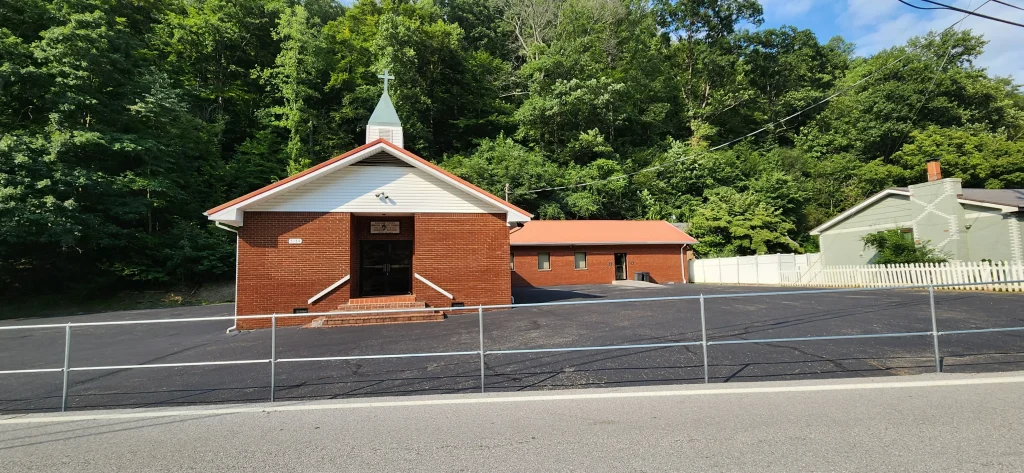
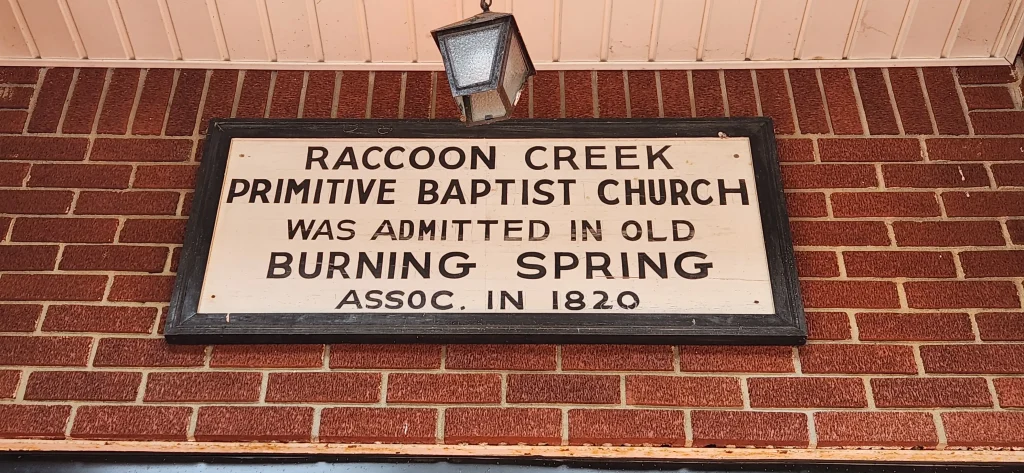
Along Raccoon Creek east of Pikeville stands a red brick church whose history reaches back to the earliest years of permanent settlement in the Big Sandy country. The building at 5174 Raccoon Road is plainly newer than the congregation it houses, but a sign above its entrance preserves a much older claim:
“Raccoon Creek Primitive Baptist Church was admitted in Old Burning Spring Assoc. in 1820.”
That date places the congregation’s story more than two centuries in the past, before Pike County itself existed as a separate county. A modern Primitive Baptist directory likewise dates Raccoon Primitive Baptist Church to 1820 and lists the congregation at the same Raccoon Road address.
The surviving historical trail supports the broad outline preserved on the church sign. Nineteenth-century Baptist historian J. H. Spencer identified Raccoon as one of the churches that entered the New Salem Association when that body was organized in 1825. Archival collections at Berea College preserve Burning Spring Association minutes reaching back to 1813, New Salem records beginning in 1825, and decades of Union Association minutes that document the religious world in which Raccoon Creek worshiped.
Together, those records place Raccoon Creek Primitive Baptist Church among the oldest surviving pieces of organized religious history in Pike County.
A Church Older Than Pike County
The year 1820 is important because there was no Pike County when the congregation entered the Burning Spring Association.
The Kentucky General Assembly authorized the division of southern Floyd County in December 1821, with the new county government taking effect afterward. The Kentucky Department for Libraries and Archives places Pike County’s formal formation in 1822 and identifies Floyd County as its parent county. The land surrounding Raccoon Creek was therefore still part of Floyd County when the church’s sign says Raccoon was admitted into Burning Spring Association.
That small jurisdictional detail gives the church unusual historical significance. Raccoon Creek Primitive Baptist Church did not grow out of the later coal camps, railroads, incorporated towns, and industrial communities that transformed Pike County during the nineteenth and twentieth centuries. Its roots belong to an earlier Appalachian world.
Eastern Kentucky in 1820 remained a landscape of scattered farms, creek settlements, rough trails, river travel, and small communities separated from one another by steep ridges. Churches often became some of the first durable institutions in those settlements. They served religious purposes, of course, but they also created networks that joined isolated mountain neighborhoods to congregations on other creeks and forks.
Raccoon’s history is especially valuable because the material gathered for this article points toward surviving associational records that may eventually allow the congregation’s earliest membership and leadership to be reconstructed in much greater detail.
Admitted to Burning Spring Association in 1820
The sign mounted above the modern church entrance does not actually say that Raccoon was “founded” in 1820. It says the church was admitted into the old Burning Spring Association that year.
That wording matters.
Admission into a Baptist association usually meant that a congregation already existed in some organized form and had petitioned for fellowship with neighboring churches. The precise date at which Raccoon’s members first began meeting could therefore have been 1820 or possibly a little earlier. Until the surviving Burning Spring minutes are examined directly for the Raccoon entry, 1820 is safest understood as the church’s traditional and associational date.
Berea College Special Collections and Archives holds Burning Spring Association meeting minutes covering 1813 through 1824 in the Elder Walter L. Akers Old Regular Baptist Research Collection. Those records are potentially the most important surviving primary source for the first years of Raccoon Creek Primitive Baptist Church.
Burning Spring itself belonged to the rapid spread of Baptist associations through early Kentucky. Historian Frank M. Masters wrote that the association was constituted in 1814 from churches largely dismissed from the North District Association. It became identified with the Regular Baptist and anti-missionary current that resisted the growing network of missionary societies and other centralized religious organizations then appearing among American Baptists.
Raccoon’s admission in 1820 therefore placed the little mountain congregation inside a much larger debate over how Baptist churches should organize, worship, cooperate, and preserve their independence.
Raccoon and the New Salem Association
Only five years after the date preserved on Raccoon’s sign, another important change came.
In 1825 churches from the eastern Kentucky mountains organized the New Salem Association. J. H. Spencer, writing his monumental History of Kentucky Baptists in the nineteenth century, named the constituent churches as New Salem, Mud, Sand Lick, Stone Coal, Union, Owen Fork, Raccoon, and Louisa Fork. Spencer believed that all had probably come from Burning Spring Association.
A later history based on the work of Baptist researchers Walter Akers and Dixon provides an interesting additional detail. It says several churches were dismissed from Burning Spring in preparation for forming New Salem, while Raccoon and Louisa Fork were formally received when the new association met in 1825.
That distinction may eventually prove useful in reconstructing exactly how Raccoon moved between associations.
What is certain is that Raccoon was recognized as part of New Salem from the association’s beginning.
FamilySearch catalogs official New Salem Association minutes beginning with the first annual session in 1825, while Berea College preserves an extensive collection of New Salem minutes, notes, correspondence, queries, resolutions, and church material. These records are among the strongest primary sources available for following Raccoon’s nineteenth-century history.
The associational system did not mean that an outside body operated the local church in the way a centralized denomination might. Old Regular and related Baptist associations were unions of congregations that sent representatives, often called messengers, to annual meetings. The churches guarded their independence closely.
A surviving statement of Union Association practice later made that principle explicit, explaining that the association could not rule over the internal rights of individual churches.
For families living along a remote creek, this arrangement offered both independence and connection. Raccoon could govern its own affairs while remaining in fellowship with congregations scattered throughout the eastern Kentucky mountains.
Growth and Change in the Mountain Associations
The New Salem Association into which Raccoon entered was small, isolated, and deeply Appalachian.
Spencer described its churches as lying across Pike, Floyd, Letcher, Perry, and Breathitt counties in a region he characterized as rough, mountainous, and thinly populated. Yet the association grew considerably during periods of religious revival. By 1844 it contained fourteen churches and 758 members. Membership later declined, then recovered, reaching twenty churches and 614 members in 1859.
Raccoon passed through those decades while Pike County itself was changing.
The settlement that became Pikeville developed into the county seat. Roads slowly improved. Farms and small communities spread farther into the creek valleys. Yet long before railroads and industrial coal mining transformed the county, Baptist churches had already created a social map of eastern Kentucky based on places such as Raccoon, New Salem, Stone Coal, Mud, Louisa Fork, and Union.
Many of those church names were geographical. They belonged to creeks, forks, and neighborhoods rather than towns.
Raccoon Creek Primitive Baptist Church still fits that pattern. Its name anchors the congregation to the valley in which generations of families lived, worshiped, married, buried their dead, and identified their homes.
The Division of 1859
The next major turning point came in 1859.
By that year New Salem had grown large enough that a group of churches sought to organize another association. Spencer recorded that New Salem dismissed nine churches containing a combined 284 members for the purpose of forming Union Association.
A denominational history identifies those churches as Thornton, Bethel, Elkhorn, Sulphur Spring, Pound Fork, Holly Creek, Union, Cloe, and Raccoon. They were instructed to meet at Union Church before the second Saturday in November 1859, where the new association was organized.
Once again, Raccoon was not a marginal congregation standing outside the major institutional developments of mountain Baptist history. It was one of the churches participating directly in the creation of a new association.
Union took its name from Union Church, described in the denominational history as the oldest congregation among the churches forming the new body. Raccoon entered a fellowship that would preserve a substantial body of records of its own.
Berea College’s Akers collection contains Union Association minutes from numerous years beginning in the nineteenth century and continuing into the twenty-first, as well as a compilation of queries, resolutions, and requests presented to Union Association between 1900 and 1990.
A published collection edited by Jeff Little and Barry Lucas, From a Long Series of Experiences: Selected Circular Letters of the Union Association of Old Regular Baptist, also includes material concerning the organization of Union Association and historical notes about its early leaders.
For Raccoon, 1859 represents another link in a chain stretching from Burning Spring to New Salem and then to Union.
Primitive Baptist and Old Regular Traditions
The names attached to these churches can be confusing to modern readers.
Historical records employ terms such as Regular Baptist, Old Baptist, Old Regular Baptist, Primitive Baptist, and other related descriptions. These names developed through generations of divisions, reunions, theological disagreements, and changes in denominational identity. They should not simply be treated as interchangeable labels in every period.
Raccoon’s own modern sign identifies it as Raccoon Creek Primitive Baptist Church. A current Primitive Baptist directory lists it more simply as Raccoon Primitive Baptist Church. Its nineteenth-century history, however, runs through associations strongly connected to the Old Regular Baptist tradition.
That tradition preserved several distinctive forms of mountain worship.
One of the best known is lined-out hymn singing. Instead of relying upon instrumental accompaniment or a trained choir, a leader gives a line of a hymn and the congregation answers, stretching the words into an elaborate collective melody.
The Smithsonian Institution has documented this singing among southeastern Kentucky Old Regular Baptists, describing it as one of the oldest surviving English-language religious musical traditions in North America. The Library of Congress added Smithsonian Folkways recordings of southeastern Kentucky Old Regular Baptist hymnody to the National Recording Registry in 2014.
Jeff Todd Titon’s Smithsonian work describes the music as unaccompanied, lined-out congregational singing rooted in older English, Scottish, and Irish sacred traditions.
This broader religious culture provides an important context for understanding churches such as Raccoon. Their importance cannot be measured only by the age of their buildings. They preserved forms of worship, community organization, oral memory, and sacred music carried through generations in the mountains.
The Church on Raccoon Road
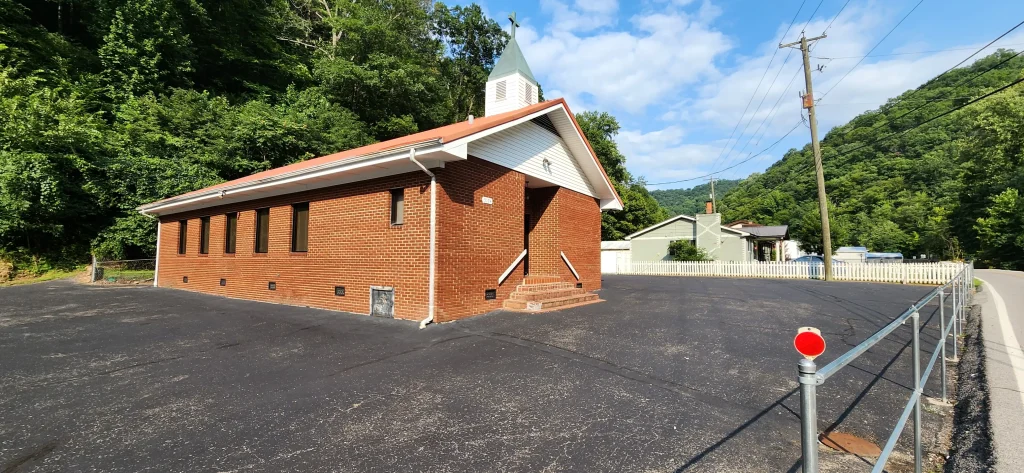
The present Raccoon Creek Primitive Baptist Church stands directly beside Raccoon Road, tucked beneath the steep forested slopes characteristic of Pike County.
The sanctuary seen today is a rectangular red brick building with a white front gable, red metal roof, and a small belfry and steeple rising above the entrance. An adjoining brick structure extends beside it. The simplicity of the building is consistent with the congregation’s emphasis on worship rather than elaborate ecclesiastical architecture.
Nothing presently located in the sources proves that this building itself dates to the nineteenth century. It almost certainly represents a later generation of the congregation’s physical history.
That distinction is important. A church can be two centuries old without occupying the same structure for two centuries.
Wooden meetinghouses burned, deteriorated, were enlarged, relocated, or replaced throughout Appalachian history. Congregations often survived every building that housed them. In the case of Raccoon, deeds, tax records, association minutes, church records, maps, and photographs may eventually reveal how many meetinghouses preceded the present brick sanctuary.
For now, the building’s greatest historical feature may be the sign above its entrance. In a few plain words, it links the modern church to the Burning Spring Association and the year 1820.
A Church for the Living and the Dead
The continued place of Raccoon Primitive Baptist Church in community life can also be seen through funeral records.
When Lillian K. Thacker died in 2016, visitation and services were held at Raccoon Primitive Baptist Church over several days before her funeral there.
Marie Coleman, who died in 2023 at the age of ninety-one, was identified in her obituary as a member of Raccoon Primitive Baptist Church.
In September 2024 the funeral of Marlene “May” Goff was held at the church, with Primitive Baptist ministers officiating before burial in a family cemetery on Raccoon. Three months later, the church hosted a memorial service for George Thomas Goff.
These notices offer small glimpses of something association statistics cannot fully capture.
For generations, mountain churches have been places where communities gather not only for preaching and communion but also at the moments when families confront death. A church becomes inseparable from local genealogy because the same surnames appear again and again in membership lists, obituaries, cemetery records, marriage connections, and associational minutes.
Raccoon’s history is therefore also the history of the families living along Raccoon Creek and its surrounding branches.
What the Surviving Records May Still Tell Us
Much about Raccoon Creek Primitive Baptist Church remains to be recovered.
Berea College may hold the key.
Its Elder Walter L. Akers Old Regular Baptist Research Collection contains approximately nine linear feet of material gathered from Old Regular Baptist, Primitive Baptist, United Baptist, Old School Baptist, Predestinarian Baptist, and related traditions. Among those papers are the Burning Spring Association minutes from 1813 through 1824, extensive New Salem records, and a long run of Union Association material.
Those documents could answer questions that cannot yet be answered safely.
Who represented Raccoon when it was admitted to Burning Spring in 1820? How many members did it have? Who were its first elders and deacons? Where did its earliest congregation meet? Did the members build a dedicated meetinghouse immediately, or worship in a home or shared structure? Who conveyed the church’s first property? When was the present site acquired? How many buildings have stood there?
Pike County deed books and older Floyd County records could add another layer. Because Raccoon’s 1820 association date predates Pike County, the earliest property transactions connected to the congregation may lie among Floyd County records. Later deeds should appear in Pike County.
The church’s long paper trail may therefore still be waiting to be assembled one annual minute, deed, obituary, and family record at a time.
Why Raccoon Creek Primitive Baptist Church Matters
It is easy to drive past a small country church and see only the building standing beside the road.
Raccoon Creek Primitive Baptist Church deserves a longer look.
Its traditional date of 1820 takes its history back to a time when the surrounding land still belonged to Floyd County. Five years later, Raccoon appeared among the churches forming the New Salem Association. In 1859 it joined eight other congregations in the movement that created Union Association. Across the generations that followed, the congregation remained part of a distinctive eastern Kentucky Baptist culture whose worship, associations, and sacred music became deeply woven into Appalachian life.
More than two hundred years after the date preserved above its doorway, people still gather at Raccoon for worship, remembrance, and funerals.
The building has changed. The county around it has changed even more. Pike County passed through settlement, Civil War, timber cutting, railroad construction, enormous coal booms, population growth, mine closures, floods, highway construction, and economic decline.
Raccoon Creek Primitive Baptist Church endured through all of it.
Its history is not simply the history of one congregation. It is evidence of how some of the oldest institutions in eastern Kentucky were built along creeks before many towns existed, before the coal companies arrived, and even before the county lines familiar today had been drawn.
Above the church door, the congregation has preserved the essential beginning in a single sentence: admitted into the old Burning Spring Association in 1820.
For a church along a mountain road in Pike County, those few words open a window into more than two centuries of Appalachian religious history.
Sources & Further Reading
Berea College Special Collections and Archives. “Burning Spring Association: Meeting Minutes 1813–1824.” Box 26, Folder 6. Elder Walter L. Akers Old Regular Baptist Research Collection, BCA 0159-SAA 161. Berea College, Berea, Kentucky. Accessed July 27, 2026. https://bereaarchives.libraryhost.com/repositories/2/archival_objects/157470
Berea College Special Collections and Archives. Elder Walter L. Akers Old Regular Baptist Research Collection. BCA 0159-SAA 161. Berea College, Berea, Kentucky. Accessed July 27, 2026. https://bereaarchives.libraryhost.com/repositories/2/resources/549
Berea College Special Collections and Archives. “New Salem Association, 1859, 1877, 1889–1891.” Box 5, Folder 1B. Elder Walter L. Akers Old Regular Baptist Research Collection, BCA 0159-SAA 161. Accessed July 27, 2026. https://bereaarchives.libraryhost.com/repositories/2/top_containers/89233
Berea College Special Collections and Archives. “New Salem Association: Queries, Resolutions and Requests Brought to the New Salem Association of Old Regular Baptist of Jesus Christ, From the Year 1825 through the Year 1969.” Box 5, Folder 1A. Elder Walter L. Akers Old Regular Baptist Research Collection. Accessed July 27, 2026. https://bereaarchives.libraryhost.com/repositories/2/top_containers/89233
Berea College Special Collections and Archives. “New Salem Association: Copies of Meeting Minutes 1825–1969.” Elder Walter L. Akers Old Regular Baptist Research Collection, BCA 0159-SAA 161. Accessed July 27, 2026. https://bereaarchives.libraryhost.com/repositories/2/archival_objects/157463
Berea College Special Collections and Archives. “Old Regular Baptist Associations.” Series 1. Elder Walter L. Akers Old Regular Baptist Research Collection, BCA 0159-SAA 161. Includes surviving Union Association minutes from 1883 through the twenty-first century. Accessed July 27, 2026. https://bereaarchives.libraryhost.com/repositories/2/archival_objects/93115
Berea College Special Collections and Archives. “The Primitive Baptist, 1922–1928.” Box 24, Folders 1–5. Elder Walter L. Akers Old Regular Baptist Research Collection, BCA 0159-SAA 161. Accessed July 27, 2026. https://bereaarchives.libraryhost.com/repositories/2/archival_objects/157412
New Salem Association of Old Regular Baptist of Jesus Christ. Minutes of the Annual Session of the New Salem Association of Old Regular Baptist of Jesus Christ. Paintsville, KY: New Salem Association of Old Regular Baptists of Jesus Christ, 1825–. FamilySearch Library. Accessed July 27, 2026. https://libcat.familysearch.org/Record/172333
Spencer, J. H. A History of Kentucky Baptists: From 1769 to 1885. Vol. 2. Cincinnati: J. R. Baumes, 1885. “New Salem Association.” Accessed July 27, 2026. https://baptisthistoryhomepage.com/spencer.ky.bap.v2.sect10.html
Masters, Frank M. A History of Baptists in Kentucky. Louisville, KY: Kentucky Baptist Historical Society, 1953. “New Salem Baptist Association.” Accessed July 27, 2026. https://baptisthistoryhomepage.com/ky.baptists.masters.chp17.miss.anti.miss.associations.html
Old Regular Baptist History. “History.” Discussion of the organization of the Union Association in 1859 and the Raccoon congregation among its constituent churches. Accessed July 27, 2026. https://oldregularbaptist.weebly.com/history.html
National Old School Primitive Baptist Church Directory. “Kentucky.” Entry for Raccoon Primitive Baptist Church, Pikeville, Kentucky, dated 1820. Accessed July 27, 2026. https://pbdirectory.org/Kentucky.htm
Folkstreams. “Beliefs and Practices of the Union Association of Regular Baptists.” Accessed July 27, 2026. https://www.folkstreams.net/contexts/beliefs-and-practices-of-the-union-association-of-regular-baptists
Titon, Jeff Todd. “Old Regular Baptists of Southeastern Kentucky: A Community of Sacred Song.” Smithsonian Folklife Festival, 1997. Accessed July 27, 2026. https://festival.si.edu/articles/1997/old-regular-baptists-of-southeastern-kentucky-a-community-of-sacred-song
Indian Bottom Association of Old Regular Baptists. Old Regular Baptists: Lined-Out Hymnody from Southeastern Kentucky. Smithsonian Folkways Recordings, 1997. Accessed July 27, 2026. https://folkways.si.edu/indian-bottom-association/old-regular-baptists-lined-out-hymnody-from-southeastern-kentucky/american-folk-sacred/music/album/Smithsonian
Gray, Scotty. “‘Old Regular Baptists: Lined-Out Hymnody from Southeastern Kentucky’—Indian Bottom Association (1997).” National Recording Preservation Board, Library of Congress. National Recording Registry essay. Accessed July 27, 2026. https://lcweb2.loc.gov/static/programs/national-recording-preservation-board/documents/OldRegularBaptists.pdf
Library of Congress. “‘Old Regular Baptists: Lined-Out Hymnody from Southeastern Kentucky’ (Album), Indian Bottom Association (1997).” National Recording Registry, 2014 selections. Accessed July 27, 2026. https://www.loc.gov/programs/national-recording-preservation-board/recording-registry/registry-by-induction-years/2014/
Kentucky Commonwealth. “Pike County.” Kentucky.gov. Notes that Pike County was established in 1821 from part of Floyd County. Accessed July 27, 2026. https://www.kentucky.gov/government/Pages/AgencyProfile.aspx?Title=Pike+County
Pike County Historical Society. “The Birth of Pike County, KY.” Discusses the December 19, 1821 act creating Pike County from Floyd County and the new county government taking effect in 1822. Accessed July 27, 2026. https://pikecountykyhistoricalsociety.com/the-birth-of-pike-county-ky/
Pike County, Kentucky, Clerk of the County Court. “Deeds 1820–1902; Index 1820–1970.” FamilySearch Library. Accessed July 27, 2026. https://www.familysearch.org/en/search/catalog/results?count=20&query=%2Bauthor_id%3A1239468416
Jenkins, Evan Cramer. Geologic Map of the Millard Quadrangle, Pike County, Kentucky. Geologic Quadrangle Map GQ-659. Washington, DC: U.S. Geological Survey, 1967. https://pubs.usgs.gov/publication/gq659
“Lillian K. Thacker.” Obituary. Tribute Archive, 2016. Records visitation and funeral services at Raccoon Primitive Baptist Church. Accessed July 27, 2026. https://www.tributearchive.com/obituaries/1747253/Lillian-K-Thacker
“Marie Coleman.” Obituary. Tribute Archive, 2023. Identifies Coleman as a member of Raccoon Primitive Baptist Church. Accessed July 27, 2026. https://www.tributearchive.com/obituaries/30180762/marie-coleman
“Marlene ‘May’ Goff.” Obituary. Tribute Archive, 2024. Records funeral services at Raccoon Primitive Baptist Church. Accessed July 27, 2026. https://www.tributearchive.com/obituaries/33220559/marlene-goff
“George Thomas Goff.” Obituary. Tribute Archive, 2024. Records a memorial service at Raccoon Primitive Baptist Church. Accessed July 27, 2026. https://www.tributearchive.com/obituaries/34210319/george-thomas-goff
Author Note: I photographed Raccoon Creek Primitive Baptist Church along Raccoon Road in Pike County in July 2026, including the sign preserving its 1820 connection to the Burning Spring Association. That simple inscription led me into more than two centuries of records connecting the congregation with some of eastern Kentucky’s oldest Baptist associations.
My mom raised us up in this church