
Appalachian History Series – Itmann Company Store and Office: Pocahontas Fuel’s Stone Citadel in Wyoming County
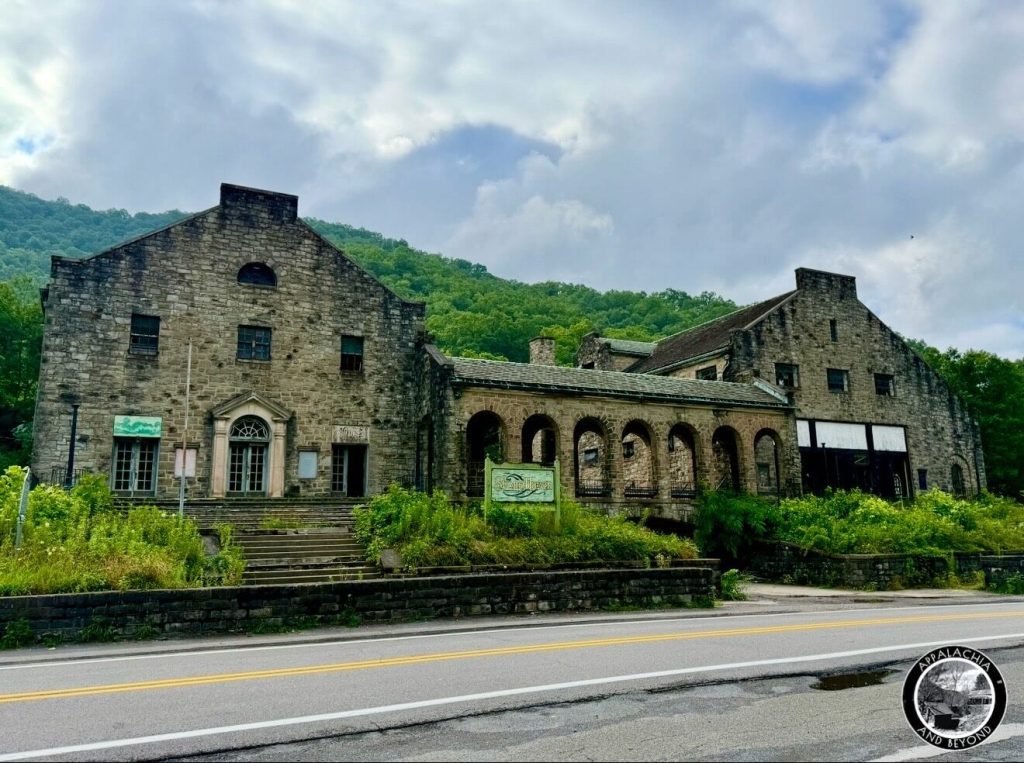
Along the Guyandotte River just west of Mullens, West Virginia, stands a building that seems almost too large and too permanent for the narrow Wyoming County valley surrounding it. The Itmann Company Store and Office rises from the roadside in heavy walls of native sandstone, its two great gabled sections joined by an arched passageway around an open courtyard. Behind it, the mountainside climbs sharply toward the old company houses that once sheltered the families whose lives revolved around the mines below.
It does not resemble the simple wooden store that many people imagine when they hear the words company store. Architecturally, Itmann is closer to a fortress, institutional complex, or manor built in stone. That impression is one reason the building has survived as one of the most recognizable structures of the southern West Virginia coalfields.
Yet its importance goes beyond architecture. For the miners and families who lived at Itmann, this building once concentrated much of the community into a single address. The coal company maintained offices there. Residents collected their mail there. They visited the doctor, barber, and poolroom there. They bought groceries, clothing, furniture, and even burial caskets there.
In Itmann, the company store was not simply somewhere to shop. It stood at the physical center of a town created by the same company that employed its miners and owned much of the community around them. The 1990 National Register nomination described the building as both a center of daily life and an expression of Pocahontas Fuel Company’s position as employer and landlord.
Building a Coal Town in Wyoming County
Before Pocahontas Fuel arrived, the future site of Itmann remained largely undeveloped countryside along the Guyandotte River. The National Register research describes the area before 1916 as vacant farmland and wilderness reached by a narrow and difficult dirt road. That changed when Pocahontas Fuel secured a lease covering more than 1,000 acres and began developing a mining community along the river.
The settlement was named for Isaac T. Mann, an important West Virginia financier connected to Pocahontas Fuel and the Bank of Bramwell. The company began developing its Itmann operation in 1916, while production from the valuable Pocahontas No. 3 seam followed during the early years of the new camp. The Virginian Railway provided the essential transportation link that allowed coal extracted from this isolated valley to reach distant industrial markets.
Pocahontas Fuel needed more than a mine. It needed a town capable of housing workers and their families.
Pre-cut frame houses began appearing on the hillsides. According to architectural historian S. Allen Chambers Jr., Ritter Lumber Company supplied approximately 120 houses in 1918, most of which were erected during a remarkably short three-month period. Another 100 houses followed in 1919. They were arranged along the rising mountainside in curved rows, with each level cut into the slope above the one beneath it.
The early community also included two frame company stores, a theater, and two schools, one serving white children and another serving Black children in accordance with the segregation laws and practices of the era. By the early 1920s, a brick school had replaced the original white school.
From the beginning, however, Pocahontas Fuel appears to have envisioned something more substantial for the commercial center of Itmann. The ground where the later company store would stand had reportedly been graded as early as 1917.
The permanent building did not rise for several more years.
Alex B. Mahood Draws the Plans
In 1923 Pocahontas Fuel turned to one of southern West Virginia’s most important architects, Alex B. Mahood of Bluefield.
The documentary evidence for Mahood’s involvement is unusually strong. The West Virginia State Archives preserves an original architectural set cataloged as Sc86-145, identified as “Pocahontas Fuel Company, Itmann Store by Alex Mahood of Bluefield, 1923.” The collection contains fourteen sheets. Those surviving plans provide direct contemporary evidence for the building Pocahontas Fuel intended to construct rather than relying only on later recollections of its appearance.
Mahood was born in 1888 and had studied at the École des Beaux-Arts in Paris after completing his earlier education in the United States. By the 1920s he had become an influential architect in Bluefield and across the surrounding coalfields, designing residences, banks, courthouses, commercial structures, and other prominent buildings.
For Pocahontas Fuel, he created something far beyond a utilitarian coal camp store.
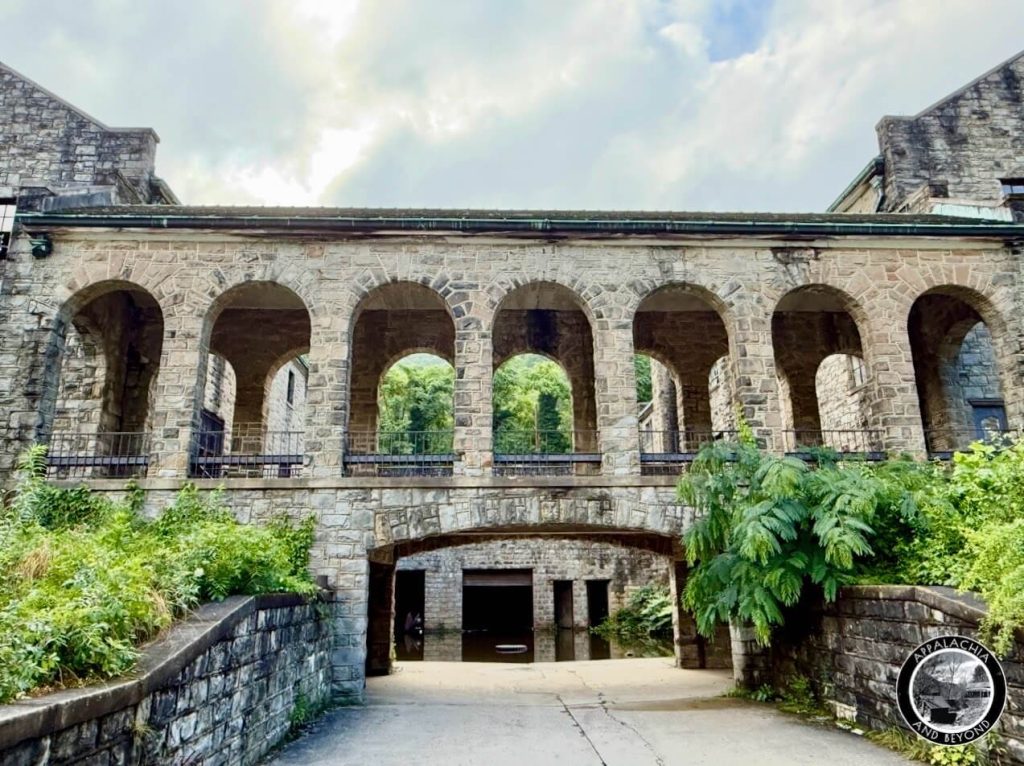
Construction continued from 1923 through 1925. The finished complex reflected elements of Classical Revival architecture while using rough-faced native sandstone that made the structure appear inseparable from the mountains surrounding it. The National Register nomination emphasized the symmetry of the building, its classical detailing, and its unusual open courtyard arrangement.
Cutting a Monument Out of the Mountain
The most memorable part of the Itmann store’s construction may be the story of the stone itself.
Rather than importing finished building stone from some distant quarry, workers cut sandstone from the cliff across the Guyandotte River. The stone had to be cut by hand, brought down the hillside, carried across the river, and placed into the growing walls of the building.
Much of that skilled masonry was performed by European immigrants, particularly Italian stonemasons brought into Itmann for the project. Their involvement placed the store within a larger transformation taking place across industrial Appalachia. Coal companies drew workers from outside the mountains as mines expanded, adding immigrants from southern and eastern Europe to communities that already included native Appalachian families, Black miners from the South, and workers moving among different coalfields.
The National Register researchers regarded the Italian masonry at Itmann as important enough to include European ethnic heritage among the property’s areas of significance. They described construction from 1923 to 1925 as a major undertaking in which dozens of workers handled stone cut from the nearby cliff.
When their work was finished, the result dwarfed nearly everything around it.
Except for the brick school, the store was reportedly the only substantial non-frame building in Itmann before World War II. In a community filled largely with standardized wooden company houses, Pocahontas Fuel’s stone headquarters announced permanence, prosperity, and authority.
Inside the Itmann Company Store
The building was really several structures joined into one complex.
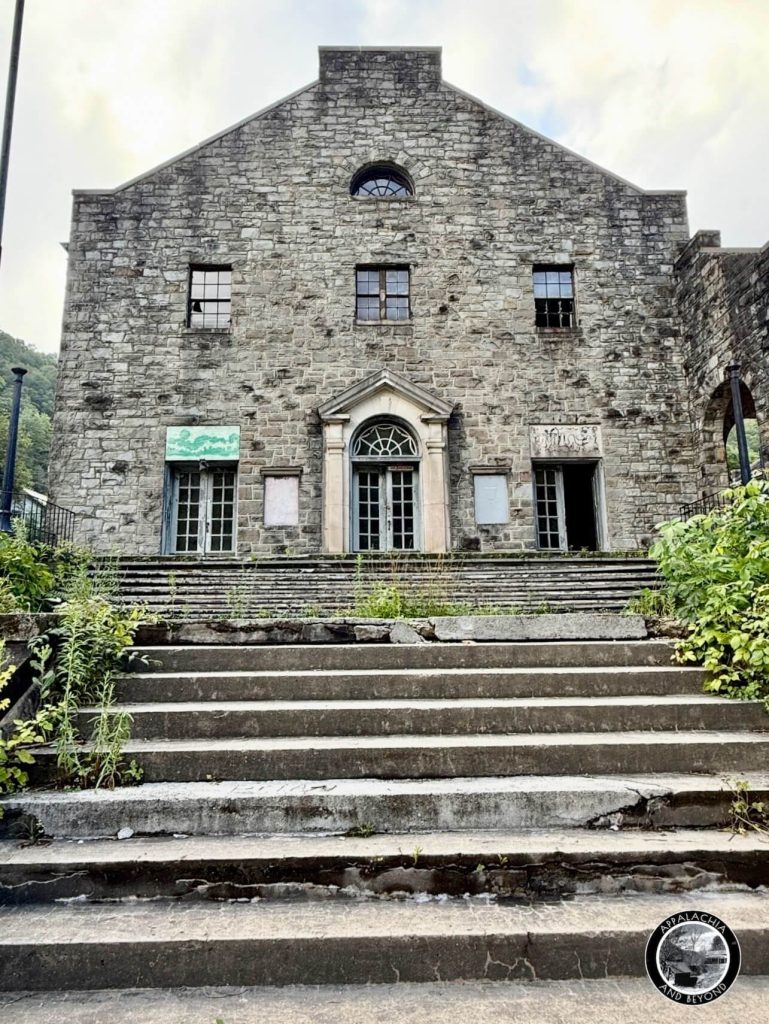
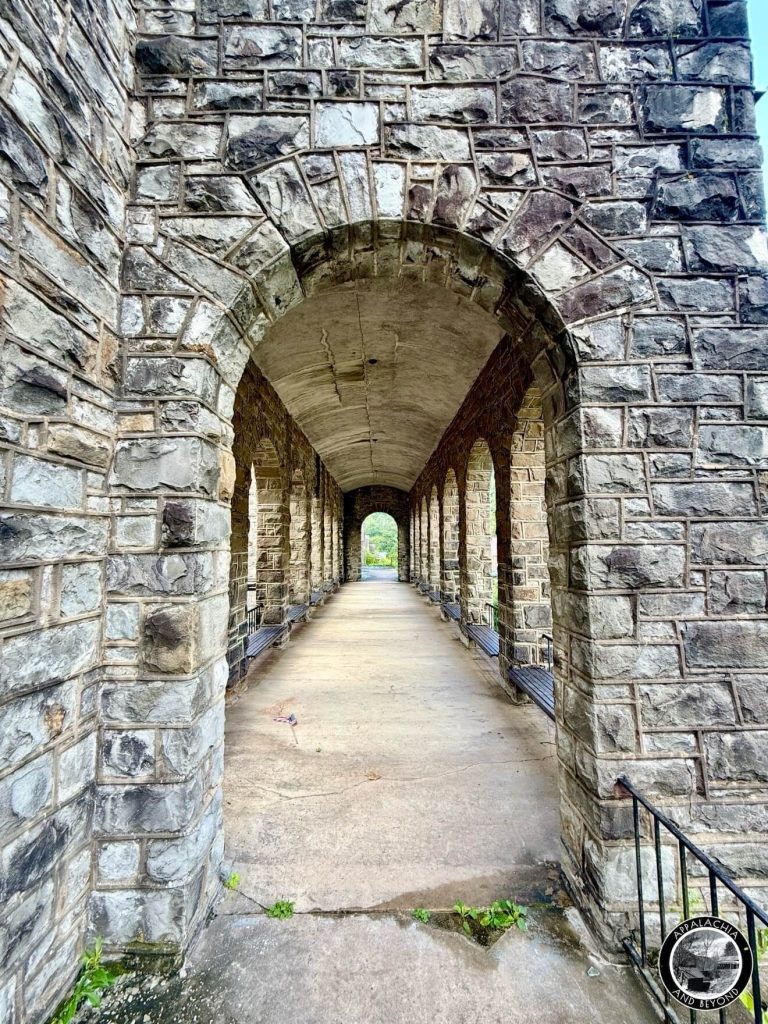
Its two largest sections were approximately two and a half stories high, facing the road with parapeted gable ends. Between them stood the lower loggia, or covered arcade, pierced by a driveway that entered the courtyard. Behind the front sections, another portion of the complex enclosed the working space around the courtyard and loading areas.
Green ceramic tiles covered portions of the roof. Steel industrial windows, stone arches, loading docks, concrete floors, and commercial entrances made the building functional as well as monumental. Smooth stone pilasters and a triangular pediment emphasized the central entrance, while carved stone lintels identified the company and post offices.
The southern portion served primarily as the store. Its main floor was largely open, with tile laid into concrete and sufficient room for a substantial retail operation. A mezzanine contained store offices. Larger merchandise, including furniture, could be kept on the second floor, and an elevator connected the commercial spaces.
The opposite wing brought together many of the administrative and community functions of Itmann. Company offices occupied several rooms. The post office operated there. Other spaces housed a barber shop, poolroom, and doctor’s office, while apartments for company employees were located upstairs.
The West Virginia Encyclopedia also identifies payroll and freight functions within the complex, further illustrating just how many parts of community life could pass through the building.
Everything From Groceries to Caskets
For a family living in Itmann during the 1920s, traveling regularly to another town was not necessarily convenient.
State Route 10 was improved during the era’s good-roads movement, but the National Register research found that travel remained difficult. Railroad transportation connected Itmann to the outside world, yet trains were hardly practical for every grocery trip or household purchase.
That gave the company store enormous importance.
Residents could obtain food and clothing there, but its inventory extended far beyond daily necessities. Furniture could be purchased in the building. So could burial caskets. Combined with the post office, doctor, barber, poolroom, company offices, and other services, the complex became one of the primary places where residents encountered one another outside their homes and workplaces.
It was convenience created by industrial isolation, but that convenience also concentrated enormous influence in Pocahontas Fuel’s hands.
The company was not merely selling goods to the people of Itmann. It was employing many of them, providing their housing, maintaining major services, and operating the town’s dominant commercial establishment. The National Register nomination interpreted that arrangement plainly, arguing that Pocahontas Fuel could recover part of the money it paid in wages through the goods and services purchased by its employees and could exercise considerable influence over their quality of life.
Company stores elsewhere in Appalachia are closely associated with scrip, payroll deductions, credit, and debates over pricing. It would be easy to transfer every element of that familiar story directly onto Itmann. The surviving sources should be treated more carefully. The evidence establishes that Pocahontas Fuel operated a large company-store system and that miners in the broader coalfields could have merchandise and other expenses connected to company accounts, but the records cited here do not establish that every Itmann customer in every period was paid or forced to shop in precisely the same manner.
That distinction does not diminish the company’s power. It makes the history more accurate.
The First Collapse of Itmann
The stone store had barely settled into its role as the new center of Itmann when the first major economic reversal arrived.
The mine closed in 1928.
Mining families began leaving, and railroad employees became increasingly important among those who remained. The community entered a long period of reduced activity that lasted into the late 1940s. Yet the store building did not simply close its doors and disappear.
The post office continued operating there, and portions of the building remained useful for shopping, services, and social interaction. By 1941, according to SAH Archipedia, the Wyoming County Department of Public Assistance had offices inside the complex.
The survival of the building through this period illustrates one reason Itmann is so historically valuable. The company store changed functions when the mining economy changed. Its rooms could move from corporate administration and retail commerce toward government services and other uses, even while the structure itself remained the most commanding building in town.
Coal Returns to Itmann
Mining returned in the late 1940s, beginning another chapter in the community’s history.
The revival ultimately became far larger than the operation Pocahontas Fuel had known during the store’s first years. A modern technical history of the Itmann mining complex reports that by 1954 Itmann had become the largest underground coal mine in West Virginia and the tenth largest in the United States, extracting more than two million tons of coal annually.
The surviving photographs from this era help put those numbers into human scale.
West Virginia University’s West Virginia History OnView collection preserves a July 1953 photograph showing two miners supporting the roof inside an Itmann Coal Company mine. Another archival image preserves the massive store and office building under Pocahontas Fuel ownership, while photographs from November 1956 document the scale of the Itmann preparation plant.
These photographs are valuable because they show two sides of the same community. Above ground stood the stone store, offices, houses, roads, and preparation facilities. Underground were the miners whose labor supported the entire system.
From Pocahontas Fuel to Consolidation Coal
The corporate ownership of Itmann changed during this second boom.
Pittsburgh Consolidation Coal Company acquired Pocahontas Fuel Company in 1956. Two years later the larger corporation again used the Consolidation Coal Company name. Virginia Tech’s Pocahontas Mines Collection and Smithsonian archival material both document this transition in the larger corporate history of the Pocahontas operations.
Itmann remained an important operation.
During the 1970s, the mining complex became Consolidation’s largest operation in the Central Appalachian region when measured by annual production and number of employees. For a community whose mine had been nearly dormant for two decades after 1928, the scale of that postwar revival was remarkable.
The old company store remained standing through all of it, although its original dominance over daily community life steadily weakened. Improved highways, automobiles, buses, and easier access to businesses outside Itmann reduced the isolation that had made the store so essential in the 1920s.
The town no longer depended on one building for nearly everything.
The Store After the Company-Town Era
Changes also took place inside the building.
In 1976 the company remodeled part of the office wing. Paneling covered portions of the original plaster walls, some woodwork disappeared, and suspended ceilings were installed. When the post office moved to another building during the mid-1980s, its boxes were removed from the old wall.
Then the mining economy again turned against Itmann.
Consolidation ceased operating the historic Itmann mine complex in 1986. A later technical report attributed the closure to increasing mining costs and declining metallurgical coal prices.
Without the mine, the company store lost the industrial system that had given it purpose.
By the time preservationists studied the property in 1990, much of the building had been virtually unused for several years. Windows had been broken, graffiti appeared on walls, concrete loading-dock roofs were deteriorating, and metal doors showed rust. Yet the most remarkable feature had survived. The enormous sandstone walls remained sound.
The building had outlasted the company-town system that created it.
Preserving the Stone Store
Recognizing that significance, historians prepared a National Register of Historic Places nomination for the Itmann Company Store and Office in 1990.
The nomination argued that the property possessed statewide significance in architecture, industry, social history, and European ethnic heritage. It qualified under Criterion A because of its relationship to the development and social organization of the mining community, and under Criterion C because of its architectural importance and association with Alex B. Mahood.
The National Park Service added the property to the National Register on November 28, 1990.
Preservationists considered it not merely an old commercial building but one of the finest surviving examples of a southern West Virginia company store.
Its scale made it exceptional. So did its stone construction, courtyard arrangement, prominent arcade, and association with immigrant craftsmanship. Many company stores across Appalachia were comparatively modest frame or brick structures. Itmann looked monumental because Pocahontas Fuel intended it to look monumental.
The Story Hidden in the Archives
One of the most exciting things about Itmann is how much of its documentary history still survives.
Beyond Mahood’s fourteen original architectural sheets, Virginia Tech holds the enormous Pocahontas Mines Collection, covering records from 1883 through 1997. The collection contains hundreds of cubic feet of mine maps, survey books, plats, mechanical drawings, architectural material, photographs, and ledgers documenting Pocahontas Fuel, Consolidation Coal, and related operations.
Researchers can go even deeper.
The archival material identified for Itmann includes town maps showing houses and company buildings, engineering plans, mine maps, coal-section drawings, and later elevation surveys. West Virginia Archives and History also preserves Pocahontas Fuel Company timecards and a timebook from 1949 to 1952, although the catalog does not establish that every entry in those volumes pertains specifically to Itmann.
The 1990 preservation research also drew upon people who still remembered the community personally. Among those interviewed were Itmann postmistress Billie Jean Blankenship, longtime resident Margie Carte, local historian Jack Feller, and C. H. Bowers, whose privately published history of Itmann became an important reference for later researchers.
Another potentially valuable collection is the Asa Orin Bishop Papers at West Virginia University. Bishop spent decades working in sales for Pocahontas Fuel and Consolidation’s company-store system. His papers include financial and operational records, annual reports, directories, union agreements, employee regulations, correspondence, photographs, ledgers, and retail sales material. He eventually became general manager of sales for a Pocahontas Fuel-Consolidation store network that grew to eighteen stores.
Together, these records offer the possibility of reconstructing Itmann not merely as an abandoned building, but as a functioning economic and social system.
Coal Comes Back, but the Old Store Remains
Mining itself has not completely disappeared from the Itmann name.
Development of the newer Itmann No. 5 Mine began in 2019, first coal production followed in 2020, and the operation reached commercial status in late 2022. The modern operation represents a new generation of mining technology and economics, not a restoration of the company-town system that surrounded the old store.
That contrast makes the surviving building even more striking.
Coal can return under a new corporation, with new machinery, new transportation, and new labor arrangements, but the old stone store belongs to a very different period. It comes from an age when opening a mine often meant constructing an entire community around it and when the coal company’s presence followed a worker from the mine entrance to his house, his mailbox, his doctor’s office, and the counter where his family purchased supper.
Why the Itmann Company Store Matters
The Itmann Company Store and Office survives because its builders constructed something intended to last.
Italian stonemasons cut sandstone from a Wyoming County hillside and carried it across the Guyandotte. Alex B. Mahood transformed those stones into an architectural statement. Pocahontas Fuel filled the completed building with groceries, furniture, offices, mail, medical care, recreation, administration, and commerce.
Miners and their families then gave those rooms their real meaning.
They walked through the doors to collect letters and wages, buy household necessities, visit the barber or doctor, speak with company officials, meet neighbors, and conduct the ordinary business of life in a town where ordinary life was inseparable from coal.
That is what makes Itmann more than an unusually beautiful abandoned company store.
The building is a surviving map of the company-town system itself. One wing speaks to commerce, another to corporate authority, upstairs rooms to employees, loading docks to supply networks, and the houses climbing the mountain behind it to the families whose labor made the entire operation possible.
Nearly a century after the first stones were set into place, the old store still dominates the narrow valley.
The mines have closed and reopened. Companies have disappeared, merged, and returned under different names. Roads that once isolated Itmann now carry travelers past the old complex in minutes.
The stone citadel remains.
Sources & Further Reading
Mahood, Alex B. “Pocahontas Fuel Company, Itmann Store.” 1923. Fourteen architectural drawings. Sc86-145. West Virginia Archives and History, Charleston, West Virginia. https://archive.wvculture.org/history/collections/specialcollections.html
Virginia Tech Special Collections and University Archives. “Pocahontas Mines Collection, 1883 to 1997.” Ms-2004-002. Virginia Tech, Blacksburg, Virginia. https://aspace.lib.vt.edu/repositories/2/resources/3408
Virginia Tech Special Collections and University Archives. “Itmann, West Virginia, Town Map with Houses and Buildings, Including West Virginia Armature Company and Pocahontas Fuel Co., Inc.” Box 231, Pocahontas Mines Collection.
Virginia Tech Special Collections and University Archives. “Itmann, Folder 2 of 5.” Pocahontas Mines Collection, Ms-2004-002. https://aspace.lib.vt.edu/repositories/2/archival_objects/109244
Pocahontas Fuel Company, Inc. “Itmann Mine Machine Drawings, Building Plans, and Data Sheets.” 1958. Box 544, Pocahontas Mines Collection, Virginia Tech Special Collections and University Archives.
Pocahontas Fuel Company, Inc. “Coal Sections from Mine Workings Map on Itmann Leasehold.” July 3, 1947. Box 648, Pocahontas Mines Collection, Virginia Tech Special Collections and University Archives. https://aspace.lib.vt.edu/repositories/2/archival_objects/110311
Pocahontas Fuel Company. “Map of Elevations at Itmann Mine along Guyandotte River.” August 11, 1959. Box 648, Pocahontas Mines Collection, Virginia Tech Special Collections and University Archives.
West Virginia and Regional History Center. “Store and Office Building, Pocahontas Fuel Company, Inc., Itmann, Wyoming County, W. Va.” Photograph 003083. West Virginia History OnView, West Virginia University Libraries. https://onview.lib.wvu.edu/catalog/003083
West Virginia and Regional History Center. “Miners at Work in an Itmann Coal Company Mine.” July 1953. Photograph 003065. West Virginia History OnView, West Virginia University Libraries. https://wvhistoryonview.org/catalog/003065
West Virginia Archives and History. “Coal Towns Photograph Collection.” Includes general views and a tipple at Pocahontas Fuel Company’s Itmann operation. https://archive.wvculture.org/history/collections/photos/ph2007-056.html
West Virginia Department of Mines. “Wyoming County: Itmann No. 3.” AR1790, Box 44. West Virginia Archives and History, Charleston, West Virginia. https://archive.wvculture.org/history/collections/ar/ar1790.html
West Virginia Department of Mines. Annual Report of the Department of Mines for the State of West Virginia. Charleston, West Virginia: Department of Mines, 1919. https://books.google.com/books/about/Annual_Report_of_the_Department_of_Mines.html?id=SkpOAAAAYAAJ
Pocahontas Fuel Company. “Timecards and Timebook, 1949 to 1952.” Ms2021-057. West Virginia Archives and History, Charleston, West Virginia. https://archive.wvculture.org/history/collections/manuscripts.html
Eastern Regional Coal Archives. “Itmann, Miscellaneous Materials On.” Craft Memorial Library, Bluefield, West Virginia. https://craftmemorial.lib.wv.us/eastern-regional-coal-archives
Eastern Regional Coal Archives. “Randel Bond Collection.” Accession 81-1. Pocahontas Operators Association records and photographs, 1880 to 1950. Craft Memorial Library, Bluefield, West Virginia. https://craftmemorial.lib.wv.us/eastern-regional-coal-archives
Eastern Regional Coal Archives. “William Z. Maratta Records.” Records of the Director of Plans and Development for Pocahontas Fuel Company, 1940 to 1974. Craft Memorial Library, Bluefield, West Virginia. https://craftmemorial.lib.wv.us/eastern-regional-coal-archives
Eastern Regional Coal Archives. “CONSOL Corporate Records.” Accession 87-46. Craft Memorial Library, Bluefield, West Virginia. https://craftmemorial.lib.wv.us/eastern-regional-coal-archives
Eastern Regional Coal Archives. “A. R. ‘Army’ Matthews Papers.” Accession 89-106. Craft Memorial Library, Bluefield, West Virginia. https://craftmemorial.lib.wv.us/eastern-regional-coal-archives
Eastern Regional Coal Archives. “Pocahontas Fuel Company Records, 1901 to 1985.” Accession 92-171. Craft Memorial Library, Bluefield, West Virginia. https://craftmemorial.lib.wv.us/eastern-regional-coal-archives
West Virginia and Regional History Center. “Smokeless Coal Operators Association Records.” A&M 1830. West Virginia University Libraries, Morgantown, West Virginia. https://archives.lib.wvu.edu/repositories/2/resources/5450
West Virginia and Regional History Center. “Asa Orin Bishop Papers.” A&M 4649. West Virginia University Libraries, Morgantown, West Virginia. https://archives.lib.wvu.edu/repositories/2/resources/7049
West Virginia and Regional History Center. “Pocahontas Consolidated Collieries Company Records.” A&M 2834. West Virginia University Libraries, Morgantown, West Virginia. https://archives.lib.wvu.edu/repositories/2/resources/941
Johnson, Mary E. “Itmann Company Store and Office.” National Register of Historic Places Registration Form. Charleston: West Virginia Historic Preservation Office, 1990. National Register Information System no. 90001775. https://npgallery.nps.gov/GetAsset/96bfb1d4-7dd0-4baa-8e79-eca01ebe2d9f/
McGehee, C. Stuart. “Itmann Company Store.” e-WV: The West Virginia Encyclopedia. West Virginia Humanities Council. https://www.wvencyclopedia.org/entries/889
Chambers, S. Allen Jr. “Itmann Company Store and Office (Former).” SAH Archipedia. Charlottesville: University of Virginia Press for the Society of Architectural Historians. https://sah-archipedia.org/buildings/WV-01-WY5
West Virginia State Historic Preservation Office. West Virginia Statewide Historic Preservation Plan, 2020 to 2024. Charleston: West Virginia Department of Arts, Culture and History. https://wvculture.org/wp-content/uploads/2021/10/2020-2024-WV-Statewide-Historic-Preservation-Plan.pdf
Bower, Charles H. Itmann. Princeton, WV: C. H. Bower, ca. 1989.
Marshall University Center for Regional Progress. The Coal Road: A Survey of Southern West Virginia Mining Tourism Potential. Huntington, WV: Marshall University, March 1989.
McGehee, C. Stuart. “I. T. Mann.” e-WV: The West Virginia Encyclopedia. West Virginia Humanities Council. https://www.wvencyclopedia.org/entries/1435
Tams, W. P. The Smokeless Coal Fields of West Virginia: A Brief History. Morgantown: West Virginia University Press. https://wvupressonline.com/node/35?page=1
Sullivan, Charles Kenneth. Coal Men and Coal Towns: Development of the Smokeless Coalfields of Southern West Virginia, 1873 to 1923. New York: Garland Publishing, 1989.
Lambie, Joseph T. From Mine to Market: The History of Coal Transportation on the Norfolk & Western Railway. New York: New York University Press, 1954.
Eller, Ronald D. Miners, Millhands, and Mountaineers: Industrialization of the Appalachian South, 1880 to 1930. Knoxville: University of Tennessee Press, 1982. https://utpress.org/9780870493416/miners-millhands-and-mountaineers/
University of Pittsburgh Library System. “Consolidation Coal Company Records, 1854 to 1971.” AIS.2011.03. Archives & Special Collections. https://digital.library.pitt.edu/islandora/object/pitt%3AUS-PPiU-ais201103/viewer
Smithsonian Institution, National Museum of American History. “Pittsburgh Consolidation Coal Company Photographs and Other Materials.” NMAH.AC.1007. https://sova.si.edu/record/nmah.ac.1007
John T. Boyd Company. Technical Report Summary: Coal Resources and Coal Reserves, Itmann Mining Complex. Prepared for CONSOL Energy Inc., 2023. https://www.sec.gov/Archives/edgar/data/1710366/000171036623000005/exhibit962.htm
Author Note: The Itmann Company Store is one of the most imposing surviving reminders of the company-town era in southern West Virginia. I hope this article helps preserve both the remarkable building and the stories of the miners, families, craftsmen, and residents whose lives once centered around it.