
Appalachian History Series – The Boissevain Company Store: Pocahontas Fuel’s Brick Heart of a Virginia Coal Camp
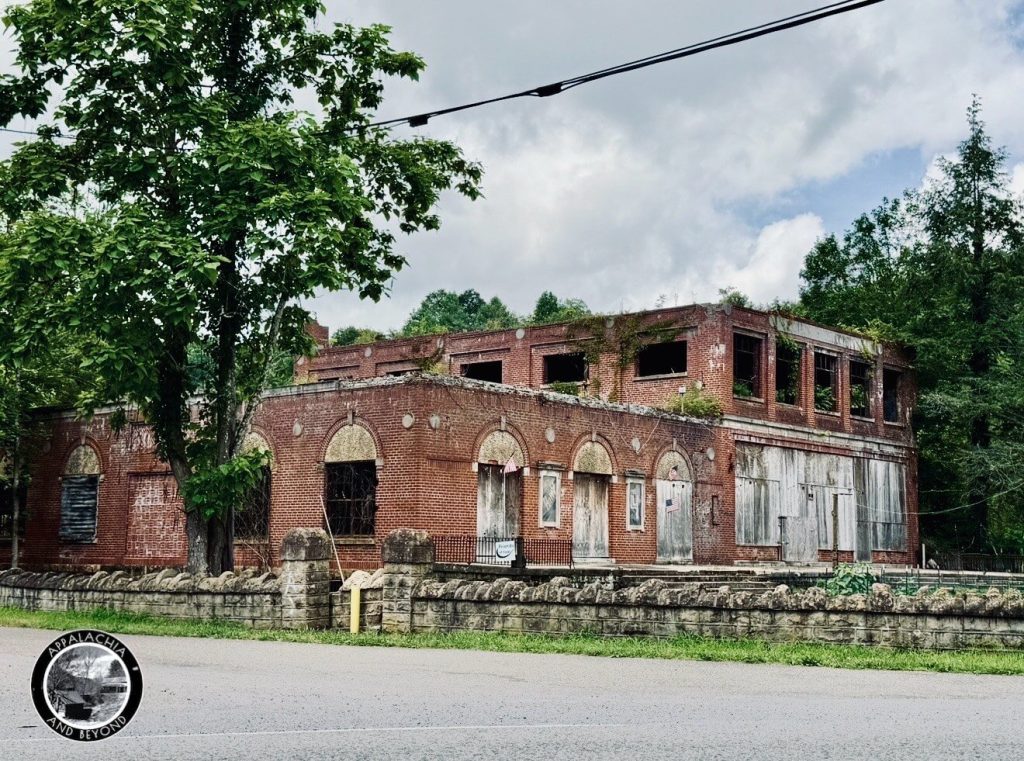
In the narrow coal country of northern Tazewell County, Virginia, the company store at Boissevain once stood at the center of a community created almost entirely by coal. The mine determined why the town existed, the railroad connected it to markets far beyond the mountains, and rows of company houses gave miners and their families places to live. Yet the store was where much of that industrial system became part of everyday life.
Period photographs preserved by Virginia Tech show the Boissevain commissary during the early 1930s as a substantial brick building rather than a simple country store. Its size and permanence reflected the importance of the operation around it. Miners and their families came there for goods, company business, and services, while the building stood close to the tracks, mine facilities, and homes that made up the camp. Virginia Tech’s collections preserve not only the commissary but also photographs of Boissevain miners, the tipple, mine interiors, and other parts of the Pocahontas Fuel operation. Together they show a community organized around one industry and one corporate network.
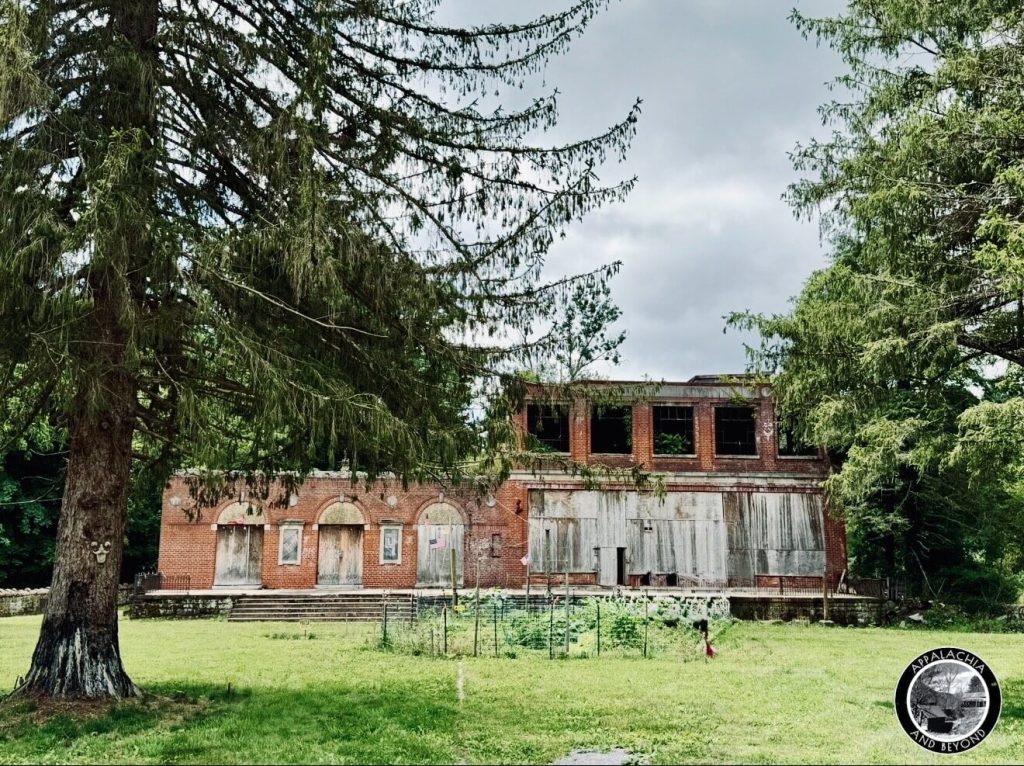
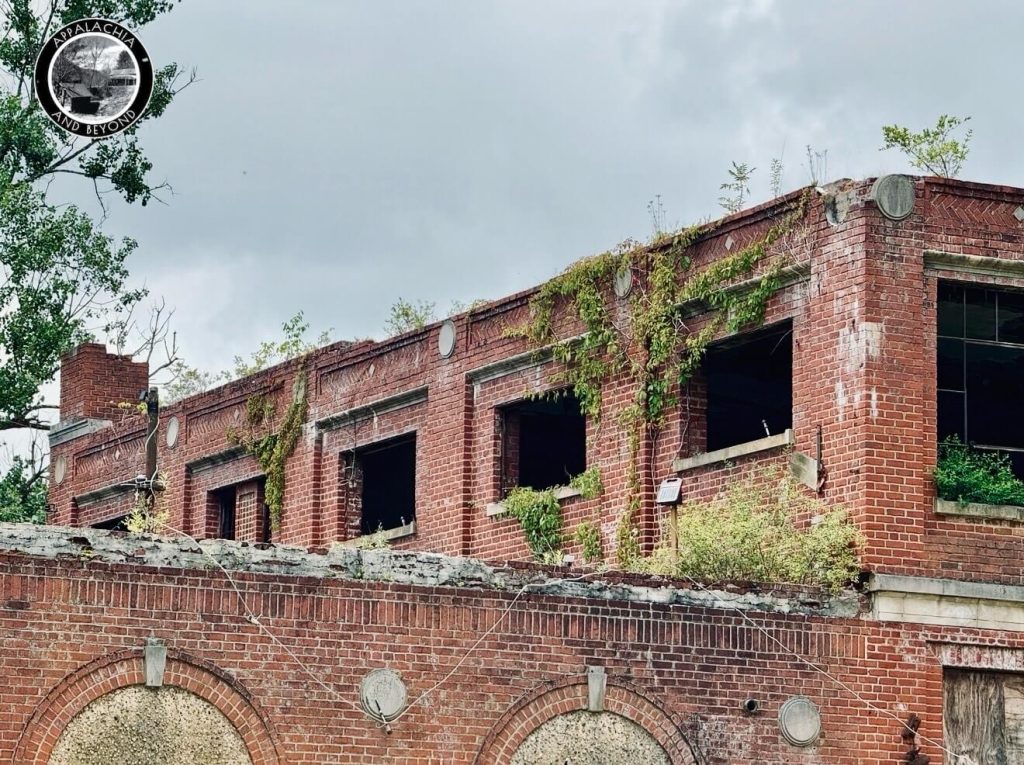
The store survived long enough to become one of Boissevain’s most visible reminders of that period. By the beginning of the twenty-first century, however, photographs showed it empty and deteriorating, its windows gone or boarded and vegetation working into a building that had once represented permanence. A 2002 history published by the Norfolk & Western Historical Society identified the Boissevain company store as having been built in 1917 and described it as already standing dilapidated and empty.
To understand why the company built such a structure in a mountain hollow, the story has to begin several years earlier, when Boissevain itself was new.
Building Boissevain Around Coal
The Virginia Department of Historic Resources dates the beginning of Boissevain to 1904, when the Pocahontas Collieries Company developed the community near a major coal mine and named it for the company’s chairman. Walter R. Hibbard Jr.’s history of Virginia coal gives an even closer description of those first years. He records that the G. L. Boissevain Company opened a shaft approximately 189 feet deep a few miles west of Pocahontas in 1904 and established a company town with a church, store, electrified houses, and a developed water system.
Those details matter because Boissevain was being planned as something more permanent than a cluster of temporary cabins beside a mine opening. Electricity, water, housing, a church, and a store were investments intended to attract and retain workers. They also placed much of a family’s daily life within a landscape created or influenced by the coal company.
The industrial plant itself was ambitious. An article titled “The Systematic Development of a Coal Mine,” published in the Engineering and Mining Journal on April 25, 1908, described the Boissevain operation as a carefully arranged modern mining property. The article reported that coal shipments had begun in October 1906 and were already averaging about 600 tons daily. The mine, shafts, machinery, ventilation equipment, tipple, and associated buildings were laid out with future expansion in mind, suggesting that the developers expected Boissevain to become an important operation rather than a short-lived prospect.
The railroad completed the system. The Norfolk & Western Railway’s 1907 annual reporting stated that the Pocahontas & Western Railroad completed and placed in operation approximately 2.90 miles of railroad to the coal tipple at the Boissevain operation in May of that year. By June 30, 1907, more than three miles of track had been laid, and grading continued toward additional Pocahontas Consolidated properties.
The following year’s report listed 3.29 miles of main line and 1.13 miles of sidings on the Pocahontas & Western. The short railroad may appear insignificant on a map, but it transformed Boissevain. Without those tracks, thousands of tons of coal buried beneath the mountains had little commercial value. With them, coal from the mine could move into the Norfolk & Western system and from there toward industrial customers across the country.
Boissevain therefore grew at the meeting point of three things: a valuable coal seam, large-scale corporate investment, and railroad transportation. The company store emerged directly from that combination.
From Pocahontas Consolidated to Pocahontas Fuel
The corporate name attached to Boissevain changed several times during the camp’s history. That can make old records confusing because photographs, deeds, directories, and mine reports do not always use the same company name.
In 1907, corporate consolidation brought together Pocahontas mining interests under the Pocahontas Consolidated Collieries Company. A Virginia court case later summarized the merger, recording that the Pocahontas Collieries companies combined in June 1907 and transferred their property to the newly organized Pocahontas Consolidated Collieries Company.
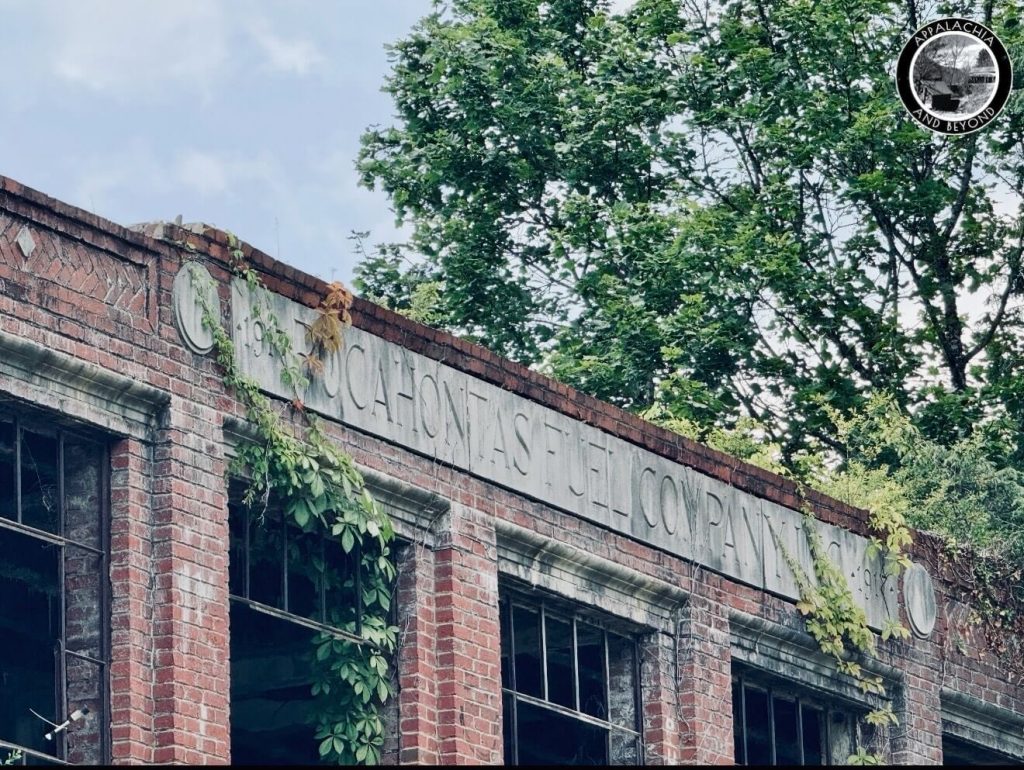
A decade later came another important change. West Virginia corporate records show that on June 29, 1917, Pocahontas Consolidated Collieries Company changed its name to Pocahontas Fuel Company Incorporated. That year is particularly important to the Boissevain store because the building itself was identified by the Norfolk & Western Historical Society as having been constructed in 1917. Surviving photographs of the abandoned building also showed the Pocahontas Fuel Company name and 1917 date prominently worked into its facade.
Boissevain was therefore receiving its permanent brick commercial landmark at nearly the same moment that the corporation adopted the Pocahontas Fuel name under which it would become widely remembered.
Elsewhere in the company’s system, the same period produced substantial company stores. At Jenkinjones, West Virginia, Pocahontas Fuel constructed separate brick store and office buildings in 1917. The National Register documentation describes them as the center of activity in an isolated company-owned community, with the store containing retail space and a post office while the neighboring building handled company business.
A Pocahontas Fuel store at Switchback was also built in 1917 with Classical Revival detailing, brick construction, a high stone foundation, and an attached business office. These buildings do not prove that every function or architectural decision at Jenkinjones or Switchback appeared exactly the same way at Boissevain, but they provide valuable corporate context. Pocahontas Fuel was investing in permanent company-store architecture across its coalfield operations at precisely the time the Boissevain building appeared.
Boissevain Supply Company
A particularly useful primary source comes from the Virginia Business Directory and Gazetteer published by the Hill Directory Company in 1917. Its Tazewell County listings identify the “Boissevain Supply Co.” as a general store and also list the business under garages. The same directory identifies the Pocahontas Consolidated Collieries Company’s Boissevain Colliery and records boarding houses, grocers, churches, and other local activity around the community.
That directory makes the store more tangible than a photograph alone can. In 1917 it was part of a functioning commercial community. Boissevain had company-controlled institutions, but it was not literally a place where no other economic activity existed. The directory lists Cheatham Brothers among local general merchants and grocers, along with boarding houses and other residents engaged in business. Coal-company influence was enormous, but everyday community life could be more complicated than the familiar image of one store possessing every dollar spent within the camp.
Still, the company store occupied a special position. It was backed by the same industrial organization that controlled the principal source of employment and much of the built environment. Its shelves and counters connected wages earned underground to the food, clothing, tools, household goods, and other necessities required aboveground.
Across Southwest Virginia’s coal camps, company commissaries carried both necessities and increasingly modern consumer goods. The Library of Virginia notes that company stores could sell everything from basic food and clothing to washing machines, radios, and refrigerators. Purchases were frequently made through credit or company scrip, allowing workers to obtain goods before payday but also ensuring that some of the money earned from the coal company returned to company-controlled commerce.
Boissevain’s individual surviving records do not justify assuming that every practice found elsewhere occurred there in exactly the same way. However, records from other Pocahontas Consolidated and Pocahontas Fuel operations show how deeply store purchases could become connected with payroll accounting. A surviving company ledger for Pocahontas No. 8 records individual earnings alongside deductions for merchandise, powder, insurance, and medical bills. It is not a Boissevain ledger, but it demonstrates the larger corporate system within which the Boissevain store operated.
More Than a Place to Buy Groceries
The company store’s importance came partly from geography. Coal camps were often built in narrow valleys where there was little room for a traditional downtown. Roads could be poor, automobiles were not yet universal, and the nearest independent commercial center might require a difficult trip. In that setting, a large store close to the houses and mine naturally became one of the places where residents crossed paths.
Virginia’s coal companies frequently built not only stores but also schools, churches, recreation facilities, hospitals, and other services. The resulting towns were corporate landscapes, yet families living within them turned those planned spaces into actual communities through worship, school activities, sports, friendships, shopping trips, and neighborhood life.
Boissevain’s land records reveal some of that development. In 1907 the Pocahontas Collieries Company conveyed a small lot to trustees of the Baptist Church of Boissevain. The deed, recorded in Tazewell County Deed Book 60, included a map of the property. Seven years later, Pocahontas Consolidated Collieries conveyed a lot in the town to trustees of the Boissevain Methodist Episcopal Church, South. The latter transaction appears in Tazewell County Deed Book 76.
These transactions show the company shaping more than the mine and store. It controlled land from which parts of Boissevain’s religious and community life were carved. By 1917, the business directory listed both Baptist and Methodist congregations at Boissevain.
The company store stood within that larger network. A person could move through a day in Boissevain from a company house to a mine owned by the company, then to a store closely tied to the same corporate structure, while churches and community institutions occupied land originally controlled by that industrial organization. At the same time, those places developed meanings that belonged to residents rather than executives. A church became a congregation. A row of company houses became a neighborhood. The store became a place where people met neighbors as well as clerks.
The Store and the Mine Were Closely Connected
One of the most striking details about Boissevain’s company store appears not in a retail account book but in the federal investigation of the 1932 mine disaster.
The U.S. Bureau of Mines described the Boissevain operation as a large shaft mine working the Pocahontas No. 3 seam, which averaged about ten feet thick at the property. Around 377 men were employed, including 74 surface employees, 77 loaders, and 226 company men. Average daily production stood at approximately 2,237 tons, while production for 1931 totaled 420,460 tons.
The operation was mechanized. Electric locomotives hauled coal underground, cutting and loading machinery worked the sections, and explosives were part of normal production. The report also recorded a practice that directly connected the store with the underground workplace. Miners received explosive powder from the company, but detonators and squibs were purchased at the company store the night before a shift and stored in workers’ homes until they were carried underground.
That small detail changes how the store can be understood. It was not simply where a miner’s family bought flour or shoes while he worked elsewhere. Goods required for mining itself passed through the store. The commercial building and the industrial operation were two pieces of the same system.
It also brings the dangers of mining unexpectedly close to domestic life. Explosive accessories purchased at the store could be taken home before going underground with the miner. The boundaries between mine, store, paycheck, and household were far less distinct than they would be in most communities.
February 27, 1932
Before daylight on February 27, 1932, Boissevain became the scene of one of the worst mining disasters in Virginia history.
At approximately 4:05 that morning, an explosion tore through the Basin Main section of the Boissevain Mine. Forty-two men were working on the night shift in that part of the mine. Thirty-eight were killed. The U.S. Bureau of Mines was notified later that morning, and federal personnel traveled to Boissevain while recovery operations were already underway.
The federal investigators found a mine filled with the machinery and hazards of modern coal production. Electric haulage, cutting machines, explosives, coal dust, ventilation systems, and extensive underground workings all became part of their examination. Samples were collected, the explosion path was studied, and investigators attempted to determine how a routine night shift had turned into catastrophe.
Their conclusion centered on blasting and coal dust. Investigators believed shots fired in one room initiated the explosion and that heavily charged shots produced sufficient flame to ignite coal dust suspended in the air. The dust then allowed the explosion to travel through a much greater portion of the mine.
The report recommended extensive changes. Investigators called for systematic rock dusting, regular sampling of treated areas, stricter procedures for blasting, better supervision of shot firing, permissible explosives, electrical firing of shots, and safer handling and storage of explosives. Some corrective measures were already being introduced while the mine was being recovered.
Contemporary images make the scale of the loss more difficult to reduce to statistics. Newsreel footage filmed in the aftermath shows miners, mourners, coffins, and families gathered around a community that had just lost thirty-eight men. Newspapers across Virginia and the nation carried reports from Boissevain while recovery crews searched the workings. The name of a relatively small coal camp suddenly appeared far beyond Tazewell County.
For the company store, the disaster must have changed the meaning of the surrounding landscape. The same building that had served ordinary errands and company business now stood within a community organizing funerals, assisting widows and children, and waiting for the dead to be recovered. The store survived the explosion, but Boissevain could never return entirely to the world that existed before February 27.
Photographs of the Camp After Disaster
Virginia Tech’s Norfolk & Western related photographs provide an unusually rich visual record of Boissevain during the years immediately surrounding the explosion.
An August 1931 photograph identifies the “Commissary Pocahontas Fuel Company in Boissevain, Virginia,” documenting the store only months before the disaster. Another photograph from January 1933 again identifies the Pocahontas Fuel Company commissary. A companion image from the same month shows Boissevain coal miners, placing human faces within the industrial landscape preserved by the railroad collection.
Other photographs show the tipple and mine workings. A December 1935 image documents the Pocahontas Fuel property during the middle of the Depression, while a 1938 photograph records “dustless treatment” in coal mining at Boissevain. That later image is particularly significant when read beside the 1932 investigation, which had emphasized coal dust as a major factor in the deadly propagation of the explosion.
These photographs preserve something written documents cannot. Technical reports tell how the mine operated, directories identify businesses, and deeds reveal ownership, but photographs show scale. They show how large the company structures appeared beside the road, how close the railroad stood to the industrial plant, and how the store occupied a prominent place in the built environment.
The store was architecture used to make corporate permanence visible. A wooden commissary could disappear in a fire or be replaced as production shifted. A two-story brick store sent a different message. Pocahontas Fuel expected to stay.
A Road Through a Company Landscape
Boissevain was never entirely isolated from neighboring mining communities. Roads and rail lines connected it with Pocahontas and with coal operations across the state line in West Virginia.
A 1919 Virginia Geological Survey report remarked upon an unusually good improved road between Boissevain and Jenkinjones, another major Pocahontas company community. That road linked two places where the corporation had invested heavily in mines, houses, stores, and community infrastructure.
The road was part of a wider company geography that did not pay much attention to the Virginia and West Virginia boundary. Pocahontas coal operations stretched through both states, as did railroad connections, labor markets, corporate management, and family ties. A miner might live on one side of the line, have relatives on the other, and work for the same company system found in both.
Boissevain’s store therefore belonged to something larger than a single Virginia coal camp. Pocahontas Fuel stores appeared at places such as Jenkinjones, Switchback, Bishop, and later Itmann. Each building differed, but all represented a basic corporate problem. Coal companies needed stable communities around their mines, and stable communities required somewhere to obtain food, clothing, household goods, mine supplies, mail, credit, and services.
The company store answered that need while also strengthening the company’s influence over the town.
When the Coal Camp Began to Fade
Coal communities rarely disappeared in a single moment. Their decline usually came gradually as mines changed, employment fell, transportation improved, families moved away, and company-owned buildings lost the purposes for which they had been constructed.
Automobiles and improved highways weakened the economic isolation that had once made company stores so important. A family that could drive to Pocahontas, Bluefield, or another commercial center was no longer completely dependent upon the store within walking distance. Mechanization also changed coal employment by allowing mines to produce large amounts of coal with fewer workers.
Boissevain remained part of the coalfield landscape, but the concentrated company-town world gradually loosened. Houses passed into private ownership or disappeared. Mine structures were removed. Railroad facilities changed. The company store eventually emptied.
By the time Gibson Worsham completed the Historic Architectural Survey of Tazewell County for the Virginia Department of Historic Resources in 2001, he summarized Boissevain in a painful sentence, observing that little trace remained of the once-thriving coal camp.
The Norfolk & Western Historical Society documented the store at roughly the same moment. Its 2002 publication included a photograph of the 1917 building standing empty and deteriorated. Modern photographs from 2006 showed the structure in ruins while noting that the old Boissevain tipple had disappeared entirely.
What had once looked permanent was proving temporary after all.
What the Boissevain Store Can Still Tell Us
Company stores are sometimes reduced to a single Appalachian image: miners paid in scrip, families trapped in debt, and the company taking back wages across its own counter. That history is important, but Boissevain shows why the full story is more complicated.
The store certainly represented corporate power. It existed because the coal company created the town and needed a reliable commercial center for its workforce. Comparable Pocahontas company records demonstrate how merchandise and other expenses could be tied directly to payroll. The 1932 mine investigation even shows miners purchasing blasting supplies from the company store before carrying them to work.
Yet the building also became part of community life in ways that cannot be explained solely by company control. Families shopped there. Neighbors met there. Information passed through it. The commercial building existed beside churches whose property histories were themselves connected to the coal company, and it stood among houses occupied by families who turned an industrial settlement into a home.
That tension runs through the history of nearly every coal camp. The company created the physical town to serve production, but the people living there created the community.
At Boissevain, the distinction is especially clear because so much of the physical coal camp has vanished. The mine buildings, tipple, railroad landscape, houses, churches, and store can be reconstructed through scattered photographs, deeds, directories, government reports, corporate records, and maps. Each source restores another piece of a place that might otherwise be remembered only for the morning thirty-eight miners died.
Why the Boissevain Company Store Matters
The Boissevain Company Store matters because it allows us to see a Virginia coal camp from the center rather than from the mine portal alone.
Its history begins with a 189-foot shaft opened in 1904, a planned community equipped with electricity and water, and a railroad built directly to the coal tipple. It continues through the growth of Boissevain Supply Company, the transformation of Pocahontas Consolidated Collieries into Pocahontas Fuel, and the construction of a permanent brick company store in 1917. By the 1930s, that building stood at the heart of a large mining operation employing hundreds of people and producing more than 400,000 tons of coal in a single year.
Then came February 27, 1932. Thirty-eight men died beneath the same community whose store sold the supplies of everyday life and, according to the federal investigation, even some of the materials miners carried underground. The disaster exposed how closely work, commerce, home, and company power were intertwined.
The brick store outlasted the most active years of the mine, but it could not escape the decline of the industrial world that had created it. By the opening years of the twenty-first century it stood abandoned and deteriorating, a shell of the institution that had once occupied the center of Boissevain.
Still, ruins have historical value. They force us to ask what stood there, who used it, and why someone once believed it important enough to build in brick and stone.
Boissevain’s company store was not simply an old grocery store beside a coal mine. It was one of the places where the entire company-town system came together. Wages earned underground became purchases aboveground. Corporate planning became community geography. Railroad coal became national commerce. A company building became a neighborhood landmark.
For a generation of families in northern Tazewell County, the store stood at the center of the world that coal had built.
Sources & Further Reading
Virginia Tech Special Collections and University Archives. “Commissary Pocahontas Fuel Company in Boissevain, Virginia.” August 1931. Norfolk & Western Historical Photograph Collection, item nw889. Digital Library at Virginia Tech. https://digitalsc.lib.vt.edu/items/show/41050
Virginia Tech Special Collections and University Archives. “Pocahontas Fuel Company, Commissary, Boissevain, Virginia.” January 7, 1933. Norfolk & Western Historical Photograph Collection, item nw887. Digital Library at Virginia Tech. https://digitalsc.lib.vt.edu/items/show/41048
Virginia Tech Special Collections and University Archives. “Pocohantas Fuel Co. – Boissevain, VA.” December 11, 1935. Norfolk & Western Historical Photograph Collection, item nw891. Digital Library at Virginia Tech. https://digitalsc.lib.vt.edu/items/show/41052
Virginia Tech Special Collections and University Archives. “Pocahontas Fuel Company in Boissevain, Virginia.” August 1931. Norfolk & Western Historical Photograph Collection, item nw888. Digital Library at Virginia Tech. https://digitalsc.lib.vt.edu/items/show/41049
Virginia Tech Special Collections and University Archives. “Coal Miners, Pocahontas Fuel Company, Boissevain, Virginia.” January 1933. Norfolk & Western Historical Photograph Collection, item nw886. Digital Library at Virginia Tech. https://digitalsc.lib.vt.edu/items/show/41047
Virginia Tech Special Collections and University Archives. “Pocahantas Fuel Company Tipple in Boissevain, Virginia.” ca. 1930s. Norfolk & Western Historical Photograph Collection, item nw890. Digital Library at Virginia Tech. https://digitalsc.lib.vt.edu/items/show/41051
Virginia Tech Special Collections and University Archives. “Coal Mine Interior at Pocahontas Fuel Company, Boissevain, Virginia.” Norfolk & Western Historical Photograph Collection, item nw893. Digital Library at Virginia Tech. https://digitalsc.lib.vt.edu/items/show/41054
“The Systematic Development of a Coal Mine.” Engineering and Mining Journal 85, no. 17 (April 25, 1908). https://upload.wikimedia.org/wikipedia/commons/c/c4/The_Engineering_and_Mining_Journal_1908-04-25-_Vol_85_Iss_17_%28IA_sim_engineering-and-mining-journal_1908-04-25_85_17%29.pdf
Norfolk & Western Railway. Eleventh Annual Report. 1907. Material concerning construction of the Pocahontas & Western Railroad to the Boissevain coal operation. https://fraser.stlouisfed.org/files/docs/publications/cfc/cfc_19070914.pdf
Norfolk & Western Railway. Twelfth Annual Report. 1908. Material concerning the Pocahontas & Western Railroad, Boissevain, and proposed extensions beyond the operation. https://fraser.stlouisfed.org/files/docs/publications/cfc/cfc_19080912.pdf
Hill Directory Company. Virginia Business Directory and Gazetteer. Vol. 2. Richmond, VA: Hill Directory Company, 1917. Boissevain listings, including Boissevain Supply Company and Pocahontas Consolidated Collieries Company. https://ldsgenealogy.com/VA/books/Virginia-business-directory-and-gazetteer-1917-v-2-part-66.htm
Davies, J. F. “Report of Explosion, Boissevain Mine of the Pocahontas Fuel Company, Boissevain, Tazewell County, Virginia.” U.S. Bureau of Mines, March 21, 1932. https://usminedisasters.miningquiz.com/saxsewell/Boisevain_1932.pdf
Oklahoma News. Coverage of the Boissevain mine explosion. February 27, 1932. Oklahoma Historical Society. https://gateway.okhistory.org/ark:/67531/metadc2009754/m1/1/
“Thirty-Six Miners Believed Dead in Blast.” Smyth County News, March 3, 1932. Virginia Chronicle, Library of Virginia. https://www.virginiachronicle.com/?a=d&d=SCN19320303.1.5
“Boissevain.” Tidewater Review, April 14, 1932. Virginia Chronicle, Library of Virginia. https://www.virginiachronicle.com/?a=d&d=TRV19320414.1.1
“Boissevain Supply Co’s Store.” Clinch Valley News, October 1, 1926. Virginia Chronicle, Library of Virginia. https://www.virginiachronicle.com/?a=d&d=CVN19261001.1.4
CriticalPast. “Local People Grieve Loss of 38 Miners Killed in Explosion at the Pocahontas Fuel Company Coal Mine in Boissevain, Virginia.” Newsreel footage, March 3, 1932. https://www.criticalpast.com/video/65675035144_mine-workers_go-inside-mine_Boissevain-Coal-Mine_woman-waits
Virginia Tech Special Collections and University Archives. Pocahontas Mines Collection, 1883–1997. Ms-2004-002. Blacksburg, VA. https://aspace.lib.vt.edu/repositories/2/resources/3408
Virginia Tech Special Collections and University Archives. “Boissevain Belt Line.” Pocahontas Mines Collection, Ms-2004-002, Box 235. https://aspace.lib.vt.edu/repositories/2/archival_objects/108237
West Virginia and Regional History Center. Asa Orin Bishop Papers, 1910–1990. A&M 4649. West Virginia University Libraries, Morgantown. https://archives.lib.wvu.edu/repositories/2/resources/7049
West Virginia and Regional History Center. Pocahontas Consolidated Collieries Company Records, 1917–1941. A&M 2834. West Virginia University Libraries, Morgantown. https://archives.lib.wvu.edu/repositories/2/resources/941
Eastern Regional Coal Archives. Pocahontas Fuel Company and Regional Coal Collections. Craft Memorial Library, Bluefield, WV. https://craftmemorial.lib.wv.us/eastern-regional-coal-archives
Harnsberger, T. K. The Geology and Coal Resources of the Coal-Bearing Portion of Tazewell County, Virginia. Virginia Geological Survey Bulletin 19. Charlottesville: Virginia Geological Survey, 1919. https://energy.virginia.gov/commercedocs/BUL_19.pdf
Englund, Kenneth J., and Roger E. Thomas. Coal Resources of Tazewell County, Virginia, 1980. U.S. Geological Survey Bulletin 1913. Washington, DC: U.S. Government Printing Office, 1991. https://pubs.usgs.gov/publication/b1913
Worsham, Gibson. Historic Architectural Survey of Tazewell County, Virginia. Richmond: Virginia Department of Historic Resources, 2001. https://www.dhr.virginia.gov/pdf_files/SpecialCollections/TZ-045_Tazewell_AH_Survey_2001_GWorsham_report_cost_share.pdf
Hibbard, Walter R., Jr. Virginia Coal: An Abridged History. Blacksburg: Virginia Center for Coal and Energy Research, Virginia Tech, 1990. https://vtechworks.lib.vt.edu/items/273ed1ce-e50e-4c0a-996d-ba8cc991dace
Wilson, Charles H., Jr. “N&W Branch Lines III: Pocahontas.” The Arrow 18, no. 3 (May–June 2002). Norfolk & Western Historical Society. https://nwhs.org/arrowdb/issueList.php?issue_id=47
Sone, Stacy. “Pocahontas Fuel Company Store and Office Buildings.” National Register of Historic Places Registration Form. Jenkinjones, McDowell County, West Virginia. Charleston: West Virginia State Historic Preservation Office, 1991. https://wvculture.org/wp-content/uploads/2021/03/Pocahontas-fuel-company-store-and-office-buildings.pdf
Sone, Stacy. “Coal Company Stores in McDowell County.” National Register of Historic Places Multiple Property Documentation Form. Charleston: West Virginia Division of Culture and History, 1991–1992. https://wvculture.org/wp-content/uploads/2021/09/64500726.pdf
Bond, John W. National Historic Landmark Nomination: Pocahontas Mine No. 1. Washington, DC: National Park Service, 1993. https://npgallery.nps.gov/NRHP/GetAsset/031d4c80-95d8-49ae-b10a-dcc828d079f7
Humphrey, H. B. Historical Summary of Coal-Mine Explosions in the United States, 1810–1958. Bureau of Mines Bulletin 586. Washington, DC: U.S. Government Printing Office, 1960. https://digital.library.unt.edu/ark:/67531/metadc12740/
U.S. Bureau of Mines. Coal-Mine Accidents in the United States, 1932. Washington, DC: U.S. Government Printing Office, 1934. https://digital.library.unt.edu/ark:/67531/metadc12548/
National Institute for Occupational Safety and Health. “Mining Disasters: 1839 to Present.” Centers for Disease Control and Prevention. Accessed August 29, 2026. https://wwwn.cdc.gov/NIOSH-Mining/MMWC/MineDisasters/Table
Brooks, Vince. “Virginia’s Coal Towns.” The UncommonWealth. Library of Virginia, January 21, 2026. https://uncommonwealth.lva.virginia.gov/blog/2026/01/21/virginias-coal-towns/
Pendleton, William C. History of Tazewell County and Southwest Virginia, 1748–1920. Richmond, VA: W. C. Hill Printing Company, 1920. https://archive.org/details/historyoftazewel00pendrich
Harman, John Newton. Annals of Tazewell County, Virginia from 1800 to 1922. Richmond, VA: W. C. Hill Printing Company, 1922. https://archive.org/details/annalsoftazewell01harm
Author Note: Boissevain’s company store is one of those places where a single building opens a window into the larger history of Appalachian coal life. I hope this article helps preserve not only the story of Pocahontas Fuel’s store, but also the miners, families, and community whose lives gave the building its meaning.