
Appalachian Churches Series – Holy Trinity Catholic Church in Harlan: A Mountain Parish in Coal Country
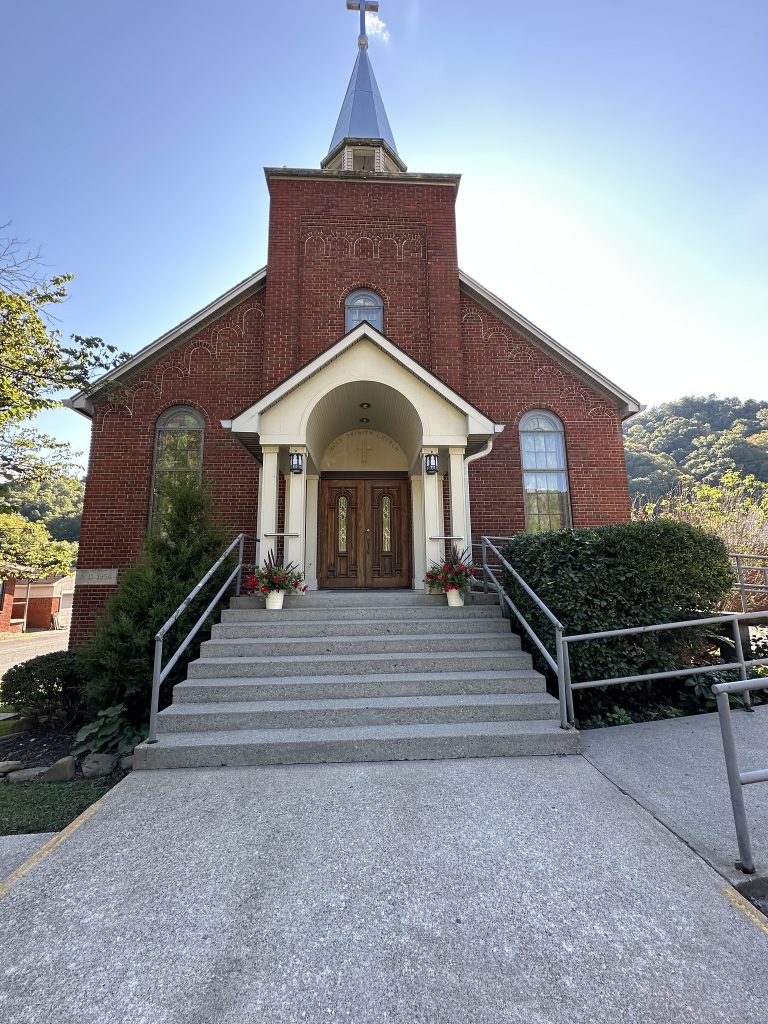
On the edge of downtown Harlan, just off U.S. 421, stands a small brick Catholic church that most travelers never notice. Holy Trinity Catholic Church is easy to miss in a county better known for coal camps, labor wars, and union ballads than for Roman collars and rosaries. Yet for more than three quarters of a century this parish and its school have quietly stitched themselves into the fabric of Harlan County life, serving miners, teachers, immigrants, and their children through boom, bust, and flood.
This is the story of how a handful of Catholics carved out a foothold in “Bloody Harlan,” why a postwar bishop in Covington cared about tiny mountain missions, and how Holy Trinity became a pantry, classroom, and refuge for people who are mostly not Catholic at all.
Coal, immigrants, and Harlan County’s first Catholic church
The Catholic story in Harlan County does not begin in the county seat. It starts up the valley, in the coal camps of the Tri-Cities.
In 1913, as Wisconsin Steel developed its company town at Benham, the company donated a lot on Maggard Creek and erected a small frame church, about twenty by forty feet, to serve new immigrant workers from Hungary, Italy, and Slavic Europe. The Catholic Church Extension Society supplied the altar, and that fall Bishop Camillus Maes of Covington came to bless the mission under the patronage of the Blessed Mother.
Known as St. Mary Mission, the little chapel was linked to the Jellico mission center that served Whitley County, Kentucky, and Campbell County, Tennessee. Benedictine priests from Cullman, Alabama, and later from Big Stone Gap, Virginia, rode the train or wagon roads into the valley to say Mass, at first once a month. In 1917 the mission finally received a resident pastor, Father Jerome Lawrence. St. Mary remained open through about 1919, then stood empty until it was demolished in the mid 1930s to make way for coal handling equipment.
Even after the building disappeared, its memory lingered. When Bishop Ronald Gainer of Lexington came to Lynch in 2013 to celebrate one hundred years of Catholic presence in Harlan County, local Catholics traced their roots back to that first mission church at Benham and to the immigrant families who filled its pews.
The closing of St. Mary did not end Catholic life in the county. Coal remained king, and new camps at Lynch and Cumberland drew more Catholic miners and families into the mountains. What the region lacked was a long-term commitment from the diocese to plant permanent parish structures in these remote hollows. That would change after the Second World War.
Mulloy’s mountain missions and the founding of Holy Trinity
When William T. Mulloy became bishop of Covington in 1945, he inherited a sprawling diocese that stretched deep into eastern Kentucky. Mulloy was already known as a rural pastor and advocate for farmers and small communities. In the late 1940s he deliberately turned his attention to the mountain counties.
A 1986 article in Northern Kentucky University’s journal Perspectives pulls back the curtain on this strategy. In a footnote surveying “parishes or missions established in the mountainous terrain of eastern Kentucky,” historian Tripta Desai lists “Holy Trinity, Harlan, 1948” among a cluster of new foundations that also included missions at Heidelberg, Pikeville, Barbourville, Hyden, Manchester, and Prestonsburg.
Mulloy’s diocesan historian, Paul Ryan, likewise treated the late 1940s and early 1950s as a period of deliberate expansion into poor rural areas, supported by Catholic Extension grants and mission priests willing to live far from northern Kentucky’s urban core.
Catholic Extension would play a direct role in Harlan. In a 2022 feature on Catholic ministry in eastern Kentucky, the Extension Society notes that it helped build Holy Trinity Catholic Church in Harlan in 1949. The same article explains that Holy Trinity was one of three mission churches in Harlan County, together with St. Stephen in Cumberland and the Church of the Resurrection in Lynch.
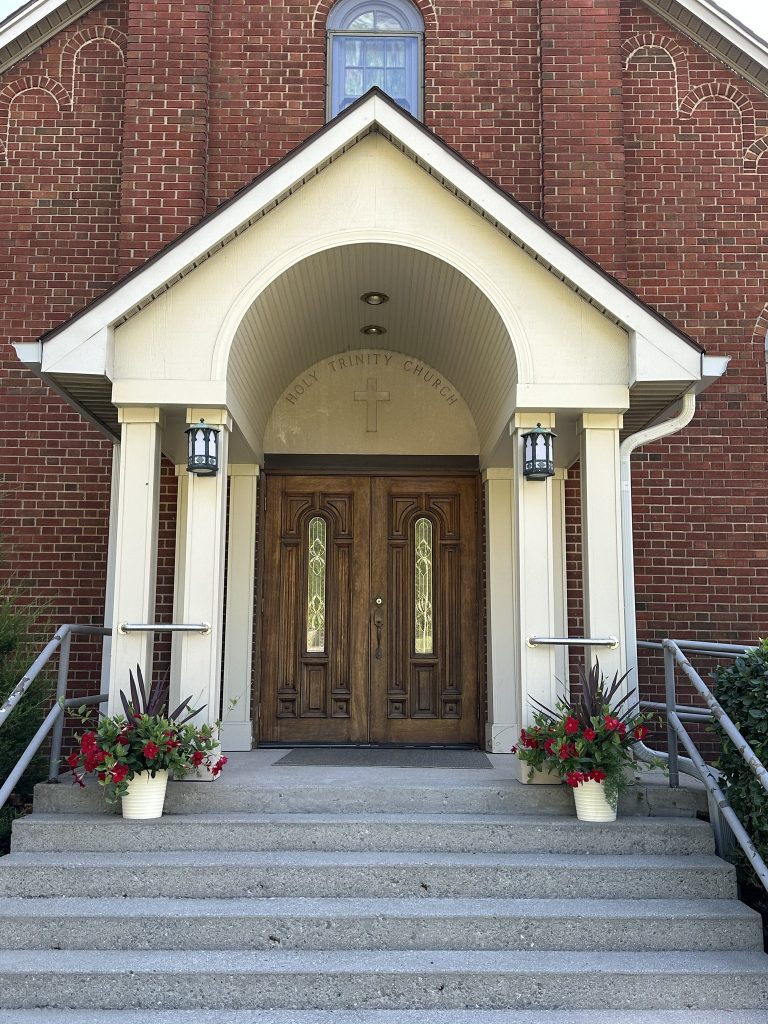
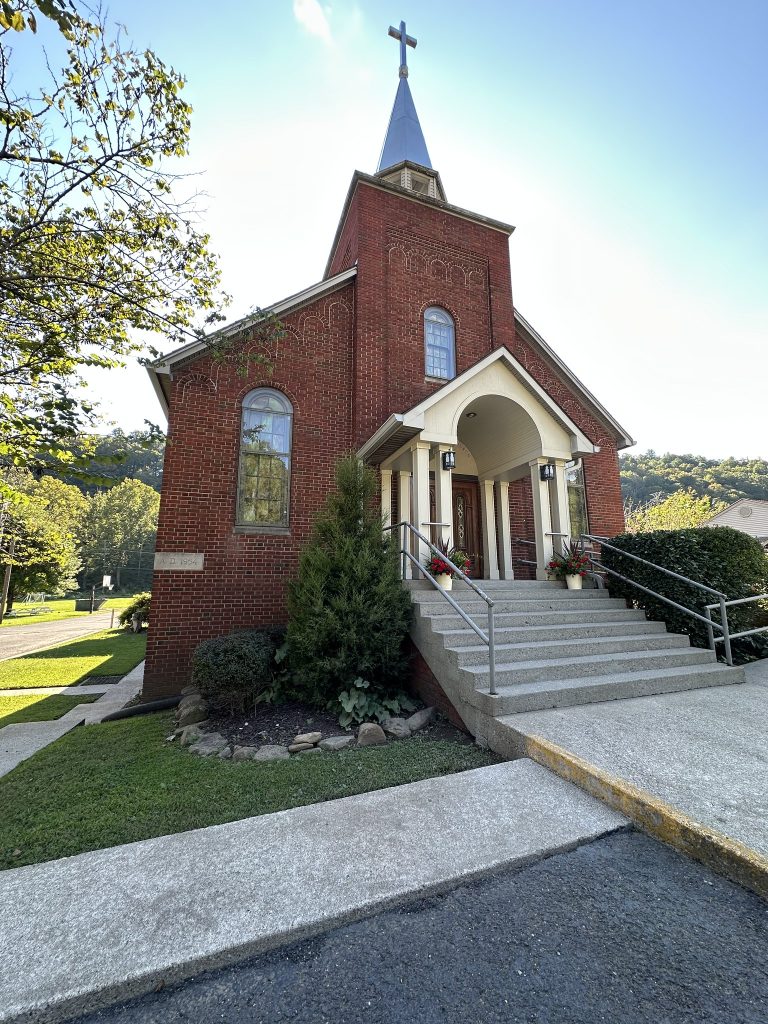
Photographs on travel blogs and parish pages show a modest brick church set into the hillside along U.S. 421, with a small bell tower and a simple, light-filled sanctuary. Early parishioners included professionals and coal families alike. One obituary from 2007 remembers Quinton P. Noe as “a charter member of Holy Trinity Catholic Church” and an active member of the Holy Name Society, hinting at a lay community that from the start took ownership of its new parish and linked its identity to traditional Catholic fraternal groups.
For the Diocese of Covington, Holy Trinity became a foothold in a county that had once hosted only a small frame mission on a company lot. For Harlan County Catholics, it was finally a church of their own.
“Oldest school in town?” Holy Trinity School and a mystery date
Next door to the church sits Holy Trinity School, a small pre-kindergarten through eighth grade Catholic school that now serves around forty students. A contemporary school profile based on federal education data lists the campus at 2536 South U.S. Highway 421, notes six classroom teachers and a very low student teacher ratio, and emphasizes the school’s mission to partner with parents to “teach as Jesus did” through Catholic doctrine, service, and community life.
What surprises historians is the “year founded” on that profile: 1883. That date predates not only Holy Trinity Church itself, founded in 1948, but also the 1913 St. Mary Mission at Benham. It may reflect an earlier Catholic school in another town whose records were later associated with Holy Trinity, or it may be a data error that crept into the National Center for Education Statistics file. Either way, the number invites further digging in diocesan and parish archives.
What we can say with more confidence is that by the late twentieth century, Holy Trinity School had become both a traditional parochial school and a neighborhood resource. Alumni photographs and reminiscences shared in online groups describe school plays, class pictures on the steps, and favorite Sisters and lay teachers. Former students remember volunteer nurses, fundraisers, and the tight connection between the parish and its classrooms.
The Sisters of Notre Dame appear repeatedly in those memories. Obituaries for Sisters Mary Sebastien, Mary Elaine, and Janet Marie Hoffman recall their years in Harlan, where they taught reading, ran the school library, and turned the convent’s front porch into a de facto social service office. Neighbors remember coming for food, diapers, and small cash gifts to cover medicine, long before “food pantry” became an everyday phrase. One sister received a Mission Award from the Diocese of Lexington for this work, underscoring how Holy Trinity’s teaching ministry blurred into direct aid.
Even as enrollment rose and fell with Harlan’s population, the school buildings stayed busy. Catholic Extension’s 2022 feature describes how, by the twenty first century, Holy Trinity’s additional school facilities were being used for preschool and tutoring programs staffed by certified teachers. Local schools, the article notes, told program director Trenna Cornett that her preschoolers arrived better prepared for kindergarten than any other group in the county.
In an area where broadband is spotty and many children fell behind during the COVID era, these classrooms, tucked in the shadow of Black Mountain, became a quiet engine of educational resilience.
Mardi Gras, Mrs. Claus, and a county wide Way of the Cross
If the school made Holy Trinity a place of weekday routines, parish traditions made it a hub for public devotion and community celebrations.
A 2013 obituary for longtime parishioner and community leader Dawn Nunez credits her as a founder of Harlan County’s “County Wide Way of the Cross” Easter observance, organizer of the Holy Trinity Mardi Gras party, and tireless fundraiser for Holy Trinity School. Nunez also aided local choirs, pageants, and hospice work, and was remembered for her Cajun cooking, laughter, and years spent playing “Mrs. Claus” in the county Christmas parade. In her life story, Catholic parish work and wider civic life were so closely intertwined that it is hard to pull them apart.
The Way of the Cross that she helped to found grew into a major county event. Harlan Enterprise pieces and WYMT television coverage describe hundreds of people gathering on Good Friday to walk through downtown Harlan, stopping at ten stations to read Scripture and sing hymns. Organizers from Holy Trinity told reporters they had been doing the walk for more than twenty years.
The procession is ecumenical, drawing participants from multiple churches, but it begins and ends with Holy Trinity’s organizing energy. The county tourism commission now lists the Way of the Cross as one of Harlan’s annual attractions, alongside coal monuments, festivals, and hiking trails.
Church bulletins and local “What’s Goin’ On” calendars reveal the smaller rhythms that surround these big events. Notices announce Lenten services rotating among Holy Trinity, Harlan United Methodist, and other downtown congregations, as well as pre registration days for Holy Trinity Preschool. The county bookmobile route even lists Holy Trinity among its regular Tuesday stops.
Taken together, these snippets show Holy Trinity as one node in a dense web of mountain religious life: Catholic, Protestant, and interdenominational, stitched together by shared observances, childcare, and the simple act of showing up.
“Feed them first”: food pantries, tutoring, and social outreach
In the twenty first century, Harlan’s coal economy continued to slide. Mines closed, companies merged or declared bankruptcy, and many younger families left in search of work. In this setting, Holy Trinity’s ministries of education and charity took on new urgency.
The Catholic Extension article on eastern Kentucky paints a vivid picture of how the parish cluster of Holy Trinity (Harlan), St. Stephen (Cumberland), and Resurrection (Lynch) functions today. Under the leadership of Father Terrence de Silva, who arrived in 2019 as the first resident priest in Harlan in more than thirty years, the three churches operate a network of food and outreach programs.
The largest food pantry is based at St. Stephen, distributing roughly six hundred boxes of food each month to families across the county. Holy Trinity, closer to many of the social service offices and schools, serves as an additional distribution site for about fifty local families.
De Silva summarized the mission bluntly for Catholic Extension: preaching matters, he said, but “we have to feed them first,” echoing the pattern of Christ feeding the crowds before teaching them.
The same story highlights Holy Trinity’s preschool and tutoring programs as an extension of that outreach. Classrooms in the former school building host after school homework help and early childhood education. All the instructors are certified teachers, and some of the children come from extremely difficult home situations. Program director Trenna Cornett told Extension staff that many of their students keep returning year after year, and that mentors often follow them beyond the program’s walls.
Where previous generations of sisters had quietly handed out groceries from a convent porch, Holy Trinity now partners with Catholic Extension grants, local volunteers, and visiting mission groups to do similar work at a larger scale. Catholic Mission Trips, Inc., for instance, has repeatedly listed Harlan as a destination, with mission reports describing volunteers staying at Holy Trinity, working on housing repairs, and assisting with food distribution in the parish cluster.
Blackjewel, unpaid miners, and a crowded parish hall
The most widely reported moment in Holy Trinity’s recent history came in July 2019, when the collapse of a coal company pushed already fragile households into crisis.
On July 1 of that year, Blackjewel LLC filed for Chapter 11 bankruptcy protection. Many miners later discovered that not only had their final paychecks bounced, but withdrawals for child support and retirement contributions had not been deposited in the proper accounts.
Local organizations scrambled to respond. On July 15, Father Jim Sichko, a priest of the Diocese of Lexington and one of Pope Francis’s designated “missionaries of mercy,” arrived at Holy Trinity with donations he had raised. News outlets and Catholic media report that miners and their families crowded into the church hall as Sichko wrote checks to cover electric bills and basic needs. In the space of a single day he handed out more than twenty thousand dollars.
Photos show tired men and women at folding tables, children in tow, in a parish where roughly ninety nine percent of those present were not Catholic. The images are striking: a Roman collar at the front of a room full of Appalachian miners whose relationship to the church is entirely practical and entirely urgent.
Subsequent reporting in the National Catholic Reporter and local papers continued to highlight Holy Trinity as one of the focal points for ongoing relief efforts. Judge Executive Dan Mosley calculated that miners were still owed millions in wages, while Father de Silva told reporters that his cluster parishes were fielding daily requests for food, clothing, and help with utilities.
The Blackjewel crisis did not create Holy Trinity’s outreach identity, but it revealed it to a national audience.
Training young leaders and hosting the wider Church
In addition to food and emergency aid, Holy Trinity has emerged as a gathering place for youth formation and leadership programs that draw participants from across the Diocese of Lexington.
In 2024 and 2025, diocesan event listings advertised a week long Servant Leadership Institute for high school students, hosted at Holy Trinity parish. The camp promised prayer, service, and leadership training on the Harlan church grounds, with youth ministers and pastors from around the diocese participating.
Campus ministry groups and Catholic student organizations from outside Kentucky have also partnered with Catholic Mission Trips to send teams to Harlan, especially after recent flooding. Fundraising pages describe Holy Trinity as the base where out of state students stay, pray, and then scatter throughout the county for work projects ranging from home repair to debris cleanup.
Beyond formal programs, Holy Trinity maintains ties with partner parishes in other states. A parish history page for Holy Name of Jesus Catholic Church in Trenton, Ohio, for instance, lists Holy Trinity in Harlan as one of its sister communities, reflecting a broader network of suburban and rural partnerships that have sustained mountain missions through decades of economic change.
These connections remind us that while Holy Trinity is deeply rooted in Harlan’s particular history, it also belongs to a wider Appalachian and American Catholic story.
A small parish with a large footprint
Standing in Holy Trinity’s parking lot, you can look down toward the courthouse square where the County Wide Way of the Cross winds each Good Friday, or up toward the narrow roads that once carried miners in and out of the camps. The parish’s physical footprint is small. Its registered membership is tiny compared to neighboring Baptist and Pentecostal congregations.
Yet from St. Mary Mission’s humble frame church at Benham to Bishop Mulloy’s decision to plant a permanent parish in Harlan, from school sisters running a front porch pantry to modern food bank logistics, from Mardi Gras parties to miners crowding a parish hall for emergency checks, Catholics in Harlan County have steadily chosen to be present where need is greatest.
Holy Trinity’s story complicates stereotypes about both mountain religion and Catholicism in the coalfields. Here the church is not a distant institution or an exotic minority. It is a small brick building off the highway where you can register your child for preschool, pick up a food box, help carry a cross through town, or simply sit for a while in a quiet sanctuary.
For Appalachian historians, the parish offers a window into how global traditions take root in isolated counties, how laypeople and sisters shape ministry far from diocesan centers, and how faith communities respond when the coal checks stop coming.
Sources & Further Reading
Catholic Extension Society. “Catholic Communities Are a Lifeline to the ‘Poorest of the Poor’ in Eastern Kentucky.” Extension (Summer 2022). October 19, 2022. https://www.catholicextension.org/stories/catholic-communities-are-a-lifeline-to-the-poorest-of-the-poor-in-eastern-kentucky/. Catholic Extension Society
“Priest Donates $20,000 to Coal Miners Whose Company Filed for Bankruptcy.” America (Associated Press), July 17, 2019. https://www.americamagazine.org/faith/2019/07/17/priest-donates-20000-coal-miners-whose-company-filed-bankruptcy/. America Magazine
Robert Alan Glover. “Miners in Kentucky Are Still Feeling the Hurt.” National Catholic Reporter, October 10, 2019. https://www.ncronline.org/feature-series/field-hospital/stories/miners-kentucky-are-still-feeling-hurt. National Catholic Reporter
“The Catholic Church Celebrates 100 Years in Harlan County.” Pipesmoke Ponderings (blog), October 3, 2013. https://pipesmokeponderings.blogspot.com/2013/10/the-catholic-church-celebrates-100.html. Appalachianhistorian.org
“Hundreds Gather in Harlan for Easter Tradition.” WYMT, March 30, 2018. https://www.wymt.com. Legacy
“Way of the Cross.” Harlan Enterprise, March 2018 and April 2020 coverage of the county-wide Good Friday procession. https://www.harlanenterprise.net. Harlan Enterprise
“Obituary for Dawn Nunez.” Anderson-Laws & Jones Funeral Home, Harlan, Kentucky, 2013. https://www.aljfh.com. aljfh.com
Catholic Mission Trips, Inc. “God’s Fingerprints: Mission Report – Harlan, KY.” Mission trip report and fundraising page, ca. 2018–2023. https://catholicmissiontrips.net/gods-fingerprints-mission-report-harlan-ky/. catholicmissiontrips.net
“Holy Trinity School.” Private School Review profile (drawing on NCES data), accessed January 3, 2026. https://www.privateschoolreview.com/holy-trinity-school-profile/40831.
Catholic Diocese of Lexington. “Holy Trinity Catholic Church, Harlan; St. Stephen, Cumberland; Church of the Resurrection, Lynch.” Parish directory and parish finder entries, accessed January 3, 2026. https://cdlex.org. Appalachianhistorian.org
Damian Hils. “The Apostolic Mission of William T. Mulloy: Shepherd of the Diocese of Covington, 1945–1959.” Perspectives in History 2, no. 1 (Fall 1986). https://inside.nku.edu/content/dam/hisgeo/docs/archives/Vol2_1_F1986perspectives.pdf. inside.nku.edu
Paul E. Ryan. History of the Diocese of Covington, Kentucky. Covington: Diocese of Covington, 1954. https://www.worldcat.org/title/history-of-the-diocese-of-covington-kentucky. Legacy
Catholic Diocese of Covington. “Diocesan Archives and Records Center.” Guide to chancery and parish records, accessed January 3, 2026. https://covdio.org/archives. Private School Review
“Catholic Churches of Harlan County, Kentucky.” Jamie in Wanderland (travel blog), August 24, 2014. https://jamieinwanderland.wordpress.com/2014/08/24/the-catholic-churches-of-harlan-county-kentucky/.
“Holy Trinity Catholic Church, Harlan, Kentucky” and “Holy Trinity Catholic School, Harlan KY” alumni and parish life posts, 2010–2025. Facebook pages and groups, accessed January 3, 2026. https://www.facebook.com.
Author note: I live in Harlan County within a short drive of Holy Trinity, and I wrote this piece as both a local neighbor and a historian trying to understand how a small parish shapes life in an overwhelmingly non-Catholic county. If you or your family have connections to Holy Trinity, St. Stephen, or Resurrection and are willing to share photos, bulletins, or memories, your stories can help deepen and correct this evolving history of Catholic life in the Harlan coalfields.
Hello – thank you for that informative and interesting history of Holy Trinity and Harlan. I will be coming to Harlan on an community outreach program this July and staying for a week at Holy Trinity – I’d love the opportunity to meet you and chat in person if you have the time 🙂