
Appalachian History Series – Founder’s Shack of Pippa Passes, Kentucky: One Room Beginning of Alice Lloyd College
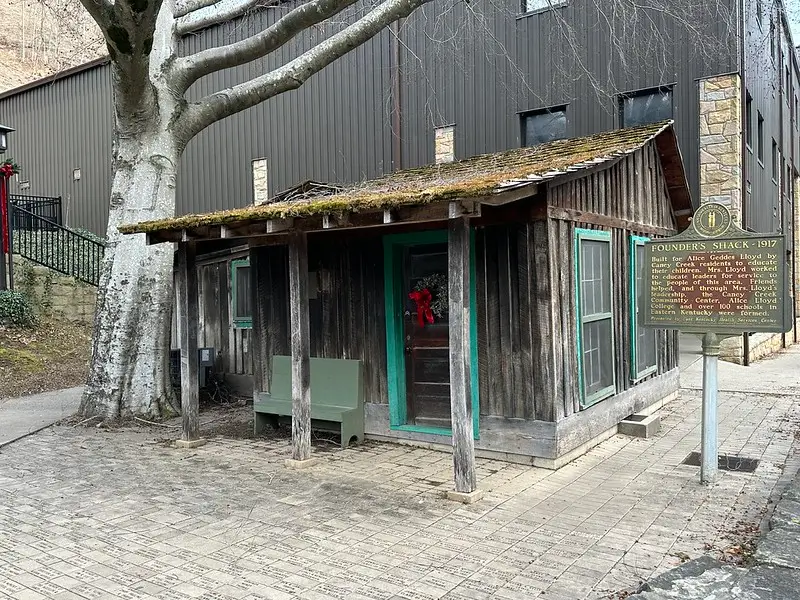
On most college campuses the oldest building is a brick hall or a stone chapel. At Pippa Passes the story begins in a small shack of rough boards and a sagging roof, tucked beside the creek that gave the institution its name. Drivers on Purpose Road see it first through a roadside marker that labels it “Founder’s Shack 1917” and explains that local people built the structure for a newcomer named Alice Geddes Lloyd so that their children could have a school.
Today the shack sits inside Alice Lloyd College’s campus, framed by dormitories, academic buildings, and the steep hills of Knott County. It survives not as a museum in the usual sense, but as a working building and a touchstone for stories that stretch from the 1910s to the present.
This is the story of how that small structure came to be, how it anchored the Caney Creek Community Center, and how it remains a symbol of education and mountain persistence more than a century later.
A Cabin for a Newcomer on Caney Creek
Alice Spencer Geddes Lloyd did not grow up in the Kentucky mountains. She was born in Massachusetts in 1876, worked as a writer and editor in New England, and moved south first for her health and then out of conviction that rural children deserved better schooling. By the mid 1910s she was in Knott County, corresponding with supporters in the North and exploring possibilities for a permanent school.
Local tradition and institutional histories agree that the crucial turn came when a Caney Creek farmer, often identified as Abisha Johnson, invited her farther up the valley. The narrow creek bottom at what is now Pippa Passes offered space for a small settlement, a few houses, and a school that could serve scattered families in the folds of the hills. On October 10, 1916, in a simple wooden building along that creek, Lloyd organized what she called the Caney Creek Community Center.
The shack that visitors see today emerged from those early years. A Kentucky Historical Society marker and a statewide roadside marker guide describe it as a one-room building erected in 1917 by Caney Creek residents specifically “to educate their children.” The same marker notes that Mrs. Lloyd devoted herself to preparing “leaders for service” in the surrounding mountain counties, tying the structure to a larger vision of training local youth to return home as teachers, nurses, and community leaders.
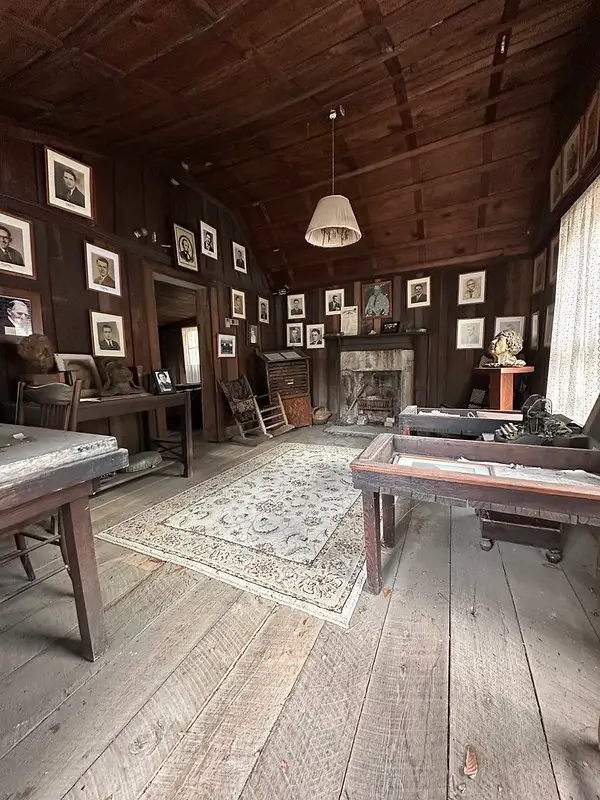
Photographs from the middle of the twentieth century show a modest frame cabin with a porch, flanked by trees and, later, by a cluster of campus buildings. The walls are rough boards; the interior, according to early descriptions, held simple benches, a heater, and the books and papers of a one woman school. Vintage postcards of “Founder’s Shack, Alice Lloyd College, Pippa Passes, Ky.” circulated the same image and reinforced the idea that everything on Caney Creek began in this small room.
Founding the Caney Creek Community Center
Lloyd did not call her experiment a college at first. The early years in the shack carried the name Caney Creek Community Center, and the work combined schooling with broader efforts at community development. Surviving letters and reports in the Alice Lloyd–Caney Creek Community Center Papers at the University of Kentucky show her writing to donors about literacy classes, clubs for mothers and girls, health campaigns, and the need for better school buildings up and down the creek.
Those papers, along with later campus histories, make clear that the shack housed more than a conventional classroom. On any given day it might serve as a general school for children of multiple ages, a meeting place for local committees, a Sunday worship space, or a headquarters where appeal letters were typed on an Oliver typewriter for audiences “back East.”
From the very beginning Lloyd insisted that the center was a partnership between mountain families and outside supporters. Local residents contributed labor, timber, and food. Donors in Boston, New York, and the Midwest sent checks, books, clothing, and building materials. Later records from groups like the Kansas City Browning Society, which kept files on its support for the Caney Creek school and college, show how organizations far from Kentucky adopted the shack and its work as causes of their own.
The shack quickly became a symbol in those fundraising networks. Newsletters and bulletins mailed from Pippa Passes in the 1920s and 1930s often used photographs of the building to represent the whole enterprise. National attention followed. A 1940 feature in Time magazine titled “School in Caney Valley” framed the Caney Creek experiment as a work study school in an isolated hollow, presenting the shack and its successors as proof that disciplined effort and small gifts could transform mountain children’s lives.
From Shack School to Caney Junior College
The organizational dates that now appear on historical markers simplify a gradual process. The Kentucky Historical Society’s ExploreKYHistory entry on Alice Lloyd College gives the key milestones in compressed form: Caney Creek Community Center organized in 1917, Caney Junior College established in 1923, and the college renamed for Alice Lloyd after her death in 1962.
On the ground those transitions looked more like a thickening of buildings and responsibilities around the shack. As elementary schools opened in nearby hollows, promising students gravitated toward Caney Creek for higher grades. By the early 1920s the community center’s leaders were offering postsecondary courses designed to train “leaders for Appalachia,” even before the junior college charter was formalized.
When June Buchanan arrived from New York in 1919, accounts from both women’s papers place the shack at the center of the campus. In an interview preserved by the Louie B. Nunn Center for Oral History, Buchanan remembered joining Lloyd in the work of teaching, bookkeeping, and public speaking, all anchored in that first cluster of buildings along the creek. Later she helped oversee the transition to a more formal junior college while still using the shack as a reference point for the institution’s identity.
By mid century, photographs and postcards show the shack surrounded by a growing campus with dormitories on stilts above the water and a chapel on the hill. Yet the small building remained visible in the foreground of many views, a reminder that the college saw its origins in a single, community built room rather than in a large benefactor’s gift.
Letters, Archives, and Postcards
What historians know about those formative years rests on a layered set of sources. The Alice Lloyd–Caney Creek Community Center Papers in Lexington cover roughly 1915 to 1972 and include correspondence, reports, and administrative files generated from the shack and later offices along Caney Creek. They preserve draft appeal letters, minutes of local meetings, and descriptions of how the community center used the shack for both schooling and social services.
In Pippa Passes itself, the McGaw Library and Learning Center maintains the college archives, an Appalachian Special Collection, the Appalachian Photo Archive, and the Appalachian Oral History Collection. The photo archive contains historic images of the campus, including multiple shots of the shack across several decades. The oral history collection, much of it created through the four college Appalachian Oral History Project, includes interviews with students, staff, and neighbors who remembered attending classes or events in the old building.
Scattered collections elsewhere add outside perspectives. The Kansas City Browning Society Records in Missouri include newsletters and correspondence about the society’s support for the Caney Creek school and college. The Mary Earle Gould Papers at Historic Deerfield contain a folder of correspondence with the Caney Creek Community Center in the 1960s, written at a time when the shack and its story had already become part of the center’s heritage. Archival material at Pine Mountain Settlement School and in Council of the Southern Mountains files at Berea College offers glimpses of how other settlement workers and regional advocates viewed Lloyd’s work and the building that symbolized it.
Visual sources carry their own narratives. Mid century postcards show the shack in crisp black and white or faded color, sometimes with printed text on the back explaining that gifts of a small building and 150 acres had enabled Alice Geddes Lloyd to offer Caney Creek residents their first educational opportunities. Online auction listings preserve scans of those cards, while Pinterest boards and campus newsletters recycle the images for new generations.
Taken together, these letters, photographs, and ephemera make it possible to move beyond a simple heroic story and to see the shack as part of a lived landscape shaped by local families, outside donors, and the daily work of students and staff.
Markers, Memory, and the Story the Shack Tells
The shack’s current prominence in public memory owes a great deal to historical markers. On Purpose Road in Pippa Passes, Kentucky Historical Society Marker 1532 stands near the building. Its inscription stresses that Caney Creek residents built the shack for Lloyd, highlights her goal of educating young people for service, and links the structure directly to the creation of the Caney Creek Community Center and what became Alice Lloyd College. The marker for “The Caney Creek Community Center,” cataloged separately, anchors the founding date in October 1916 and repeats the claim that “in this shack was founded the Caney Creek Community Center.”
Those signs do more than mark a spot. They distill a long and complicated story into a few sentences that drivers can read in passing. In doing so they cement certain themes in public consciousness: that the initiative began with one determined woman, that local people built the first structure, and that the center’s purpose was to train leaders who would remain in the mountains rather than leave.
Campus language echoes those themes. The Alice Lloyd College catalog for 2022–2024 describes Founder’s Shack as the tiny building from which Mrs. Lloyd provided “the first education in the Caney Creek area” and notes that it now stands surrounded by a campus that testifies to the more than 115 elementary and high schools she helped establish across eastern Kentucky.
At the same time, scholarly work has complicated the older sentimental narrative. P. David Searles’s book A College for Appalachia and his article “Dissension Among the Do Gooders” draw on the same archival base to emphasize how Lloyd’s fundraising letters sometimes leaned on exaggerated images of mountain backwardness and how her leadership style could generate friction with colleagues and neighbors. Those critiques do not erase the importance of the shack or the schools that followed, but they remind us that institutions born in simple buildings are still embedded in the social and political dynamics of their time.
Founder’s Shack on a Working Campus
Unlike many historic schoolhouses, Founder’s Shack is not preserved as a frozen exhibit cut off from contemporary life. It remains part of a working campus. College publications note that the building has housed offices and that its surroundings have been reshaped into a brick plaza used for events commemorating the 95th anniversary of the Caney Creek Community Center and other milestones.
In campus tours and recruitment materials, the shack serves as a starting point for explaining the college’s work study model and its commitment to Appalachian students. Students walking past on their way to classes or work assignments see it framed by newer brick and concrete, a physical reminder that the promise of “a college for Appalachia” grew out of a space not much larger than a modern classroom.
For local residents, alumni, and visitors, the building anchors a sense of continuity. Oral histories and alumni magazine pieces carry memories of family members who attended school in the shack, helped repair its roof, or posed for photographs on its porch. In that sense the structure is not only an artifact from 1917 but also a backdrop for personal stories woven through the rest of the twentieth century.
Why Founder’s Shack Matters
From a historian’s perspective, Founder’s Shack matters for several reasons.
First, it is a concrete link between national movements for rural uplift and the specific communities of Caney Creek. The University of Kentucky papers, the McGaw archives, and scattered manuscript collections show how one small building became a staging ground where local families and reformers from outside Appalachia negotiated what education should look like in an isolated valley.
Second, the shack illustrates how institutions grow from improvisation. Before there were dormitories, science labs, or paved roads, there was a small structure beside a mountain creek where lessons, letters, and community meetings all happened in the same humble space. That reality complicates later images of the college as a fully formed work study campus and emphasizes the incremental nature of change.
Third, the building’s afterlife as a symbol invites questions about memory. Historical markers, postcards, television programs, and campus tours have all used the shack to tell particular versions of Caney Creek’s story. By reading those sources critically, researchers can trace how images of Appalachian poverty, self help, and female leadership have been constructed and contested over time.
Finally, Founder’s Shack stands as an unusually well documented example of how a local initiative became a regional institution. Few historic wooden buildings anywhere in Appalachia can be followed so closely from their construction through decades of use, commemoration, and interpretation. As long as the shack remains beside the creek, it offers a tangible starting point for anyone who wants to understand how a single room on Caney Creek helped educate generations of students and reshape the educational landscape of eastern Kentucky.
Sources & Further Reading
Kentucky Historical Society. “Founder’s Shack – 1917.” Kentucky Historical Marker 1532. Frankfort: Kentucky Historical Society. https://history.ky.gov/markers/founders-shack-1917 history.ky.gov
Historical Marker Database. “Founder’s Shack.” HMdb.org: The Historical Marker Database. https://www.hmdb.org/m.asp?m=146283 HMDB
Historical Marker Database. “The Caney Creek Community Center.” HMdb.org: The Historical Marker Database. https://www.hmdb.org/m.asp?m=146340 HMDB
Beebout, Christopher. “Alice Lloyd College.” ExploreKYHistory. Kentucky Historical Society. https://explorekyhistory.ky.gov/items/show/873 explorekyhistory.ky.gov
Wells, Dianne, comp. Kentucky Roadside Markers. Frankfort: Kentucky Historical Society; Elizabeth Cady Stanton Trust, n.d. PDF. https://elizabethcadystanton.org/wp-content/uploads/2020/08/kyrm.pdf Elizabeth Cady Stanton
Frazier History Museum. “Beat the Heat at Beer Fest, Introducing ‘Saturday Sarah’ and Dr. James Barry.” Weekly blog, June 24, 2024. https://www.fraziermuseum.org/weekly/6-24-2024 Frazier Kentucky History Museum
Whitner, Jerri. “Providing Opportunities for a Century: The Caney Creek Community Center.” Kentucky Living, April 24, 2017. https://www.kentuckyliving.com/news/providing-opportunities-century-caney-creek-community-center Kentucky Living
Hall, Jennifer, and Ty Reagan. “Alice Lloyd College: 100 Years of Affordable Education in Appalachia.” Kentucky Monthly, August 10, 2023. https://www.kentuckymonthly.com/culture/kentucky-explorer/alice-lloyd-college-100-years-of-affordable-education-in-app/ kentuckymonthly.com
University of Kentucky Libraries Special Collections Research Center. Alice Lloyd – Caney Creek Community papers, 1915-1923. Finding aid. Lexington, KY. http://exploreuk.uky.edu/catalog/xt7mgq6r127r/guide Wikipedia
State Historical Society of Missouri, Research Center – Kansas City. Kansas City Browning Society Records (K0003), 1895-1970. Finding aid and collection guide. https://files.shsmo.org/manuscripts/kansas-city/K0003.pdf files.shsmo.org
Historic Deerfield. Mary Earle Gould Papers, 1915-1975. Finding aid. https://www.historic-deerfield.org/sites/default/files/inline-files/Mary%20Earle%20Gould%20Papers.pdf Historic Deerfield
University of Kentucky Libraries Special Collections Research Center. James Still Papers, 1885-2007. Finding aid. http://exploreuk.uky.edu/catalog/xt79p843rt9n/guide stillbib.omeka.net+1
Alice Lloyd College. “McGaw Library and Learning Center.” Institutional archives description, including the Appalachian Photo Archive and Appalachian Oral History Collection. https://alc.edu/academics/mcgaw-library-and-learning-center/ alc.edu
National Agricultural Library. “Appalachian Oral History Project Collection, 1970-1977 (MS0316).” Special Collections, National Agricultural Library, Beltsville, MD. https://archivesspace.nal.usda.gov/repositories/4/resources/782 archivesspace.nal.usda.gov
Hazard Community and Technical College. “Hazard-Lees Appalachian Oral History Project.” Kentucky Digital Library. https://kdl.kyvl.org/digital/collection/haz-lees-aohp kdl.kyvl.org+1
Emory & Henry College. “Appalachian Oral History Project.” Appalachian Center for Civic Life Digital Archives. https://www.emoryhenry.edu/live/profiles/1126-appalachian-oral-history-project Emory & Henry University
Appalachian State University. “Oral History Program.” W. L. Eury Appalachian Collection, Special Collections Research Center. https://collections.library.appstate.edu/collections/oral-history-program Home
McGaw Library and Learning Center. Appalachian Photo Archive. Alice Lloyd College, Pippa Passes, KY. Collection description. https://alc.edu/academics/mcgaw-library-and-learning-center/ alc.edu
Ogeechee Trading Company. “Founders Shack Alice Lloyd College Pippa Passes Kentucky 1970 Postcard.” Vintage postcard listing. https://www.ebay.com/itm/236095915812 eBay
OldPostcards.com. “Alice Lloyd College Founders Shack, Pippa Passes, Kentucky Postcard (ky_yy_10323).” https://www.oldpostcards.com/uspostcards/kentucky/ky_yy_10323-alice-lloyd-college.html oldpostcards.com
WorthPoint. “Pippa Passes, KY – Founders Shack, Alice Lloyd College 4×6 postcard.” Archived listing. https://www.worthpoint.com/worthopedia/pippa-passes-ky-kentucky-alice-lloyd-4926817518 WorthPoint
“Education: School in Caney Valley.” Time, April 8, 1940. https://time.com/archive/6763157/education-school-in-caney-valley/ TIME+1
“Education: School in Caney Valley.” Time Vault, U.S. Edition, April 8, 1940, vol. 35, no. 15. https://content.time.com/time/subscriber/article/0,33009,763811-2,00.html Time+1
“Alice Spencer Geddes Lloyd.” Biographical entry. Wikipedia. https://en.wikipedia.org/wiki/Alice_Spencer_Geddes_Lloyd Wikipedia
Allen County Public Library Genealogy Center. “Alice Lloyd cottage” and “Alice Lloyd and Dr. June Buchanan, Caney Creek Community Center history, 1917-2017.” Kentucky Explorer Periodical Source Index entries for Vol. 5, no. 8 (February 1991) and Vol. 32, no. 4 (September 2017). https://www.genealogycenter.info/results_persilocation_detail.php?cosearch=USA&loc=KY&rectype=HS&sort=title&subloc=Knott Genealogy Center+1
Searles, P. David. A College for Appalachia: Alice Lloyd on Caney Creek. Lexington: University Press of Kentucky, 1995. https://books.google.com/books?id=Q27vC0mfTmgC Google Books+1
Searles, P. David. “Dissension Among the Do-Gooders: Alice Lloyd and Her Critics in Appalachia.” Register of the Kentucky Historical Society 93, no. 2 (Spring 1995): 151-177. https://www.jstor.org/stable/23383768 OUP Academic
Davis, Jerry C. Miracle on Caney Creek: June Buchanan Joins Alice Lloyd in a Crusade to Educate Kentucky Mountain Leaders. Pippa Passes, KY: Caney Creek Community Center, 1982. https://apmtbooks.com/products/miracle-on-caney-creek-by-jerry-c-davis Appalachian Mountain Books+1
Dutton, William S. Stay On, Stranger!: An Extraordinary Story of the Kentucky Mountains. New York: Farrar, Straus and Young, 1954. https://catalog.freelibrary.org/Record/740907 ThriftBooks+1
Shackelford, Laurel, and Bill Weinberg, eds. Our Appalachia: An Oral History. Lexington: University Press of Kentucky, 1988. https://www.kentuckypress.com/9780813101842/our-appalachia/ The University Press of Kentucky+1
Appalachian State University. “App State Oral History Program Preserves the Past and Present Through Storytelling.” Appalachian Today, November 18, 2024. https://today.appstate.edu/2024/11/18/oral-history-project Home
Sikes, Scott. “Meaning and Memory: Reconsidering the Appalachian Oral History Project.” International Journal of Information, Diversity, & Inclusion 5, no. 2 (2021): 84-98. https://jps.library.utoronto.ca/index.php/ijidi/article/view/34830 jps.library.utoronto.ca+1
Williams, John R., and Katherine R. Martin. “The Appalachian Oral History Project: Then and Now.” Provenance: The Journal of the Society of Georgia Archivists 2, no. 1 (1984). https://digitalcommons.kennesaw.edu/provenance/vol2/iss1/5/
Author Note: I work just up the hill from Founder’s Shack, and I still notice new details every time I pass it. I hope this piece helps you see that small building as part of a bigger story about education, labor, and memory along Caney Creek.