
Appalachian History Series – The Coal Camp Post Office at the Heart of a Company Town
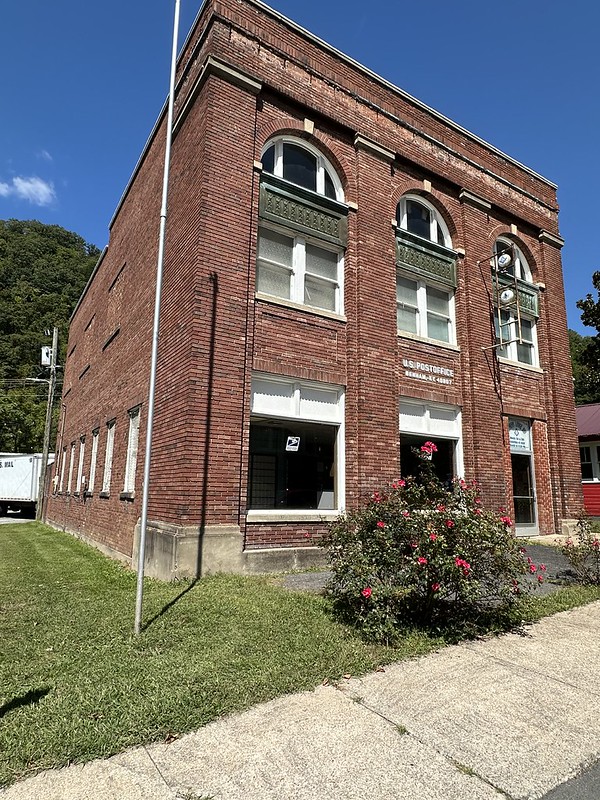
The Benham Post Office has never been the biggest building in town. It does not tower over the valley like the old tipples once did, and it does not have the imposing bulk of the commissary that now houses the Kentucky Coal Museum. What it has instead is persistence. Since 1923 this brick post office on Main Street has anchored the civic heart of Benham, quietly carrying letters, bills, postcards, and packages in and out of a coal camp that became a historic district and then a heritage destination.
Step outside the lobby and you stand at the edge of the circular park that planners for Wisconsin Steel laid out in the early twentieth century. Around that circle rise the same brick landmarks listed in the Benham Historic District nomination: theatre, city hall, commissary, hospital, school, church, and park. The nomination describes seven major brick buildings and the surrounding park as the core of a self-sustaining coal town, designed in the early 1920s as the visible face of the company’s welfare program. The post office sits in that ring like a small but important gear in a larger machine, a federal service nested inside a private coal camp.
From Yowell to Benham
Before there was a Benham post office there was a Yowell post office. Tri-Cities Main Street’s local history traces the town’s first name to early settlers who claimed to hear the growl of mountain wildcats in the valley. The Yowell post office opened in 1900, serving a scattering of farms along Looney Creek at the foot of Black Mountain.
At that point the valley was still remote and hard to reach. The comparative history of Benham and similar company towns notes that Yowell’s little post office became a vital link between those farm families and the outside world. When the Louisville and Nashville Railroad pushed a spur up the valley in the early 1910s, and when International Harvester’s Wisconsin Steel subsidiary began to buy up land along the Benham Spur, that same post office suddenly sat in the path of something much larger.
On 23 July 1911 the Post Office Department formally changed the office’s name from Yowell to Benham. The academic study on the company towns of Benham and Lynch emphasizes this date as more than a bit of paperwork. It marked the moment when a rural hamlet became the seed of a model coal town, built to keep coke flowing to International Harvester’s steel mill in South Chicago. Local tradition holds that the new name honored a company official, while the mailbags and cancellation stamps began to carry the word “Benham” out into the wider world.
A Company Town Built around a Park and a Post Office
The National Register narrative and Kentucky Coal Museum’s excerpts agree on the basic outline of Benham’s planned landscape. After the railroad arrived in 1911 company architects from Wisconsin Steel laid out a new town in 1912 with a central circular park, company buildings facing both the main highway and the railroad, and residential streets climbing up toward the lower slopes of Black Mountain. Streets took the names of trees. Dozens of frame houses went up along those streets during the first building phase.
As coal production increased, Wisconsin Steel replaced the original frame office, store, and service buildings with a coordinated set of brick structures around the park between roughly 1920 and 1925. The Register text lists a brick theatre, meat market, commissary, company office, fire hall, hospital, Methodist church, grade school, and, in 1923, a new post office. All of these were tied together by a coal-fired steam heating system that ran through underground pipes, an engineering detail that underlined how thoroughly the company planned the town’s infrastructure.
In this rebuilt civic core the post office held a particular place. It sat just off the park, three bays wide on its main façade, between the more utilitarian meat market and the imposing commissary. Sanborn fire insurance maps prepared specifically for the Wisconsin Steel camp at Benham in 1928 show the post office’s footprint and its relationship to the park, store, theatre, and other public buildings, a visual confirmation of how closely federal and company functions were intertwined in the town plan.
The Architecture of a Small Landmark
The Benham Historic District nomination calls the post office “the most decorative of the community structures,” and a quick look at photographs and the Kentucky Coal Museum’s excerpted description makes it easy to see why. The building rises two and a half stories in brick, but its front elevation is carefully composed rather than plain.
On the ground level, large plate-glass windows flank an offset entrance, the kind of storefront glazing meant to flood the lobby with light and invite people in off Main Street. Above that, the second story uses simple one-over-one sash windows, but the wall between the second and half-story levels carries bands of copper panels with decorative patterns pressed into them. These panels sit between the windows like jewelry on the building’s face. The half-story windows at the top are arched, set into radiating brickwork with stone keystones and concrete sills. Doric pilasters separate the bays, their stone capitals catching light under a copper cornice that runs the full width of the roofline.
Inside, the first floor has been remodeled more than once, but the building still houses the community’s post office. The National Register account notes that the upper stories were designed as meeting rooms, and by the early 1980s the owner of record was Benham Lodge No. 880, underscoring the building’s dual role as both a federal facility and a local gathering place. Where many company-town structures were plainly utilitarian, this one carried a bit of architectural flourish, signaling that the mail and the organizations upstairs were central to community life.
Work, Welfare, and the Mail in a Coal Camp
From the moment the brick post office opened in 1923 it functioned at several scales at once. For miners and their families it was a place to pick up pay envelopes that arrived from company offices in Chicago, to send money orders, to receive mail-order goods from Sears and other catalogs, and to keep up with relatives who had moved away to other mining camps or to cities on the railroad.
At the same time the post office linked Benham to state and federal systems that were not entirely under company control. Records of appointment of postmasters, preserved today on National Archives microfilm in Record Group 28, show a series of postmasters whose names overlap with the world of local merchants and company officials, a reminder that the boundary between corporate and civic life was thin. Those same federal records trace the office’s continuity through the twentieth century, confirming the Yowell establishment date, the 1911 name change, and the ongoing operation of the Benham office that residents still use today.
The comparative history of Benham and Lynch stresses how welfare-capitalism ideals shaped these towns. Company magazines and publicity photographs from the 1920s and 1930s show brick schools, hospitals, and stores, but the post office often appears in the background rather than at center stage. Even so, its presence on the park’s edge meant that every parade, every gathering in the playground, and every walk to the commissary passed by its doors, folding the daily act of sending and receiving mail into the rhythm of coal-camp life.
Decline, Incorporation, and Historic District Status
By the late 1920s Benham was near its peak, with the Register describing about 1,200 miners at work and hundreds of ovens turning out coke for Wisconsin Steel. Employment fell during the Depression and then surged again during the Second World War, but mechanization and falling demand after the war gradually reduced the number of jobs.
Tri-Cities Main Street’s summary explains what happened next. In the early 1960s, facing economic and technological change, International Harvester began selling houses in Benham to the families who lived in them. Churches were deeded to their congregations, the school transferred to the county system, and the hospital turned over to a nonprofit group. In 1961 the company moved to incorporate Benham, creating a mayor-council government and formally handing many public functions over to the town.
The National Register nomination, completed in 1983, captured Benham at a moment when the mines were declining but the town center still held its original plan and architecture with remarkably few changes. In that nomination the post office, Methodist church, and school are singled out as buildings that continued to serve their original functions, while the company office had become city hall and several other structures stood vacant or had shifted to new commercial uses. Two decades later the Advisory Council on Historic Preservation’s Preserve America profile described Benham as a town founded in 1911 whose last mine closed in the 1970s, now “forging a new identity” that relies on well-preserved historic assets, including the public buildings around the park.
In the 2000s and 2010s residents and advocates pushed for even stronger protection. A petition filed by Kentuckians for the Commonwealth asked state officials to declare the historic districts of Benham and nearby Lynch, and the watersheds that supply their drinking water, as “areas unsuitable for mining.” The petition emphasized that the Benham Historic District, about thirty acres bounded by KY 160, Central Avenue, and nearby streets, represented nationally recognized historic and cultural resources with a period of significance from 1900 to 1924. The post office’s brick façade, copper cornice, and familiar lobby were part of what that petition sought to safeguard.
A Working Post Office in a Historic Landscape
One measure of the Benham Post Office’s endurance is that the United States Postal Service still lists it as an active facility at 229 Main Street, Suite 1, Benham, Kentucky 40807. Public directories that draw on USPS data note its short weekday afternoon retail hours and Saturday morning window, a schedule that fits a small town but keeps the office open as a gathering point and service hub.
If you stand at the center of the park today and turn slowly, you can still read the coal-camp story in every direction. The former commissary, now the Kentucky Coal Museum, fills one side of the circle. The old company office is city hall. The school has become the Schoolhouse Inn. The red-brick jail and the weathered theatre mark the edge of the district. The post office completes that ring, its copper trim and pilasters still catching light in the same way they did when miners’ children first ran up its steps with letters to faraway relatives.
For historians, the building offers a tangible link to a rich paper trail. Postal appointment records, site-location reports, Sanborn maps, USGS quadrangles, and local government minutes all converge on this one address, allowing researchers to trace how a rural hamlet called Yowell became a coal town called Benham and how that town navigated the long shift from company camp to incorporated city to historic district. For residents, it is simply where you still go to pick up the mail.
In that sense the Benham Post Office is more than a handsome brick structure in a register listing. It is a working piece of infrastructure that has outlasted the company that helped build it, the tipples that once overshadowed it, and even the trains that first made Benham possible. As long as its lobby stays open and its address stays in use, the story of a coal camp that learned how to persist will keep moving in and out of town, one envelope at a time.
Sources & Further Reading
Thomason, Philip. “Benham Historic District.” National Register of Historic Places Inventory–Nomination Form. Washington, DC: National Park Service, April 14, 1983. PDF, NPGallery Digital Asset Management System. https://npgallery.nps.gov/GetAsset/cb3927ea-5def-4e52-99d2-d7b29bfccc1a Wikipedia
Kentucky Coal Mining Museum. “Register of Historic Places.” Kentucky Coal Mining Museum. Accessed January 3, 2026. https://kycoalmuseum.southeast.kctcs.edu/explore/national_register.aspx Kentucky Coal Museum
Kentucky Coal Mining Museum. Historic Downtown Benham Walking Tour Map. Benham, KY: Kentucky Coal Mining Museum, ca. 1990s. PDF brochure. https://kycoalmuseum.southeast.kctcs.edu/media/other/historic-downtown-benham-walking-tour-map.pdf Kentucky Coal Museum
Sanborn Map Company. Wisconsin Steel Co., Inc., Benham, Harlan Co., Ky., 1928 September 7. Sanborn Fire Insurance Maps of Kentucky. University of Kentucky Libraries Special Collections Research Center, Lexington. Accessed via ExploreUK digital collections. https://exploreuk.uky.edu UKY Archives
Sanborn Map Company. Sanborn Fire Insurance Maps: Kentucky, including sheets for Benham and Lynch, Harlan County, ca. 1920s-1940s. Library of Congress, Geography and Map Division. https://www.loc.gov/collections/sanborn-maps National Archives
U.S. Post Office Department. Records of Appointment of Postmasters, 1832-1971. Microfilm Publication M841. Washington, DC: National Archives. Descriptive entry at https://www.archives.gov/research/post-offices/m841-appointments Cincinnati Public Library
U.S. Post Office Department. Records of Site Locations, 1837-1950. Record Group 28. Washington, DC: National Archives. Descriptive entry at https://www.archives.gov/research/post-offices/site-locations kentonlibrary.org
Rennick, Robert M. “Harlan County’s Post Offices.” Typescript, ca. early 2000s. Kentucky County Histories Collection, Morehead State University, ScholarWorks. https://scholarworks.moreheadstate.edu/kch_postoffices/339 MSU Digital Archives
Jim Forte Postal History. “Post Offices in Harlan County, Kentucky.” Postal History. Accessed January 3, 2026. https://www.postalhistory.com/postoffices.asp?county=Harlan&state=KY&task=display postalhistory.com
United States Geological Survey and Robert M. Rennick. Benham Quadrangle: Kentucky–Virginia 7.5 Minute Series (Topographical). Map, 1979. Rennick Topographical Map Collection, Morehead State University, ScholarWorks. https://scholarworks.moreheadstate.edu/rennick_maps_all/48 MSU Digital Archives
Advisory Council on Historic Preservation. “Benham, Kentucky.” Preserve America Community profile. Accessed January 3, 2026. https://www.achp.gov/preserve-america/community/benham-kentucky U.S. Access Board
National Park Service. “Kentucky – National Register of Historic Places and Preserve America Listings.” National Park Service. Accessed January 3, 2026. https://www.nps.gov/state/ky/list.htm?program=all National Park Service
National Park Service. “Kentucky.” State overview page. Accessed January 3, 2026. https://home.nps.gov/state/ky/index.htm?program=all National Park Service
Kentuckians for the Commonwealth. Petition to Designate the Historic Districts within the Cities of Benham and Lynch and the Viewshed from Those Districts, and the Watersheds that Provide the Water Supply for Those Cities, as Areas Unsuitable for Mining. Ca. 2010s. PDF. https://kftc.org/sites/default/files/docs/resources/harlanlumfinal.pdf KFTC 40th Anniversary
Kentucky Coal Heritage Project. “Benham, Kentucky.” Coal Camps and Communities. Accessed January 3, 2026. https://www.coaleducation.org/coalhistory/coaltowns/benham.htm coaleducation.org
Kentucky Heritage Council. “National Register of Historic Places – Overview.” Kentucky Heritage Council. Accessed January 3, 2026. https://heritage.ky.gov/historic-places/national-register/Pages/overview.aspx Kentucky Heritage Council
Moore, Sam. “The Town International Harvester Built.” Farm and Dairy, October 20, 2016. https://www.farmanddairy.com/columns/the-town-international-harvester-built/375249.html Facebook
McDaniels, Jennifer. “Former UK Trustee and Her Husband Spearhead Benham Coal Camp History Project.” WUKY, October 25, 2025. https://www.wuky.org/wuky-news/2025-10-25/former-uk-trustee-and-her-husband-spearhead-benham-coal-camp-history-project wuky.org
Author Note: Coal camp buildings can feel abstract until you stand in front of one and trace the paper trail behind it. I hope this look at Benham’s post office helps you see how a single brick building can hold a whole town’s history.