
Appalachian Churches Series – Jenkins United Methodist Church in Jenkins, Kentucky
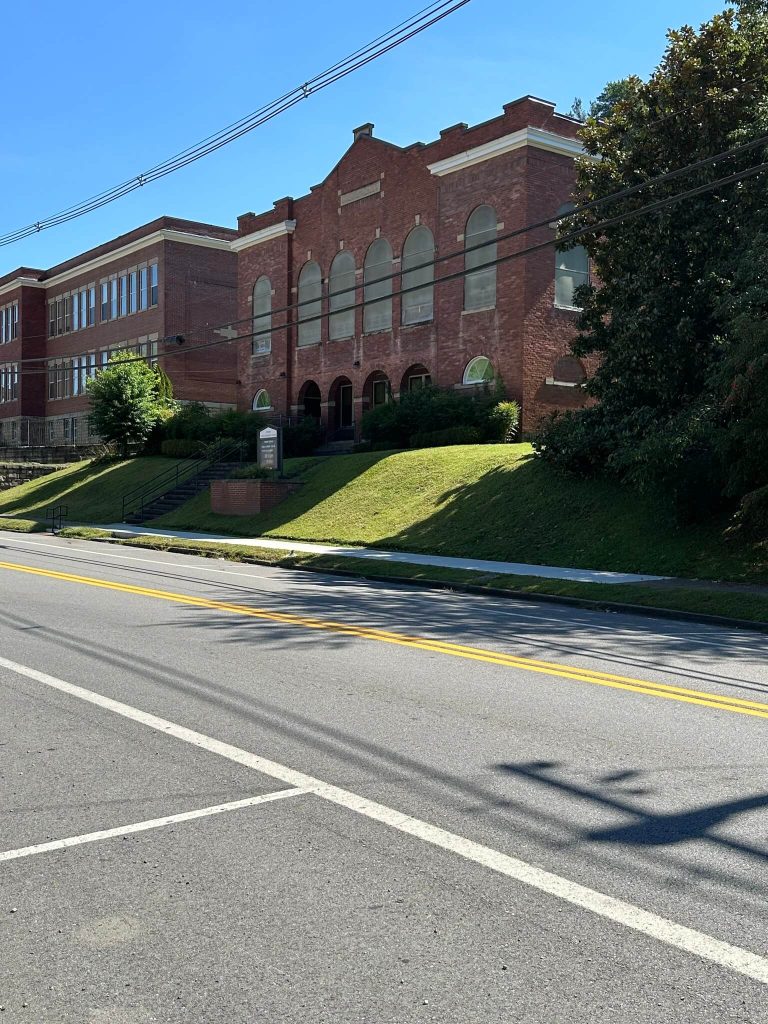
On the uphill side of Main Street in Jenkins, Kentucky, a two story brick church with a row of tall arched windows still looks out over the old company town. Across the street the former depot holds the David A. Zegeer Coal Railroad Museum, and behind both buildings the hills rise steeply toward former mine camps and company houses. For more than a century the congregation now known as Jenkins United Methodist Church has gathered in that brick sanctuary while coal, commerce, and population have surged and ebbed around it.
Like the rest of Jenkins, the church was a product of corporate planning as well as local devotion. In 1911 Consolidation Coal Company bought a vast block of land in Letcher and neighboring counties and laid out a model town along Elkhorn Creek. Company engineers drew the street grid, built rows of houses, opened a hospital and schools, and financed a cluster of churches that would make the new camp feel like a complete community to workers and their families. The town’s history and the Kentucky Historical Society marker both stress that churches were part of the original package of houses, stores, hospital, and schools that the company erected.
This article leans first on primary material. The corporate record appears in Consolidation Coal’s own Mutual Magazine and in a 1916 company photograph of “Methodist Church, Jenkins, Kentucky.” Local memories are preserved in the community history The History of Jenkins, Kentucky, in obituary files, and in the pages of The Mountain Eagle. Methodist conference directories and journals trace the congregation’s place in the Kentucky Annual Conference, while early and mid twentieth century postcards and photo collections document how the building looked over time. It then turns to wider studies of religion in the coal fields and county level histories to place Jenkins United Methodist Church within the story of Appalachian Methodism and coal town life.
A company town and a brick Methodist church
The best short account of the church’s beginnings appears in the “Churches” section of The History of Jenkins, Kentucky, a community volume compiled in 1973 from local records and interviews. The entry on the United Methodist Church explains that, according to an article in Consolidation Coal Company’s Mutual Magazine, the Methodist Church of Jenkins was established through cooperation between the Kentucky Conference and local citizens. The company publication bragged that the new brick structure was the most modern church building in the coal section of Kentucky.
That boast matched the building’s appearance. The 1916 corporate photograph now held by the Smithsonian’s National Museum of American History shows a substantial two story brick rectangle with a raised basement, three arched entrances opening onto a covered porch, and a symmetrical row of large stained glass windows at sanctuary level. The church fronts directly onto a graded street with newly planted saplings and a few houses visible behind it, a reminder that the sanctuary was rising at almost the same moment as the rest of the town.
The same community history notes that the first minister was identified only as Rev. Crutchfield and that J. Marvin Kinzer served as Sunday School superintendent. In a town where almost all land and buildings belonged to Consolidation Coal, early lay leadership seems to have mixed company officials and working families. The Methodist congregation drew from a population that included migrants from older Kentucky farms, mountain hollows, and other coal regions, all trying to make a life around the mines and tipples of the Elkhorn Division.
As the camp matured, the company gradually sold off its houses and utilities. In the “They Built a Town” chapter, the same 1973 history recalls that all church buildings in Jenkins were eventually deeded to their members for a token price of one dollar when Consolidation got out of the real estate business. That transfer turned structures that had begun as part of a corporate welfare program into property controlled by local congregations, including the brick Methodist church on Main Street.
Pastors, lay leaders, and the library downstairs
From the beginning, Jenkins Methodist was part of a wider Methodist network. Kentucky Annual Conference journals list Jenkins among the churches and charges in the mountain districts, and modern conference records still show the church as part of the South East Kentucky district. In 2007 conference legislation formally dissolved a combined Jenkins and Whitesburg charge so that each could function as a separate station church, a reminder that even small congregations in the hills remain woven into the appointment system and polity of United Methodism.
Within the town itself, the church quickly became a place where religious and civic life overlapped. In the 1930s local women organized the Jenkins Women’s Civic Club. By the mid 1940s their most ambitious project was a “free public library,” opened with donated books and staffed by volunteers. A 1955 feature in the Louisville Courier Journal, reprinted in The History of Jenkins, reports that the library first occupied the women’s club meeting room in the Methodist church basement before moving to a Boy Scout cottage and later to its own building. In those years anyone coming for a book or a club meeting had to walk under the arches and down the stairs beneath the sanctuary.
The Methodist building hosted other organizations as well. The same community history and later reminiscences describe Kiwanis events, club meetings, and civic suppers held in the basement rooms. The Mountain Eagle’s “The Way We Were” columns have recalled dinners, youth programs, and community gatherings at the church. These fragments point to a familiar pattern in coal towns: the church basement doubled as a social hall where people planned festivals, raised money for school projects, and shared news long after the mines closed for the day.
Photographs, postcards, and stained glass
A rich photographic record lets us watch the building age without losing its basic form. The 1916 Pittsburgh Consolidation Coal Company photograph captures the church shortly after construction, when the surrounding trees were still small and the brick walls and stone steps were new.
By mid century the congregation had been in place for decades. A real photo postcard, postmarked 1952 and preserved by CardCow, shows the church from nearly the same angle. The brick walls are a little darker, the landscaping more established, and the stained glass windows deeply shadowed, but the arched entryway and the row of five tall sanctuary windows are unchanged. That postcard was not produced for an internal company report. It was a souvenir someone might mail to relatives to say “this is our church” and “this is our town.”
Other photographs, including images in the Jenkins Photographic Collection at the University of Kentucky and reproductions on local history sites, show the church from farther away as part of Main Street streetscapes. The Methodist building appears alongside other downtown structures, a familiar landmark in panoramic views that have become stock illustrations for Jenkins history.
Modern color photographs on genealogical and family history sites show the church much as it looks today. The brick front still carries a slightly stepped parapet. The same three arches frame the entrance porch. The stained glass windows have been repaired, but their placement and size match the early images. Concrete steps climb from the sidewalk, flanked by metal railings and a small signboard announcing service times for Jenkins United Methodist Church.
Taken together, the 1916 company photograph, the 1950s postcard, and contemporary images form an almost continuous visual record. They show a church that has weathered a century of coal booms and busts while maintaining the basic form praised a hundred years ago as “most modern” in the coal fields.
Banquets, funerals, and the social life of Jenkins
Because the Methodist church belonged to a company town, its story appears not only in denominational journals but also in local newspapers and obituary files. The Mountain Eagle in nearby Whitesburg has long treated Jenkins as part of its beat. Through the twentieth and early twenty first centuries, its society columns and community notes have mentioned banquets held in the Jenkins Methodist Church basement, anniversary celebrations, and occasional ecumenical services.
Obituaries are an especially valuable near primary source. USGenWeb’s Letcher County obituary compilations and online records from local funeral homes repeat notices that identify the deceased as lifelong or long time members of Jenkins Methodist or United Methodist Church. Many of these notices mention roles such as choir member, Sunday School teacher, trustee, or leader in women’s groups. When read in sequence, they let historians reconstruct a lay leadership roster that stretches from the company town era into the post coal years.
These sources also underline how deeply the church was woven into daily life. Weddings, funerals, and revival services filled the sanctuary, while dinners, Bible schools, club meetings, and library hours used the basement and side rooms. When residents left Jenkins for other counties or other states, their obituaries often looked back to Jenkins United Methodist Church as the place where they had been baptized, married, or confirmed.
Methodist faith in a changing coalfield
The Methodist presence in Jenkins did not stand alone. For more than a century the congregation has been part of the Kentucky Annual Conference, whose records follow shifts in districts and charges across the mountains. Modern conference directories list Jenkins United Methodist Church in the South East Kentucky district, reflecting its place among other small town and rural congregations.
Conference business records show how that relationship evolved. In 2007 the Kentucky Annual Conference formally dissolved the combined Jenkins and Whitesburg charge so that each congregation would be recognized as a station church with its own pastoral appointment. That administrative decision came at a time when both towns were coping with mine closures and population loss, yet it affirmed that each church still warranted its own pastoral leadership.
The History of Jenkins entry on the United Methodist Church notes that the congregation later changed its name to Jenkins United Methodist Church after the 1968 merger of the Methodist Church and the Evangelical United Brethren to form the United Methodist Church. The building, in other words, outlasted denominational reorganizations and simply absorbed a new name onto its cornerstone and bulletins.
Religious historians have used Jenkins as a case study for broader patterns in the coal fields. In his book Work and Faith in the Kentucky Coal Fields: Subject to Dust, Richard J. Callahan Jr. argues that company towns like Jenkins relied on churches to promote order, respectability, and a sense of moral community. He notes that Methodist congregations in particular linked the daily lives of miners and their families to larger denominational structures that stretched far beyond the Elkhorn valley.
Jenkins United Methodist Church today
In the early twenty first century, Jenkins is a much smaller town than the booming camp of the 1910s and 1920s. Coal employment has sharply declined, and many houses on the hillsides stand empty or have been demolished. Yet Jenkins United Methodist Church continues to meet in the brick building on Main Street. Denominational directories and church listing sites give the congregation’s location in downtown Jenkins and record regular Sunday worship and seasonal programs, even if the average attendance is now modest.
The church’s social media presence and local news coverage show that it remains a public witness in town life. In recent years the congregation has hosted community events, participated in charity drives, and opened its doors for special services responding to national and international crises. Coverage of vigils and prayer services in Jenkins has noted the church’s stained glass windows glowing over Main Street as people gathered to pray for neighbors and for distant conflicts.
Stand on the sidewalk in front of the church today and the scene lines up closely with the old black and white postcard. The five tall windows on the sanctuary level are still there. The brick façade still rises above an arched porch. The steps still climb from the street toward heavy double doors that have swung open for weddings, funerals, revivals, club meetings, and quiet weekday library hours. Only the cars parked along the curb and the newer signs across the way at the Zegeer Museum mark the passage of time.
Jenkins United Methodist Church began as part of a coal company’s plan for a model town. Over the decades it became something else: a congregation owned by its members, a meeting place for civic life, a landmark in photographs and postcards, and a spiritual home for generations of mountain families. In its bricks, windows, and records we can trace a century of intertwined stories about corporate power, community resilience, and Methodist faith in the Appalachian coalfields.
Sources & Further Reading
Jenkins Area Jaycees. History of Jenkins, Kentucky: Compiled in Honor of the Sixtieth Anniversary Homecoming Celebration, 1912-1973. Jenkins, KY: Jenkins Area Jaycees, 1973. Online transcription, Thayer’s Gazetteer. https://penelope.uchicago.edu/Thayer/E/Gazetteer/Places/America/United_States/Kentucky/Letcher/Jenkins/_Texts/HJK/home.html
Consolidation Coal Company. “Jenkins, Kentucky Photographic Collection, 1911-1930.” Special Collections and Digital Programs, University of Kentucky Libraries, Lexington. ArchiveGrid collection record. https://researchworks.oclc.org/archivegrid/collection/data/225865203
“Jenkins, Kentucky.” History in Photos (blog), 2014. Uses images from the Jenkins Photographic Collection with contextual captions on town life and institutions. https://historyinphotos.blogspot.com/2014/08/jenkins-kentucky.html
National Museum of American History. “Pittsburgh Consolidation Coal Company Photographs and Other Materials, NMAH.AC.1007.” Archives Center, Smithsonian Institution, Washington, DC. Finding aid PDF documenting photographs of Jenkins churches and other company town structures. https://sirismm.si.edu/EADpdfs/NMAH.AC.1007.pdf
Georgia State University Library, Special Collections. “The Mutual Magazine by Consolidated Coal Company, Vol. 3 No. 1, 3–4, 7–8; Vol. 4 No. 1, 4, 1920–1921.” In M. H. Ross Papers, L2001-05, archival object 1527. Finding aid entry describing bound issues of The Mutual Magazine, which includes the article on the founding of the Jenkins Methodist Church. https://archivesspace.library.gsu.edu/repositories/2/archival_objects/1527
Georgia State University Library, Special Collections. “Mutual Magazine by Consolidated Coal Company, Vol. 2 No. 7, July–August 1919.” Digital Library of Georgia entry in the M. H. Ross Papers, describing issues of The Mutual Magazine that cover coal company town development in Appalachia. https://dlg.usg.edu/collection/gsu_mhross
Jenkins United Methodist Church. “Jenkins United Methodist Church.” Facebook page for the congregation, with photos, announcements, and contact information. https://www.facebook.com/JenkinsMethodistChurch/
United Methodist Church. “Jenkins United Methodist Church.” Find-A-Church directory listing, with address, contact, and basic congregational information. https://www.umc.org/en/find-a-church/church?id=001Um00000PF67xIAD
UMData. “Jenkins United Methodist Church – Active.” Church profile listing GCFA number 366903, district, charge name, and physical and mailing addresses. https://www.umdata.org/church?church=366903
“Shepherd’s Stream Kentucky Church Directory – Jenkins United Methodist Church.” Shepherd’s Stream listing with telephone contact, welcome text, and basic location details for the Jenkins congregation. https://shepherdsstream.com/kentucky-church-directory/jenkins-united-methodist-church
Kentucky Annual Conference of The United Methodist Church. “Letcher County Charge Conference.” Event listing, October 8, 2017, noting that the charge conference was held at Jenkins United Methodist Church. https://www.kyumc.org/eventdetail/letcher-county-charge-conference-9507579
Kentucky Historical Society. “Jenkins.” Kentucky Historical Marker Database, marker 1804, summarizing the origins of Jenkins as a company town with company built churches among its planned institutions. https://history.ky.gov/markers/jenkins
Kentucky Historical Society. “Jenkins.” ExploreKYHistory entry (item 233), providing historical context for the Jenkins marker and describing Consolidation Coal’s role in building houses, stores, schools, and churches. https://explorekyhistory.ky.gov/items/show/233
Callahan, Richard J. Jr. Work and Faith in the Kentucky Coal Fields: Subject to Dust. Bloomington: Indiana University Press, 2009. Interprets religious life in coal camps, including Jenkins, with discussion of Methodist congregations in company towns. https://archive.org/details/workfaithinkentu0000call
CoalCampUSA. “Jenkins, Kentucky.” CoalCampUSA east Kentucky section with photographic essay on Jenkins as a coal company town, including a labeled contemporary photograph file “jenkins-methodist-church.jpg.” https://www.coalcampusa.com/eastky/elkhorn/jenkins-kentucky/jenkins-kentucky.htm
USGenWeb. “Letcher County, Kentucky – Genealogy.” Letcher County USGenWeb main page, which links to the article “Letcher County’s Methodist Heritage” reprinted from The Mountain Eagle and to other Methodist related material. https://usgenwebsites.org/KYLetcher/letcher.htm
Letcher County Historical and Genealogical Society. “Letcher Heritage News Index.” Letcher Heritage News index entry pointing to “Letcher County’s Methodist Heritage” and other local church history articles. https://sites.rootsweb.com/~kyletch/lchgs/lhn_ndx.htm
USGenWeb. “Letcher County Obituaries.” Obituary abstracts from The Mountain Eagle and other local papers, often noting membership in Jenkins Methodist or Jenkins United Methodist Church. https://sites.rootsweb.com/~kyletch/obituaries/obit1.htm
“Letcher County Community News-Press, May 16, 2007, page 4.” Cromona, Kentucky. Issue containing an obituary noting that Terrill was a member of Jenkins United Methodist Church. https://lch.stparchive.com/Archive/LCH/LCH05162007p04.php
“Letcher County Community News-Press, April 24, 2013, page 10.” Cromona, Kentucky. Issue with obituary recording that a decedent was a member of Jenkins United Methodist Church and active in its life. https://lch.stparchive.com/Archive/LCH/LCH04242013p10.php
“Letcher County Community News-Press, October 31, 2007, page 3.” Cromona, Kentucky. Community calendar listing prayer meeting times and pastor information for Jenkins United Methodist Church. https://lch.stparchive.com/Archive/LCH/LCH10312007p03.php
Carty Funeral Home. “Obituaries 2015.” Online obituary list for a Jenkins funeral home, with multiple entries that identify individuals as members of Jenkins United Methodist Church or note services held there. https://www.cartyfuneralhome.com/obituaries-2015
The Mountain Eagle. “The Way We Were.” The Mountain Eagle (Whitesburg, KY), September 6, 2023. Retrospective column referencing Methodist congregations in Jenkins and neighboring coal camps. https://www.themountaineagle.com/articles/the-way-we-were-825/
The Mountain Eagle. “The Way We Were.” The Mountain Eagle (Whitesburg, KY), October 4, 2023, page 6. PDF reprint of historical clippings, available via KY Public Notice, used for broader context on Letcher County church life. https://kypublicnotice.com/KYLegals/2023/70216-2023-10-04_1004.pdf
The Mountain Eagle. “Donna Kay Boggs, 81, Was Active on Boards, Committees.” The Mountain Eagle (Whitesburg, KY), obituary noting her membership and service in Jenkins United Methodist Church. https://www.themountaineagle.com/articles/donna-kay-boggs-81-was-active-on-boards-committees/
The Mountain Eagle. “Services Are Held for John William Brown.” The Mountain Eagle (Whitesburg, KY), obituary describing funeral services connected with Jenkins United Methodist Church. https://www.themountaineagle.com/articles/services-are-held-for-john-william-brown/
Kentucky Tennessee Living. “The First Library in Jenkins.” Kentucky Tennessee Living, December 5, 2021. Local history article explaining how women’s groups and the Methodist church basement helped house the first free public library in Jenkins. https://kentuckytennesseeliving.com
“Flags and a Vigil Across EKY City Honors Ukraine.” WYMT Mountain News, April 6, 2022. Coverage of a community prayer vigil and flag display in Jenkins, illustrating contemporary civic and religious collaboration in which Jenkins United Methodist members participated. https://www.wymt.com/2022/04/06/flags-around-eky-city-honors-ukraine/
“Jenkins, Kentucky.” Wikipedia, last modified 2024. General overview of the city’s origins as a Consolidation Coal company town, population trends, and civic institutions that frame the setting for Jenkins Methodist and other churches. https://en.wikipedia.org/wiki/Jenkins%2C_Kentucky
Author Note: I first noticed Jenkins United Methodist Church beside the old Jenkins school, and something about that brick landmark on Main Street stayed with me. It felt like the kind of place worth writing about, because its walls have watched a century of Jenkins life rise and fall.