
Repurposed Appalachia Series – Benham Theater of Harlan County
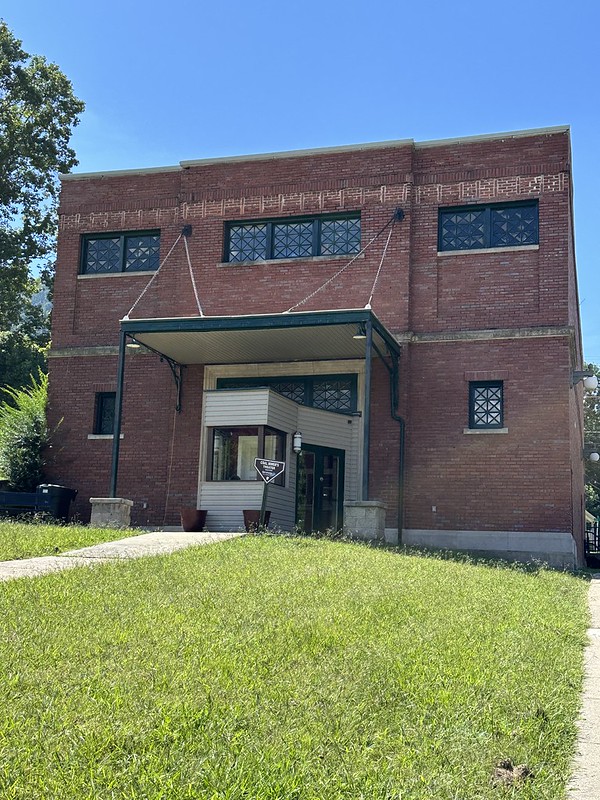
On the quiet streets of Benham, the brick facade of the old theater still faces Circle Park, its green ticket booth and canopy standing out against the red walls and the backdrop of Black Mountain. The building began life as the Benham Theater in the early 1920s, a company playhouse and movie house in a town that Wisconsin Steel and its parent, International Harvester, carefully planned as a model coal camp. Nearly a century later it survives as the Betty Howard Coal Miners Memorial Theater, a reminder that community life in the coalfields has always been about more than the mines.
A Theater for a Company Town
Benham itself is a creation of corporate planning. International Harvester, searching for captive coal to feed its South Chicago mills, acquired land on the Benham Spur of Black Mountain in the 1910s and set its subsidiary Wisconsin Steel to work building a town. By the early 1920s Benham held a commissary and meat market, schools, churches, health facilities, and more than four hundred company houses, laid out as a model coal community rather than a haphazard patch town.
Within that built landscape the theater was one of the most conspicuous public buildings. The National Register of Historic Places nomination for the Benham Historic District describes the Benham Theater as a two story brick structure erected in the early 1920s, built by Wisconsin Steel as an entertainment and meeting center for miners and their families. The nomination and related building lists from the Kentucky Coal Mining Museum note its rectangular massing, flat roof, and simple yet distinctive details, including a molded stone surround around the main entrance and decorative plasterwork inside.
Contemporary maps of the company town show the theater close to the other civic buildings along the main street and Circle Park, near the center of company power. In this respect it fit the pattern described by scholars of Appalachian company towns, where opera houses and theaters often stood at the heart of planned communities, as visible evidence that the coal camp was modern, civilized, and respectable.
Films, Stars, and Saturday Nights
From the beginning the Benham Theater served as a multipurpose venue. A walking tour brochure prepared by the Kentucky Coal Mining Museum describes it as a two story brick theater built in 1922 that showed silent films at first and then talking pictures as technology changed. The same brochure recalls how Hollywood cowboy stars such as Lash LaRue and Hoot Gibson appeared on its stage, giving miners and their families a direct brush with national popular culture right in a coal camp in Harlan County.
For local people, the theater was woven into weekly rhythms. After long shifts underground or in the company shops, miners and their families lined up at the ticket booth for Saturday shows, church benefits, boxing exhibitions, or home talent performances. That pattern fits what William Faricy Condee documents in his study of Appalachian opera houses, where coal town theaters typically hosted everything from traveling productions and concerts to church services and school programs.
The stage was not the only place in Benham where people performed, and the surviving photographic record hints at the broader world of entertainment that the theater helped support. The Southeast Kentucky Community and Technical College Appalachian Archive holds the Benham Lynch Collection, roughly twenty five hundred photographs and negatives taken by company photographers between about 1917 and 1958. These images, originally created to document town building for corporate officials, captured school plays, festivals, and civic events that reveal how central performance and spectacle were to community life.
One 1925 photograph from the U.S. Coal and Coke and International Harvester image collection shows boys and girls in costume on the stage at Benham High School during a senior play, with students named on the back of the print. Another photograph records a football team posed in uniform with a public building behind them. Even when these scenes took place in the school auditorium rather than in the Benham Theater itself, they belong to the same company town culture that filled the theater’s seats on show nights.
Corporation, Community, and Social Control
Benham was celebrated by some visitors as a model coal town because it offered comparatively good housing, paved streets, health care, and recreational facilities at a time when many miners elsewhere in Appalachia lived in far harsher conditions. Yet historians of company towns have long pointed out that those amenities were part of a system of social control. The company that built the houses and schools also paid the preachers, monitored politics, and chose where people gathered after work.
In that framework the Benham Theater was more than a simple movie house. A comfortable and affordable venue for family entertainment helped channel leisure into company approved forms. Films and live acts could offer escape, but they could also model proper behavior, reinforce gender roles, and showcase patriotic or religious themes that supported the industrial order. Historians of Appalachian towns have shown how company sponsored orchestras, choirs, and theatrical productions often marched in step with corporate interests, even as workers and their families reclaimed those spaces for their own uses in subtle ways.
Labor and corporate records place the theater within this broader system. Agreements between Wisconsin Steel and the Benham Employees Association from the late 1930s, preserved today in regional archives, speak to the carefully managed relationship between company and workforce. Federal mining and industrial directories that list Wisconsin Steel’s Benham operations likewise make clear that the same corporate apparatus that supervised the mine and the company store also built and maintained the town’s social spaces.
Decline, Closure, and a Youth Center
As with most coal company towns, prosperity in Benham depended on national energy markets that community residents could not control. After the Second World War, changing fuel usage and corporate investment patterns began to undercut the future of captive coal operations. By the late 1950s, according to the Kentucky Coal Mining Museum’s walking tour, the Benham Theater had closed as a movie house. The building was then donated to the city and used as a youth center, a sign that the community still valued it as a gathering place even after the projectors went dark.
The building and the town around it weathered years of disinvestment. A blogger who documented the restored theater in the mid 2010s notes that like many coal company structures in Harlan County, the Benham Theater fell into disrepair before local residents began a broad campaign of preservation that included the schoolhouse, the company store turned museum, and public spaces. That same account points out that the theater and most of the surviving core of Benham were listed together on the National Register of Historic Places in July 1983, formal recognition that this industrial streetscape had national significance.
National Register documentation confirms that the Benham Historic District was added to the register in 1983. Within that district the theater stands as one of the key public buildings that defined the company town in the 1920s and that continue to define the skyline today.
From Benham Theater to the Betty Howard Coal Miners Memorial Theater
The story of the building’s second life belongs to the people of Benham. Local histories and community accounts describe how, beginning in the late twentieth century, residents and allies sought grants and private donations to restore the theater interior, repair or replace the decorative moldings, and make the stage usable again. The Kentucky Coal Mining Museum’s walking tour credits grants and donations for the restoration and notes that the renewed theater once again hosted city events and group meetings.
The restored house operates today as the Coal Miners Memorial Theater, and more specifically as the Betty Howard Coal Miners Memorial Theater, named for the late Benham mayor Betty Howard, who helped lead the town’s preservation efforts. A Tri Cities community page and regional writers both emphasize Howard’s role in spearheading the renovation and in tying the theater’s revival to a wider project of community renewal that included the Benham Schoolhouse Inn, the Coal Miners Memorial Park, and other heritage sites.
Cinema Treasures, a movie theater history project, lists the building under its present name and notes that the former Benham Theater, opened in the early 1920s, has been reborn as a live venue with about three hundred seats. Exterior photographs highlight its brick walls, small square windows with patterned glass, and the green ticket booth that now serves as a visual landmark for visitors to the historic district.
A Working Stage in the Twenty First Century
If the Benham Theater began as a symbol of corporate modernity, its current life is a testament to local resilience. In recent years the Betty Howard Coal Miners Memorial Theater has hosted vintage style Christmas concerts by Harlan County musicians, with proceeds supporting community causes like the Tri City Empty Stocking Fund. Coverage in the Harlan Enterprise describes sold out holiday shows, jazz inflected arrangements of classic songs, and a crowd that fills the hall to hear neighbors perform on a historic stage.
The theater has also become a venue for heritage themed events. Kentuckians for the Commonwealth chose the restored Benham house as the site for panels and gatherings during its Appalachia’s Bright Future conference, positioning the building as a place where people could talk about economic transition and community organizing in the coalfields.
Tourism materials from Harlan County highlight the historic theater in event calendars and promotional guides. A recent cryptids lecture invited visitors to sit beneath the old plasterwork ceiling, buy popcorn at the vintage concession stand, and listen to talks on Bigfoot, Dogman, and other creatures, while Halloween events have transformed the space into themed haunted attractions. At Christmas, posters for concerts at the Miner’s Theater circulate alongside ads for Portal 31 mine tours and hikes at Kingdom Come State Park, tying the theater into a regional tourism loop that treats the Tri Cities as a living museum of coal country.
The site has even drawn paranormal interest. The documentary Benham Theater: Specters of the Stage uses the building as both setting and subject, blending interviews, ghost hunting, and historical commentary. While the ghost narratives sit in the realm of belief, the film itself functions as a near primary audio visual record of what the theater looked and felt like in the years after restoration, capturing details that written sources sometimes overlook.
Reading the Theater through the Archives
For researchers, the story of the Benham Theater does not begin and end with what is visible from Circle Park. Archival collections hold the scattered documents and images that make it possible to tell a fuller history. The Benham Lynch Collection at the Southeast Kentucky Community and Technical College Appalachian Archive, cataloged through the CLIR Hidden Collections program, includes around twenty five hundred photographs, negatives, and glass plates that document the construction and early years of Benham and Lynch. Company photographers working for Wisconsin Steel and U.S. Coal and Coke recorded public buildings, coal operations, and community events, giving historians a window into the company town world that the theater served.
The Appalachian Archive’s online exhibit “Benham, Kentucky, The Town that International Harvester Built” provides additional context, explaining how executives used photography to track progress and how the town was divided by race, class, and company status. That exhibit, along with individual catalog records for school plays, sports teams, and street scenes, allows scholars to reconstruct the social geography of entertainment in a town where music and drama were both encouraged and constrained.
The Kentucky Coal Mining Museum in Benham, housed in the former company store, keeps both artifacts and interpretive materials that refer to the theater and its role within the historic district. Its walking tour brochure, building inventories, and video collections, including documentary films about Benham’s history, work together to situate the theater within a broader narrative that includes the company store, the lamphouse, schools, and later preservation efforts.
Newspapers and trade journals help fill in the gaps. Back issues of the Harlan Enterprise, now available through the Harlan Public Library, are the best source for opening announcements, film listings, advertisements, and coverage of community events held at the theater. Boxoffice and similar theater trade magazines, preserved in digitized serials, list the Benham Theater among other small town Kentucky houses and record mid century changes in ownership and programming.
Corporate and labor records add another layer. The Wisconsin Steel agreement with the Benham Employees Association for the late 1930s, kept today in coal company archives, reflects the controlled industrial environment in which Benham residents went about their daily lives. Federal directories that list Wisconsin Steel’s Benham operations and later studies of company towns make it clear that the theater, the school, and the store were all parts of a single corporate design.
Why the Benham Theater Matters
Today the Betty Howard Coal Miners Memorial Theater stands at the intersection of several Appalachian stories. It is a physical reminder of a period when corporations built entire towns as extensions of their factories, shaping not only work but also recreation, politics, and culture. It is also a symbol of how residents of those same towns have spent decades reclaiming and redefining the spaces around them, turning an aging company playhouse into a community run venue for concerts, festivals, and conversations about the region’s future.
For anyone walking the streets of Benham, the theater offers more than a photo opportunity. Its walls still carry the echoes of miners’ children watching their first picture show, of senior plays and civic rallies, of the years when the building sat quiet, and of the recent evenings when jazz standards, bluegrass tunes, or Christmas hymns spill out into the cold mountain air. To understand the coalfields as a lived place rather than as an abstraction, it helps to sit for a while in a theater like this one and remember that even in the most tightly controlled company town, people found ways to tell their own stories from the stage.
Sources & Further Reading
Thomason, Philip. “Benham Historic District.” National Register of Historic Places Inventory – Nomination Form. Washington, DC: National Park Service, April 14, 1983. PDF, NPGallery Digital Asset Management System. Accessed January 3, 2026. https://npgallery.nps.gov/GetAsset/cb3927ea-5def-4e52-99d2-d7b29bfccc1a NPGallery
Kentucky Coal Mining Museum. “Register of Historic Places.” Kentucky Coal Mining Museum. Accessed January 3, 2026. https://kycoalmuseum.southeast.kctcs.edu/explore/national_register.aspx kycoalmuseum.southeast.kctcs.edu
Kentucky Coal Mining Museum. “Historic Downtown Benham Walking Tour Map.” Brochure PDF. Benham, Kentucky, n.d. Accessed January 3, 2026. https://kycoalmuseum.southeast.kctcs.edu/media/other/historic-downtown-benham-walking-tour-map.pdf kycoalmuseum.southeast.kctcs.edu
Wisconsin Steel Co., Inc. Wisconsin Steel Co., Inc., Benham, Harlan Co., Ky, 1928 Sept. 7. Map. Gwen Curtis Map Collection – Sanborns, University of Kentucky Libraries Special Collections Research Center, 1928. Accessed January 3, 2026. https://libwwwapps13.uky.edu/catalog/xt7dnc5sbs7q libwwwapps13.uky.edu
“Recent additions to ExploreUK!” Curiosities and Wonders (blog), University of Kentucky Libraries Special Collections Research Center, June 25, 2024. Accessed January 3, 2026. https://ukyarchives.blogspot.com/2024/06/recent-additions-to-exploreuk.html ukyarchives.blogspot.com
Southeast Kentucky Community and Technical College Appalachian Archive. “Appalachian Archive Online Exhibit.” Southeast Appalachian Archives. Last modified December 8, 2022. Accessed January 3, 2026. https://appalachianarchive.com/ appalachianarchive.com
Southeast Kentucky Community and Technical College Appalachian Archive. “Benham, Kentucky – ‘The Town that International Harvester Built’.” Southeast Appalachian Archives. Accessed January 3, 2026. https://appalachianarchive.com/exhibit4/vexmain4.htm appalachianarchive.com
Southeast Kentucky Community and Technical College Appalachian Archive. “1984.001.3001, Print, Photographic.” U.S. Coal & Coke Co. and International Harvester Image Collection. Accessed January 3, 2026. https://appalachianarchive.com/exhibit4/e40048a.htm appalachianarchive.com
Southeast Kentucky Community and Technical College Appalachian Archive. “1984.001.3078, Print, Photographic.” U.S. Coal & Coke Co. and International Harvester Image Collection. Accessed January 3, 2026. https://appalachianarchive.com/exhibit4/e40052a.htm appalachianarchive.com
Kentucky Coal Mining Museum. “Shop.” Kentucky Coal Mining Museum. Accessed January 3, 2026. https://kycoalmuseum.southeast.kctcs.edu/shop/ kycoalmuseum.southeast.kctcs.edu
“Benham Historic District.” Wikipedia. Last modified 2023. Accessed January 3, 2026. https://en.wikipedia.org/wiki/Benham_Historic_District
“Benham, Kentucky.” Wikipedia. Accessed January 3, 2026. https://en.wikipedia.org/wiki/Benham,_Kentucky
“Kentucky Coal Mining Museum.” Wikipedia. Accessed January 3, 2026. https://en.wikipedia.org/wiki/Kentucky_Coal_Mining_Museum
Cinema Treasures. “Coal Miners Memorial Theater, Benham, KY.” Cinema Treasures. Accessed January 3, 2026. https://cinematreasures.org
Cinematour. “Betty Howard Coal Miners Memorial Theater.” Cinematour. Accessed January 3, 2026. http://www.cinematour.com
Jamie. “Betty Howard Coal Miner’s Memorial Theater – Harlan County, Kentucky.” Jamie in Wanderland (blog). Accessed January 3, 2026. https://jamieinwanderland.com
Zombie Media Publishing. “Benham Theater: Specters of the Stage.” DVD and streaming video. Zombie Media Publishing, n.d. Accessed January 3, 2026. https://zombiemediapublishing.com
Boxoffice Magazine. “Benham Theatre, Benham, Ky.” Boxoffice, October 23, 1948. Digitized edition. Accessed January 3, 2026. https://www.yumpu.com
Condee, William Faricy. Coal and Culture: Opera Houses in Appalachia. Athens: Ohio University Press, 2005. https://www.ohioswallow.com
Shifflett, Charles A. “A Double-Edged Sword: Social Control in Appalachian Company Towns.” In Engineering Earth: The Impacts of Megaengineering Projects, edited by Stanley D. Brunn, 1185–1202. Dordrecht: Springer, 2011. https://link.springer.com
Author Note: I live and work in Harlan County, just down the road from the old Benham Theater and the other brick company buildings around Circle Park. Writing this piece is part of my ongoing project to document how coal camp landmarks find new lives as gathering places in the Appalachian mountains.