
Repurposed Appalachia Series – Brown Proctoria Hotel of Winchester
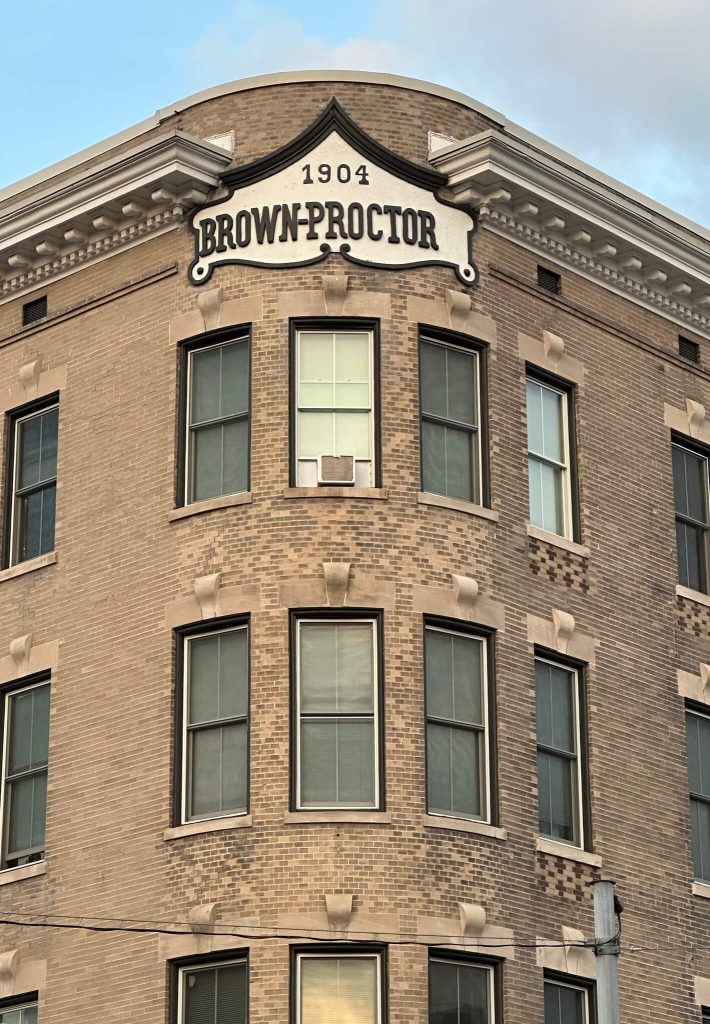
On the corner of Main Street and Lexington Avenue in Winchester, the Brown Proctoria Hotel still fills an entire city block, its limestone base and brick walls catching the light the way they did more than a century ago. For travelers arriving from the Bluegrass and the eastern hills, this corner was once the first glimpse of modern Winchester. Railroad passengers stepped out within sight of its dome and flagstaff. Motorists on the Dixie Highway and the Midland Trail steered toward its name on postcards and matchbooks that promised “wonderful meals” and restful furnishings. The Brown Proctoria was built to be the city’s front parlor, and for much of the twentieth century it lived up to that ambition.
This is the story of how one downtown lot evolved from an early frontier inn to a four story hotel that tried to claim Winchester’s place as a gateway to the Kentucky mountains, and how that building has survived through decline, abandonment, and renewed preservation.
From tavern lot to Rees House
The story begins long before the Brown Proctoria’s cornerstone was laid. When Winchester was laid out as the seat of newly formed Clark County in the 1790s, the corner that would later hold the hotel was Lot 67 on the original town plat. Around 1804 Peter Flanagan built a log tavern on the lot along the Lexington and Mount Sterling road, taking advantage of traffic that moved between the older Bluegrass towns and the settlements toward the foothills. Within a year he sold the property to Chilton Allan, who replaced the log structure with a brick inn that grew into one of the best known hostelries in central Kentucky. According to later county histories and the Brown Proctoria National Register of Historic Places nomination, guests like Andrew Jackson and other notable travelers stopped there on journeys between Nashville, Washington, and points west, tying the lot to the long arc of national travel history.
During the nineteenth century the inn passed through several hands, eventually becoming known as the Rees House or National Hotel under Major W. E. Rees. By then Winchester was a small but significant town on turnpikes linking the Bluegrass and the mountains, and the Rees House served both local residents and commercial travelers. Descriptions of downtown in late nineteenth century guidebooks like W. M. Beckner’s Hand Book of Clark County and the City of Winchester, Kentucky emphasize court days, rail connections, and hotel corners, showing how important a prominent inn was to the public life of the square.
By the turn of the twentieth century, however, the old brick structure was aging. In 1902 Rees sold the property to Joseph L. Brown and his brother in law George M. Proctor, both Clark County men who had mostly farmed before deciding to stake their future on hotel keeping. They operated the Rees House for a short time before deciding that the corner demanded something bigger and grander than a refitted antebellum inn.
“Old Landmark Going”
Winchester’s newspapers preserve the moment when the old building gave way to the new. In April 1904 the Winchester Democrat ran a small but evocative item under the headline “Old Landmark Going,” reporting that contractor Joe Jones had begun tearing down the Rees House, “one of the oldest hotel buildings in central Kentucky.” The article looked back to the early nineteenth century, when Flanagan had demolished the original log cabin on the site and erected part of the brick structure now coming down, and then cast its eyes forward. Brown and Proctor, the paper told readers, would replace the old house with “a magnificent four story hotel and office building.”
Earlier that spring the same paper had noted preparations for construction and the decision of Brown and Proctor to invest heavily in a modern hotel. Over the following months it would record contracts for stone, brick, and interior finish, including a September 1904 notice that Lexington firm Tudor and Company had received the job of supplying the hotel’s woodwork and interior trim. These short items, taken together, show a community watching one of its most conspicuous corners being completely rebuilt and feeling both nostalgia for the Rees House and pride in the rising structure.
A Beaux Arts statement on the square
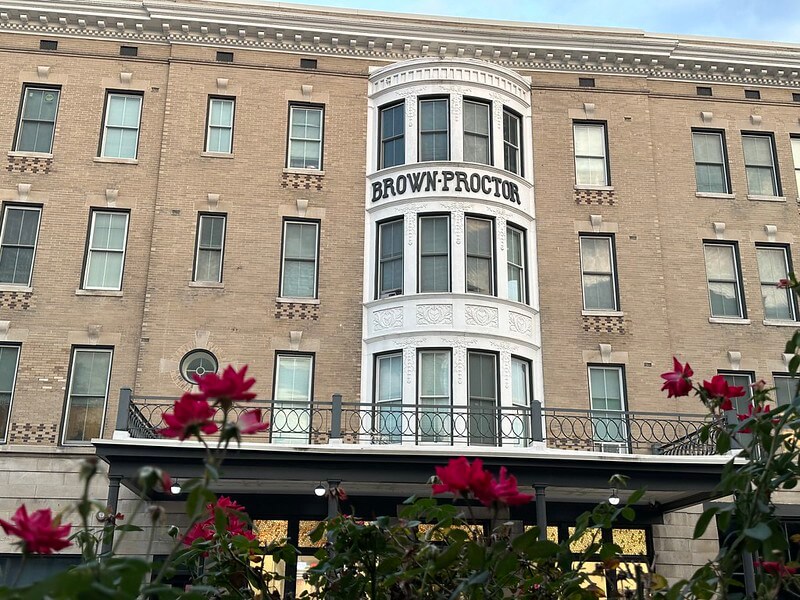
The building that emerged between 1904 and 1906 was unlike anything else on the Winchester square. Designed by architect H. W. Aldenburg and built by contractor John W. Crone, the Brown Proctoria Hotel rose four stories above an Indiana limestone and granite base. Its brick walls carried Colonial Revival details and Beaux Arts massing that made it dominate the intersection. The National Register nomination describes how the hotel’s corner is emphasized by a rounded bay capped with a domed cupola and flagstaff, with a carved name panel at the cornice line. Long rows of tall windows, a projecting iron balcony, and a recessed entrance along Main Street added to the sense that this was a grand urban hotel rather than a small town inn.
Inside, guests entered a spacious lobby with marble wainscoting, decorative columns, and a wide stair leading to the floors above. Historic photographs and the nomination form describe mosaic tile floors, pressed metal ceilings, and woodwork that reflected both Victorian taste and early twentieth century aspirations toward refinement. A large dining room occupied much of the second floor, with a smaller café and dining space at street level. Bedrooms lined the upper floors, many with transoms and simple but substantial trim.
Brown and Proctor divided ownership of the project but both names appeared in the hotel’s identity. Postcards, matchbooks, and other ephemera from the early twentieth century use the Brown Proctoria spelling and market the property as a modern hostelry “in the heart of the famous Blue Grass region, in the foothills of the Kentucky Mountains.” One widely circulated postcard published by L. F. Mattingly of Lexington promised travelers that the Brown Proctoria was noted for its meals, its “up to date restful furnishings,” and its location “where Dixie Highway meets Midland Trail,” capturing the way the hotel stood at the crossroads of emerging auto routes as well as older rail lines.
Gateway to the Kentucky mountains
The Brown Proctoria opened just as Winchester boosters were trying to position their town as the “gateway to the Kentucky mountains.” Promotional booklets like Winchester, Kentucky, Mountains to Blue Grass portrayed the city as a hinge between the Bluegrass and the eastern coalfields, with trains and eventually highways funnelling traffic through Main Street. The new hotel fit this marketing perfectly. Travelers from mountain counties could stop in a modern facility that still stood within sight of the courthouse, and commercial agents who did business from the Bluegrass hills to the head of the Kentucky River could use the hotel as a base.
A 1906 retrospective on Winchester’s “remarkable year,” written many decades later but grounded in contemporary papers, highlights how the Brown Proctoria’s completion symbolized a moment when railroads, industries, and civic improvements converged. Electric street lights along Main, sometimes called the “Great White Way,” gave the square an almost metropolitan glow. Later local histories point to a prominent lamp standard near the People’s State Bank entrance in the Brown Proctoria block as one of the most visible pieces of that early lighting, reinforcing the idea that the hotel stood at the center of Winchester’s modernization.
Life inside the hotel
For the first half of the twentieth century the Brown Proctoria was not just a place to sleep. It was the scene of dinners, dances, and local celebrations that helped define social life in Clark County. Columns like Sue Staton’s “Down the Lane: Memories of the Brown Proctor” recall a “ritzy hotel” where the ballroom hosted regular dances and community events. Her memories, formed decades after the hotel’s opening, capture a time when dressing up for an evening at the Brown Proctor was part of coming of age in Winchester.
The hotel also housed businesses and professionals that tied it more deeply into the life of downtown. Around 1920, photographer William B. Ogden opened his first studio in the building. A short feature from the Kentucky Historical Society on the Ogden Studio negatives notes that some of the earliest images of downtown Winchester were made from this vantage point, preserving views of the Brown Proctoria’s balconies and the flow of traffic around the square. Pharmacies and other storefronts occupied the street level spaces, and mid twentieth century recollections reference the Brown Proctoria Pharmacy as a familiar stop for locals.
Competition from the St. George Hotel and other lodging options did not erase the Brown Proctoria’s hold on the public imagination. A Garden to Gables feature on Winchester hotels notes that the St. George was briefly hailed as the city’s finest before the Brown Proctoria opened and eclipsed it, making clear that by the 1910s and 1920s the Brown Proctoria had become the standard against which other local lodging was judged.
A Hollywood connection in the lobby
One of the most colorful episodes in the hotel’s history unfolded quietly in October 1948, when two relatively unknown actors checked into the Brown Proctor and decided to be married in the lobby. As Pete Koutoulas recounts in WinCity Voices, touring performers Rance Howard and Jean Speegle were traveling with a company staging Snow White and the Seven Dwarfs when they learned that Kentucky law would allow them to marry quickly. They reached Winchester for a performance at the high school, obtained a license, and held a hastily arranged ceremony right in the Brown Proctor’s lobby, with a local minister presiding and several little person actors from the troupe serving as groomsmen. The bride wore a Cinderella ball gown from the show, a three tiered cake was improvised by a local bakery, and the hotel’s jukebox supplied the wedding music.
At the time the couple’s names meant little outside the world of touring theater. Their later children, Ron and Clint Howard, would become familiar faces on American television and film, giving Winchester an unexpected “claim to fame.” The story of their parents’ wedding now circulates widely in local memory and adds another layer of narrative to the Brown Proctoria’s lobby.
Decline, apartments, and abandonment
Like many downtown hotels, the Brown Proctoria struggled as travel patterns changed after World War II. New motels along highways lured motorists away from courthouse square lodging, and the rise of automobile oriented shopping shifted commerce outward. Over time, the hotel’s rooms were increasingly converted to longer term rentals and eventually to apartments. By the time the building was listed on the National Register of Historic Places in 1977, its architecture was recognized as significant, but its future use was uncertain.
The National Register nomination prepared in the 1970s emphasized the hotel’s Beaux Arts influenced architecture and its long history as the successor to the Rees House, arguing that the Brown Proctoria was one of downtown Winchester’s key anchors. At the same time, preservation surveys warned that the building was vulnerable to neglect. Photographs from Historic Structures and local postcard collections show how, by the late twentieth century, the dome’s original flagstaff was gone and some ground floor storefronts were empty or altered.
By the early twenty first century, the former hotel was largely known as the Brown Proctor Apartments, and many units had fallen into disrepair. Local memories record concerns about safety and maintenance, and the building’s upper floors were at risk of becoming a symbol of abandonment rather than pride. It is in this context that efforts to rehabilitate the property took on added urgency for preservationists and city planners.
Preservation and rehabilitation
In the 2010s a partnership between private developers, the Kentucky Housing Corporation, Winterwood, Inc., and local officials brought new resources to the Brown Proctor. Winchester Sun coverage from 2018 describes a nearly four million dollar renovation project aimed at updating the apartments while preserving the building’s historic character. The project leveraged historic tax credits and affordable housing programs, a common strategy for reusing large downtown structures that no longer function as hotels.
Architectural firm Necto Architecture’s portfolio summarizes the rehabilitation as a restoration of existing units in a historic hotel, highlighting work on systems and finishes that allowed the building to remain in residential use. While interior alterations over the decades had changed some spaces, the project preserved the exterior massing, window patterns, and key decorative elements identified in the original National Register nomination. The Brown Proctor thus continued in its role as a visual anchor of the square, even as its use shifted fully to apartments.
Today, downtown walking tour brochures and city planning documents still feature the Brown Proctoria as one of Winchester’s signature historic structures. They point out its domed corner tower, its early role in welcoming both mountain travelers and Bluegrass visitors, and its layers of history stretching back to the Rees House and the early tavern on Lot 67. For visitors, it is a photo stop and a reminder that small city squares could once support grand hotels. For residents, it has been everything from a place to attend a dance to an apartment building to a symbol of downtown investment.
Lot 67 in the long view
Seen across more than two centuries, the Brown Proctoria and its predecessors tell a compact story of Kentucky’s shifting landscapes. The early brick inn that rose on the site in the early 1800s belonged to the turnpike era, when stagecoaches and horseback travelers needed beds, meals, and stables at regular intervals. The Rees House years correspond to a time when Winchester was solidifying its role as a county seat and market town. The decision by Brown and Proctor to raze that inn and build a four story hotel coincided with the arrival of more rail traffic and the rise of a civic elite that wanted their town to reflect the same modern sensibility seen in Lexington and Louisville.
The Brown Proctoria’s postcards and promotional lines about Dixie Highway and Midland Trail mark the automobile age, when highway tourism became part of Winchester’s identity. Mid century dances, weddings, and pharmacy counters show how a hotel block could function as a community living room. The decline and conversion to apartments mirror the broader story of downtowns that lost through traffic to bypasses and interstates. Finally, the building’s listing on the National Register and its twenty first century rehabilitation connect it to a preservation movement that regards such structures not as expendable relics, but as essential links in the urban fabric.
Standing on the corner of Main and Lexington today, it is possible to imagine the sequence of buildings that have occupied that ground: Flanagan’s log tavern, Allan’s brick inn, Rees’s National Hotel, Brown and Proctor’s four story replacement. Each reflected a particular moment in Winchester’s relationship to the surrounding Bluegrass and the Appalachian foothills. The Brown Proctoria that survives is more than an attractive façade. It is the current form of a long lived hostelry that has greeted travelers, celebrated local milestones, and weathered the cycles of boom, neglect, and renewal that mark so many Appalachian and Bluegrass towns.
Sources & Further Reading
“Preparing to Build.” Winchester Democrat (Winchester, KY), March 11, 1904. Kentucky Digital Newspaper Program, University of Kentucky Libraries. https://kentuckynewspapers.org Kentucky Newspapers+1
“Old Landmark Going.” Winchester Democrat (Winchester, KY), April 5, 1904. Kentucky Digital Newspaper Program, University of Kentucky Libraries. https://kentuckynewspapers.org Kentucky Newspapers+1
Winchester Democrat (Winchester, KY). Coverage of the Brown-Proctor Hotel dome, plaque, and “cloud-reaching flagstaff,” May 15–16, 1905. Kentucky Digital Newspaper Program, University of Kentucky Libraries. https://kentuckynewspapers.org NPGallery+1
Winchester Democrat (Winchester, KY). Brief notice awarding the contract for Brown-Proctor Hotel woodwork and interior finish to Tudor & Co. of Lexington, September 9, 1904. Kentucky Digital Newspaper Program, University of Kentucky Libraries. https://kentuckynewspapers.org NPGallery+1
“Passing of the Rees House. Brief History of the Famous Old Hostelry Now Being Razed to Make Way for a Modern Building.” Winchester Democrat (Winchester, KY), ca. 1904. Transcript in University of Kentucky Special Collections Research Center; quoted in “Brown-Proctoria Hotel” National Register of Historic Places nomination. Accessed via NPGallery, National Park Service. https://npgallery.nps.gov/NRHP NPGallery
Beckner, W. M. Hand-Book of Clark County and the City of Winchester, Kentucky. Chicago: The Artotype Publishing Co., 1889. Digital facsimile, University of Kentucky Libraries. https://libwwwapps13.uky.edu/catalog/xt780g3gxq90 University of Kentucky Libraries
Collins, Lewis, and Richard H. Collins. Collins’ Historical Sketches of Kentucky: History of Kentucky. Vol. 2. Covington, KY: Collins & Co., 1874. Digital edition, Internet Archive. https://archive.org/download/collinshistorica02coll/collinshistorica02coll.pdf Internet Archive+1
D. G. Beers & Co. Atlas of Bourbon, Clark, Fayette, Jessamine and Woodford Counties, Ky.: From Actual Surveys and Official Records. Philadelphia: D. G. Beers & Co., 1877. Digital images, Library of Congress. https://www.loc.gov/item/2005627107/ The Library of Congress+1
Kentucky Heritage Commission. Survey of Historic Sites in Kentucky: Supplement. Frankfort: Kentucky Heritage Commission, 1976. Available via NPGallery, National Park Service. https://npgallery.nps.gov/NRHP NPGallery
National Park Service. “Brown-Proctoria Hotel.” National Register of Historic Places Inventory–Nomination Form, Ref. No. 77000609. Washington, DC: National Park Service, 1977. Accessed via NPGallery Digital Asset Management System. https://npgallery.nps.gov/NRHP NPGallery
Winchester Commercial Club. Winchester, Kentucky: Mountains to Blue Grass. Winchester, KY, ca. 1920. Promotional booklet cited in “Brown-Proctoria Hotel” NRHP nomination. Accessed via NPGallery, National Park Service. https://npgallery.nps.gov/NRHP NPGallery
Eastern Kentucky University Digital Collections. “The Brown-Proctoria Hotel, Winchester, KY.” Postcard in Justine Bryson Postcards Collection, March 24, 1911. https://digitalcollections.eku.edu/items/show/1824 EKU Digital Collections+1
Eastern Kentucky University Archives. “Clark County Businesses and Scenes” (photo set including Brown-Proctor Hotel views). EKU Digital Collections. https://digitalcollections.eku.edu (search “Clark County Businesses and Scenes” and “Brown-Proctor Hotel”) EKU Digital Collections+1
Clark County Public Library. “Local History & Genealogy Collection.” Local history room guide noting Beers Atlas, Sanborn maps, and other Winchester resources. https://www.clarkbooks.org/local-history-geneology CCPL
Clark County Public Library / Pinterest. “Brown Proctor Hotel Exterior.” Vintage postcard of the Brown-Proctor Hotel, Winchester, KY, Roots board, ca. 1960s. https://www.pinterest.com/pin/5629568268575992/ Pinterest
CardCow Vintage Postcards. “Brown-Proctoria Hotel, Winchester, KY.” Early 20th-century hotel postcard (multiple printings). https://www.cardcow.com/c/65502/kentucky-winchester/ CardCow Vintage Postcards+1
City-Data.com. “Winchester, KY: old brown-proctoria hotel in winchester.” User-contributed photograph, August 21, 2005. https://www.city-data.com/picfilesv/picv14392.php City-Data
Historic-Structures.com. “Brown-Proctoria Hotel, Winchester Kentucky.” October 25, 2022. https://historic-structures.com/ky/winchester/brown_proctoria.php Kentucky Heritage Council
Necto Architecture. “Brown Proctor – Restoration of the Existing Brown Proctor Hotel in Winchester, KY.” Project description, Necto | Architecture. https://necto-architecture.com Winchester Sun
City of Winchester / Kentucky League of Cities. Downtown Master Plan: Winchester, KY. Sections on Historic Resources and Key Buildings describe the Brown-Proctoria as a courthouse-square anchor. https://winchester.klc.org/assets/files/uploads/_20251103120358197_d44d8d72d15c4fb59e9483b86d7eaecc.pdf City of Winchester
City of Winchester / Tourism Commission. “Downtown Walking Tour.” Brochure, c. 2015, including a Brown Proctor entry and brief hotel history. https://visitwinchesterky.com/wp-content/uploads/WinchesterWalking2015.pdf Visit Winchester KY
Visit Winchester KY. “Did You Know?” Local-history feature highlighting Bluegrass Heritage Museum resources on Clark County history and genealogy. https://visitwinchesterky.com/did-you-know-3/ Visit Winchester KY
Kentucky Historical Society. “Piecing Together History: The William B. Ogden Studio Collection in Winchester.” Event description noting Ogden’s first studio in the Brown-Proctor Hotel (opened 1920). https://events.thehistorylist.com/events/piecing-together-history-the-william-b-ogden-studio-collection-in-winchester-winchester-kentucky The History List
Staton, Sue. “Down the Lane: Memories of the Brown Proctor.” Winchester Sun, October 5, 2017. https://winchestersun.com/2017/10/05/down-the-lane-memories-of-the-brown-proctor/ Winchester Sun
“Brown Proctor hotel apartments to be renovated.” Coverage of renovation and related events in Winchester Sun, August 2018 (including “Community calendar for Aug. 14, 2018”). https://winchestersun.com/2018/08/14/community-calendar-for-aug-14-2018/ Winchester Sun
“History behind Rees House.” Winchester Sun, December 30, 2021. https://winchestersun.com/2021/12/30/history-behind-rees-house/ Apartments.com
“1906: Winchester’s remarkable year.” Winchester Sun, December 23, 2016. https://winchestersun.com/2016/12/23/1906-winchester%E2%80%99s-remarkable-year/ Internet Archive
McCann, Bill. “Arts’ Watch: A Brown-Proctor Wedding.” Winchester Sun, January 6, 2024. https://winchestersun.com/2024/01/06/arts-watch-a-brown-proctor-wedding/ City of Winchester
Koutoulas, Pete. “Little noted at the time, a 1948 Winchester wedding is now a local ‘claim to fame.’” WinCity Voices, June 5, 2024. https://www.wincityvoices.org/little-noted-at-the-time-a-1948-winchester-wedding-is-now-a-local-claim-to-fame/ Visit Winchester KY
Enoch, Harry. “Brick Streets and ‘The Great White Way.’” WinCity Voices, September 30, 2025. https://www.wincityvoices.org/brick-streets-and-the-great-white-way/ WinCity Voices
Kentucky Transportation Cabinet. Design Guidelines for Downtown Winchester. Design guidance document referencing the Brown-Proctor Hotel as a key historic corner building. https://winchester.klc.org/assets/files/uploads/_20251103170459606_216b4a5765bb4ca091981e9ee1ce3431.pdf City of Winchester
Kentucky Digital Newspaper Program. “Kentucky Digital Newspaper Collections.” University of Kentucky Libraries, Special Collections Research Center. Portal providing access to historic runs of the Winchester Democrat and Winchester Sun used for Brown-Proctoria research. https://kentuckynewspapers.org/program/index.php?id=collections Kentucky Newspapers+1
Author Note: As you read this story of the Brown Proctoria, I hope you see more than a hotel and its brick walls. My goal is to show how one corner building can carry generations of travel, work, celebration, and preservation in a single small Kentucky town.