
Repurposed Appalachia Series – From Depot Yard to Coal Miners Memorial Park in Benham, Kentucky

Benham sits in a narrow valley beneath Black Mountain, the highest point in Kentucky. A century ago this was one of the most productive coal camps in the world, a company town built by Wisconsin Steel, a subsidiary of International Harvester. The mines have long since closed, but the town’s identity still turns on coal and on the ways people choose to remember it.
Coal Miners Memorial Park is one of those choices. Today visitors find a red caboose, a bronze miner, a quiet pond, and a wall of names behind the Kentucky Coal Mining Museum, at the end of a short walk along the Benham rail trail. It can be hard to imagine that this same ground once held tracks, loading facilities, and piles of discarded industrial junk. Yet the park’s story is exactly that of a coal yard turned into a place of memory and community life.
Benham: the little town that coal built
When Wisconsin Steel began building Benham in 1911, it set out to create a model coal town. Company architects from Chicago laid out streets, housing, and a compact civic core with store, theatre, hospital, school, church, and a central public park. By the mid 1910s a circular green known as Benham Park served as a planned playground and open space in the middle of this brick and frame townscape.
Coal moved the whole system. The Louisville and Nashville Railroad threaded into the valley, and a depot with sidings and yard space sprawled near the lower end of town. From 1911 on, loaded cars of Benham coal rolled out along those tracks, giving the company a direct connection to regional and national markets.
For decades almost everything in Benham turned on International Harvester. The company built hundreds of houses between 1912 and 1914, later expanding the camp as the mines prospered. At its peak during the Second World War, more than nine hundred miners worked here. Not until the 1970s did the last mine close, leaving the town to reinvent itself in the shadow of its own history.
That reinvention leaned heavily on preservation. The former commissary became the Kentucky Coal Mining Museum. The white school became the Benham School House Inn. Many of the public buildings identified in the Benham Historic District nomination remained standing, and local residents began to imagine a heritage economy built from coal camp streets instead of coal seams.
From depot yard to “Valley of the Drums”
While the downtown historic district gained new purposes, the old depot yard did not. When coal shipments slowed and the L and N depot eventually disappeared, the flat ground below town became an all purpose dumping place. Scrap metal, drums, and discarded equipment collected in the low space where tracks once ran.
Local accounts remember the site as an eyesore and environmental worry, a rusting echo of the extraction that had shaped the town. Some residents took to calling it the “Valley of the Drums,” a nickname that captured both the physical clutter and the unease people felt about what was leaking into the ground.
Yet even in its derelict state that patch of land was central. It lay between the core of Benham and the creek, within easy walking distance of the company store and school. When preservationists and town leaders began to talk of heritage tourism and outdoor recreation, the wasted space at the bottom of town stood out as both a problem and an opportunity.
The Benham Garden Club and the Petticoat Mafia
The turning point came in the early 1990s, when a group of local women in the Benham Garden Club decided the depot yard did not have to stay a dump. Armed with shovels, plants, and a stubborn sense that the town deserved better, they began cleaning the discarded metal and trash from the old railroad ground.
Stories about this period emphasize how much of the change was driven from below. The women pushed city officials, coordinated with the Kentucky Coal Mining Museum, and chased grants and donations. Their persistence earned them a half joking nickname that stuck, the “Petticoat Mafia,” a reminder that in Benham some of the strongest pressure for environmental cleanup and historic preservation came from garden club members who were not willing to accept a junkyard at the heart of town.
A profile of these “heroic women” in a regional magazine later described how the Garden Club transformed the “Valley of the Drums” into Coal Miners Memorial Park. That retelling stressed that they were not simply planting flowers. They were reclaiming company ground for public memory and neighborhood use, and tying it into a broader effort to protect Benham and Lynch from new strip mining on the surrounding ridges.
Building the park: caboose, statue, spring, and wall
A walking tour map prepared by the Kentucky Coal Mining Museum gives the clearest near primary account of what came next. It identifies the site as Benham Miners Park or Miners Memorial Park, located “on the former Benham Depot rail yard.” It notes that coal shipments by L and N began in 1911 and that the yard remained in use through 1994, then explains that in the 1990s the Benham Garden Club began cleaning the yard and creating a walking trail and picnic area. The map dates the dedication of Miners Memorial Park to September 1993.
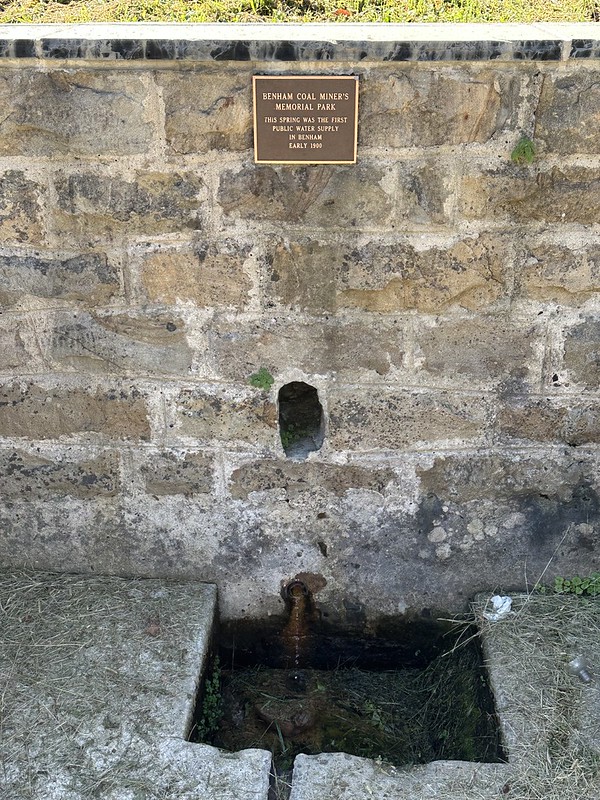
That early park did not yet look exactly like the one visitors see today, but its key features were already in place. The Garden Club and their partners brought in a 1949 L and N caboose, repainted in bright colors, and placed it near the center of the site. They commissioned or secured a life size bronze statue of a coal miner, a figure in work clothes and hardhat carrying a pick, to stand facing town. A historic spring nearby was cleaned and interpreted. On one edge of the park a memorial wall began to take shape, with plaques honoring miners and a separate monument for those killed in International Harvester’s mines.
A later Facebook post from a Kentucky history marker group notes that “Coal Miner’s Park” was formally dedicated on 24 November 2000, likely marking a rededication or completion of the monument ensemble rather than the first opening of the green space. That two stage history helps explain why different sources remember different dates for the park, yet all agree that its development belongs to the preservation wave of the 1990s and early 2000s.
Over time the city and local partners added more amenities. A Tri Cities Main Street guide now describes Benham Coal Miners Memorial Park as a space behind the Kentucky Coal Mining Museum with a gazebo, playground equipment, swing set, large shelter with picnic tables and restrooms, a train caboose with a mural, a fishpond, and a coal miners memorial wall, all tied into the town’s walking trail.
On the rail trail between museum and memory
The idea of a rail trail linking the Kentucky Coal Mining Museum and Coal Miners Memorial Park grew naturally from the site’s railroad past. Modern trail descriptions call it the Benham Rail Trail or Coal Miners Walking Trail, a path that follows the old rail corridor across town and connects the museum to the park’s statue, red caboose, and memorial wall.
Travel writers and bloggers who have walked the trail underscore the symbolism. One Black Mountain hiking blog notes that the depot itself is gone, but that the miners’ monument wall and caboose now stand in the park as “symbols of the town’s coal mining past” and of a community that is using its history to support a new kind of tourism economy.
Seen from the trail, the park works as both gateway and hinge. Visitors who start at the museum walk out of the old company store and along the rail line where coal once left town by the trainload. They end at a space where the focus is no longer tonnage but memory, where the names and images that matter are those of miners and families rather than corporate executives.
Names on the wall
The miners memorial wall in Benham is part of a broader constellation of remembrance in Harlan County. Downtown Harlan has its own Coal Miners Memorial Monument, a countywide obelisk whose plaques list hundreds of miners by name. A transcription of that monument, created for the USGenWeb Harlan County page, gives dates, mine names, and sometimes brief notes about the accidents or disasters that claimed each life.
The Benham wall is more focused and more local. It centers on miners tied to the Tri Cities area, including men who worked for International Harvester and later operators above Looney Creek and Clover Fork. Some of the same names that appear on the county monument recur here, but now in a different spatial context. Instead of standing near the courthouse in the county seat, they stand below the old company town that depended on their labor.
Other panels in the park remember specific mine accidents in the Benham and Lynch area, or recognize miners who died of causes that do not fit neatly into a single date, such as black lung disease. The point is not to create a complete fatality list, which may be impossible given the fragmentary historical record. It is to make clear that the comfortable houses and handsome brick buildings in the historic district were built on dangerous work underground, and that the human cost of that work stretched across the county.
A heritage landscape under pressure
By the late 2000s the coal camp landscape around Benham and Lynch had won national attention. The National Trust for Historic Preservation named the two towns among America’s “11 Most Endangered Historic Places,” warning that new strip and auger mines proposed for the surrounding ridges could damage both the built environment and the streams that support it. A widely shared article in Appalachian Voices used a photo of Benham’s miner statue and caboose to symbolize what was at stake.
Local residents and organizations responded by filing a Lands Unsuitable for Mining petition, arguing that surface mining on Looney Ridge and nearby slopes would endanger resources that supported a fragile but growing heritage economy. Among the places named in that petition were the Kentucky Coal Mining Museum, the Benham School House Inn, Portal 31, church buildings, historic neighborhoods, and the Benham Coal Miners Memorial park itself. The document emphasized that the cities of Benham and Lynch had invested “much time and effort” into preserving these resources and diversifying away from a single industry.
In that context the park is not just a pretty spot with a statue and a caboose. It is evidence in a public argument about what kind of future the valley should have, and about how much weight past sacrifices ought to carry when new projects are proposed.
A working park in a living town
Coal Miners Memorial Park is not a static monument. Local Facebook posts show it in use as a community gathering space, with International Harvester Day celebrations, car shows, concerts, and church events filling the shelter and green space.
In recent years the park has also become a staging ground for races and fundraisers. A Giddy Up Go 5K in 2023, for example, began at the park and raised money for a downtown patio project that will preserve historic brick storefronts and create a new public space on Main Street. Organizers described the race as part of an effort by Friends of Benham to invest in the town’s core and honor residents who spent their lives working for the Tri Cities.
City posts highlight smaller changes as well. New picnic tables arrive with thanks to local donors. Volunteers repair storm damage to the memorial wall. Trail runners and tourists share photos of the bronze miner and red caboose, often captioned with a simple note that they “visited Coal Miners Memorial Park in Benham, Kentucky.”
All of this means that the park is doing at least three jobs at once. It is a green space for local families, a memorial for miners, and a visible sign that Benham is still here and still adapting.
Why this park matters
Stand in the middle of Benham Coal Miners Memorial Park and the layers of history are hard to miss. Behind you the brick bulk of the old commissary houses the Kentucky Coal Mining Museum, full of artifacts from the days when this valley sent coal across the country. In front of you the bronze miner faces the town as if just emerged from the drift mouth, while a child plays on the swings and someone pushes a stroller down the walking trail.
Under your feet is fill dirt brought in to smooth what used to be a tangle of tracks and scrap. Above you is the ridge where residents have fought to keep new surface mines from undoing the work of preservation. Around you are the names of miners who died in and for this industry, carved into stone to make sure they are not forgotten.
The park does not pretend that coal was only triumph or only tragedy. It lets the caboose and the memorial wall sit side by side. It honors miners while also celebrating the people, especially the women of the Garden Club, who insisted that a junked rail yard could become a place of shade, memory, and gathering.
For visitors who come to Benham to see a model coal camp, the park is a reminder that history is not just in museum cases and old photographs. It is on the ground, in the choices communities make about how to live with the legacies of extractive industry. For those who grew up here or have family names on the wall, it is something even more immediate. It is proof that in a small town once built entirely around coal, there is room for both mourning and renewal.
Sources & Further Reading
Kentucky Coal Mining Museum. Historic Downtown Benham Walking Tour Map. Benham, KY: Kentucky Coal Mining Museum, n.d. PDF. Accessed January 1, 2026. https://kycoalmuseum.southeast.kctcs.edu/media/other/historic-downtown-benham-walking-tour-map.pdf. Ky Coal Museum
Thomason, Philip. “Benham Historic District.” National Register of Historic Places Inventory Nomination Form. Washington, DC: National Park Service, 1983. PDF. Accessed January 1, 2026. https://npgallery.nps.gov/GetAsset/cb3927ea-5def-4e52-99d2-d7b29bfccc1a. NPGallery
Kentucky Coal Mining Museum. “Register of Historic Places.” Kentucky Coal Mining Museum. Accessed January 1, 2026. https://kycoalmuseum.southeast.kctcs.edu/explore/national_register.aspx. Ky Coal Museum
Advisory Council on Historic Preservation. “Benham, Kentucky.” Preserve America Community profile. Accessed January 1, 2026. https://www.achp.gov/preserve-america/community/benham-kentucky. Administration for Community Living
“Benham Historic District.” Wikipedia. Accessed January 1, 2026. https://en.wikipedia.org/wiki/Benham_Historic_District. Wikipedia
“Kentucky Coal Mining Museum.” Wikipedia. Accessed January 1, 2026. https://en.wikipedia.org/wiki/Kentucky_Coal_Museum. Wikipedia
Tri-Cities KY Main Street. “Parks and Playgrounds.” Tri-Cities Heritage Development. Accessed January 1, 2026. https://www.tricitieskymainstreet.com/parks. Tri-Cities KY Main Street
HomeTrail. “Benham Coal Miners Memorial Park.” HomeTrail. Accessed January 1, 2026. https://hometrail.net/single-location/benham-coal-miners-memorial-park/. HomeTrail
“Benham Rail Trail.” TrailLink. Rails to Trails Conservancy. Accessed January 1, 2026. https://www.traillink.com/trail/benham-rail-trail/. Tri-Cities KY Main Street
“Mine Deaths from the Harlan Miners Memorial Monument.” USGenWeb Harlan County, Kentucky. PDF. Accessed January 1, 2026. https://www.usgenwebsites.org/KYHarlan/Mine%20Deaths%20From%20The%20Harlan%20Miners%20Memorial%20%20Monument.pdf. Appalachianhistorian.org
Kentuckians For The Commonwealth. “Petition to Designate Area as Unsuitable for Mining in Harlan County, Kentucky.” PDF. Accessed January 1, 2026. https://kftc.org/sites/default/files/docs/resources/harlanlumfinal.pdf. KFTC 40th Anniversary
Moore, Molly, and Jillian Randel. “Hidden Treasures Kentucky.” Appalachian Voices, May 31, 2011. Accessed January 1, 2026. https://appvoices.org/2011/05/31/hidden-treasures-kentucky/. Appalachian Voices
“25 Historic Stops in Harlan County.” Harlan County Trails blog, September 8, 2021. Accessed January 1, 2026. https://www.harlancountytrails.com/blog/25-historic-stops-in-harlan-county/. Appalachianhistorian.org
City Data. “Benham, Kentucky (KY 40807) City Data Profile.” City Data. Accessed January 1, 2026. https://www.city-data.com/city/Benham-Kentucky.html. Reddit
Callahan, Richard J. Work and Faith in the Kentucky Coal Fields: Subject to Dust. Bloomington: Indiana University Press, 2009. Accessed January 1, 2026. https://archive.org/details/workfaithinkentu0000call. Internet Archive
Jamieinwanderland. “Benham Kentucky and the Kentucky Coal Mining Museum.” Jamie in Wanderland blog, February 6, 2015. Accessed January 1, 2026. https://jamieinwanderland.wordpress.com/2015/02/06/benham-kentucky-and-the-kentucky-coal-mining-museum/. Jamie in Wanderland
Show Caves. “Kentucky Coal Mining Museum.” Show Caves of the United States. Accessed January 1, 2026. https://www.showcaves.com/english/usa/mines/KentuckyCoal.html. showcaves.com
Down the Road with Steve and Debbie. “Hiking Black Mtn Kentucky.” Down the Road with Steve and Debbie blog, 2018. Accessed January 1, 2026. https://downtheroadwithsteveanddebbie.blogspot.com/2018/06/hiking-black-mtn-kentucky.html. facebook.com
Author Note: This piece looks at how Benham turned its old depot yard into a coal miners memorial and gathering space. I hope it helps you see the park not just as a pretty stop on the rail trail, but as part of a much larger story about coal, memory, and community in Harlan County.