
Repurposed Appalachia Series – Harlan County Extension Depot
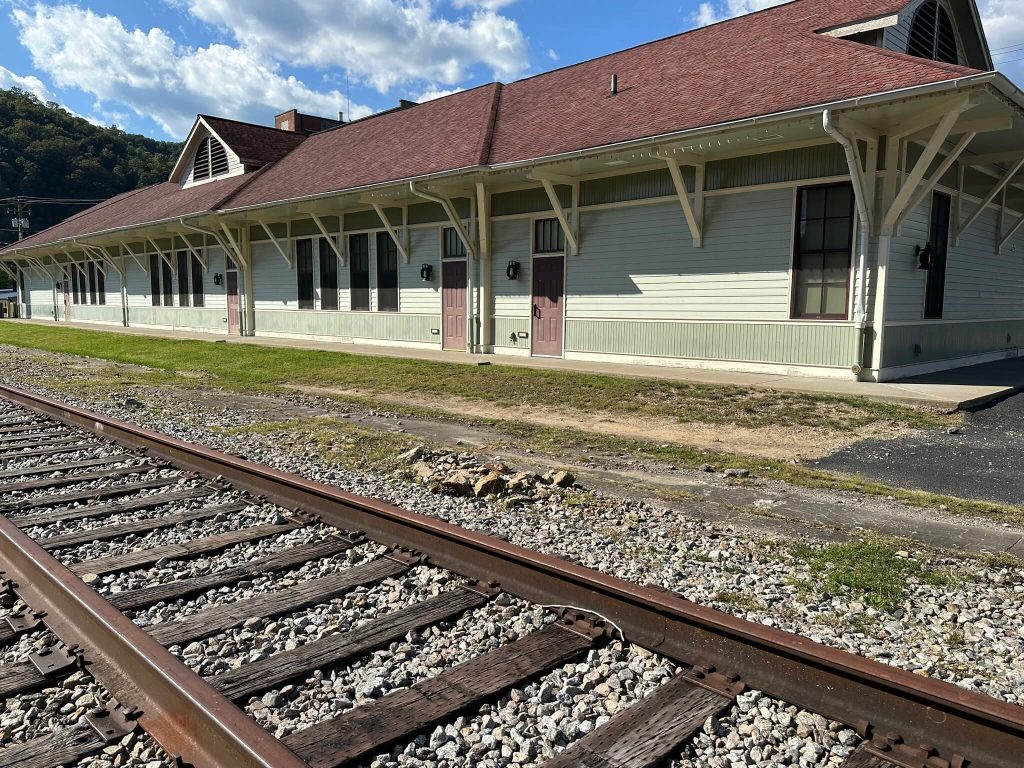
On a short bend of River Street in downtown Harlan, a long, depot-shaped building sits with its wide eaves turned toward the tracks. On the county extension website it appears in plain bureaucratic language as the Harlan County Extension Depot, 110 River Street, listed alongside the main office on South Main Street. In real life it feels less like an annex and more like a civic living room.
On any given week its calendar fills with quilting clubs, homemakers’ meetings, 4-H speech contests, cooking demonstrations, crafting workshops, and orientation sessions for summer camp. Extension event listings point again and again to the same address, describing programs like “Laugh, Learn and Craft,” “Cooking Through the Calendar,” 4-H Communications Day, Backyard Poultry clinics, and camp orientations held “at the Harlan County Extension Depot, 110 River Street, Harlan, KY 40831.” Local newspaper calendars and feature pieces note holiday bazaars, scrapbooking events, and homemakers’ drives meeting at the depot as well.
To a visitor, the building looks older than it is. Its long profile and low roof echo classic early twentieth century depot design. Harlan County’s tourism blog, in a feature on “25 Historic Stops in Harlan County,” explains why. The Louisville and Nashville Railroad Depot on this spot was the first depot in the county and helped spark Harlan’s growth. When that building was demolished, the Extension Service built a multipurpose facility in the original footprint that “closely resembles the original depot,” a “glimpse into the past with a modern twist.”
University of Kentucky’s Martin-Gatton College of Agriculture told the same story more directly in a 2007 news release. In an article titled “East Kentucky Extension Office Revives Train Depot,” reporter Aimee Nielson described how Harlan County Cooperative Extension constructed a depot-style annex on the site of the original L&N station to serve as a new activity center for meetings and programs. The result is a building that looks backward and forward at once, and it only makes sense if you know the longer story of River Street, the railroad, and the rise of Extension work in Harlan County.
The First Depot on River Street
The Louisville and Nashville Railroad did not reach Harlan all at once. After the company opened its Cumberland Valley Division from Corbin to Norton, Virginia, in 1891, engineers and promoters spent years debating exactly how to push deeper into the mountains. Mineralogists Andrew S. McCreath and E. V. D’Invilliers had recommended a line into Harlan County as early as 1887, but the company only followed through after the turn of the twentieth century.
By 1911 the long-anticipated line finally reached the county seat. A July 15, 1911 dispatch in the Middlesboro News-Record, quoted in the depot’s later National Register narrative, announced that passenger trains would begin running into Harlan on July 17 even though the station itself still needed work. The paper praised the new building and predicted that once completed the Harlan station would be among the best of the smaller depots on the L&N system.
The depot that rose on River Street was large enough to match those expectations. The National Register nomination describes it as a long, narrow combination freight and passenger station, roughly four hundred feet by fifty feet, running parallel to the main line along the river. The freight room occupied the east end, passenger waiting rooms were placed in the west, and offices and baggage rooms filled the center. A brick foundation, frame walls punctuated by paired windows, a hipped tile roof over the passenger section, and a gabled roof over the freight wing gave the building a distinctive silhouette.
Architecturally, the Harlan depot fit into a broader L&N pattern. The nomination credits two of the railroad’s chief engineers, Richard Montfort and William Howard Courtenay, as responsible for the standard depot designs used across the system in the early twentieth century. In Harlan that standard plan was stretched and modified to meet local freight demand. Four additions lengthened the freight room by 280 feet between 1913 and 1918, and more alterations followed in the 1920s as coal shipments surged.
Inside, thirteen-foot ceilings, beaded board wainscoting, wooden benches, and simple overhead lights made the waiting rooms functional but not grand. A long wooden platform ran along the freight side, with a concrete platform on the passenger side. Trains pulled in and out at all hours, linking Harlan to Corbin, Norton, and the wider network beyond.
Sanborn Fire Insurance maps from 1919, 1925, 1932, and a combined 1932–1947 volume, preserved today through the Library of Congress and genealogy indexes, show the depot and its yard in fine detail. They trace the building’s footprint, the run of sidings and spurs, adjacent warehouses, and nearby commercial blocks as the rail complex became the industrial spine of downtown Harlan.
Rail Hub, Coal Gateway, and “Hub City”
For local residents the River Street depot was more than a set of dimensions on a map. As coal camp production expanded in the 1910s and 1920s, Harlan’s station became a gateway where traveling salesmen stepped off passenger cars to reach hotels on Main Street, company officials arrived to inspect mines, and families waited for loved ones to come home or ship out.
That bustling role lingered in community memory well into the late twentieth century. In 2007, at a ribbon-cutting for the new Extension Depot, longtime resident Charlotte Nolan recalled that the original station had been “the hub of our town,” a place where traveling salesmen and visitors poured into downtown and where daily life often revolved around train schedules. The nickname “Hub City,” visible on period aerial photographs of Harlan, captured the same idea: a mountain county seat suddenly connected to the outside world by steel rails and telegraph lines rather than wagon roads.
Coal made the depot even more central. The Historic-Structures summary of the nomination notes that the first carload of coal to leave Harlan County had been shipped in 1911 from Old Wallins Creek, and by 1928 the Harlan district was sending hundreds of thousands of carloads down the line each year. Freight trains rolled past the depot loaded with that coal, while yard crews and station staff handled the paperwork and switching that kept cars moving.
In that setting the River Street station became a visible symbol of the county’s shift from relative isolation to deep integration into industrial markets. Its long roofline and platforms provided a backdrop for the everyday scenes of miners leaving for work, soldiers heading to war, and families traveling to larger cities.
From National Register Listing to Demolition
By the 1960s the L&N Railroad no longer needed the depot in the way it once had. The nomination notes that the railroad ceased using the building during that decade, leaving its passenger and office sections vacant while local businesses occasionally used the freight area for storage. Concerned residents and preservationists, recognizing the depot’s significance, succeeded in getting it listed on the National Register of Historic Places in 1980. The withdrawn-properties finding aid for the Register records the listing under the title “Louisville and Nashville Railroad Depot,” also known as “Harlan Railroad Depot,” reference number 80001537, with River Street as the address. It identifies the period of significance as the early twentieth century, cites commerce and transportation as the key themes, and names Montfort and Courtenay as the architects.
Listing, however, did not guarantee survival. The same federal record shows that the depot’s listing was removed on December 30, 1985. The Historic-Structures narrative fills in what happened in between. After plans for rehabilitation as a community facility fell through, the City of Harlan demolished the building in 1985 despite its recognized historic value.
For more than a decade the empty footprint along River Street stood as a reminder of what had been lost. Coal trains continued to pass, but passengers no longer boarded there and the great frame depot that had once dominated the block existed only in photographs, Sanborn maps, and memory.
Re-creating the Depot as an Extension Annex
The decision to bring a depot-shaped building back to River Street came from an unexpected direction: the Harlan County Cooperative Extension Service.
By the early 2000s Harlan’s Extension agents had outgrown their space. In Aimee Nielson’s 2007 article, Family and Consumer Sciences agent Teresa Howard traced their trajectory from a small courthouse office to an old house they remodeled themselves, a building so cramped that packing in one hundred people for a meeting meant overcrowded rooms and limited program options. The Extension board, she explained, began dreaming of a larger facility where they could host one big meeting or divide the space into three smaller rooms.
They found their solution in the old depot site. The Extension Service already had the funds in hand, so the project did not require new local taxes. According to county agent Jeremy Williams, quoted in the same piece, many residents were still upset that the original depot had been torn down. Re-creating its form on the same property seemed like a way to meet program needs and honor community memory at the same time.
Nielson’s story emphasized that the new building was an annex of the Harlan County Cooperative Extension Service rather than a railroad facility. The structure resembled the original depot in its massing and roofline, but inside it housed flexible meeting rooms, modern HVAC, and the wiring needed for contemporary educational programs. Coal trains still rumbled by without stopping, but now the focus inside the building was on 4-H activities, quilting clubs, financial literacy classes, and community workshops.
For people who remembered the old station, the emotional impact was immediate. At the ribbon-cutting, Charlotte Nolan told the crowd that when the new depot rose on River Street it felt like “a member of our family has come home.” In her words, the project had “given us back our history,” even as it served new purposes.
A Working Extension Depot
Today the Harlan County Extension website clearly distinguishes between the main office at 519 South Main Street and the “Harlan County Extension Depot” at 110 River Street, treating the depot as a dedicated program space rather than administrative headquarters. The events posted there show just how fully the building functions as a community classroom.
In 2023 and 2024, for example, Extension staff hosted a series of “Laugh, Learn and Craft” programs at the depot that combined self-care lessons with hands-on projects, from charcuterie boards to fruit bouquets to heart-healthy themed door hangers. Each listing marks the sessions as in-person events at the Harlan County Extension Depot, 110 River Street, and provides the main office phone number for registration.
Agriculture and Natural Resources programs use the space as well. A Backyard Poultry workshop advertised in county newsletters and Extension web pages notes that the evening program will be “held at the Harlan County Extension Depot” and appears in an agricultural newsletter calendar that places several spring events at the depot by default.
Youth programs are equally rooted there. A 4-H Communications Day, where local students deliver speeches and demonstrations, is scheduled as an in-person event at the Harlan County Extension Depot. Camp orientation nights and other youth meetings follow the same pattern, turning the depot into a regular gathering place for young people from across the county.
The rhythm extends beyond Extension’s own programs. The Harlan Enterprise has promoted homemakers’ club meetings, scrapbooking events, and a “Spring Scrapfest” held at the depot, reinforcing the site as a familiar location for county civic activities. Other organizations, including regional nonprofits and legal-aid groups, have used the Extension Depot for free clinics and information sessions on topics like wills and heirs’ property, taking advantage of the building’s central location and public familiarity.
In 2021 Harlan County’s tourism office codified that public role by including the Harlan County Extension Depot among its “25 Historic Stops in Harlan County.” The write-up briefly recounts the old L&N depot’s role as the first station in the county, notes its demolition, and highlights the Extension Service’s decision to rebuild a close replica as a multipurpose building in the same footprint. For visitors, it frames the depot as a place where they can literally step into the outline of the past while attending a modern workshop or event.
A Civic Meeting Ground for Food, Design, and Downtown Harlan
The reconstructed depot’s importance becomes even clearer when you look at county-wide initiatives that chose it as their base.
In May 2017 the Harlan community hosted a two-day workshop under the federal Local Foods, Local Places program, organized by USDA, EPA, and other partners. The resulting Community Action Plan for Harlan, Kentucky explains that the public community meeting on the first evening and the all-day action-planning session on the second day were both held at the Harlan County Extension Depot. Organizers saw the building as a natural venue for discussions about farmers markets, prescription produce programs, and the role of local food systems in revitalizing downtown.
The report emphasizes that Harlan County Cooperative Extension was a key member of the steering committee for that effort, working alongside Pine Mountain Settlement School, Mountain Comprehensive Health Corporation, community farm organizations, and local government. The depot, in this context, functioned as a bridge between those partners and the public, housing visioning sessions where residents imagined a downtown shaped by food, art, and walkability rather than by the decline of coal.
Around the same time, the Community and Economic Development Initiative of Kentucky (CEDIK) and the UK College of Design used the depot as a base for a broader downtown revitalization effort. The Harlan County Downtown Revitalization Project Summary notes that during the summer of 2019 a multidisciplinary intern cohort lodged downtown and set up a mobile design studio in the “Harlan County Cooperative Extension’s Depot Building.” From there they hosted community engagement events, collected ideas at festivals, and worked with local partners to map out strategies for strengthening Main Street and the surrounding blocks.
Seen through those projects, the Extension Depot is not just another meeting room. It is one of the places where Harlan residents talk about the town’s future, share ideas about health and food, look at design drawings of potential streetscapes, and weigh what it means to live in a post-coal economy.
Reading the Site Through Maps and Memory
Stand on River Street today and the layering of those histories becomes tangible. Freight trains still move through town without stopping, linking to the same Cumberland Valley line that brought the original depot to life. The modern Extension Depot sits roughly where Sanborn maps and National Register documents place its predecessor, occupying a long narrow band between the tracks and the street.
Historic photographs reproduced in preservation articles show the earlier station with its taller freight wing, long platforms, and freight doors. In comparison the Extension building is more compact, built to modern codes and focused entirely on public assembly rather than freight handling. Yet the visual rhyme is strong enough that older residents immediately recognize what it is meant to evoke.
The story here is not a simple tale of preservation. The original L&N depot was demolished despite being listed on the National Register. The current building is a replica in form but not in materials or internal layout. What ties them together is the decision to keep this particular sliver of land in public use, first as a rail gateway and then as an educational and civic hub.
That continuity matters in a town that has seen many landmarks lost to fire, flood, or redevelopment. It lets people map the photographs in their family albums onto the spaces where they now attend Extension programs. It allows a new generation of 4-H participants, homemakers, and small farmers to feel that they belong in the same public spaces their grandparents once used to catch a train.
Why the Harlan County Extension Depot Matters
At first glance the Harlan County Extension Depot might look like a nostalgic curiosity, a modern building dressed in historic clothes. A closer look shows that it is something more complex and more Appalachian.
The original Louisville and Nashville Railroad Depot marked the moment when Harlan’s economy pivoted toward coal and national markets. It was a symbol of connectivity, a structure that signaled the county’s link to the wider world by rail. Its demolition in 1985 left a hole in both the streetscape and local memory.
The Extension Depot, completed more than twenty years later, marked a different kind of turning point. It signaled that Cooperative Extension work had become central enough to county life that local leaders were willing to claim one of downtown’s most visible sites for it. It turned a symbol of extraction into a symbol of education, community organizing, and everyday problem-solving.
In that shift you can see the broader story of eastern Kentucky in the late twentieth and early twenty-first centuries. Railroads and coal once defined Harlan’s place in the region. Today institutions like Extension, public health partners, farmers markets, arts organizations, and small businesses are trying to build another kind of future atop the same ground.
On River Street the past and present meet in the outline of a depot. Trains no longer stop there, but people do. They come to learn how to raise backyard chickens, to practice speeches, to plan new murals and farmers markets, to sign up for camp, to sit through legal clinics and design charrettes. The building that looks like a train station has become a place where Harlan residents decide where they are going next.
Sources & Further Reading
Aimee Nielson. “East Kentucky Extension Office Revives Train Depot.” University of Kentucky College of Agriculture, Food and Environment News, January 10, 2007. https://news.ca.uky.edu/article/east-kentucky-extension-office-revives-train-depot. MGCafe News
Harlan County Extension Office. “Harlan County Extension Office.” University of Kentucky, Martin-Gatton College of Agriculture, Food and Environment. Accessed January 1, 2026. https://harlan.mgcafe.uky.edu/. Harlan County Extension Office
Harlan County Extension Office. “Upcoming Events.” University of Kentucky, Martin-Gatton College of Agriculture, Food and Environment. Accessed January 1, 2026. https://harlan.mgcafe.uky.edu/events. Harlan County Extension Office
Harlan County Extension Office. “Cooking Through the Calendar.” University of Kentucky, Martin-Gatton College of Agriculture, Food and Environment, last revised January 2, 2025. https://harlan.mgcafe.uky.edu/events/cooking-through-calendar. Harlan County Extension Office
Harlan County Extension Office. “4-H Youth Development – Harlan County.” University of Kentucky, Martin-Gatton College of Agriculture, Food and Environment. Accessed January 1, 2026. https://harlan.mgcafe.uky.edu/4h-youth-development. Harlan County Extension Office
Harlan County Extension Office. “4-H Summer Camp 2026.” University of Kentucky, Martin-Gatton College of Agriculture, Food and Environment, last revised December 18, 2025. https://harlan.mgcafe.uky.edu/events/4-h-summer-camp-2026. Harlan County Extension Office
Harlan County Tourism. “25 Historic Stops in Harlan County.” Harlan County Trails Blog, September 8, 2021. https://www.harlancountytrails.com/25-historic-stops-in-harlan-county.php. Harlan County
U.S. Department of Agriculture, Agricultural Marketing Service. Local Foods, Local Places: Community Action Plan for Harlan, Kentucky. Washington, DC: USDA, August 2017. https://www.ams.usda.gov/sites/default/files/media/LFLPHarlanKY.pdf. AMS
U.S. Environmental Protection Agency. “Podcast: Local Foods, Local Places in Harlan, Kentucky.” Audio and transcript, June 10, 2015. https://www.epa.gov/smartgrowth/podcast-local-foods-local-places-harlan-kentucky. US EPA
Allan Davis et al. Harlan County Downtown Revitalization Project Summary 2020. Community and Economic Development Initiative of Kentucky, University of Kentucky College of Agriculture, Food and Environment, 2021. https://personnel.mgcafe.uky.edu/files/cv/2025-08/2022%20Jayoung%20Koo%20CV.pdf. MGCafe Directory
“Harlan County: Extension Depot.” Flickr photo set, University of Kentucky / Harlan County Extension. Accessed January 1, 2026. https://www.flickr.com/photos/uky/sets/72157632486277959/. Flickr
Harlan Enterprise. “Harlan County Homemaker’s Holiday Bazaar Returns.” Harlan Enterprise, November 7, 2023. https://www.harlanenterprise.net/2023/11/07/harlan-county-homemakers-holiday-bazaar-returns/. Harlan Enterprise
Harlan Enterprise. “Harlan Native to Celebrate Launch of Book This Weekend.” Harlan Enterprise, April 4, 2023. https://www.harlanenterprise.net/2023/04/04/harlan-native-to-celebrate-launch-of-book-this-weekend/. Harlan Enterprise
LiKEN Knowledge. “Last Will & Testament Free Clinic: Harlan County.” LiKEN Knowledge, 2025. https://likenknowledge.org/event/last-will-testament-free-clinic-harlan-county/. LiKEN Knowledge
LiKEN Knowledge. “Estate Planning & Heirs’ Property Info Session: Harlan County.” LiKEN Knowledge, 2025. https://likenknowledge.org/event/estate-planning-heirs-property-info-session-harlan-county/. LiKEN Knowledge
“Louisville and Nashville Railroad Depot, Harlan Kentucky.” Historic-Structures.com, May 24, 2022. https://www.historic-structures.com/ky/harlan/l_and_n_depot.php. Historic Structures+1
“Pictures Louisville and Nashville Railroad Depot, Harlan Kentucky.” Historic-Structures.com, 1980 photo set. https://www.historic-structures.com/ky/harlan/l_and_n_depot1.php. Historic Structures
“National Register of Historic Places Listings in Harlan County, Kentucky.” Kiddle Encyclopedia. Accessed January 1, 2026. https://kids.kiddle.co/National_Register_of_Historic_Places_listings_in_Harlan_County,_Kentucky. Kiddle
Sanborn Map Company. Sanborn Fire Insurance Map from Harlan, Harlan County, Kentucky. February 1919. Map. Library of Congress, Geography and Map Division. https://www.loc.gov/item/sanborn05136_004/. The Library of Congress+1
LDSGenealogy.com. “Harlan Genealogy (in Harlan County, KY).” LDSGenealogy, 2008–2025. https://ldsgenealogy.com/KY/Harlan.htm. LDS Genealogy
“Harlan, Kentucky, ‘The Hub City,’ 1928.” University of Louisville Photographic Archives, ULPA 1994_018_0319. Digital Collections, University of Louisville Libraries. https://digital.library.louisville.edu/u?/collection,ULPA_1994_018_0319. Digital Library of Louisville+1
T. R. Bryant. Historical Sketch of Extension Work in Kentucky. Lexington: University of Kentucky Cooperative Extension Service, May 1939. https://4-h.mgcafe.uky.edu/sites/4-h.ca.uky.edu/files/historical_sketch_of_extension_work_in_kentucky.pdf. 4-H Youth Development+1
Kentucky Extension Homemakers Association. “History of the Kentucky Extension Homemakers Association.” KEHA, University of Kentucky, Martin-Gatton College of Agriculture, Food and Environment. https://keha.mgcafe.uky.edu/content/history-ky-extension-homemakers-association. KY Extension Homemakers
National Institute of Food and Agriculture (USDA). “Cooperative Extension History.” NIFA, September 15, 2025. https://www.nifa.usda.gov/about-nifa/what-we-do/extension/cooperative-extension-history. Nation Institute of Food and Agriculture+1
University of Kentucky 4-H Youth Development. “Celebrating KY 4-H History in 1909–1919.” 4-H History, University of Kentucky. https://4-h.mgcafe.uky.edu/history/1909-1919. 4-H Youth Development
University of Louisville Photographic Archives. “Harlan, Kentucky, ‘The Hub City,’ 1932.” ULPA 1994_018_0320. Digital Collections, University of Louisville Libraries. https://digital.library.louisville.edu/u?/collection,ULPA_1994_018_0320. Digital Library of Louisville+1
Author Note: The Harlan County Extension Depot is one of those places where the old outlines of the railroad town are still visible if you know how to look. In telling its story, I hope readers see how a lost depot and a busy Extension building can both belong to the same living history of downtown Harlan.