
Repurposed Appalachia Series – The Benham Schoolhouse Inn of Harlan County
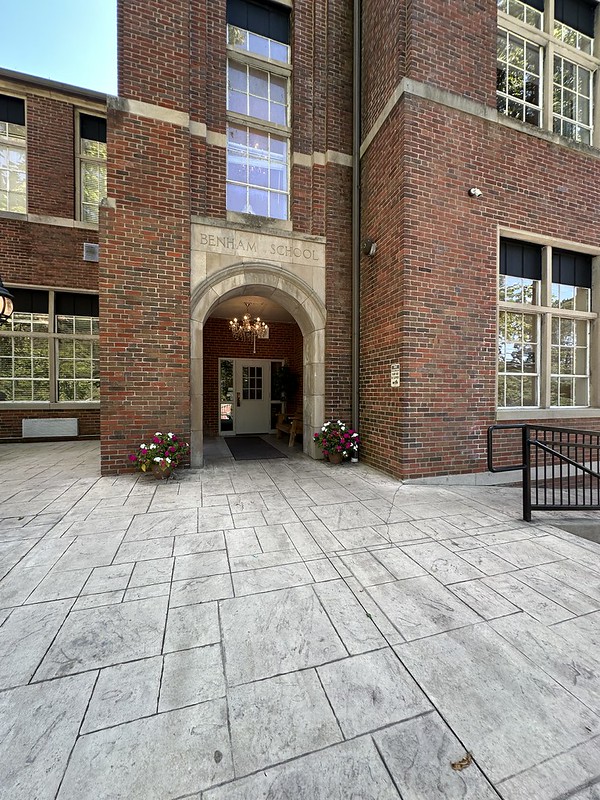
If you stand in the center of Benham and look toward the long brick facade of the old schoolhouse, it is easy to see what Wisconsin Steel and International Harvester were trying to build in the 1920s. The company did not just carve driftmouths into Black Mountain and lay tipple tracks along Looney Creek. It designed a complete town, with a central park ringed by the commissary, theater, clinic, churches, and a modern consolidated school that would signal stability to miners and their families.
Today that school is the Benham Schoolhouse Inn, a hotel and event space where guests sleep in former classrooms, walk past rows of lockers, and eat supper in a gym that once shook with the cheers of Benham Tigers fans. The building’s second life is a preservation story, but it begins as a company promise to provide something better than a one room school on a coal camp edge.
Building a “Progressive” School in Benham
International Harvester’s subsidiary, the Wisconsin Steel Corporation, laid out Benham around 1909 after purchasing several thousand acres in the Looney Creek valley. Company planners designed a central park with civic buildings on every side and extended Louisville and Nashville Railroad tracks into the new camp by 1911, tying the town directly to the steel works in Chicago.
As coal production and population grew, company officials and the Harlan County school system turned to a larger consolidated school for Benham’s children. The existing church and graveyard on the hill by the park were moved in 1926 so that a substantial brick school could rise on the site, with the church resettled beside it and the cemetery shifted to Benham’s west end. The builders even raised the church foundation so that its steeple would still stand higher than the new school roof.
The Benham school opened that year as a combined elementary and high school for the camp’s white children. Company and school officials advertised it as a modern facility. The building had multiple stories, broad staircases, terrazzo hall floors, specialized rooms for subjects like home economics and art, and a full size gymnasium. Both the Kentucky Coal Museum and the inn’s own history describe how Wisconsin Steel and later International Harvester supplemented teacher salaries so that Benham could attract staff who matched the company’s vision of a first class school in a remote mountain valley.
From the perspective of coal camp recruiting, the school was part of a package. Company photographs in the McCormick International Harvester collection show Benham’s civic core as a showcase of brick buildings and paved streets meant to counter stereotypes of Appalachian backwardness and reassure workers that their families would have decent public services.
Segregated Classrooms and the Wider Tri Cities Story
Like other institutions in Harlan County, Benham’s schools were segregated for much of the twentieth century. While the new brick Benham School housed white students, African American children from Benham attended Benham Colored School and later Lynch Colored School, which also drew students from nearby camps. The Notable Kentucky African Americans Database notes a network of Black schools in Harlan County, including Benham, and traces their development through early twentieth century reports and county level education studies.
A postcard preserved in the Appalachian Archive shows Benham Colored School as a purpose built brick structure designed by Harlan architect D. E. Perkins, a reminder that the town’s educational landscape was always divided by race even as the company advertised progress.
Oral histories and scholarship gathered through the Eastern Kentucky African American Migration Project at the University of North Carolina place Benham and Lynch within a broader story of Black coal miners and their families who followed labor agents from Alabama and elsewhere, settled in the Tri Cities, and built their own churches, schools, and community organizations in the shadow of the same tipples and smokestacks.
Life Inside Benham School
Within the brick walls of Benham School, everyday routines blended the familiar rhythms of any American school with the particularities of a company town. The inn’s current history page preserves many of those details. Former students remember the long front hallway lined with lockers, the terrazzo floors that echo underfoot, and the hardwood classroom floors that still creak in places. There was a kindergarten room near the rear stairs, now a conference suite, and a bright upstairs sitting room that once served as an art classroom, lit by a large chandelier that has watched generations come and go.
The home economics classroom occupied what is now the commercial kitchen, and the area that once held the principal’s office, secretary’s office, nurse’s station, and teachers’ lounge has become the Dinner Bucket restaurant and associated spaces. Students were lined up in the hall for daily spoonfuls of cod liver oil in an era when company physicians and school staff tried to manage public health with simple remedies and routine checkups.
Photographs in the Benham Coal Company records and the Benham and Lynch image collections show classes gathered outside the building, National Honor Society inductees in their best clothes, senior plays on makeshift stages, and baseball and basketball teams posing on the athletic field between the school and the mountain slopes.
Athletics were central to the school’s identity. The Kentucky High School Athletic Association’s Benham High School file, held at Eastern Kentucky University, covers the years 1929 to 1961. Together with local sports columns, it documents Benham Tigers teams that competed in the Cumberland Valley Conference and occasionally claimed conference titles. A 1957 football squad, for example, is remembered as co champion of the league, and former players like John Bond carried that legacy into college athletics and coaching careers recognized later in the KHSAA Hall of Fame.
Inside, the gymnasium was more than a sports venue. It hosted community gatherings, church programs, and novelty events such as donkey basketball games that still show up in alumni stories and tourism copy. In many ways that gym foreshadowed the building’s future role as a regional event hall.
Closing the High School and Keeping the Doors Open
By the middle of the twentieth century, the educational landscape of Harlan County was changing. Statewide consolidation efforts and shifting population pushed smaller high schools toward merger with larger county institutions. Countywide educational studies from the mid century period list Benham High School alongside other small high schools and track increasing costs for facilities and transportation that made continued operation difficult.
The last Benham High School class graduated in 1961. After that, the building became Benham Elementary School in the Harlan County system, serving younger students while older teens were bused to consolidated schools elsewhere in the county. The Kentucky Coal Museum’s walking tour brochure notes that the high school closed that year and that the elementary school carried on until its final closure in 1992.
Kentucky Living’s 1999 feature “Once was School Lives On” captures the sense of loss and possibility that followed. The author describes the familiar problems of abandoned schools across Kentucky and then invites readers to Benham, where lockers still line the corridor, a letter jacket hangs from one door, and elementary students have been gone since 1992. The article recounts how a group of private investors bought the property after the closure and how the structure eventually came under the administration of the Southeast Education Foundation in support of Southeast Community College.
A curriculum packet from the Kentucky Coal Museum fills in one more important detail. It notes that after the elementary school closed, the building was sold at public auction in 1993 and then developed into the Benham School House Inn, which opened in 1994, the same year the Kentucky Coal Mining Museum opened in the former commissary. In other words, Benham’s civic square traded an operating school for a new combination of museum and inn that kept the heart of the town active even after the mines declined.

From Classrooms to Guest Rooms
The transformation from school to inn was anchored in preservation ideals. The Benham School, listed as a contributing building in the Benham Historic District on the National Register of Historic Places, was recognized with an Ida Lee Willis Memorial Preservation Award in 1995, honoring School House Inn Incorporated for adapting the structure without erasing its character.
The new Benham School House Inn opened with roughly thirty guest rooms carved out of former classrooms, conference spaces in converted education rooms, and a banquet hall fashioned from the gymnasium. Kentucky Living’s 1999 visit described hearty meals in what it called the Apple Room, high occupancy rates in summer, and a sitting room beneath a three century old chandelier where art students once worked. Tourism listings soon placed the inn among Kentucky’s unique historic lodgings, emphasizing its K 12 past and its proximity to the Kentucky Coal Mining Museum, Portal 31, and Kingdom Come State Park.
Local accounts repeat the detail that lockers still line the hallways and that some even hold folded notes and stickers left by students whose school has become a destination for tourists, wedding parties, and conferences. The Kentucky Coal Museum’s “Our History” summary likewise stresses that the building, constructed in 1926 for high school and elementary students, kept its educational layout even as it shifted into a bed and breakfast.
New Stewards and a Third Act
The inn’s story did not end with its first round of adaptive reuse. In the 2010s, after a period of uncertainty, Appalachian Hospitality Group led by Harlan County native Travis Warf took over management. WYMT stories on the 2016 grand reopening and on a new restaurant stressed the hundreds of hours of cleanup work and Warf’s personal connection to the building, where he had worked as a teenager.
A 2018 feature from Shaping Our Appalachian Region (SOAR) presented the inn as a vital player in Benham’s future. Warf noted that the building was “steeped in history and tradition” and argued that it could help anchor economic development in Benham, Harlan County, and eastern Kentucky. Around the same time, a Kentucky Heritage Council “Main Street Monday” spotlight described the Schoolhouse Inn as part of a broader downtown revitalization effort that tied historic preservation directly to small town resilience.
Like many hospitality businesses, the inn faced serious pressure during the COVID 19 pandemic. The hotel side remained open but the Dinner Bucket restaurant and popular Sunday suppers shut down for nearly two years. When the dining room reopened with a murder mystery dinner and buffet in 2022, local news treated it as another sign that the town’s heritage assets were still finding ways to survive.
By 2024, the story had moved again, this time into county government. When Appalachian Hospitality Group announced that it would not renew its lease, the Harlan County Fiscal Court created a Benham Schoolhouse Inn Board to oversee operations and keep the hotel open. WYMT and the Harlan Enterprise covered the transition, quoting officials who described the inn as both historically and economically important. Judge Executive Dan Mosley called the building a key tourism anchor, while Benham Mayor Danny Quillen, serving on the board, emphasized that local control was meant to preserve both the structure and the jobs tied to it.
Ghost Stories, Mosaics, and Living Memory
Because it is both old and emotionally charged, the Benham Schoolhouse Inn has attracted ghost stories alongside preservation awards. Local tourism sites and “Haunted Benham” promotions tell of unexplained locker noises at night, the sound of children’s laughter in empty hallways, and flickers of movement in former classrooms. These tales coexist with family reunions, professional conferences, and county meetings held in the same spaces, suggesting that for many people the building is both a haunted and a very practical place.
Just outside, the Higher Ground public art project installed a mosaic in front of the inn that honors pre coal mountaineers and the older subsistence culture that coal towns like Benham disrupted and reshaped. The artwork depicts gardeners, canners, and everyday scenes from a time when the valley’s economy revolved around land rather than seams. Placed at the literal doorstep of a former company school turned heritage inn, the mosaic invites visitors to consider how many layers of Appalachian life are stacked in one small spot.
Meanwhile, other archives quietly deepen the story. The Benham Coal Company records at the University of Kentucky document how the company funded school and church expenses, how Black and white miners were recruited and housed, and how civic buildings fit into broader corporate strategy. The Eastern Kentucky African American Migration Project gathers oral histories from families who passed through Benham’s schools or were kept outside their doors by segregation. KHSAA files preserve eligibility lists and game reports that put names and scores back into the gym that is now a banquet hall.
Why the Benham Schoolhouse Inn Matters
Taken together, the history of Benham School and the Benham Schoolhouse Inn shows how one building can hold an entire century’s worth of Appalachian experience. It began as a company showcase meant to reassure miners that their children would not be shortchanged on education. It operated for decades as a school shaped by segregation, consolidation, and the ups and downs of coal markets. When those decades ended, a coalition of alumni, local leaders, educators, and preservationists refused to let the structure rot, instead turning it into a place where visitors can literally sleep inside the history they have come to study.
Walk its halls today and you move through overlapping layers. The lockers, terrazzo, and stairwells belong to the 1920s. The banquet hall remembers the Tigers. The mosaic and museum remind you that Benham sits within both a deeper mountain past and a contested labor history. Current debates over management, county involvement, and tourism funding show that the story is still unfolding.
For anyone who works in Appalachian history or simply loves Harlan County, the Benham Schoolhouse Inn is not only a curiosity or a unique lodging. It is a living archive where a coal company’s civic experiment, a community’s pride in its school, and a region’s struggle to reinvent itself all share the same roof.
Sources & Further Reading
Benham School House Inn. “History.” Benham School House Inn. Accessed January 3, 2026. https://benhaminn.com/history/
Benham School House Inn. “About the Inn.” Benham School House Inn. Accessed January 3, 2026. https://benhaminn.com/about-the-inn/
Kentucky Department of Tourism. “Benham School House Inn.” Kentucky Tourism. Accessed January 3, 2026. https://www.kentuckytourism.com/explore/benham-school-house-inn-6017
The Kentucky Wildlands. “Benham Schoolhouse Inn.” The Kentucky Wildlands. Accessed January 3, 2026. https://www.explorekywildlands.com/listing/benham-schoolhouse-inn/830/
Kentucky Living. “Once-was School Lives On.” Kentucky Living, September 1, 1999. Accessed January 3, 2026. https://www.kentuckyliving.com/archives/once-was-school-lives-on
Kentucky Coal Mining Museum. “Historic Downtown Benham Walking Tour.” Kentucky Coal Mining Museum, Southeast Kentucky Community and Technical College. Accessed January 3, 2026. https://kycoalmuseum.southeast.kctcs.edu/
Kentucky Coal Mining Museum. “Historic Downtown Benham Walking Tour Map.” Kentucky Coal Mining Museum, Southeast Kentucky Community and Technical College. Accessed January 3, 2026. https://kycoalmuseum.southeast.kctcs.edu/
Kentucky Coal Mining Museum. “Register of Historic Places: Benham Historic District.” Kentucky Coal Mining Museum, Southeast Kentucky Community and Technical College. Accessed January 3, 2026. https://kycoalmuseum.southeast.kctcs.edu/
Thomason, Philip. “Benham Historic District, Harlan County, Kentucky.” National Register of Historic Places Inventory Nomination Form. Washington, DC: National Park Service, 1983. Accessed January 3, 2026. https://npgallery.nps.gov/NRHP
Shaping Our Appalachian Region (SOAR). “Historic Benham Schoolhouse Inn Playing a Vital Role in the Future of Benham, Harlan County.” SOAR-ky.org, July 16, 2018. Accessed January 3, 2026. https://soar-ky.org/historic-benham-schoolhouse-inn-playing-a-vital-role-in-the-future-of-benham-harlan-county/
Shaping Our Appalachian Region (SOAR). “The Dinner Bucket, Benham Schoolhouse Inn Style.” SOAR-ky.org, February 26, 2020. Accessed January 3, 2026. https://soar-ky.org/the-dinner-bucket-benham-schoolhouse-inn-style/
Shaping Our Appalachian Region (SOAR). “Harlan County Businessman Shares Story of Success.” SOAR-ky.org, January 5, 2019. Accessed January 3, 2026. https://soar-ky.org/harlan-county-businessman-shares-story-of-success/
Kentucky Heritage Council. “Main Street Monday! July 23, 2018.” Main Street Monday newsletter (featuring Benham Schoolhouse Inn). Frankfort: Kentucky Heritage Council, 2018. Accessed January 3, 2026. https://heritage.ky.gov/community/main-street/Main%20Street%20Mondays/MSM7-23-18.pdf
Atlas Obscura. “Benham Schoolhouse Inn.” Atlas Obscura, last modified March 21, 2023. Accessed January 3, 2026. https://www.atlasobscura.com/places/benham-schoolhouse-inn
Explore The Kentucky Wildlands. “Haunts of The Kentucky Wildlands.” The Kentucky Wildlands. Accessed January 3, 2026. https://www.explorekywildlands.com/heritage-and-culture/legends-and-lore/haunts/
Harlan County Trails. “Haunted Benham Inn.” Harlan County Trails. Accessed January 3, 2026. https://www.harlancountytrails.com/haunted-harlan-county-tour/haunted-benham-inn/
Appalachian Archive, Southeast Kentucky Community and Technical College. “Virtual Exhibit Page 4: Benham, Kentucky – ‘The Town that International Harvester Built.’” U.S. Coal & Coke Co. and International Harvester Image Collection. Accessed January 3, 2026. https://appalachianarchive.com/exhibit4/vexmain4.htm
Appalachian Archive, Southeast Kentucky Community and Technical College. “Virtual Exhibit Page 1: U.S. Coal & Coke Co. and International Harvester Image Collection.” Accessed January 3, 2026. https://appalachianarchive.com/exhibit1/vexmain1.htm
Appalachian Archive, Southeast Kentucky Community and Technical College. “Benham, Kentucky – ‘The Town that International Harvester Built’ [photographic records].” U.S. Coal & Coke Co. and International Harvester Image Collection. Accessed January 3, 2026. https://appalachianarchive.com/
Hidden Collections Registry. “Southeast Kentucky Community and Technical College: The Benham Lynch Collection (circa 1917 to 1958).” Council on Library and Information Resources. Accessed January 3, 2026. https://omeka.dev.clir.org/s/hidden-collections-registry/item?Search=&page=3
Wisconsin Historical Society. “McCormick-International Harvester Collection.” Wisconsin Historical Society. Accessed January 3, 2026. https://www.wisconsinhistory.org/Records/Article/CS3958
Wisconsin Historical Society. “Sub-Station No. 2 | Photograph (Benham, Kentucky).” Image ID 11937. Wisconsin Historical Society, date unknown. Accessed January 3, 2026. https://www.wisconsinhistory.org/Records/Image/IM11937
Wisconsin Historical Society. “Workers and Steam Shovel in the Mud | Photograph (Benham, Kentucky).” Image ID 11946. Wisconsin Historical Society, date unknown. Accessed January 3, 2026. https://www.wisconsinhistory.org/Records/Image/IM11946
Wisconsin Historical Society. “Company House at Benham | Photograph.” Image ID 46836. Wisconsin Historical Society, circa 1919. Accessed January 3, 2026. https://www.wisconsinhistory.org/Records/Image/IM46836
University of Kentucky Special Collections Research Center. “Benham Coal Company Records, 1911-1973.” Manuscripts and Archives. Accessed January 3, 2026. https://libraries.uky.edu/scrc
Notable Kentucky African Americans Database. “African American Schools in Harlan County, KY.” University of Kentucky Libraries. Accessed January 3, 2026. https://nkaa.uky.edu/nkaa/items/show/1932
Southern Historical Collection, University of North Carolina at Chapel Hill. “Eastern Kentucky African American Migration Project (EKAMP).” Collection no. 20326. Accessed January 3, 2026. https://finding-aids.lib.unc.edu/20326/
Ward, C. “A History of Education in Harlan County, Kentucky.” M.A. thesis, University of Tennessee, 1951. Accessed January 3, 2026. https://trace.tennessee.edu/
Burkhart, Ralph Clayton. “An Analysis of the Most Influential Factors in the Development of Interscholastic Basketball in the Cumberland Valley Conference.” M.A. thesis, College of William and Mary, 1950. Accessed January 3, 2026. https://scholarworks.wm.edu/items/8b53cd2c-3cac-4629-81e6-c8766259b1db
Jones, Chris. “Mergers Led to End of Cumberland Valley Conference.” Harlan County Sports, December 12, 2020. Accessed January 3, 2026. https://harlancountysports.com/3052/harlan-county-history/mergers-led-to-end-of-cumberland-valley-conference/
Moore, Sam. “The Town International Harvester Built.” Farm and Dairy, October 20, 2016. Accessed January 3, 2026. https://www.farmanddairy.com/columns/the-town-international-harvester-built/375249.html
Advisory Council on Historic Preservation. “Benham, Kentucky.” Preserve America Community Profile. Accessed January 3, 2026. https://www.achp.gov/preserve-america/community/benham-kentucky
Quinton, Sophie. “Former Coal Mining Towns Turn to Tourism.” Stateline, March 11, 2019. Accessed January 3, 2026. https://stateline.org/2019/03/11/former-coal-mining-towns-turn-to-tourism/
Christian Science Monitor. “Kentucky’s Coal Mining Towns Seek Revival from Tourism.” Christian Science Monitor, March 12, 2019. Accessed January 3, 2026. https://www.csmonitor.com/USA/2019/0312/Kentucky-s-coal-mining-towns-seek-revival-from-tourism
The Kentucky Wildlands. “Photo Contest Showcases Fall Colors of Southern and Eastern Kentucky.” The Kentucky Wildlands, September 27, 2021. Accessed January 3, 2026. https://www.explorekywildlands.com/articles/post/fall-photo-contest/
Kentucky Coal Mining Museum. “Kentucky Coal Mining Museum.” Kentucky Coal Mining Museum, Southeast Kentucky Community and Technical College. Accessed January 3, 2026. https://kycoalmuseum.southeast.kctcs.edu/
Author Note: As you read this piece, I hope you will picture Benham Schoolhouse Inn as more than a novelty place to stay. It is a working example of how an old coal camp school can keep carrying community memory, even as it helps sustain Harlan County’s future through history and tourism.