
Repurposed Appalachia Series – The Kentucky Coal Mining Museum in Benham, Kentucky

On a gray morning in the Tri-Cities, the old company store at Benham still anchors Main Street. Brick walls rise in neat lines against the slope of Black Mountain, and the wide storefront windows look out on a town that once lived by coal and corporate schedules. Where clerks once weighed sugar and coffee for families paying in scrip, visitors now study display cases and listen for the echoes of a coal camp that refused to disappear.
Inside that building is the Kentucky Coal Museum, often called the Kentucky Coal Mining Museum, a heritage center that turns a former commissary into a keeper of stories for Benham, Lynch, and the wider coalfields of Harlan County. The building is a survivor from the company town era. The museum is a product of the years when coal seemed finished, and people here had to decide whether their history would vanish with it.
A Coal Town Built for Wisconsin Steel
Benham began as a corporate project on Looney Creek. In the early 1910s, purchasing agents for Wisconsin Steel, a subsidiary of International Harvester, assembled about 6,000 acres near the little trading point then known as Poor Fork. The Louisville and Nashville Railroad pushed a spur into the valley in 1911, and by that fall coal from Benham was rolling north to steel mills in Chicago.
Like other “model” coal camps of its era, Benham was carefully planned. Company architects laid out streets named for trees, built sewers and sidewalks, and ringed a central park with the institutions that would hold the town together: company offices, theatre, school, post office, hospital, and commissary. The first generation of those buildings was frame. When production boomed in the early 1920s, Wisconsin Steel replaced them with substantial brick structures heated by a shared steam plant.
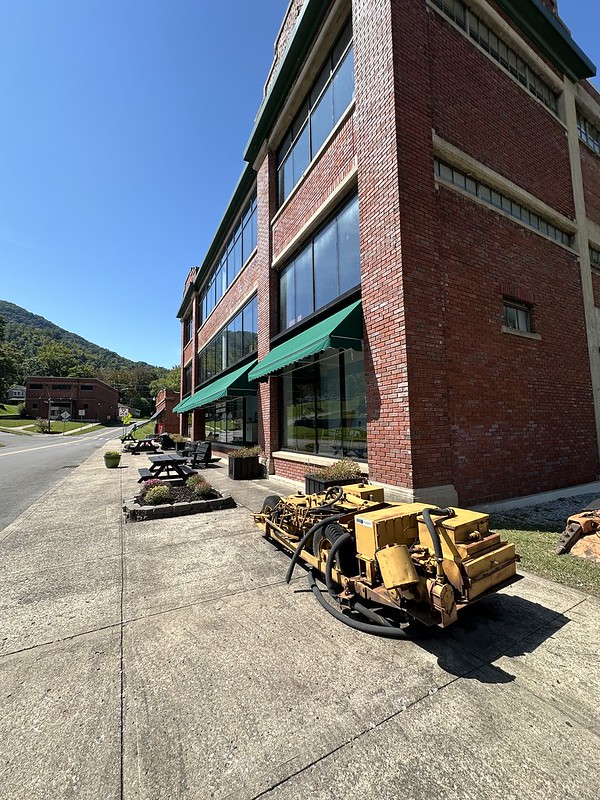
The commissary that now houses the museum went up in 1923. The National Register of Historic Places nomination describes it as the largest structure in Benham, a three story brick building with a flat roof, broad display windows at street level, and a mezzanine that held office space and overlooked the sales floor. The museum’s own curriculum materials preserve camp memories of that building as the place where families bought everything from shoes and hardware to caskets and where children measured time by trips to the soda fountain.
The coal camp that grew up around it was never simply a map of buildings. It was also a social world. Oral histories such as the 1976 interview with Paul Graham and Clyde H. Irwin recall Benham’s mix of immigrant families, the rhythms of company paydays, the realities of scrip, and the tensions around unionization. Those memories, and many more from the Benham Credit Union Oral History Project, form a human backdrop for the museum that now fills the commissary’s floors.
From Feasibility Study to Museum Doors
The idea of a coal museum in eastern Kentucky circulated long before anyone hung exhibits on the old store’s walls. In 1979 the Kentucky Legislative Research Commission produced a lengthy feasibility report titled “The Feasibility of a Kentucky Coal Museum,” outlining arguments for a state-supported institution devoted to mining heritage. That study treated a coal museum as both a cultural obligation and a potential economic engine. It foreshadowed the transformation that would eventually take place in Benham.
Locally, the turning point came in 1990 when the Tri-City Chamber of Commerce bought the vacant commissary for use as a museum. With state and other grant support, the building was renovated in the early 1990s. A board of directors, curator, and staff were in place by 1993. The Kentucky Coal Museum opened to the public in 1994, turning a space once known for its shoe department and chocolate milkshakes into one of the most ambitious coal heritage museums in the region.
Today the museum is owned by Southeast Kentucky Community and Technical College. That affiliation ties it into a wider educational mission and helps explain both its curriculum materials for teachers and its experiments with things like podcasting and radio.
Four Levels of Coalfield Memory
Visitors who step through the green awnings on Main Street enter a building that still feels like a store, but the shelves tell a different story. The museum uses all of the old commissary’s spaces, including a finished basement, to create four levels of exhibits. Harlan County Trails describes more than thirty separate displays spread across those floors, from geology and early mining technology to coal camp kitchens and classrooms.
On the upper levels, vitrines of tools and safety equipment sit beside photographs of miners and their families. There are exhibits on coal formation and fossil plants, displays that walk visitors through the steps of underground mining, and rooms that re-create the interiors of coal camp homes, schools, and churches. The museum foregrounds the company towns of Benham and Lynch, treating them as case studies in industrial planning and community life.
One of the strongest strands in these exhibits is the insistence that coal camps were multicultural places. Panels and photographs highlight the European and African American workers who came into the valley, the ways they kept distinct identities, and the ways they built shared institutions. Kentucky tourism materials note that the museum participates in regional African American heritage initiatives, in part through its attention to the diverse workforce that made coal production possible.
The third floor leans into popular memory. Here the museum houses the Loretta Lynn “Coal Miner’s Daughter” exhibit, a tribute to the singer’s life and to the coalfield roots that made her a global symbol of working class Appalachia. News coverage of the museum’s 2021 celebration of the film’s fiftieth anniversary showed how closely visitors now associate the museum with Lynn’s story, and how deftly staff use that connection to draw people toward deeper histories of coal camp life.
In the basement, a mock mine allows visitors to walk or ride through a re-created underground working. It is dark and narrow. Recorded sounds and staged scenes help convey the physical experience of mining, from the clank of steel and coal cars to the constant awareness of danger. The simulation is not a substitute for Portal 31’s actual underground tour in nearby Lynch, but it gives museum guests some sense of why miners in oral histories still talk about the mine as both livelihood and threat.
Teaching Coal Country in the Classroom
From the beginning, the Kentucky Coal Museum has presented itself as an educational institution as much as a tourist attraction. Its curriculum guide for teachers introduces students to the history of Wisconsin Steel, the building of Benham as a planned coal town, and the functions of the commissary in everyday life. It prompts classes to think about coal camp economics, from company scrip and store credit to the ways a single employer could shape housing, health care, and schools.
This educational framing matters because it shapes how younger generations encounter coal. Rather than only encountering mining as a political issue or a nostalgic slogan, students who visit the museum see objects, photographs, and recorded voices. They learn about black lung, explosions, and strikes, but also about picnics, church services, and school days. That blend of hardship and ordinary life mirrors the oral history collections that surround the museum, including the Harlan County Oral History Project and the Benham Credit Union interviews.
Scholars have taken notice. In a graduate project on Benham and Lynch, L. M. Myers describes the museum as a place where artifacts, personal collections, and exhibits such as “Twenty-Three Lives Lost” work together to keep local memory alive even as mountaintop removal and economic decline threaten both the landscape and the tourism economy that now depends on it.
Coal Heritage in a Post-Coal Economy
By the time the museum opened in the mid 1990s, Benham’s mines had been closed for decades and the town was searching for a new identity. The Advisory Council on Historic Preservation’s Preserve America profile of Benham describes how the community has leaned on its intact historic district and institutions like the Kentucky Coal Museum to build a heritage tourism economy.
The museum rarely stands alone in those stories. Tri-Cities tourism materials place it in a circuit that includes Portal 31 in Lynch and the Benham Schoolhouse Inn, both housed in adapted company buildings. Coal Miners Memorial Park behind the museum, with its caboose, memorial wall, and walking trail, extends the story outdoors and makes it harder to forget the lives lost in the county’s mines.
Journalists covering the rise of coal heritage tourism in eastern Kentucky often stop in Benham. A 2019 Stateline article on former coal mining towns turning to tourism points to the Tri-Cities as examples of communities trying to reuse industrial spaces as engines for a different kind of economy. Other pieces in outlets like Grist and the Christian Science Monitor have highlighted how residents here have had to argue, petition, and organize to protect both their water supplies and the viewsheds that make historic districts and museums worth visiting. The petition asking Kentucky regulators to declare the Benham and Lynch historic districts and their surrounding watersheds “unsuitable” for new surface mining drew directly on the town’s Preserve America status and the presence of the Kentucky Coal Museum as evidence of what was at stake.
In that sense, the museum is not just about the past. It is one of the tools local people use in present day fights over land, memory, and economic survival.
A Coal Museum Powered by the Sun
If there is a single story that carried the Kentucky Coal Museum into international headlines, it is the solar array on its roof. In 2017 the museum and Southeast Kentucky Community and Technical College partnered to install roughly eighty solar panels. College and museum materials explain that the project was meant to cut one of Benham’s largest electric bills and to provide power not only to the museum but also to nearby city offices and the Benham Schoolhouse Inn.
Energy writers seized on the symbolism of a coal museum going solar. Outlets from Ars Technica to Vox reported that the panels were expected to generate around sixty kilowatts at peak and save roughly eight thousand dollars a year in power costs. For locals, the story was less a joke about contradictions and more evidence that the town’s institutions were trying to make practical decisions in a changing energy landscape.
The panels do not erase the history inside the building. Instead, they add another layer to it. Visitors who step through the doors today enter a space that tells stories about steam locomotives and carbide lamps, but they do so under a roof that is quietly harvesting sunlight. The building that once concentrated corporate power in a company town now holds a community museum powered, at least in part, by a resource that does not have to be dug out of the mountain underneath it.
Why the Kentucky Coal Museum Matters
For someone driving into Benham for the first time, the Kentucky Coal Museum is an obvious stop. It offers what travel sites promise: four floors of exhibits, a mock mine, and a chance to walk through a well preserved company town.
For people who live in Harlan County or trace family roots here, it is something more complicated. Inside the old commissary are photographs that might show a grandfather on a tipple, a grandmother standing with a church group on the school steps, or a relative’s name on a memorial wall. The museum’s collections draw on corporate records, oral histories, family donations, and long hours of curatorial work by people who know the difference between tidy myth and lived experience.
The building itself ties that history to a particular place. To stand in the former Benham Company Store is to feel how thoroughly coal once structured life in this valley. To see that space now used to tell stories about miners, families, unions, disasters, and survival is to see how communities have tried to reclaim their own narrative.
In a county where coal is both memory and wound, the Kentucky Coal Museum gives visitors a place to sit with that complexity. It reminds outsiders that Appalachia’s coal camps were not empty caricatures of poverty but intricate communities built by people who expected their work to matter. It reminds locals that the old company town is still capable of making something new.
Sources & Further Reading
Advisory Council on Historic Preservation. “Benham, Kentucky.” Preserve America Community profile. https://www.achp.gov/preserve-america/community/benham-kentucky Appalachianhistorian.org
Ailshie, Karli Bryn. “Harlan County, Kentucky in a Post-Coal America: A Case Study.” Chancellor’s Honors Program Projects, University of Tennessee, Knoxville, 2022. https://trace.tennessee.edu/utk_chanhonoproj/ (search within 2022 projects for title). TRACE+1
Appalachian Voices. “Former Coal Company Town Integrates Energy Efficiency and Solar.” Appalachian Voices, 2015. https://appvoices.org (search the site for “Former coal company town integrates energy efficiency and solar”). Appalachian Voices
“Benham, Kentucky.” Wikipedia. https://en.wikipedia.org/wiki/Benham,_Kentucky Wikipedia
Coalcampusa.com. “Benham, KY – East Kentucky Coalfields – Harlan County.” http://www.coalcampusa.com/eastky/harlan/benham.htm Farm and Dairy
Durand, Kevin L. “Roots, Ruins, and Renewal: The Past, Present, and Future of Two Former Coal Mining Communities in Harlan County, Kentucky.” Unpublished thesis manuscript, ca. 2019. https://independent.academia.edu/DurandKevin Academia.edu+1
Flanders, Laura. “Appalachia Tries to Make a Life After Coal.” Grist, July 26, 2014. https://grist.org/climate-energy/appalachia-tries-to-make-a-life-after-coal/ Grist
Geuss, Megan. “To Save Money, Kentucky Coal Museum Turns to Solar Panels.” Ars Technica, April 8, 2017. https://arstechnica.com/science/2017/04/to-save-money-kentucky-coal-museum-turns-to-solar-panels/
Harlan County Tourism Commission. “Kentucky Coal Mining Museum.” Harlan County Trails. https://www.harlancountytrails.com (search attractions for “Kentucky Coal Mining Museum”).
Kentucky Coal Museum. “Kentucky Coal Museum.” Southeast Kentucky Community and Technical College. https://kycoalmuseum.southeast.kctcs.edu Kentucky Coal Museum
Kentucky Coal Museum. “History of the Kentucky Coal Museum.” Southeast Kentucky Community and Technical College. https://kycoalmuseum.southeast.kctcs.edu/about_us/history.aspx Kentucky Coal Museum
Kentucky Coal Museum. “Explore: Kentucky Coal Museum.” Southeast Kentucky Community and Technical College. https://kycoalmuseum.southeast.kctcs.edu/explore/index.aspx
Kentucky Coal Museum. Coal Town Curriculum: Exploring the Underground. Teacher curriculum guide PDF. Southeast Kentucky Community and Technical College. https://kycoalmuseum.southeast.kctcs.edu/media/other/coal-education-curriculm.pdf Kentucky Coal Museum
Kentucky Coal Museum. “Kentucky Coal Museum Looking to Solar Power.” News release, 2017. Southeast Kentucky Community and Technical College. https://kycoalmuseum.southeast.kctcs.edu/news/solar_panels.aspx Kentucky Coal Museum
“Kentucky Coal Mining Museum.” Atlas Obscura. https://www.atlasobscura.com/places/kentucky-coal-mining-museum Grist
“Kentucky Coal Museum.” Wikipedia. https://en.wikipedia.org/wiki/Kentucky_Coal_Museum Wikipedia
Kentucky Historical Society. “Oral History Interview with Paul Graham and Clyde H. Irwin.” Harlan County Oral History Project, 1976. Kentucky Oral History Commission / Pass the Word digital collections. https://kentuckyoralhistory.org (search for interviewees’ names). Legislative Research Commission
Kentucky Historical Society. “Benham Historic District Recognized (with Bill Burchfield).” This Week in Kentucky History podcast, July 19, 2021. SoundCloud audio. https://soundcloud.com/kentuckyhistoricalsociety/khs-2021-07-19-benham-historic-distric-recognized-with-bill-burchfield SoundCloud
Kentucky Tourism. “Kentucky Coal Mining Museum.” Kentucky Department of Tourism. https://www.kentuckytourism.com (search attractions in Benham for “Kentucky Coal Mining Museum”).
Louie B. Nunn Center for Oral History. “Benham Credit Union Oral History Project.” University of Kentucky Libraries. https://nunncenter.net (search collections for “Benham Credit Union Oral History Project”).
Moore, Sam. “The Town International Harvester Built.” Farm and Dairy, October 20, 2016. https://www.farmanddairy.com/columns/the-town-international-harvester-built/375249.html Farm and Dairy
National Park Service. “Benham Historic District.” National Register of Historic Places Inventory–Nomination Form, by Philip Thomason, April 14, 1983. PDF, NPGallery Digital Asset Management System. https://npgallery.nps.gov/GetAsset/cb3927ea-5def-4e52-99d2-d7b29bfccc1a NPGallery
National Register of Historic Places. “National Register of Historic Places Listings in Harlan County, Kentucky.” https://en.wikipedia.org/wiki/National_Register_of_Historic_Places_listings_in_Harlan_County,_Kentucky Wikipedia
Nationalregisterofhistoricplaces.com. “Harlan County, Kentucky.” https://nationalregisterofhistoricplaces.com/ky/harlan/state.html National Register of Historic Places
Oklahoma Geological Survey. “Mining Exhibits, Mining Museums, and Tour Mines in the United States.” Oklahoma Geological Survey educational resources directory. https://ogs.ou.edu (search for “Mining Exhibits, Mining Museums, and Tour Mines”).
“Our Creative Promise: Harlan County.” Our Creative Promise – Arts and Cultural Assets of the Kentucky Promise Zone and Promise Neighborhoods, March 16, 2018. https://ourcreativepromise.com/harlan/ Our Creative Promise
Rennick, Robert M. “Harlan County – Post Offices.” In Kentucky County Histories. Morehead State University, 2004. https://scholarworks.moreheadstate.edu/cgi/viewcontent.cgi?article=1384&context=kentucky_county_histories MSU Digital Archives
Tabler, Dave. “We Need a Certain Class o’ People Workin’ in the Mine.” AppalachianHistory.net, February 13, 2017. https://www.appalachianhistory.net/2017/02/we-need-certain-class-o-people-workin.html Appalachian History
Tripadvisor. “Kentucky Coal Mining Museum, Benham, Kentucky – Reviews and Visitor Photos.” https://www.tripadvisor.com (search attractions for “Kentucky Coal Mining Museum Benham”). Kentucky Coal Museum
Unroe, Colleen E. “Social Movement Learning About Just Transition in Central Appalachia.” PhD diss., Pennsylvania State University, 2021. https://etda.libraries.psu.edu/catalog/22298ceu107 ETDA+1
University of Kentucky Libraries Special Collections Research Center. “Benham Coal Company Records Available Online.” UKNow, July 27, 2016. https://uknow.uky.edu/research/arts-humanities/benham-coal-company-records-available-online UKNow
“Williamson, West Virginia, and Benham, Kentucky – Former Coal Company Towns Turn to Tourism.” Stateline, Pew Charitable Trusts, 2019. https://www.pewtrusts.org (search Stateline for “Former Coal Mining Towns Turn to Tourism”). Our Creative Promise
Wonderful Museums. “Kentucky Coal Mining Museum: Unearthing the Heart of Appalachia’s Heritage.” WonderfulMuseums.com, September 13, 2025. https://www.wonderfulmuseums.com/museum/kentucky-coal-mining-museum/ Wonderful Museums
WYMT-TV. “Kentucky Coal Museum Celebrating 50th Anniversary of ‘Coal Miner’s Daughter’.” WYMT Mountain News, 2021. https://www.wymt.com (search for the article title with “Kentucky Coal Museum”). Kentucky Coal Museum
Author Note: I grew up thinking of the Kentucky Coal Mining Museum mostly as the big brick store in downtown Benham, but the more I read its records and walk through its exhibits, the more I see it as a living archive for the whole coal camp. I hope this piece helps you look at the museum not only as a place to visit, but as a community-built way of keeping miners’ stories, company-town struggles, and post-coal reinvention in one shared space.