
Appalachian History Series – The Brookside Strike: When Families Took the Picket Line
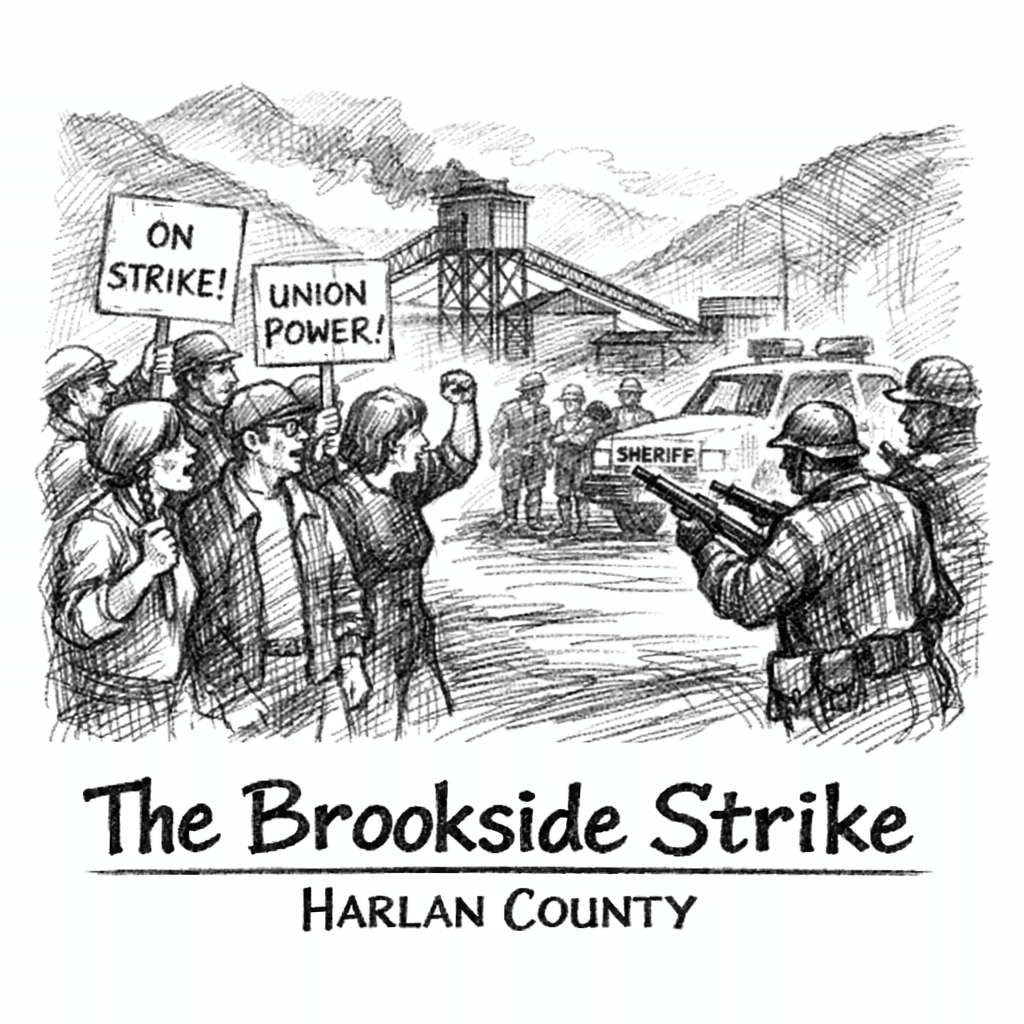
In the summer of 1973, the road into Brookside in Harlan County looked like many other coal camp highways in eastern Kentucky. Company houses lined the hollow. A tipple and prep plant hunched over the tracks. Men moved between the mine, the store, and their homes with the practiced rhythm of shift work.
Within a few months that ordinary company road had become one of the most watched picket lines in America. A contract dispute between 180 miners and Duke Power’s Eastover Mining Company at the Brookside mine turned into a thirteen month standoff that pulled in a reformed United Mine Workers of America, national church groups, a citizens’ inquiry, federal hearings, and eventually an Oscar winning documentary film.
Today, historians and families can reconstruct the strike in unusual detail. Oral histories at the Louie B. Nunn Center and Eastern Kentucky University capture the voices of miners, organizers, and women from the Brookside camps. The proceedings of the Citizens’ Public Inquiry into the Brookside Strike and a congressional oversight hearing preserve testimony that once rang out from a school gym in Evarts and a hearing room in Washington. Union correspondence and internal memos survive in the United Mine Workers archives at Penn State. And Barbara Kopple’s film Harlan County, USA remains a visual record of the picket line, the funeral of Lawrence Jones, and the crowded company houses where people waited out the long months without a paycheck.
What follows is one way of telling the Brookside story using those primary records alongside contemporary journalism and later scholarship.
A Small Mine in a Long Harlan Story
Brookside was not Harlan County’s first coal battle. In the 1930s county mine wars and the “Bloody Harlan” strikes seared the name into national headlines as operators and deputies fought union drives with guns, evictions, and blacklists.
By the mid 1960s the Brookside property had already seen one bitter fight. In 1965 the owner, Harlan Collieries, chose not to renew its contract with the United Mine Workers. A long strike followed, marred by violence and the same kind of hardheaded opposition to unionism that had shaped earlier Harlan struggles.
In July 1970 Duke Power Company quietly extended its reach deeper into the Kentucky coalfields. Through a wholly owned subsidiary, Eastover Mining and the related Eastover Land Company, Duke purchased the Brookside mine along with the nearby Highsplint and Arjay operations. About 180 miners worked at Brookside, most of them long time Harlan men who had grown up inside or just beyond the camp. Their houses, utilities, and often their credit at the store all ran through the company.
Not long after the sale, Duke’s new management signed a contract at Brookside with the Southern Labor Union, a rival outfit that miners later remembered as a company union. Workers did not vote on the agreement. In a later Trotskyist account, the Southern Labor Union was described bluntly as a “scab herding” organization, installed over rank and file objections.
The deal planted seeds of resentment. Underground, miners complained about “bad top,” poor ventilation, weak safety enforcement, and a lack of meaningful grievance procedures. One near contemporary piece in Facing South recorded a veteran’s verdict that Brookside was “very, very bad” in roof conditions and had “no safety at all in the mine,” a judgment that echoed through later oral histories.
From Southern Labor to the UMWA
Outside Harlan, the United Mine Workers of America was going through its own upheaval. The rank and file Miners for Democracy movement challenged long time union president W. A. “Tony” Boyle following the 1969 assassination of reformer Joseph Yablonski and his family, murders carried out with union funds. Federal intervention led to new elections. In 1972 Arnold Miller, a black lung activist and Miners for Democracy candidate, won the UMWA presidency on a promise to rebuild a democratic, fighting union.
Brookside became one of the first tests of that new direction. In June 1973 miners at Brookside voted 113 to 55 to leave the Southern Labor Union and join the UMWA. Local miners wanted Eastover to sign the standard industry agreement negotiated between the union and the Bituminous Coal Operators Association. That contract promised higher pay but also medical cards, stronger safety language, and a grievance system that did not run through a company friendly union.
Eastover refused to sign. Duke executives insisted that they were willing to match the economic terms of the national agreement while keeping their separate arrangement at Brookside. For the miners, the key issue was not only wages but recognition and the right to a real union contract. A congressional oversight hearing in July 1974 later laid out those positions, recording testimony about the no strike clause, the representation elections, and Duke’s insistence on handling Brookside on its own terms.
As negotiations stalled, tempers rose in the camp. On July 26, 1973, after a month of unsuccessful talks, roughly 180 miners walked out of Brookside and set up picket lines at the mine and the nearby prep plant.
The miners took up an old phrase that would soon become a national slogan: no contract, no coal.
On the Line: Women, Families, and Everyday Tactics
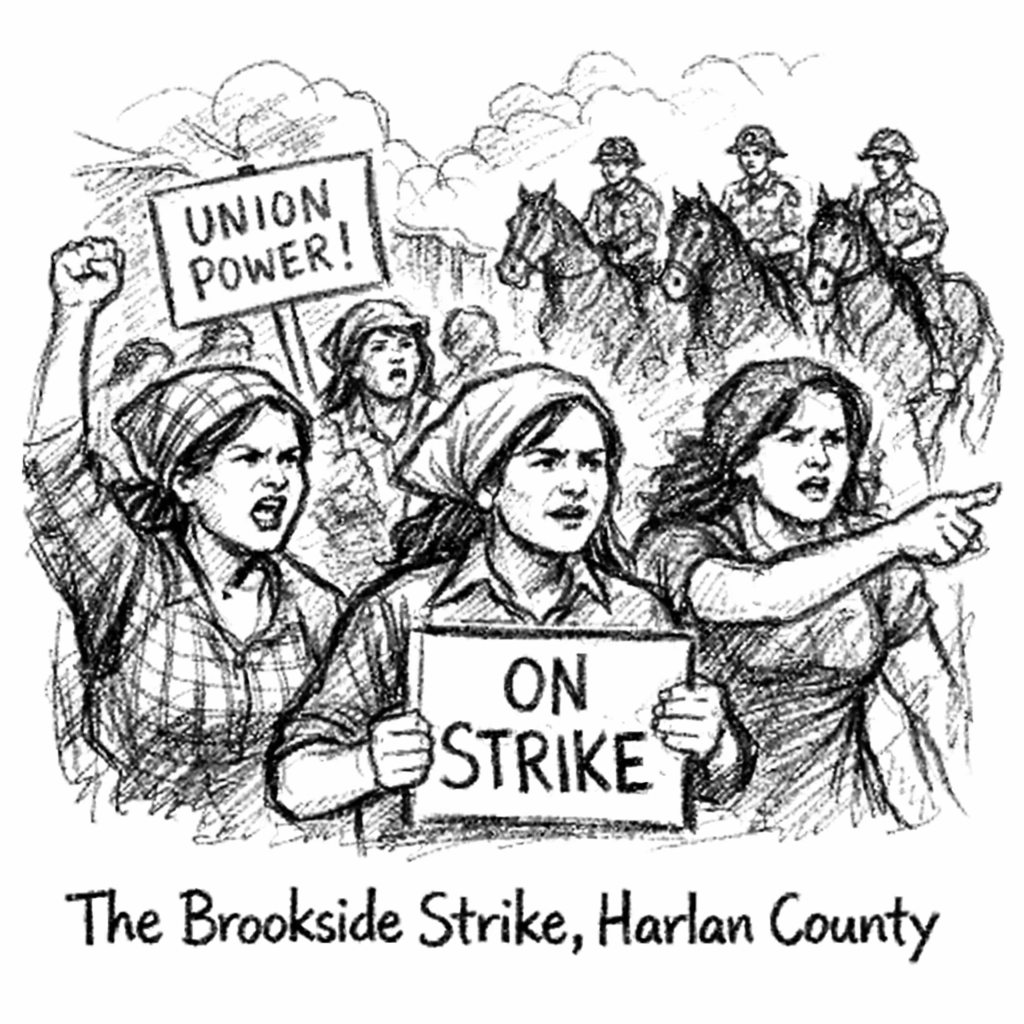
The picket line at Brookside did not belong only to the men who worked underground. From the first months of the strike, wives, daughters, and mothers helped organize food, watches, and transportation. Oral histories with Lois Scott, one of the most visible leaders of the Brookside women, describe how she and others used CB radios, car pools, and late night shifts to keep the line covered and to track company traffic on mountain roads.
In later interviews Scott remembered that miners still had to go into dangerous mines elsewhere to make some kind of living, so women took up more and more of the day to day work at the gate. She recalled setting up child care, running errands, and confronting cars of strikebreakers, sometimes in simple house dresses and sometimes in work clothes.
The strike’s nonviolent campaign reflected that family centered reality. The Global Nonviolent Action Database, drawing on union records and contemporary reporting, notes the careful mix of tactics that miners and their families used. These included mass picketing, road blockades, solidarity caravans to other Eastover mines, a boycott campaign aimed at Duke stockholders, and public appeals through church networks and campus allies.
Eastover pushed back in court. The company won injunctions that limited the number of picketers at the gate and armed escorts for strikebreakers. In response, Brookside women sometimes put their bodies in the road, standing or sitting in front of convoys. They sang union songs and traditional coal ballads. In Harlan County, USA, the camera captures one morning when the Brookside Women’s Club faces down the sheriff’s cruisers and a line of cars filled with replacement workers, singing and refusing to move.
Scott became the face of that defiance. The film shows her publicly scolding neighbors who stayed home, reminding them that every absence lengthened the strike. In one widely remembered moment she pulls a small pistol from her bra while talking about self defense, a gesture that startled outside audiences but made perfect sense in a county with a long memory of harassment and shootings on the picket line.
“Burning Up People to Make Electricity”
Brookside did not stay a local fight. As the months dragged on, outsiders arrived who would document, interpret, and sometimes shape the strike.
Marquis Childs, a syndicated columnist writing in The Atlantic, traveled to Harlan County while the strike still raged. He framed Brookside as a new chapter in an old story. In the 1930s, he reminded readers, novelist Theodore Dreiser and other writers had come to Harlan to investigate beatings and killings during earlier mine wars. Now another citizens’ group had formed to take testimony against Eastover and Duke Power.
Childs titled his piece “Burning Up People to Make Electricity,” a phrase that captured the sense among miners that the cost of cheap power for Southern cities was written in black lung, crippled backs, and dead men back in the camps. He described the Brookside mine as part of a system where profits for the parent utility had jumped by triple digits in a single year even as miners struggled to pay for food and medicine on strike pay and community relief.
The Citizens’ Public Inquiry into the Brookside Strike brought many of those themes together. Meeting in Evarts on March 11 and 12, 1974, the Inquiry invited miners, wives, clergy, physicians, and outside experts to give sworn testimony about working conditions, housing, health, and violence around Brookside. The published proceedings run to more than 300 pages and appear repeatedly in coal mining bibliographies, union correspondence, and later film criticism.
Not all testimony came from polished reformers. In one frequently quoted passage, Brookside miner Bill Doan told the Inquiry that if workers called someone from the Southern Labor Union, “he might come in a week, he might come in a month,” and that grievances often disappeared in the paper shuffle. The line captures why so many miners were willing to walk off a job they needed and risk being blacklisted.
For UMWA president Arnold Miller and national staff, Brookside became both a moral obligation and a strategic test. Internal memos preserved in the J. Davitt McAteer mining papers and United Mine Workers correspondence files show how closely national officers followed the daily developments in Harlan County, weighing how much money and staff to commit to a single mine that had become a symbol far beyond its tonnage.
Violence and the Death of Lawrence Jones
For thirteen months the Brookside strike seesawed between tense stand offs and outright violence. The Nonviolent Action Database counts roughly ninety arrests and dozens of incidents, including shootings, rock throwing, and cars driven into picket lines.
The worst came late in the struggle. On the night of August 24, 1974, away from the main gate, a young striking miner named Lawrence Jones was shot in the head by a company supporter. Various accounts list his age as twenty two or twenty three. He left behind a sixteen year old wife, a baby daughter, and an elderly mother.
In Harlan County, USA, the sequence surrounding the shooting and its aftermath is among the most haunting. Film critics and scholars have described the moment when the camera focuses on an unidentifiable glistening shape on the pavement while a hand stirs the muck and a voice explains that it is part of Jones’s brain.
At his funeral the film shows his mother wailing and nearly collapsing over the coffin as fellow miners hold her up. That raw grief later became part of the public case for settlement. Surviving company and union records, as well as later reflections from Duke officials, concede that the killing of Jones pushed national opinion decisively toward the miners and increased pressure on Eastover to reach a contract.
Contract, Courts, and Aftermath
Within days of the shooting the balance shifted. Encyclopaedia Britannica’s entry on “Bloody Harlan” notes that Lawrence Jones’s death drew national attention, and that Eastover offered a contract to the Brookside strikers on August 29, just five days after the killing.
The settlement ended the local strike after thirteen months. Miners at Brookside won recognition of their new UMWA local, the right to the national contract, and improvements in wages and benefits that matched or exceeded Duke’s earlier offers.
The victory, however, was complicated. Three months after Brookside miners went back to work, the national UMWA contract expired. In November 1974 more than one hundred thousand miners across the country walked out, and a new national agreement included a controversial no strike clause that limited the use of local walkouts. Some Brookside veterans later wondered whether the power they had built on that Harlan County road could be maintained inside a system that now tied their hands more tightly.
Legal questions also lingered. In later years a federal court case, International Union, UMWA v. Eastover Mining Co. and related NLRB proceedings revisited aspects of Duke’s obligations under the 1974 contract and its successor agreements, using Brookside and other Eastover operations as case studies in successorship and labor law.
Yet in the memory of many miners and supporters, the essential point remained simple. As one summary in the labor press put it several years later, the Brookside miners “won,” but only after a year of arrests, shootings, and hardship, and only with help from a national campaign that reached from Harlan County to Wall Street.
Harlan County, USA and the Memory of Brookside
If the Citizens’ Public Inquiry and congressional hearings gave Brookside a paper record, Harlan County, USA gave it a lasting public image. Completed in 1976, Barbara Kopple’s film spent years in the camps and on the picket line, capturing both the dramatic confrontations and the quieter moments of families trying to stretch strike pay and donations into food, rent, and medicine.
The film went on to win the Academy Award for Best Documentary and was later placed on the National Film Registry list of culturally significant American movies. Critics have praised it for its unflinching portrayal of class conflict and for centering Appalachian women who organized and spoke publicly in ways that challenged stereotypes about mountain communities.
Within the region, the documentary joins union songs, family stories, and later writing as part of a larger Brookside memory. Hazel Dickens’s coal ballads and Si Kahn’s “Brookside Strike,” advertised in Facing South as part of a tape of “struggle songs,” fed a musical tradition that carried the story into union halls and living rooms.
Recent essays such as “The Ballad of Harlan County” in the Economic Hardship Reporting Project and other outlets have drawn on family papers and company records to trace how ownership changes and corporate strategies paved the way for the strike. They remind readers that the conflict was never only about one mine gate. It grew from decades of labor struggles, corporate consolidation, and community organizing in the Appalachian coalfields.
Why Brookside Still Matters
Fifty years after miners first walked out of Brookside, Harlan County still appears in headlines when coal workers protest unpaid wages or shuttered benefits. Commentators often reach back to the 1930s mine wars and the 1973 to 1974 strike to explain why the words “Bloody Harlan” still carry weight.
The primary sources left behind from Brookside give that phrase texture and detail. Oral histories let us hear Lois Scott explain, in her own voice, why women refused to leave the road even when cars inched forward toward their knees. Published testimony from the Citizens’ Inquiry preserves the way miners like Bill Doan talked about daily humiliations under a company friendly union. The congressional hearing record shows Duke executives defending their decisions while members of Congress pressed them on safety and representation. Harlan County, USA fixes on the faces of people who are otherwise just names in those transcripts.
For Appalachian communities and labor historians, Brookside is more than an iconic film scene or a footnote in union history. It is a reminder that small mines and small towns can become national battlegrounds when people insist on being heard. It shows how women’s organizing and family labor sustained a long strike that most observers expected would collapse in a few weeks. And it marks one of the moments when the region spoke loudly enough that even distant power companies and federal offices had to listen.
Sources & Further Reading
Louie B. Nunn Center for Oral History. Appalachia: Brookside Mine Strike (1973–1974) Oral History Project. University of Kentucky Libraries. Accessed December 26, 2025. https://kentuckyoralhistory.org/collections/appalachia-brookside-mine-strike-1973-1974-oral-history-project
Eastern Kentucky University Oral History Center. “Interviews on the Brookside Mine Strike and Harlan County, Kentucky.” Oral History Collections, Eastern Kentucky University. Accessed December 26, 2025. https://oralhistory.eku.edu
Pollitt, Daniel H. “The Duke Power Strike at Brookside Mine in Harlan County, Kentucky.” Oral history interview. Southern Oral History Program Collection, University of North Carolina at Chapel Hill, 1970s. Accessed December 26, 2025. https://docsouth.unc.edu/sohp
Barbara Kopple. Harlan County, USA. Documentary film, 103 min. Cabin Creek Films, 1976. Reference entry accessed December 26, 2025. https://en.wikipedia.org/wiki/Harlan_County,_USA
American Archive of Public Broadcasting. “Hart Perry and Nancy Barker Discuss Harlan County, USA and the Brookside Strike.” Radio program, c. 1970s. American Archive of Public Broadcasting. Accessed December 26, 2025. https://americanarchive.org
“1973–1974 Brookside Strike – Bloody Harlan Once Again.” Workers Vanguard Special Supplement, April 1977. Spartacist League. PDF reprint, Marxists Internet Archive. Accessed December 26, 2025. https://www.marxists.org/history/etol/newspape/workersvanguard/1977/Special%20Supplement_04_1977.pdf
“Proceedings of the Citizens’ Public Inquiry into the Brookside Strike, March 11–12, 1974, Evarts, Kentucky.” Citizens’ Public Inquiry into the Brookside Strike, 1974. Indiana University of Pennsylvania Libraries finding aid. Accessed December 26, 2025. https://www.iup.edu/library
U.S. Congress. House Committee on Education and Labor. Oversight Hearing on the Brookside Mine Labor-Management Dispute, Harlan County, Kentucky. 93rd Congress, 2nd sess., 1974. Accessed December 26, 2025. https://books.google.com
International Union, United Mine Workers of America v. Eastover Mining Co., 603 F. Supp. 1038 (W.D. Ky. 1985). Accessed December 26, 2025. https://law.justia.com/cases/federal/district-courts/FSupp/603/1038
Pennsylvania State University Libraries. “J. Davitt McAteer Papers: United Mine Workers of America, Correspondence – Brookside Strike.” Coal Research Center / Special Collections. Accessed December 26, 2025. https://libraries.psu.edu
Gerald R. Ford Presidential Library. “Coal Labor Disputes Briefing Materials: Eastover Mining and Brookside Mine (Harlan County, Kentucky).” White House Central Files, c. 1974–1975. Accessed December 26, 2025. https://www.fordlibrarymuseum.gov
Nonviolent and Violent Campaigns and Outcomes (NV Database). “Harlan County, KY, Coal Miners Win Affiliation with UMWA Union, United States (1973–1974).” Swarthmore College. Accessed December 26, 2025. https://nvdatabase.swarthmore.edu/content/harlan-county-ky-coal-miners-win-affiliation-umwa-union-united-states-1973-1974
Childs, Marquis. “Burning Up People to Make Electricity.” The Atlantic, July 1974. Accessed December 26, 2025. https://www.theatlantic.com
Southern Exposure. “The Brookside Mine – 1974.” Southern Exposure 2, no. 1 (1974). Reprinted at Facing South, Institute for Southern Studies. Accessed December 26, 2025. https://www.facingsouth.org/brookside-mine-1974
Soodalter, Ron. “The Price of Coal, Part II: Bloody Harlan and the Coal War of the 1930s.” Kentucky Monthly, October 31, 2016. Accessed December 26, 2025. https://www.kentuckymonthly.com/culture/history/the-price-of-coal_1
“The Ballad of Harlan County.” Economic Hardship Reporting Project, 2016. Accessed December 26, 2025. https://economichardship.org
“1974: Contract at Brookside.” Facing South (Institute for Southern Studies), 1974. Accessed December 26, 2025. https://www.facingsouth.org
“13-Month Strike Is Ended by Kentucky Mine Accord.” New York Times, August 30, 1974. Accessed December 26, 2025. https://www.nytimes.com
Klemesrud, Judy. “Coal Miners Started the Strike, Then Their Women Took Over.” New York Times, May 15, 1974. Accessed December 26, 2025. https://www.nytimes.com
Portelli, Alessandro. They Say in Harlan County: An Oral History. New York: Oxford University Press, 2011. Accessed December 26, 2025. https://books.google.com/books?id=fJAVDAAAQBAJ
Wilkerson, Jessica. “The Company Owns the Mine but They Don’t Own Us: Feminist Critiques of Capitalism in the Coalfields of Kentucky in the 1970s.” Gender & History 28, no. 1 (2016): 165–180. Accessed December 26, 2025. https://onlinelibrary.wiley.com/doi/10.1111/1468-0424.12183
Ewen, Lynda Ann. Which Side Are You On? The Brookside Mine Strike in Harlan County, Kentucky, 1973–1974.WorldCat catalog record. Accessed December 26, 2025. https://www.worldcat.org
Hansell, Tom, Patricia D. Beaver, and Angela J. Wiley. Keep Your Eye upon the Scale: Harlan County, USA and the Politics of Documentary. Morgantown: West Virginia University Press, 2015. Accessed December 26, 2025. https://wvupressonline.com
Nonviolent and Violent Campaigns and Outcomes (NV Database). “Harlan County, KY, Coal Miners Win Affiliation with UMWA Union, United States, 1973–1974.” Swarthmore College. Accessed December 26, 2025. https://nvdatabase.swarthmore.edu/content/harlan-county-ky-coal-miners-win-affiliation-umwa-union-united-states-1973-1974
Portelli, Alessandro. “Harlan County, USA: Oral History and the Class Struggle in the Coalfields.” In They Say in Harlan County and related essays. Reviewed in H-Net Reviews. Accessed December 26, 2025. https://www.h-net.org/reviews/showpdf.php?id=32514
Southern Exposure / Institute for Southern Studies. “America’s Best Music and More…: Coal, Strikes, and Song in Harlan County.” Southern Exposure 2, no. 1 (1974). Accessed December 26, 2025. https://www.facingsouth.org/brookside-mine-1974
Author’s Note: The Brookside stand reminds us that the line between isolation and history’s center can be one dirt road, one song, or one stubborn grandmother away.