
Appalachian Figures Series – The Story of Carl Dodd of Laurel, Kentucky
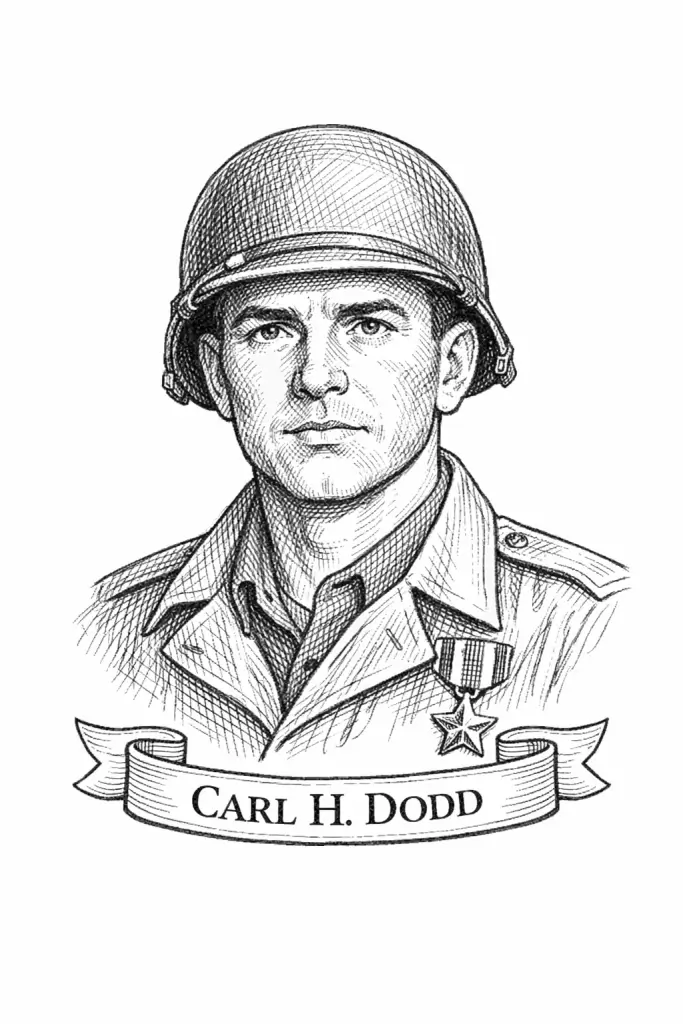
High on a little rise at Cumberland Memorial Gardens near Lily, Kentucky, a black Kentucky Historical Society marker tells visitors about First Lieutenant Carl H. Dodd. It says he was born in Harlan County, served with Company E in the Korean War, and won the Medal of Honor for taking Hill 256 near Subuk. His grave lies a few yards away, but his story begins farther back along the mountains in the tight hollows of Harlan County.
Coal camp beginnings in Harlan County
Carl Henry Dodd was born on April 21, 1925, in a small settlement listed in records as Cote or Cotes near Evarts in Harlan County. Genealogical and biographical compilations agree that he was the son of Edward F. Dodd and Ruby Eagle Dodd and identify him as the first of a large group of children in the household.
A Defense Department profile based on interviews with his parents describes a childhood shaped by coalfield life and church life. When Carl was about three, the family left the hamlet where he was born and moved to a farm near the coal camp of Kenvir in Harlan County. His parents later remembered him as a quiet boy who joined the Boy Scouts and was active in their Baptist church.
Like many Harlan County teenagers in the 1940s, Dodd entered the mines before he ever saw a uniform. After his second year of high school he registered for the draft, left school, and went to work for the Black Mountain Coal Company. The ExploreKYHistory marker and modern military biographies both note this early work underground as part of his path into the Army.
From World War II sergeant to Korean War platoon leader
Dodd enlisted in the United States Army in 1943 when he turned eighteen. During the final years of the Second World War he served stateside as a trainer and developed a lingering foot problem from long days on his feet. He was discharged in March 1946 as a sergeant, only to reenlist six months later at the same rank, a sign that soldiering had become more than a temporary wartime duty.
In the fall of 1947 he married Libbie Rose Anderson. Later summaries list three children from the marriage, sons Carl Jr. and David and a daughter, Lorana. Between 1947 and 1950 postings took him to Fort Knox in Kentucky, then overseas to Korea and Hawaii. By the time the Korean War erupted in 1950 he was an experienced noncommissioned officer in Company E of the 2nd Battalion, 5th Infantry Regiment, part of the 24th Infantry Division.
That experience showed quickly in combat. On August 7, 1950, near Chindong ni in the Battle of Masan, Dodd was serving as a master sergeant when his platoon was overrun and its officer went missing. After the attack he pulled the remaining dozen men together, led them back to their position, and held it under heavy fire. When he learned that two soldiers were still forward, he went back for them under machine gun and small arms fire and covered their withdrawal before leaving himself. For this action he received the Silver Star, with the citation praising his repeated exposure to fire and his refusal to abandon wounded men.
The Masan fighting led to a battlefield commission. By late 1950 Dodd had become a second lieutenant and soon afterward a first lieutenant, now leading a platoon in the same company where he had once been an enlisted trainer and squad leader.
Hill 256 above Subuk
In January 1951 United Nations forces launched Operation Thunderbolt, an offensive meant to push Chinese and North Korean troops back from central Korea. As part of that operation, Dodd’s unit was ordered to take Hill 256 near the village of Subuk, a position that had already repelled several earlier American attacks.
On January 30 Dodd was given the job of leading 2nd Platoon, Company E, up the hill. The Medal of Honor citation and Army general orders describe a series of actions that lasted from the afternoon into the next day. Under heavy small arms, mortar, and artillery fire, his men faltered on the slopes. Dodd moved up and down the line, pulled the platoon back together, then led a charge that knocked out at least one enemy machine gun position. Inspired by his example, the platoon advanced with grenades and bayonets and cleared a first line of defenses.
As the attack continued, Dodd reorganized his men again and pushed them across a narrow ridge toward the main crest of Hill 256. Accounts of the action emphasize that he repeatedly went ahead of his troops, using his rifle and grenades to take out an enemy mortar team and other positions that blocked their advance. Darkness stopped the fighting, but at first light on January 31 he again moved to the front and led the platoon through fog against the remaining defenders until the hill was finally secured.
General Orders No. 37, published on June 4, 1951, awarded him the Medal of Honor for this action. The citation credits his leadership with turning a stalled assault into a successful attack on a key height and stresses the way his personal courage pulled wavering soldiers forward.
From the Oval Office back to Kentucky
On May 19, 1951, Carl Dodd traveled from the Korean hillsides to the White House. In photographs preserved at the Harry S. Truman Library, President Truman stands with several Korean War soldiers wearing the pale blue ribbon of the Medal of Honor, among them Lieutenant Dodd. Captions identify the setting as the Oval Office and note that Secretary of Defense George C. Marshall and other officials were present.
Later summaries sometimes place the ceremony at Blair House, the presidential guest residence, but the dated Oval Office photographs and their archival descriptions give the strongest evidence for the White House location. The Congressional Medal of Honor Society profile notes the same date and lists him as a first lieutenant in 2nd Platoon, Company E, 5th Infantry Regiment, 24th Infantry Division.
Dodd stayed in uniform after the ceremony. Official biographies and state marker text note that he completed a twenty one year Army career that stretched from his 1943 enlistment to his retirement as a major in 1965. Along the way he accumulated decorations that included the Medal of Honor, the Silver Star, the Bronze Star, and campaign medals for both the Second World War and the Korean War.
Life and memory in Laurel County
After leaving active duty, Dodd made his home in southeastern Kentucky. A newsletter of the 24th Infantry Division Association lists his address as Mill Creek Road in Corbin. The Kentucky Historical Society marker at Cumberland Memorial Gardens explains that he lived in Laurel County for the last thirty three years of his life and emphasizes both his Harlan County birth and his long residence near Corbin.
Dodd died on October 13, 1996, at a veterans hospital in Lexington at the age of seventy one. An obituary in the Louisville Courier Journal recalled that he had worn the Medal of Honor since the early 1950s and underlined that he was one of the best known Kentucky veterans of the Korean War. Military and genealogical records agree that he was buried at Cumberland Memorial Gardens near Lily in Laurel County, where his grave lies within sight of the state marker that bears his name.
In the decades since his death, Dodd has appeared wherever Kentuckians list notable people from Harlan County or Laurel County. County histories and popular reference sites regularly name him as a Korean War soldier and Medal of Honor recipient from Harlan. Local coverage in Laurel County highlights the cemetery marker and the veterans groups who sponsored it, treating him as part of the region’s military heritage.
Harlan roots, national service
For Appalachian historians, Carl H. Dodd’s story sits at the intersection of local and national history. Federal records and military citations show a highly decorated officer whose leadership on Hill 256 became part of the official narrative of the Korean War. State markers, cemetery stones, and hometown memories place him back in the hills, first as a coal camp boy from Kenvir who left school for the mines, then as a veteran who came home and stayed in the region for the rest of his life.
The path that runs from a farm near Evarts, through Black Mountain Coal Company and Company E of the 5th Infantry Regiment, to the Oval Office in Washington and finally to a hillside cemetery at Lily is very much an Appalachian one. It ties together coal work, military service, migration inside the region, and a layered memory that belongs at once to Harlan County, Laurel County, and the wider United States.
Sources & Further Reading
Congressional Medal of Honor Society. “Carl Henry Dodd.” Accessed December 28, 2025. https://www.cmohs.org/recipients/carl-h-dodd
Lange, Katie. “Medal of Honor Monday: Army Maj. Carl H. Dodd.” U.S. Department of Defense, January 31, 2022. Accessed December 28, 2025. https://www.defense.gov/News/Feature-Stories/Story/Article/2911554/medal-of-honor-monday-army-maj-carl-h-dodd/
United States Army. “Korean War Medal of Honor Recipients.” Medal of Honor citations page, Army.mil. Accessed December 28, 2025. https://www.army.mil/medalofhonor/citations24.html
United States Army Center of Military History. “Medal of Honor Recipients – Korean War.” Medal of Honor Citations, January 5, 2012. Accessed December 28, 2025. https://history.army.mil/html/moh/koreanwar.html
Military Times. “Carl Henry Dodd.” Hall of Valor: Military Awards for Valor. Accessed December 28, 2025. https://valor.militarytimes.com/recipient/recipient-304/
Harry S. Truman Library and Museum. “President Harry S. Truman with Medal of Honor Recipient Lt. Carl H. Dodd in the Oval Office, May 19, 1951.” Photograph 77-1634. Accessed December 28, 2025. https://www.trumanlibrary.gov/photograph-records/77-1634
Harry S. Truman Library and Museum. “President Harry S. Truman with Medal of Honor Recipients Ernest Kouma, John A. Pittman, and Carl H. Dodd, May 19, 1951.” Photograph 77-1633. Accessed December 28, 2025. https://www.trumanlibrary.gov/photograph-records/77-1633
Kentucky Historical Society. “Marker 2033 – First Lt. Carl H. Dodd (1925–1996).” ExploreKYHistory. Accessed December 28, 2025. https://explorekyhistory.ky.gov/items/show/942
Kentucky Historical Society. “First Lt. Carl H. Dodd (1925–1996). Marker Search Results.” Kentucky Historical Marker Database. Accessed December 28, 2025. https://history.ky.gov/markers/search-results?subject=200
“First Lt. Carl H. Dodd / Medal of Honor Winner.” The Historical Marker Database. Accessed December 28, 2025. https://www.hmdb.org/m.asp?m=62761
OpenPlaques. “First Lt. Carl H. Dodd (1925–1996).” Open Plaques – Kentucky Historical Society. Accessed December 28, 2025. https://openplaques.org/plaques/46512
Kentucky General Assembly. “A Joint Resolution Designating Honorary Names for Portions of the State Highways and State Highway Structures.” House Joint Resolution 7, 2014 Regular Session. Accessed December 28, 2025. https://apps.legislature.ky.gov/record/14RS/hjr7/bill.doc
Kentucky Historical Society. “License Plate, Medal of Honor.” Object record 1998.1.9. Accessed December 28, 2025. https://kyhistory.pastperfectonline.com/webobject/BFCE18FF-2F1F-4891-A2F8-947243496110
Associated Press. “Corbin’s Carl Dodd, Who Received Medal of Honor, Dies at 71.” The Courier-Journal (Louisville, Kentucky), October 16, 1996, 6. Accessed via Newspapers.com December 28, 2025. https://www.newspapers.com/newspage/111271321/
Associated Press. “Former Harlan County Resident Who Won Medal of Honor Dies.” The Harlan Daily Enterprise (Harlan, Kentucky), October 16, 1996, 2. Accessed December 28, 2025. https://news.google.com/newspapers?id=rTxBAAAAIBAJ&pg=4767,1906089
“Other Kentucky Men Who Have Won the Medal of Honor.” Lexington Herald-Leader, September 13, 2011. Accessed December 28, 2025. https://www.kentucky.com/news/state/kentucky/article44125416.html
24th Infantry Division Association. “History of 24th Infantry Division in Taro Leaf – Index.” Compiled by Larry W. Gay, September 19, 2013. Accessed December 28, 2025. https://24thida.com/taro_leaf/images/Taro%20Leaf%20Index%20Gay%2016Sep13.pdf
Find a Grave. “Carl Henry Dodd (1925–1996).” Memorial 7718701. Accessed December 28, 2025. https://www.findagrave.com/memorial/7718701/carl_henry-dodd
Find a Grave. “Kentucky Medal of Honor Recipients – Virtual Cemetery.” Accessed December 28, 2025. https://www.findagrave.com/virtual-cemetery/942662
“Carl H. Dodd.” Wikipedia. Last modified December 18, 2025. Accessed December 28, 2025. https://en.wikipedia.org/wiki/Carl_H._Dodd
“Carl H. Dodd.” Wikipedia Bahasa Indonesia. Last modified March 20, 2022. Accessed December 28, 2025. https://id.wikipedia.org/wiki/Carl_H._Dodd
“Додд, Карл Генри [Dodd, Carl Henry].” Russian Wikipedia. Last modified 2024. Accessed December 28, 2025. https://ru.wikipedia.org/wiki/Додд,_Карл_Генри
Author Note: This article traces the life of Korean War Medal of Honor recipient Carl H. Dodd from his Harlan County coal camp beginnings to his burial at Cumberland Memorial Gardens in Laurel County. It draws on primary sources such as Medal of Honor records, Truman Library photographs, Kentucky historical markers, and contemporary newspaper coverage to place his story within both Appalachian and national military history.