
Appalachian Figures Series – The Story of Elbert Smith of Harlan, Kentucky
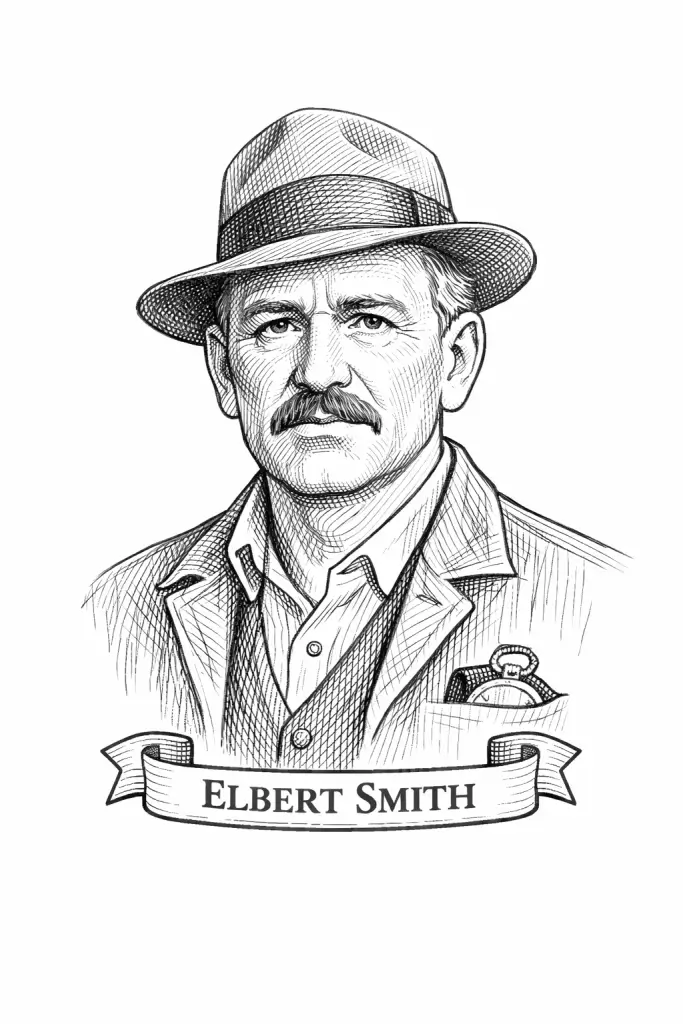
When Elbert Benjamin Smith was born in Benham in the spring of 1921, the town itself was still a young experiment. International Harvester had carved Benham out of the narrow Looney Creek valley so that coal from Harlan County could feed steel mills around the Great Lakes. Rows of company houses climbed the hillsides. The big brick commissary stood near the tracks. Nearly every paycheck depended on coal.
From that tightly managed coal camp came a boy who would grow up to explain the United States presidency to readers across the world. Under the name E. B. Smith he wrote about Thomas Hart Benton, James Buchanan, Zachary Taylor, Millard Fillmore, and Francis Preston Blair. He also stood for the United States Senate twice, helped build the Fulbright program, and carried the story of American democracy into classrooms from Tokyo to Moscow and Beijing.
Benham beginnings
Smith was born on May 1, 1921, in Benham, Kentucky, to Elbert and Gladys Smith. Benham at that time was still a classic company town. Wisconsin Steel, a subsidiary of International Harvester, had bought land on Looney Creek around 1910 and built a model coal camp with a school, hospital, company store, and rows of modest houses. Nearly every building except the depot belonged to the company.
Growing up in that setting meant that work, politics, and the wider world were never abstract ideas. Coal prices influenced whether a father kept his job. Corporate decisions made in Chicago shaped daily life in the hollow. Benham’s streets were full of accents and backgrounds mixed together by the coal boom. For a boy like Elbert, the company school and the small public library offered one of the few paths that led beyond the valley.
Those who remembered him later described a student who was curious about the broader sweep of American history, particularly the nineteenth century and the story of the West. The AHA memorial notes that he was “always interested in the American west and the people who had roamed its frontiers,” a fascination that would eventually steer him toward Thomas Hart Benton and the antebellum Senate.
Maryville College and the war years
After Benham’s schoolrooms, Smith’s next step took him across the state line into Tennessee. He enrolled at Maryville College, a small Presbyterian institution near Knoxville that drew many mountain students who wanted a liberal arts education but still needed to stay relatively close to home. He graduated with a Bachelor of Arts degree in 1940, just as the world was sliding toward wider war.
World War II soon pulled him away from the classroom. Smith entered the United States Navy and served as a communications officer. For a young man from a coal camp that had only recently been connected by rail, the war years meant an entirely different geography. Naval service required a clear head, careful handling of information, and the ability to keep perspective under pressure. Those habits would later show up in his scholarship and in his quiet, methodical political style.
The University of Chicago and the making of a historian
When the war ended, Smith took advantage of the educational opportunities open to returning veterans. He went to the University of Chicago, one of the leading centers of historical study in the United States. There he completed his master’s degree in 1947 and his Ph.D. in history in 1949.
At Chicago he focused on nineteenth century politics, sectional conflict, and the way parties and presidents managed the crises that led to the Civil War. He became especially interested in figures who stood at the fault lines of expansion and slavery: Thomas Hart Benton of Missouri, the Democratic senator who championed western development, and James Buchanan, the Pennsylvania president whose failures helped bring about secession. Those interests would define his first major books and place him squarely in debates about how to judge antebellum leaders.
From the coalfields to the classroom
With his Chicago degrees in hand, Smith began the part of his life that thousands of students would remember. Over the next four decades he taught American history at Youngstown University, Iowa State University, the University of Wisconsin, and finally the University of Maryland.
At Iowa State, he became known not only as a demanding but fair lecturer, but also as a professor who treated undergraduates as potential citizens and leaders. One of those students was Tom Harkin, a young man from Cumming, Iowa, who would later serve five terms in the United States Senate. In a tribute delivered on the Senate floor in 2013, Harkin remembered “E. B.” as a mentor who encouraged him to think seriously about public life.
Smith’s teaching career eventually brought him to the University of Maryland in 1968. There he joined a growing faculty in American history and, in time, became professor emeritus. The AHA memorial describes him as “ever popular with his students” and notes that he balanced classroom work with an active research agenda that produced a steady stream of books and articles.
An Appalachian on the campaign trail
For all his commitment to scholarship, Smith never believed that historians should remain entirely on the sidelines. In the early 1960s, while teaching at Iowa State, he decided to test his ideas about policy and democracy in the rougher arena of electoral politics.
In 1962 he sought and won the Democratic nomination for the United States Senate from Iowa. Official canvass records from that election list “Elbert B. Smith” as the Democratic challenger to long time Republican incumbent Bourke B. Hickenlooper. Hickenlooper ultimately retained his seat, but the race was close by the standards of the era, with Smith taking roughly forty six percent of the vote in a state that still leaned Republican in federal contests.
Four years later, in 1966, Smith tried again. That year he ran against Republican Senator Jack Miller. National election statistics and contemporary analyses record the outcome. Miller was reelected with a comfortable margin, and Smith once more returned to the classroom rather than to Washington.
The campaigns mattered for reasons beyond the vote totals. In his Senate tribute, Tom Harkin remembered how those races inspired a generation of Iowa students. He recounted serving as president of the Young Democrats at Iowa State when the group passed a controversial resolution urging that the People’s Republic of China be admitted to the United Nations. When Harkin worried about how that might affect Smith’s campaign, the candidate told him, “That is your call, Tom, stick to your guns, I will stand by you.”
For a boy from a Harlan County coal camp to stand on the national stage as a Senate candidate was a reminder that Appalachian lives could reach far beyond the company town. It was also an example of what it looked like when a working historian brought his convictions into public life without abandoning his principles.
Fulbright scholar and citizen of the Cold War world
Smith’s sense that history should inform public life did not stop at the Iowa border. Beginning in the 1950s he became deeply involved with the Fulbright Program and the broader world of international academic exchange. That work carried him into the heart of the Cold War.
In the mid 1950s he spent a year in Japan as a Fulbright Scholar in American history and international relations, teaching at Ochanomizu University and the University of Tokyo. At a time when Japan was rebuilding its society and its relationship with the United States after World War II, his courses gave students a window into the American past from a southerner and Appalachian who had himself served in the United States Navy.
Two decades later he went to the Soviet Union as a Fulbright professor at Moscow State University in 1976. The AHA memorial describes this as a pioneering effort to thaw Cold War tensions by bringing a more open discussion of American history into Soviet classrooms. He later returned to teach again at Leningrad State University in 1991 as the Soviet system was collapsing.
In the 1980s he extended that work to China, serving as an exchange professor at Peking University in 1983 and 1988. Moving between Beijing, Moscow, Tokyo, and College Park, he helped build a network of scholars who argued that understanding each other’s histories was essential for any hope of peace.
His leadership in this arena went beyond individual appointments. The Fulbright Association’s records list him as president of the organization in 1989, and a spring 1989 newsletter notes his role in representing the association in testimony about international education before Congress. President Jimmy Carter also appointed him to the United States Board of Foreign Scholarships, the body that oversaw the Fulbright program at the federal level.
Writing the presidents
Most readers who encounter Smith today meet him on the page rather than in a classroom or campaign photograph. His books on American politics and leadership became part of the standard literature on the presidency and the coming of the Civil War.
His first major work, Magnificent Missourian: The Life of Thomas Hart Benton, appeared in 1958. It examined the career of the long serving Missouri senator who championed western expansion and economic development. Reviewers in journals such as The American Historical Review praised the book for taking Benton seriously as a political thinker rather than treating him simply as a colorful frontier character.
The Death of Slavery: The United States, 1837–1865, published by the University of Chicago Press in 1967, offered a sweeping interpretation of the late antebellum period and the Civil War. Smith traced how political maneuvering, sectional crises, and the stubborn defense of slavery combined to make conflict almost unavoidable. Later studies of secession and wartime politics have continued to cite this work for its synthesis of political and social forces.
In The Presidency of James Buchanan, issued in 1975 as part of the American Presidency Series, Smith confronted one of the most controversial presidents in American history. Rather than simply echoing the familiar verdict that Buchanan was a failure, he tried to explain why a cautious, legal minded Pennsylvanian was so badly equipped to handle the secession crisis. His careful reconstruction of Buchanan’s choices still appears in legal and political scholarship that probes executive power on the eve of the Civil War.
He followed that study with Francis Preston Blair: A Biography in 1980, which traced the life of the influential Washington editor and political broker whose family stood close to Andrew Jackson, Abraham Lincoln, and a generation of national leaders.
Smith’s work on the White House reached a kind of culmination in The Presidencies of Zachary Taylor and Millard Fillmore, another volume in the Kansas presidency series, published in 1988. There he challenged the easy habit of dismissing both men as minor figures. He argued instead that Taylor’s short term and Fillmore’s compromise politics mattered a great deal for the fate of the Union in 1850. Modern reference works on Taylor and Fillmore still list his book among their core sources.
Even after retirement he remained engaged with those subjects. In 2007 he published President Zachary Taylor: The Hero President, a more accessible one volume biography that brought decades of research to a wider reading public.
From Benham to C-SPAN
By the 1990s, when television history series began to seek out scholars who could speak directly to viewers, Smith was a natural choice. C-SPAN’s American Presidents series invited him to appear in its “Life Portrait” episode on Zachary Taylor, which aired in 1999. Millions of viewers saw a soft spoken historian from Harlan County explaining the Mexican War, slavery controversy, and Taylor’s short presidency in plain language.
For Appalachian readers, there is something striking about that image. The coal camp boy from Benham, raised in a town built by International Harvester and surrounded by the sounds of the mines, became the national face of Taylor scholarship on public affairs television. The distance between the commissary floor and a C-SPAN studio meets in the figure of one man who carried his Harlan County beginnings into every discussion of presidents and policy.
Family, community, and final years
Outside his public roles, Smith built a long family life. He married Jean Smith and together they raised four sons and a daughter. In his later years they settled in the Harwood and Annapolis area of Maryland, where he remained active in church and community life even after retirement from teaching. He officially became professor emeritus at Maryland in 1990 but continued to write, lecture, and support international educational exchanges.
Elbert B. Smith died on April 30, 2013, at the age of ninety two. Funeral and obituary notices from Maryland, along with a floor tribute in the United States Senate, marked his passing. The American Historical Association published a formal in memoriam essay the following year, and Senator Harkin used the Congressional Record to remember the Benham born historian who had once encouraged him to “stick to your guns.”
An Appalachian legacy
For Appalachian history, Smith’s story shows how far the paths from Harlan County could reach. Benham was created to serve a single company’s need for coal, but it also produced a historian whose books shaped how the country remembers the politics of slavery, the Civil War, and the mid nineteenth century presidency.
He belonged to several worlds at once. He was the son of a coal camp who never forgot that public policy decisions in distant capitals had real consequences for families in narrow hollows. He was a Chicago trained scholar whose careful prose still appears in footnotes and bibliographies. He was a teacher who treated undergraduates in Iowa and Maryland as future citizens, and a Fulbright professor who tried to build understanding with students in Tokyo, Moscow, and Beijing.
Seen from Harlan County, the life of Elbert B. Smith is a reminder that Appalachian experience does not stop at the ridgeline. It extends into the archives of presidential history, the Congressional Record, and the lecture halls of distant universities. The boy born in a Benham company town spent his life explaining how American leaders rose and fell. In doing so, he became one more example of how the coalfields quietly shaped the wider story of the United States.
Sources & Further Reading
Kentucky Cabinet for Health and Family Services. “The Office of Vital Statistics.” Accessed January 4, 2026. https://chfs.ky.gov/agencies/dph/dehp/vsb/Pages/default.aspx Cabinet for Health and Family Services
Centers for Disease Control and Prevention, National Center for Health Statistics. “Where to Write for Vital Records: Kentucky.” Accessed January 4, 2026. https://www.cdc.gov/nchs/w2w/kentucky.htm CDC
Rausch Funeral Homes. “Dr. Elbert B. ‘E.B.’ Smith.” Obituary, 2013. https://rauschfuneralhomes.com/service/dr-elbert-b-e-b-smith/ Rausch Funeral Homes
Barnes, Bart. “E.B. Smith, U-Md. History Professor.” Washington Post, May 7, 2013. https://www.washingtonpost.com
Capital Gazette / Legacy.com. “Dr. Elbert B. (E.B.) Smith, 93.” Obituary notice, May 2013. https://www.legacy.com
Harkin, Tom. “Remembering Dr. Elbert B. Smith.” Congressional Record, 113th Cong., 1st sess., May 21, 2013. Available via Congress.gov. https://www.congress.gov
Harkin, Tom. “Remembering Elbert B. Smith.” History News Network, May 23, 2013. https://historynewsnetwork.org
Peterson, Barbara Bennett. “Elbert B. Smith (1921–2013).” Perspectives on History (American Historical Association), September 2, 2014. https://www.historians.org/perspectives-article/elbert-b-smith-1921-2013-september-2014/ AHA
“Iowa Official Canvass of the Primary Election, June 4, 1962.” Des Moines: Office of the Secretary of State, 1962. https://sos.iowa.gov/elections/pdf/results/60s/1962primcanv.pdf Iowa Secretary of State
“Iowa United States Senate Election, 1962.” In 1962 United States Senate Election in Iowa. Wikipedia. Accessed January 4, 2026. https://en.wikipedia.org/wiki/1962_United_States_Senate_election_in_Iowa Wikipedia
“Iowa United States Senate Election, 1966.” In 1966 United States Senate Election in Iowa. Wikipedia. Accessed January 4, 2026. https://en.wikipedia.org/wiki/1966_United_States_Senate_election_in_Iowa
“Elbert B. Smith.” Wikipedia. Accessed January 4, 2026. https://en.wikipedia.org/wiki/Elbert_B._Smith Wikipedia
C-SPAN. Life Portrait of Zachary Taylor. American Presidents: Life Portraits series, aired May 31, 1999. Includes on-air commentary by Elbert B. Smith. https://www.c-span.org/program/american-presidents/life-portrait-of-zachary-taylor/136517 C-SPAN
C-SPAN. “Elbert B. Smith.” Person page aggregating televised appearances. Accessed January 4, 2026. https://www.c-span.org/person/elbert-b-smith/60485/ C-SPAN
Fulbright Association. “Board and Past Presidents” and related newsletters noting Elbert B. Smith’s service as national president, c. 1989. Fulbright Association archival and newsletter materials. https://fulbright.org
Maryville College Library. “Fulbright Scholars and Alumni Notes” (late 20th-century newsletters referencing Elbert B. Smith’s Fulbright appointments and honors). Maryville College, Tennessee. https://library.maryvillecollege.edu
Open Library. “Elbert B. Smith.” Author page listing major works and publication data. Accessed January 4, 2026. https://openlibrary.org/authors/OL1121536A/Elbert_B._Smith Open Library
Goodreads. “Books by Elbert B. Smith.” Author bibliography with brief descriptions and publication years. Accessed January 4, 2026. https://www.goodreads.com/author/list/445271.Elbert_B_Smith Goodreads
Smith, Elbert B. Magnificent Missourian: The Life of Thomas Hart Benton. Philadelphia: J. B. Lippincott, 1958; reprint, Westport, CT: Greenwood Press, 1973. Listing and bibliographic details via Open Library. https://openlibrary.org/authors/OL1121536A/Elbert_B._Smith
Smith, Elbert B. The Death of Slavery: The United States, 1837–1865. Chicago: University of Chicago Press, 1967. Summary and catalog data via Goodreads. https://www.goodreads.com/book/show/3929329-the-death-of-slavery
Smith, Elbert B. Lincoln: Opportunist or Statesman. New York: Alfred A. Knopf, 1969. Cataloged in Open Library. https://openlibrary.org/authors/OL1121536A/Elbert_B._Smith
Smith, Elbert B. The Presidency of James Buchanan. Lawrence: University Press of Kansas, 1975. Overview and reference via Open Library. https://openlibrary.org/authors/OL1121536A/Elbert_B._Smith
Smith, Elbert B. Francis Preston Blair: A Biography. New York: Free Press, 1980. Listed in Open Library and other library catalogs. https://openlibrary.org/authors/OL1121536A/Elbert_B._Smith
Smith, Elbert B. The Presidencies of Zachary Taylor and Millard Fillmore. Lawrence: University Press of Kansas, 1988. Referenced in presidential studies and summarized at NetState. https://www.netstate.com/presidents/va_zachary_taylor.htm NetState
Smith, Elbert B. President Zachary Taylor: The Hero President. New York: Nova Science Publishers, 2007; repr. 2011. Publisher information via Nova Science. https://novapublishers.com/shop/president-zachary-taylor-the-hero-president/ Nova Science Publishers
Amazon.com. President Zachary Taylor: The Hero President (First Men, America’s Presidents Series), by Elbert B. Smith. Product listing with bibliographic details. Accessed January 4, 2026. https://www.amazon.com/dp/1608769127 amazon.com
Barnes & Noble. President Zachary Taylor: The Hero President, by Elbert B. Smith. Product listing with page count and publication data. Accessed January 4, 2026. https://www.barnesandnoble.com/w/president-zachary-taylor-elbert-b-smith/1110904030 barnesandnoble.com
https://doi.org/10.59350/v6rnb-1z818
Author Note: Writing about Elbert B. Smith means following a coal camp childhood in my home county all the way to the halls of national power and international classrooms. I hope this profile shows how a life that begins in Benham can ripple through presidential history, Cold War exchange programs, and generations of students far beyond the Looney Creek valley.