
Appalachian Figures Series – The Story of Ferrel Harris of Pike, Kentucky
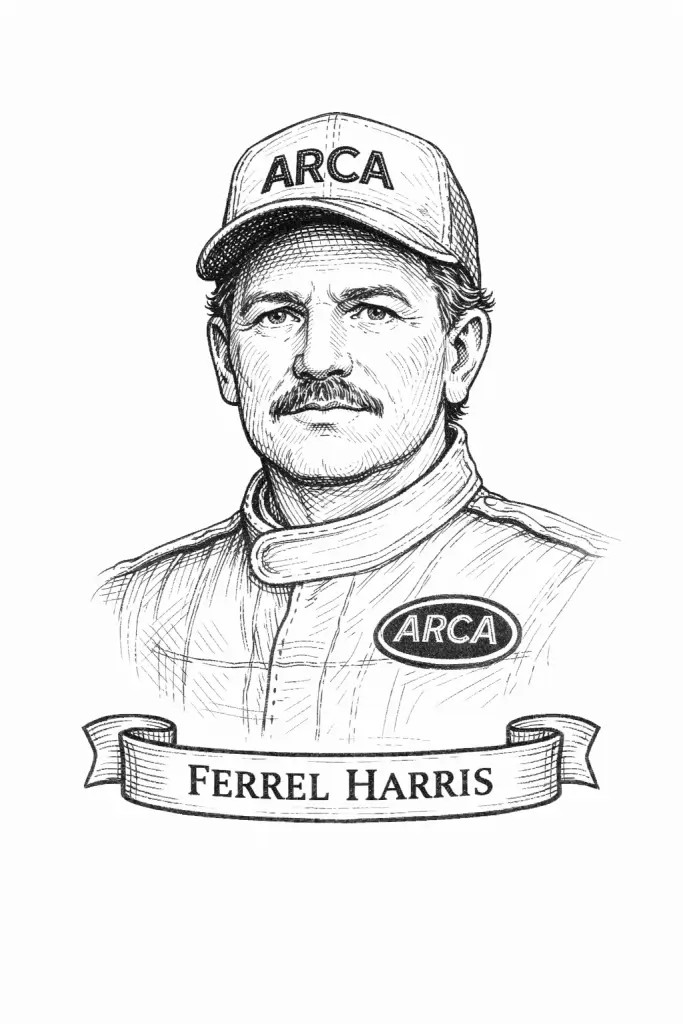
On a February afternoon in 1983, a white No. 69 Oldsmobile rolled into Daytona’s victory lane with a name on the door that meant a great deal in the hills of eastern Kentucky. The winner of the ARCA 200 that day was Thomas Ferrel Harris, a coalfield racer tied to Pikeville and Cox Farm, who had spent years hauling cars to Florida and Alabama and then hauling himself back home to work. The Getty victory lane photos show him in his firesuit smiling beneath the grandstands at Daytona International Speedway, a driver from Appalachian coal country whose name would be written permanently into the record of that track.
Nearly every modern biography calls him “Ferrel Harris of Pikeville, Kentucky,” and that phrase is right about where he belonged in the end. The ARCA obituary published at his death, however, gives a more precise beginning. Harris, it notes, was born in 1940 at Seale, a small community in Russell County, Alabama, and later made his way into stock car racing and the Appalachian coal business. He died on 7 May 2000 at Pikeville Methodist Hospital at age fifty nine, his funeral held at Thacker Funeral Home and his grave placed at Cox Farm Estate in Pike County, the property where he lived.
That mix of places explains why different sources disagree about his “hometown.” Official ARCA material and the death notice emphasize Seale as his birthplace, while statistical sites and trading card backs tend to list Pikeville as both his home and origin. What the record does show clearly is that by the time Harris became a known name in stock car circles he was already settled in eastern Kentucky, working in coal and towing race cars from the mountains to some of the fastest tracks in North America.
From Seale, Alabama to Cox Farm in Pike County
The exact path that took Harris from rural Alabama into the central Appalachian coalfields is not yet fully documented in surviving public sources. What we can see is the imprint he left once he was there. By the mid 1970s, a Kingsport Times motorsports feature referred to him plainly as “a coal miner from Pikeville, Ky.,” describing him as a thirty year old veteran of dirt track competition who was stepping into bigger stock cars on larger stages.
Family notices help fill in the picture of his home life. The ARCA obituary identifies him as a former coal operator and lists his wife as Bobbie Harris, along with a circle of stepchildren, step grandchildren, and siblings. Bobbie’s own obituary two decades later notes that she was born in Pike County in 1931 and spent her life there, which matches local tradition that Cox Farm was part of her family’s land and the place where the couple made their home.
Regional papers followed his career as a point of pride. The Floyd County Times, for example, ran a prominent feature in March 1977 that celebrated Harris’s runs at Daytona and treated him as “our man” among the big names during Speedweeks. Later, when he died in 2000, the same paper carried a short death notice that closely tracked the ARCA release and repeated the detail that he was buried at Cox Farm Estate.
Taken together, these fragments show a man whose adult identity was deeply rooted in the coal economy and community life of Pike County, even though the birth line in his obituary points back to Seale. For eastern Kentucky readers, Ferrel Harris was one of their own, a coal operator who raced at Daytona and came back to the same hills after the checkered flag fell.
Building an ARCA career at Daytona and Talladega
The ARCA obituary is our best single guide to Harris’s long relationship with the ARCA series. It records that he joined ARCA in 1966 and continued racing in that sanctioning body as late as 1991, a span that touched four different decades of stock car history. The Third Turn database, built from period results reports, counts nineteen ARCA starts spread across those years, with one win, three top five finishes, six top tens, and several races where he led laps.
Harris’s strongest tracks were the high speed superspeedways. ARCA’s own Daytona and Talladega records, along with the Daytona International Speedway media guide, show that he won the ARCA 200 at Daytona on 14 February 1983 and started from pole position at that same race three different years. At Daytona he captured the pole for the ARCA 200 in 1976, 1981, and 1984, and his best Talladega ARCA finish was fifth in 1990.
The compiled results for the 1983 Daytona ARCA 200 give a sense of how decisive that victory was. On that Monday afternoon Harris drove the No. 69 Oldsmobile, entered by Parker Racing, to a win over 80 laps and 200 miles at an average speed just over 144 miles per hour. The results sheet credits him with leading 18 laps, notes that the race ended under caution, and places his name among the line of superspeedway specialists who have won ARCA’s February race at Daytona.
Photographs from the ISC Archives and other collections show his ARCA cars in the mid 1970s and early 1980s with sponsor names that reinforce the ties to his home region. One oft reproduced image from 1975 shows a Cougar Coal sponsored Dodge at Daytona, while another captures his later No. 69 ARCA car in action at the same track. Those cars carried the names of Pikeville area coal businesses into the infield at one of the most visible tracks in American motorsport.
Although ARCA was Harris’s most enduring home, it was only one part of a working racer’s calendar that also took in occasional USAC stock car outings and, most visibly, stretches of NASCAR Cup competition.
A Cup career built on superspeedway savvy
In NASCAR’s top division, Harris was never a factory backed star, yet his record is quietly substantial. The Third Turn’s Cup statistics list forty one Winston Cup starts between 1975 and 1982. His strongest year by far was 1978. That season he ran fourteen of thirty Cup races and logged all five of his career Cup top ten finishes, enough to place him thirty fifth in the final standings despite running a partial schedule.
The statistical sites that compile old Cup results agree that Harris’s best known drive came at the 1978 Daytona 500. Driving Jim Stacy’s No. 6 Dodge, he started twenty third and finished ninth in a race remembered for Bobby Allison’s long overdue win. A distribution of his career finishes shows that year as an outlier in a difficult era for independent or semi independent drivers. Across his Cup career he recorded one seventh place finish, one eighth, two ninths, and one tenth, all in 1978, with most of his other starts scattered deeper in the field.
What makes those results more striking is the kind of cars and backing he usually carried. Early in his Cup tenure Harris often appeared with self funded or lightly funded entries carrying coal branding from Pike County, including the Cougar Coal Dodge that he brought to Daytona during Speedweeks in 1975. Later he found rides with established owners like Ed Negre and Jim Stacy, but even those teams were usually a step behind the biggest factory associated operations of the day. Statistical breakouts by track type suggest that he did his best work on the drafting tracks, where patience and race craft sometimes mattered more than sheer horsepower.
Harris dipped into other series when opportunities allowed. The Third Turn notes two USAC stock car starts in 1976 and a single NASCAR Modified National Championship appearance in 1980 that produced a top five and top ten finish in his only outing on that tour. By the end of the 1980s, however, his national schedule had dwindled to occasional ARCA superspeedway runs. His final recorded ARCA start came at Daytona in February 1991, closing a career that had brought a coal operator from eastern Kentucky into the same box scores as national champions.
Coal money, Jim Stacy, and the risks behind the scenes
If the race result tables show where Harris ran, a court file and a few long form articles suggest some of what it took to get there. In the late 1970s his most visible Cup rides came with car owner Jim Stacy, another figure whose wealth flowed from coal and trucking and who tried to buy rapid influence in NASCAR by fielding multiple cars.
That partnership did not end quietly. In 1981 the North Carolina Court of Appeals handed down a decision in Harris v. Jim Stacy Racing, Inc., a case in which Harris and crew chief Harry Hyde sought to recover money connected to a promissory note. The opinion identifies him as “Thomas Ferrel Harris” and summarizes a complicated fight over a judgment, an execution on Stacy’s property, and later efforts to claw back the funds. Later historical writing on Stacy’s career describes the lawsuit more plainly as an attempt by Harris and Hyde to collect an eighty thousand dollar loan and other unpaid obligations after Stacy’s short lived multi car empire began to come apart.
For an Appalachian historian, the lawsuit is not just a footnote in racing law. It puts into legal language a story that many independent drivers lived: to make the grid they relied on unstable money from speculative owners, risky personal loans, or their own regional businesses. When those deals went wrong, the same drivers who had chased drafting lines at Daytona found themselves chasing judgments in unfamiliar courtrooms. Harris’s case is a rare place where that behind the scenes struggle surfaces in the archival record.
“Our man at Daytona” and the memory of a coalfield racer
During Harris’s active years, eastern Kentucky newspapers and fans treated him as a kind of ambassador from the coalfields to the superspeedways. The Floyd County Times feature from 1977 that framed him as “our man at Daytona” captured that feeling, turning a regional driver into a symbol of local pride during the long winter when racing from Florida filtered back into homes along the Big Sandy and its tributaries.
Other small pieces show how his image circulated. Trading cards issued in the early 1990s, including a 1991 Langenberg ARCA / Hot Stuff card, placed his photo and statistics in binders alongside national champions and future stars. Online photo archives and fan forums now trade images of his Cougar Coal No. 82 at 1970s Daytona Speedweeks and his later No. 69 ARCA car, usually captioned simply with his name and “Pikeville, Ky.”
Even in the Daytona and ARCA media guides, which compress decades of history into tables, his name remains easy to spot. In the lists of ARCA winners and pole sitters at Daytona, “Ferrel Harris” appears once as race winner and three times as polesitter, threaded among factory backed efforts and national champions. For a coal operator from the hills above Pikeville, those entries may be the most enduring inscription of his career.
Why Ferrel Harris matters to Appalachian history
As a driver, Ferrel Harris did not win Cup championships or dominate a series. His achievements are smaller in number yet large in meaning. He won the ARCA 200 at Daytona, took three ARCA poles on one of the sport’s most famous tracks, and logged forty one Cup starts during one of NASCAR’s most competitive eras.
Viewed from the Cumberland Plateau, however, his story is about more than statistics. Harris embodied a particular Appalachian pathway into modern American life. He came from a rural background, worked in coal, invested in race cars, and used those machines to step into a national arena without leaving behind his ties to Pike County. Newspapers that called him a coal miner from Pikeville and fans who still share his photos online are responding to that mixture.
In the end, the most accurate description may be the one implied by the records. He was born in Alabama, built his adult life around a Pike County farm, stood in Daytona’s victory lane in 1983, and lies now in the ground at Cox Farm within sight of the hills that shaped him. For a site devoted to Appalachian history, his life offers a reminder that the region’s stories are not only about mines, strikes, and courthouse squares, but also about the ways people from those same places carried their skills and their risks onto ovals where the grandstands towered above the pines.
Sources & Further Reading
Auto Channel. “ARCA: Thomas Ferrel Harris Dies at Age 59.” The Auto Channel, May 13, 2000. https://www.theautochannel.com/news/ The Auto Channel
Auto Racing Club of America (ARCA). “ARCA Menards Series: 1500 Races by the Numbers.” Feature article, June 3, 2021. https://www.arcaracing.com/2021/06/03/arca-menards-series-1500-races-by-the-numbers/ ARCA
Daytona International Speedway. 2020 Daytona International Speedway Media Guide. Daytona Beach, FL: Daytona International Speedway, 2020. https://www.daytonainternationalspeedway.com/wp-content/uploads/sites/1003/2021/03/05/2020_DIS_Media_Guide.pdf Daytona International Speedway
Daytona International Speedway / ARCA Menards Series. Daytona ARCA 200 statistical yearbook (online edition). PubHTML5, c. 2021. https://pubhtml5.com/dkbq/mpsu/basic/ PubHTML5
“Daytona ARCA 200.” Ultimate Racing History, race results for Daytona ARCA 200, Daytona International Speedway, February 14, 1983, and related Daytona ARCA 200 events in the 1970s–1980s. https://www.ultimateracinghistory.com/race.php?raceid=2855 and https://www.ultimateracinghistory.com/racelist3.php?trackid=81 Ultimate Racing History+1
ESPN. “Ferrel Harris Stats.” ESPN.com, driver statistics page. https://www.espn.com/racing/driver/stats/_/id/2622/ferrel-harris ESPN.com
Floyd County Times (Prestonsburg, KY). Issue of March 23, 1977. Front-page and sports coverage relating to Ferrel Harris and Daytona racing. Floyd County Public Library Digital Archive. https://fclib.org/
Frontstretch. Waid, Steve. “Two Who Spent Huge Sums to Gain NASCAR Influence – Power, Briefly.” Waid’s World column, Frontstretch.com, c. 2010s. https://www.frontstretch.com/
Getty Images. “Ferrell Harris of Pikeville, KY, Drove This Dodge Charger in 10 NASCAR Cup Races during the Season.” ISC Images & Archives news photo, 1975. https://www.gettyimages.com/detail/news-photo/ferrell-harris-of-pikeville-ky-drove-this-dodge-charger-in-news-photo/144035450 Getty Images
Getty Images. “Ferrel Harris Enjoys His Moment in Victory Lane at Daytona International Speedway after Winning the ARCA 200.” ISC Images & Archives news photo, February 14, 1983. https://www.gettyimages.com/detail/news-photo/february-14-1983-ferrel-harris-enjoys-his-moment-in-victory-news-photo/156317498 Getty Images
Harris, Thomas Ferrel, and Harry Hyde v. Jim Stacy Racing, Inc. 53 N.C. App. 597, 281 S.E.2d 455 (North Carolina Court of Appeals, 1981). Full text at Justia. https://law.justia.com/cases/north-carolina/court-of-appeals/1981/8119sc37-1.html Justia
Kingsport Times-News (Kingsport, TN). Motorsports feature describing Ferrel Harris as “a coal miner from Pikeville, Ky.,” c. mid-1970s. Newspapers.com archive. https://www.newspapers.com/
Lucas & Son Funeral Home. “Bobbie Harris, 88, of Pikeville.” Obituary, April 24, 2020. https://www.lucasandsonfh.com/obituaries/bobbie-harris-6 Racers Reunion
Motorsport Magazine. “Ferrel Harris.” Motorsport Database driver entry. https://www.motorsportmagazine.com/database/drivers/ferrel-harris/ Motor Sport Magazine
Motorsport Stats. “Ferrel Harris – Statistics and Results.” MotorsportStats.com, NASCAR Cup Series summary. https://motorsportstats.com/driver/ferrel-harris/summary/series/nascar-cup-series motorsportstats.com
NascarReference.com. “Ferrel Harris’ NASCAR Cup Series Statistics.” Team statistics and race summary for Harris Racing. https://www.nascarreference.com/team/teamviewall.php?Series=1&TeamID=3243A and https://www.nascarreference.com/team/teamstats.php?TeamID=3243 nascarreference.com+1
Racing-Reference.info. “Ferrel Harris.” ARCA Permatex SuperCar Series driver season stats and related NASCAR Cup data. https://www.racing-reference.info/drivdet/harrife01/1983/A/ racing-reference.info
RacersReunion. “ARCA #69 Ferrel Harris 1984 @ Daytona.” John Betts gallery image and discussion. https://racersreunion.com/john-betts/gallery/41407/arca-69-ferrel-harris-1984-daytona Racers Reunion
RacersReunion. “A Somewhat-Nefarious Figure Passes.” Forum discussion of J. D. Stacy and his NASCAR career, including reference to lawsuits by Harry Hyde and Ferrel Harris. October 28, 2016. https://racersreunion.com/community/forum/stock-car-racing-history/38983/a-somewhat-nefarious-figure-passes Racers Reunion
SpeedwayMedia.com. “ARCA Racing Series Presented by Menards Lucas Oil 200 Driven by General Tire – Fast Facts.” February 6, 2019. https://speedwaymedia.com/2019/02/06/arca-racing-series-presented-by-menards-lucas-oil-200-driven-by-general-tire-fast-facts/ SpeedwayMedia.com
SpeedwayMedia.com. “ARCA Menards Series at Daytona: Daytona ARCA 200 Pre-Race Notes.” February 14, 2024. https://speedwaymedia.com/2024/02/14/arca-menards-series-at-daytona-daytona-arca-200-pre-race-notes/ SpeedwayMedia.com
Stock Car Racing Wiki. “Ferrel Harris.” Stock Car Racing Wiki (Fandom) entry. https://stockcarracing.fandom.com/wiki/Ferrel_Harris stockcarracing.fandom.com
The Third Turn. “Ferrel Harris.” Driver career-results page with NASCAR Cup, USAC, and ARCA statistics. https://thethirdturn.com/wiki/Ferrel_Harris The Third Turn
Trading Card Database. “1991 Langenberg ARCA/Hot Stuff #44 – Ferrel Harris.” Card front and back images and checklist entry. https://www.tcdb.com/GalleryP.cfm/pid/97125/Ferrel-Harris and https://www.tcdb.com/Checklist.cfm/sid/73395/1991-Langenberg-ARCA/Hot-Stuff Trading Card Database+1
Ultimate Racing History. “Daytona International Speedway – ARCA Events.” Track history and multi-year Daytona ARCA 200 results listing including the 1983 win by Ferrel Harris. https://www.ultimateracinghistory.com/racelist3.php?trackid=81 Ultimate Racing History
Wikipedia. “ARCA races at Daytona.” Consolidated winners table for Daytona ARCA 200 events, including 1983 victory by Ferrel Harris. https://en.wikipedia.org/wiki/ARCA_Menards_Series_at_Daytona
Wikipedia. “Ferrel Harris.” Biographical entry with summary of NASCAR Cup and ARCA career. https://en.wikipedia.org/wiki/Ferrel_Harris Wikipedia
DriverAverages.com. “Ferrel Harris – Driver Averages at Darlington Raceway (and other tracks).” Historical average finishes and qualifying positions. https://www.driveraverages.com/nascar/drivertrack.php?drv_id=419&trk_id=5 driveraverages.com
https://doi.org/10.59350/xf114-ffx85
Author Note: Writing about Ferrel Harris lets me link eastern Kentucky coal history with the wider world of superspeedway racing. I hope his story shows how Appalachian lives and risks have always reached far beyond the hills where they began.