
Appalachian Figures Series – The Story of John Paul Riddle of Pike, Kentucky
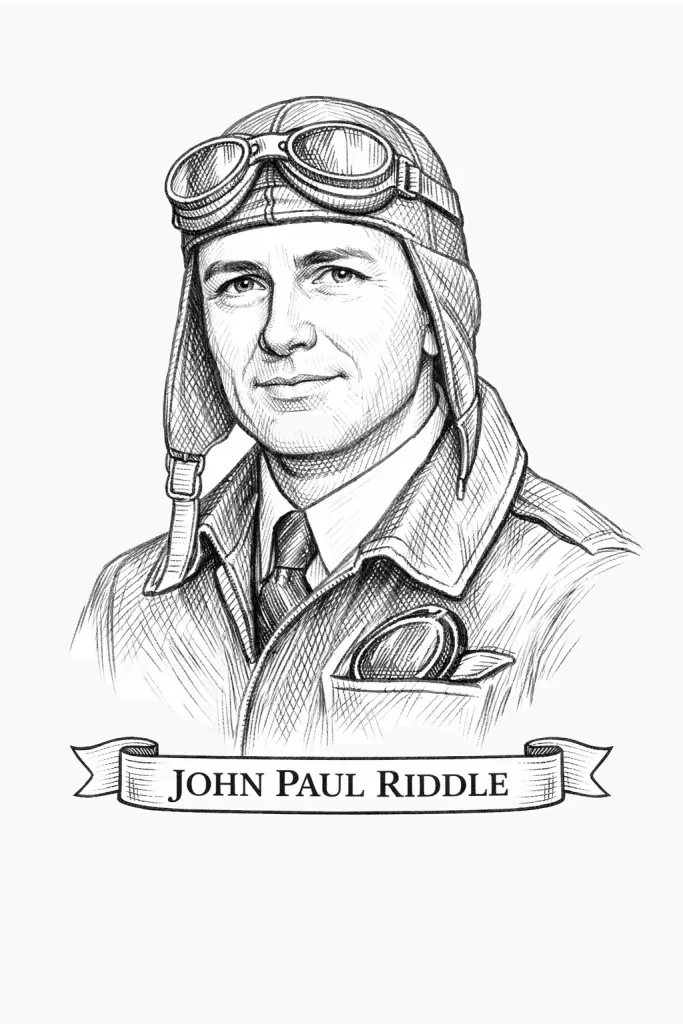
John Paul Riddle was born in Pikeville on May 19, 1901, at a time when powered flight was still a rumor from the coast and a line in the newspapers. He grew up in a courthouse town where the Levisa Fork bent around the business district and where most boys expected to stay on the ground. He instead carried around a question that he later phrased as wondering why people had not been given wings.
Riddle attended Pikeville College Academy and finished his studies there in 1920. His education came in the middle of a local push to modernize, as Pikeville’s school leaders brought in new faculty, new buildings, and a stronger college program for mountain students. In a later Pikeville College reminiscence, an alum remembered that the boy who would become world famous in aviation first stood out as a trombone player in the town band.
Within just a few years he moved from student to Main Street entrepreneur. Pikeville College yearbooks from the early 1920s carry an advertisement for the J. P. Riddle Co., a Brunswick phonograph shop in the Pauley Building, with Riddle and Walter P. Walters listed as proprietors. A trade piece in The Talking Machine World noted that Riddle, a Brunswick dealer in Pikeville, used attention getting promotions and that he had just moved into a prominent new house on Second Street. Taken together, the yearbook and trade press show a young Pike County businessman who understood spectacle and sound before he ever climbed into a cockpit.
Learning to fly
After graduating from Pikeville College Academy, Riddle entered the United States Army Air Service at a moment when military aviation was still sorting itself out after the First World War. A Pike County Historical Society biography, based on contemporary records, notes that from about 1920 to 1922 he served as an aviation cadet and was sent first to the mechanics school at Kelly Field in San Antonio, then to Chanute Field in Illinois, and finally to flying school at Carlstrom Field near Arcadia, Florida.
At Carlstrom, a World War I era training base surrounded by open ranch country, Riddle learned to fly in the same region where he would later build a wartime flight training empire. He also served at Post Field in Lawton, Oklahoma, gaining experience with aircraft construction and maintenance. When his Army service ended, he stepped into the uncertain world of barnstorming.
According to the Pike County Historical Society, Riddle bought a surplus Curtiss Jenny for a few hundred dollars and began flying from rough fields across a dozen states, selling short rides and performing exhibition flights. An article on Appalachian barnstormers at AppalachianHistory.net uses Riddle as an example of the itinerant pilots who followed the new highways and rail lines into the interior, looking for towns with open ground and crowds willing to pay. He quickly learned that wide, flat farmland in Ohio or the Bluegrass made safer runways than narrow bottoms hemmed in by hills, but he never lost his connection to Pikeville.
Fourth of July under Middle Bridge
Riddle’s most famous homecoming stunt came on July 4, 1923. The Kentucky Historical Society marker that now stands near the site describes how Pikeville residents lined the riverbank to watch their local pilot fly a Curtiss Jenny under the town’s Middle Bridge, which spanned the Levisa Fork near the business district. Local histories and the Pike County Historical Society’s narrative confirm the story and emphasize just how low the clearance was between the river, the bridge trusses, and the biplane’s wings.
The stunt was more than a daredevil flourish. It folded aviation into Pikeville’s public life and gave the town a visual symbol of modernity that residents remembered for generations. When the Kentucky Historical Society approved a roadside marker about Riddle in the twenty first century, the bridge flight shared space on the plaque with his later achievements in global aviation.
Riddle’s barnstorming career was risky in more ways than one. In July 1924 the Pike County News reported that Lieutenant Riddle, flying for the Burgess Flying Company at Portsmouth, Ohio, crashed into the river while trying to avoid spectators crowding his planned landing area. The paper described how he unbuckled his own belt and that of his passenger under water and then held the passenger’s head above the surface until help arrived. Both survived, but the story reinforced Riddle’s reputation at home as a daring pilot who accepted danger to protect his customers.
Later that year, another Pike County News item proudly announced that Pikeville could claim more than a passing interest in the national Ford Reliability Air Tour because Lieutenant Riddle was one of the participating pilots. In a few short years he had gone from a mountain town academy to the national stage of early aviation.
Lunken Field and the birth of Embry-Riddle
Riddle’s barnstorming carried him regularly across the Ohio River. In 1925, while working in the Cincinnati area, he met businessman T. Higbee Embry at Lunken Field. Their partnership, struck on December 17, 1925, created the Embry-Riddle Company, a firm that combined flight training, scenic flights, aircraft sales, air shows, and eventually passenger and cargo routes.
Embry-Riddle’s official history notes that the company first operated as a flying school and Waco, Fairchild, and Monocoupe distributorship, then expanded into aerial advertising and a small travel agency that helped organize air travel for others. By 1927 the firm was flying passengers and cargo between Louisville, Cincinnati, and Cleveland and had secured a key airmail contract that made Cincinnati one of the first cities in the country with regular airmail service.
These years are also documented in institutional histories, trade publications, and in the later “Life in Aviation” oral history series Riddle recorded for Embry-Riddle’s archives in the 1980s. In those tapes he looks back on the Lunken years as a leap from barnstorming to structured aviation work, even if the boundaries between stunt flying, airmail hauling, and passenger promotion often blurred.
In 1929 the Embry-Riddle Company became one of the first five flying schools to be certified under the new Air Commerce Act. That same year, however, the company merged into the Aviation Corporation (AVCO). Within a short time the flying school closed, the airline and cargo routes were absorbed into what became American Airways, and by 1932 the original Embry-Riddle enterprise had disappeared into a larger corporate structure. Riddle left American Airways that year and began looking for a new base of operations.
Reborn in Florida and training for war
Embry-Riddle’s own “Reborn” history and associated university narratives trace Riddle’s move to Florida in the early 1930s. He believed Miami’s climate and its position facing the Caribbean and South America made it an ideal base for aviation. Over several years he tried different ventures and partners before settling on a seaplane base on Biscayne Bay, launched in 1939 with Miami attorney John McKay. They revived the Embry-Riddle name and opened the Embry-Riddle School of Aviation with a handful of aircraft and a tiny staff.
The timing was significant. The Civilian Pilot Training Program of 1939 and the looming war in Europe created enormous demand for flight and technical training. Embry-Riddle’s partnership with the University of Miami brought in student pilots, and federal contracts soon followed. In 1940 the United States Army Air Corps selected Embry-Riddle to participate in its training program, on the condition that Riddle find suitable airfields for thousands of cadets.
Riddle chose to return to familiar ground. In March 1941, after major reconstruction, the Riddle Aeronautical Institute opened a new training facility on the site of Carlstrom Field, where he had learned to fly two decades earlier. The institute then added nearby Dorr Field, creating what the university now describes as the largest non-military operated flight training center in the United States during the war.
Under the British Flying Training School Program, Embry-Riddle also operated No. 5 British Flying Training School at Riddle Field near Clewiston. Sources from the British Flying Training School Association and Embry-Riddle’s own 5BFTS site note that more than 1,300 Royal Air Force cadets completed pilot training at Riddle Field between 1941 and 1945, alongside American cadets. Photographs and yearbooks from the period show rows of Stearman trainers, RAF cadets in formation, and technical classes at Carlstrom and Riddle fields, all under the Embry-Riddle banner.
During these years Riddle was not only an administrator. He also wrote for aviation publications, including the article “London Journey” in Flying magazine and a feature on Embry-Riddle for American Pilot. The wartime in-house paper, the Embry-Riddle Fly Paper, regularly carried accounts of training milestones, graduations, and visits by dignitaries, often with photographs of Riddle at ceremonies in Miami, Arcadia, and Clewiston.
Brazil and the global classroom
The wartime surge in training did not stop at the end of the airfields in Florida. Responding to a request from Brazil’s air minister, Embry-Riddle established a technical school in São Paulo in 1943 to train Brazilian Air Force personnel in aircraft, engines, and instruments. The program, known then as the Escola Técnica de Aviação, has evolved into a major Brazilian Air Force technical school and is often cited in Brazilian and Embry-Riddle histories as a lasting legacy of Riddle’s international work.
In his oral history tapes, Riddle treated the Brazilian venture as part of a wider mission to create what he once called an “air university” for both military and civilian fliers. Even after wartime contracts ended, the philosophy behind Carlstrom, Riddle Field, and São Paulo continued to shape how Embry-Riddle grew into a degree-granting institution and later a university with campuses on several continents.
Riddle Airlines and the cargo age
After the war, Riddle turned to air cargo. He founded Riddle Aviation in Miami, which soon became Riddle Airlines, one of the first scheduled all-cargo airlines in the United States. Histories of air cargo describe Riddle Airlines as an early player in hauling freight on long-range aircraft and note that the company eventually took the name Airlift International.
Trade press pieces, airline fleet histories, and pilots’ reminiscences show four-engine propeller aircraft with the Riddle or Airlift name painted along the fuselage, moving cargo through Miami and other hubs during the 1950s and 1960s. For a man who began with a single surplus Jenny, it was a remarkable arc.
Final years and remembrance
Riddle gradually stepped back from daily operations, but he continued to appear at Embry-Riddle events and aviation gatherings. In 1986 the National Aeronautic Association honored him as a Distinguished or Elder Statesman of Aviation, recognizing a lifetime of contributions to flight training and air commerce.
He died in Florida on April 6, 1989, with official records and later biographies agreeing on that date. A memorial marker at Oak Ridge Cemetery in Arcadia, where many RAF cadets from the Carlstrom and Riddle Field era are also buried, identifies him as an American pioneer of aviation and co-owner of the flying school where British cadets trained during the Second World War.
Embry-Riddle’s alumni magazine Lift tells the story of his “final flight,” when an Embry-Riddle graduate scattered his ashes from an aircraft, closing the circle on a life spent in the air. In Pikeville, a Kentucky Historical Society marker at Main and Division Streets, along with local museum exhibits and articles, ensure that his mountain beginnings remain part of the story told about Embry-Riddle’s founder.
An Appalachian life in global aviation
For Appalachian history, Riddle’s story is not just a tale of one talented aviator. It shows how a boy from a small Eastern Kentucky town could step into one of the most modern technologies of his age and then carry that expertise outward. His barnstorming flights and Fourth of July stunt under Middle Bridge connected Pikeville to a national culture that was learning to look up when engines passed overhead. His work with Embry-Riddle, military cadets, and Brazilian trainees reveals how Appalachian born people helped build the aviation networks that shaped the mid twentieth century world.
When students walk past the Embry-Riddle flight line today or when a researcher clicks through the institution’s archival oral histories, they are following a path that began along the Levisa Fork. The markers in Pikeville and Arcadia, the RAF graves at Oak Ridge Cemetery, and the preserved Waco aircraft on the Daytona Beach campus all point back to John Paul Riddle’s decision to leave a mountain college, learn to fly, and then use that skill to teach others.
Sources & Further Reading
Riddle, John Paul. “John Paul Riddle – Life in Aviation.” Oral history audio, May 1985. Oral History Collection, Embry-Riddle Aeronautical University Archives, Daytona Beach, FL. https://commons.erau.edu
Riddle, John Paul. “John Paul Riddle – Oral History Interview.” Oral history audio, 29 May 1985. Oral History Collection, Embry-Riddle Aeronautical University Archives, Daytona Beach, FL. https://commons.erau.edu
Riddle, John Paul. “John Paul Riddle – Heritage Project Oral History.” Multiple oral history interviews, 1973–1986. Heritage Project Oral History Series, Embry-Riddle Aeronautical University Archives, Daytona Beach, FL. https://commons.erau.edu
Embry-Riddle Aeronautical University Archives. “John Paul Riddle Participates in Graduation Ceremonies at Embry-Riddle School of Aviation, Miami, Florida.” World War II – Flight & Technical Training Photograph, ca. 1940. Embry-Riddle Aeronautical University Archives, Daytona Beach, FL. https://commons.erau.edu
Pikeville College. Highlander Yearbook, Class of 1924. Pikeville, KY: Pikeville College, 1924. https://www.e-yearbook.com/yearbooks/Pikeville_College_Highlander_Yearbook/1924/Page_1.html e-yearbook.com
LDSGenealogy.com. “Pike County, Kentucky School Records.” Listing of Pikeville College yearbooks including The Record (1924). https://ldsgenealogy.com/KY/Pike-County-School-Records.htm LDS Genealogy
“The Talking Machine World.” Trade journal, September 1923 issue, item noting J. P. Riddle of Pikeville, Kentucky, as a Brunswick dealer. Digital facsimile at World Radio History. https://www.worldradiohistory.com/Archive-Talking-Machine/20s/Talking-Machine-1923-09.pdf World Radio History
Kentucky Historical Society. “John Paul Riddle, 1901–1989.” Kentucky Historical Marker No. 2251, Main and Division Streets, Pikeville, Kentucky. https://history.ky.gov
ExploreKYHistory (Kentucky Historical Society). “John Paul Riddle.” Expanded online marker entry with biographical narrative. https://explorekyhistory.ky.gov
Aviation Museum of Kentucky. “John Paul Riddle.” Hall of Fame biography, enshrined 1996. https://aviationky.org/hall_of_fame/john-paul-riddle/ The Aviation Museum of Kentucky-AMK
Find a Grave. “John Paul Riddle (1901–1989), Oak Ridge Cemetery, Arcadia, DeSoto County, Florida.” Memorial ID 126749815. https://www.findagrave.com/memorial/126749815/john_paul-riddle Find a Grave
National Aeronautic Association. “Distinguished Statesman and Stateswoman of Aviation Award Recipients.” Listing for John Paul Riddle, 1986. https://naa.aero
Embry-Riddle Aeronautical University. “Embry-Riddle Reborn.” University archives narrative on the 1939 rebirth of Embry-Riddle in Miami. https://erau.edu/leadership/archives/reborn Embry-Riddle Aeronautical University
Craft, Stephen G. “Embry-Riddle History: Embry-Riddle in a World at War, 1939–1945.” Internal historical study, Embry-Riddle Aeronautical University, posted as PDF on Scribd. https://www.scribd.com/document/49975356/Embry-Riddle-History Scribd
AeroCrew News. “Embry-Riddle Aeronautical University’s Storied Past.” AeroCrew News, 13 December 2018. https://aerocrewnews.com/2018/12/13/embry-riddle-aeronautical-universitys-storied-past/ Aero Crew News
Embry-Riddle Aeronautical University. “Final Flight: Remembering John Paul Riddle’s Last Ride.” Lift (Embry-Riddle alumni magazine), Fall/Winter 2020. https://lift.erau.edu/final-flight/ Lift Magazine
Crawford, Byron. “Above and Beyond.” Kentucky Living, 1 March 2022. https://www.kentuckyliving.com/lifestyle/pike-county-native-fulfills-sky-high-dreams Kentucky Living
Plane & Pilot Magazine. “John Paul Riddle: Former Barnstormer Partnered to Create a World-Class Flight Training School.” Feature article, Plane & Pilot, September 1, 2024 digital edition. https://planeandpilotmag.com/john-paul-riddle/ Plane & Pilot
Plane & Pilot Magazine. “Plane & Pilot, September 2024 Issue (Digital Edition).” OverDrive listing noting the John Paul Riddle feature. https://owwl.overdrive.com/media/12395729 OWWL Library System
American Air Museum in Britain. “No. 5 British Flying Training School (Riddle Field), Clewiston, Florida.” Unit history and photographs. https://www.americanairmuseum.com
Tabler, Dave. “Daring Young Men in Their Flying Trapezes.” AppalachianHistory.net, 7 June 2017. https://www.appalachianhistory.net
Pikeville, City of. “Appendices: City of Pikeville Comprehensive Plan.” Section on heritage tourism referencing aviator John Paul Riddle. Pikeville, KY, 2021. https://pikevilleky.gov/wp-content/uploads/2021/04/Pikeville-Comp.-Plan-Appendices-1.22.21.pdf pikevilleky.gov
Wikipedia. “John Paul Riddle.” Last modified 2025. https://en.wikipedia.org/wiki/John_Paul_Riddle commons.erau.edu
https://doi.org/10.59350/wx9da-cx767
Author Note: John Paul Riddle’s life shows how a boy from an Appalachian river town helped shape modern aviation across the world. I hope this profile makes his Pike County roots and global impact easier to see for students, neighbors, and researchers.