
Appalachian Figures Series – The Story of Peter Tinsley of Pike, Kentucky
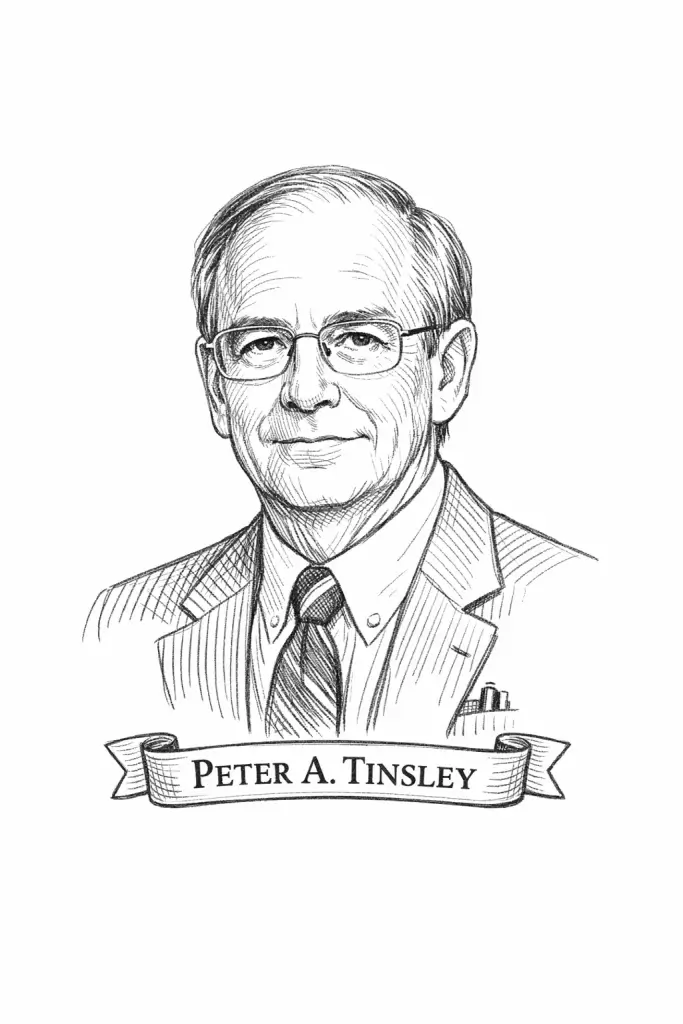
Peter Ault Tinsley spent most of his professional life in rooms far removed from the hills of eastern Kentucky. His work unfolded in the long corridors of the Federal Reserve Board in Washington and in quiet offices in Cambridge and London. Yet his story begins in Pikeville, the seat of Pike County, where mining roads curl along the Levisa Fork and where most young people in 1939 would never have imagined a future at the center of global monetary policy.
Tinsley would become one of the key architects of the Federal Reserve’s modern macroeconomic modeling. He helped design the FRB/US model that still underpins policy analysis, and he pushed the central bank toward a more explicit treatment of expectations and credibility. His research on inflation expectations, yield curves, and zero lower bound policy became part of the toolkit used by central banks around the world. For Appalachian history, his life is a reminder that the region’s influence has extended into the technical heart of modern finance and economics.
Pikeville beginnings and a preacher’s family
Peter Ault Tinsley was born in Pikeville, Kentucky, on January 21, 1939, the son of Rev. Benjamin William Tinsley Sr. and Evelyn Ault Tinsley. His father’s calling in the ministry meant that the family’s life revolved around church communities and the rhythms of small town congregations. The obituary written by his family recalls him first of all as the child of a preacher and as someone whose life of the mind grew from that background of close knit community and serious conversation.
The Tinsleys did not remain in Pike County forever. By the time Peter was a teenager the family had settled in West Lafayette, Indiana, where he graduated from high school. That move placed him within reach of universities and the expanding postwar world of American higher education, but Pikeville remained the first line of every formal biography. In later reference works and memorials he appears as an “economist from Kentucky” and “person from Pikeville” even though his career would be lived out far from the Tug Fork and the eastern Kentucky coalfields.
Hobart, McKinsey, and the road to Princeton
After high school Tinsley enrolled at Hobart and William Smith Colleges in Geneva, New York. Student registers from the late 1950s list “Peter Ault Tinsley … West Lafayette, Ind.” among the Hobart undergraduates, documenting a young man whose path now ran from Pikeville to Indiana to the Finger Lakes. He completed his degree in 1961.
Instead of going straight into academia he spent several years at the consulting firm McKinsey and Company in Chicago. According to his obituary, it was there that he learned and honed his skills as a computer programmer, at a time when serious computing still meant mainframes, punch cards, and long overnight runs. That early fusion of data, programming, and economics would shape the rest of his career.
Tinsley then entered graduate school at Princeton University and completed a PhD in economics in 1966. Friends remembered him as an intense student and a polymath who consumed a book of fiction most nights even while mastering the mathematics and theory that defined mid twentieth century macroeconomics. He was studying as debates raged about Keynesian models, the Phillips curve, and what it would mean to take expectations seriously in economic policy. Those arguments would not stay on the blackboard for long.
Joining the Federal Reserve in an age of inflation
In 1965, even before finishing his doctorate, Tinsley joined the staff of the Board of Governors of the Federal Reserve System as an economist in the Division of Research and Statistics. He arrived just as the United States was entering the period later known as the Great Inflation. For the next thirty three years, through oil shocks, recessions, disinflation, and the early years of the “Great Moderation,” he worked inside the institution that was trying to understand and control those forces.
Over time he rose to become a Deputy Associate Director of the Research and Statistics Division, retiring from the Board in 1998. Colleagues recall that he led the Special Studies group, an internal research shop where the Fed experimented with new modeling techniques and where younger economists could test ambitious ideas.
In that role he stood at the crossroads of academic theory and central bank practice.
Policy rules, uncertainty, and the early turn to rational expectations
From the 1970s onward, Tinsley’s research helped push the Federal Reserve away from purely backward looking equations toward a style of modeling that took expectations, forward planning, and optimal control seriously.
One of his early landmark contributions, written with John H. Kalchbrenner, was “On the Use of Feedback Control in the Design of Aggregate Monetary Policy,” published in the American Economic Review in 1976. In that paper they treated monetary policy as a feedback control problem. The central bank’s interest rate decisions were no longer just discrete moves but part of a rule that responded systematically to inflation and output. The work showed how optimal control techniques could be used to design policy in large scale econometric models and it became a touchstone for later discussions of rule based policy.
Tinsley also ventured into corporate finance with his 1970 article “Capital Structure, Precautionary Balances, and Valuation of the Firm” in the Journal of Financial and Quantitative Analysis, which explored financial risk and precautionary cash holdings. That early work already displayed a habit of thinking in terms of dynamic adjustment and risk, themes that would reappear in his later macroeconomic modeling.
With P. A. V. B. Swamy and James R. Barth he co authored “The Rational Expectations Approach to Economic Modelling,” a 1982 article in the Journal of Economic Dynamics and Control that laid out practical methods for incorporating rational expectations into econometric models. This was not just a theoretical exercise. It offered statisticians at the Board ways to translate the Lucas critique and rational expectations into estimable equations that could be used in policy analysis.
Tinsley’s research interests were never narrow. In the late 1980s he worked with David Neumark and Suzanne Tosini on “After Hours Stock Prices and Post Crash Hangovers,” published in the Journal of Finance in 1991, which examined the behavior of stock prices in the wake of the 1987 market crash using high frequency data. Even in that project, though, the underlying question remained the same. How do markets process information. How do expectations adjust after a shock.
FRB/US and the Fed’s forward looking model
The work for which Tinsley is most remembered at the Federal Reserve is the design of the FRB/US model. In the 1990s the Board decided to replace its older MPS model with a new system that would be more explicitly forward looking and better able to respond to the criticisms raised by the Lucas critique.
The result was FRB/US, a large scale quarterly econometric model of the United States. The official guide, A Guide to FRB/US: A Macroeconomic Model of the United States, lists Flint Brayton and Peter Tinsley as editors and describes a framework in which most behavioral equations are based on optimizing behavior with explicit expectations of firms, households, and financial markets. The guide emphasizes that private sector expectations of policy are a major channel through which monetary policy affects the economy and that the model was designed to fit the data while respecting rational expectations restrictions where possible.
A companion article, “The Role of Expectations in the FRB/US Macroeconomic Model,” published in the Federal Reserve Bulletin in 1997 and co authored by Brayton, Mauskopf, Reifschneider, Tinsley, and John Williams, explained in detail how the model handled expectations. It laid out the mixture of model consistent expectations and learning schemes that allowed FRB/US to represent how households, firms, and markets forecast future variables.
In later oral history interviews for the Federal Reserve Board, officials such as Donald Kohn and David Stockton singled out FRB/US as the moment when the staff moved decisively from backward looking forecasting equations to models in which forward looking behavior and expectations were explicit. They credited “Peter Tinsley and others” with making that transition possible and with insisting that policy analysis had to respect the implications of rational expectations.
FRB/US did not remain a one off experiment. Central bank researchers have continued to use the model for decades. Studies such as Robert Tetlow’s work on “real time model uncertainty” examine dozens of vintages of FRB/US as a way of understanding how robust simple policy rules are across changing model specifications. Other researchers, including Anna Cieslak and Annette Vissing Jorgensen in “The Economics of the Fed Put,” still cite Brayton and Tinsley’s guide as the standard reference for the model’s structure.
When the Federal Open Market Committee debates interest rate decisions, staff presentations still draw on tools that descend from FRB/US. That means that when the Federal Reserve weighs how quickly to fight inflation or how aggressively to support employment, a piece of the machinery underneath can be traced back to an economist who was born in Pikeville, Kentucky in 1939.
Rational error correction and dynamic adjustment
Beyond FRB/US, Tinsley continued to push forward the theory of dynamic adjustment in macroeconomic models. In 1998 he published a Finance and Economics Discussion Series paper titled “Rational Error Correction,” later expanded into an article in Computational Economics. The work explored how error correction mechanisms could be derived from optimizing behavior under rational expectations rather than simply being tacked onto time series equations.
Those ideas proved influential. Later researchers studying sticky price models and dynamic macroeconomic relationships cited “Rational Error Correction” as they worked out how to reconcile short run dynamics with long run equilibria. Again, the recurring theme was Tinsley’s effort to make sure that the equations used in central bank models had a clear behavioral and theoretical foundation.
Inflation expectations, term structures, and credibility
In the late 1990s and 2000s Tinsley’s work increasingly focused on inflation expectations and the information embedded in the term structure of interest rates. Much of this research was done with Sharon Kozicki, then at the Bank of Canada and later an important central bank researcher in her own right.
Together they produced a series of papers that explored how to extract measures of long run inflation expectations and policy credibility from yield curves and surveys. Their 2001 articles “Term structure views of monetary policy under alternative models of agent expectations” and “Shifting endpoints in the term structure of interest rates” showed how forward rates could be interpreted when the perceived long run inflation endpoint itself moves over time. These methods allowed researchers to infer when markets believed that a central bank’s inflation target had changed or when they doubted that policymakers would stick to their announced plans.
Kozicki and Tinsley then turned to survey data in a pair of Bank of Canada working papers, “Survey Based Estimates of the Term Structure of Expected U.S. Inflation” and “Perhaps the FOMC Did What It Said It Did: Tests of Policy Consistency Using Survey Data.” Those studies combined survey measures with model based estimates to construct time varying series for expected inflation at different horizons and to test whether the Federal Open Market Committee’s actions matched its stated objectives.
Their final joint contribution in this area, “Effective Use of Survey Information in Estimating the Evolution of Expected Inflation,” was published in the Journal of Money, Credit and Banking in 2012 and offered a framework for blending surveys and model based expectations in a coherent way. By this point, central banks had fully embraced the idea that expectations were themselves policy tools. Tinsley’s work supplied some of the concrete methods they needed to measure and analyze those expectations.
Policy at zero and the tools for modern crises
Perhaps the most widely cited paper that carries Tinsley’s name in the context of recent crises is “Monetary Policy When the Nominal Short Term Interest Rate Is Zero,” co authored with James Clouse, Dale Henderson, Athanasios Orphanides, and David Small. First issued as a Finance and Economics Discussion Series paper in 2000 and later published in the B. E. Journal of Macroeconomics, the article explored what central banks could do when policy rates hit the zero lower bound.
Years before the 2008 financial crisis or the Covid era, the authors examined unconventional tools such as forward guidance and large scale asset purchases. When the Federal Reserve and other central banks found themselves constrained by zero or near zero interest rates, they reached for strategies that had already been mapped in that work.
In retrospect, the arc of Tinsley’s research looks remarkably prescient. Starting from feedback control in the 1970s, through rational expectations and FRB/US, forward looking inflation expectations, and zero lower bound policy, he repeatedly worked on the questions that would define monetary policy in the late twentieth and early twenty first centuries.
Cambridge, Birkbeck, and a second career in the classroom
After retiring from the Federal Reserve in 1998, Tinsley began what his family described as a second career. He joined the Faculty of Economics and Politics at the University of Cambridge, first as a visitor and then as a permanent member between 1998 and 2003. In 2006 he became a full professor in the Department of Economics, Mathematics and Statistics at Birkbeck College, University of London, where he taught until 2014.
Obituaries from Cambridge and memorials in the Princeton Alumni Weekly describe a teacher who loved economic research and took real pleasure in explaining complex ideas to students. He continued to write on policy design and expectations and was working on a graduate level textbook on economic policy for Cambridge University Press at the time of his death in 2018.
The guest book attached to his Washington Post obituary includes tributes from colleagues and former students who remembered him as both brilliant and kind. One colleague at the Fed recalled that Tinsley fought internal battles on behalf of his staff, using his institutional standing to protect research projects and positions. Another remembered meeting him as a young economist and finding in him a mentor whose combination of intellect and good humor helped convince them to join the Board.
Outside work, his family remembered him as a person who loved long running family trips to Frisco on North Carolina’s Outer Banks, returning to the same stretch of barrier island for more than forty years. His chosen charities included scientific institutions such as the Carnegie Institution’s Department of Terrestrial Magnetism and the National Park Service, a pairing that fits someone whose life had been spent thinking about data, dynamics, and the natural world.
An Appalachian story in the heart of modern central banking
From the outside, the world of central bank modeling can seem impossibly distant from Pike County. Yet Peter A. Tinsley’s life demonstrates that this world has Appalachian roots. Born in a small Kentucky county seat in 1939, he moved through Indiana, New York, and New Jersey before spending three decades at the Federal Reserve Board and then teaching in Cambridge and London. Along the way he helped redesign the way the Fed thinks about policy, expectations, and risk.
Historians of economic thought now treat the Fed’s large scale models as important artifacts in their own right. Studies of the Board’s macro models and of the “place of the Phillips curve” in those systems underscore how crucial the FRB/US era was in shifting central banks toward forward looking analysis and expectations based policy. Tinsley’s name appears throughout that literature in connection with FRB/US, rational error correction, and the treatment of inflation expectations.
For Appalachian history, his story complicates any simple picture of brain drain or one way departure. The boy born in Pikeville did not return to become a local official or banker. Instead, his influence rippled outward through the technical machinery of macroeconomic models, policy rules, and expectations series that shaped interest rate decisions from the 1970s into the twenty first century.
When students in Pike County or elsewhere in the mountains encounter the idea that the Federal Reserve relies on large computer models to weigh what will happen if rates rise or fall, the story of Peter Ault Tinsley offers a concrete connection. Someone from their region not only learned how those models work. He helped build them.
Sources & Further Reading
Dignity Memorial. “Peter Ault Tinsley.” Obituary, March 2018. https://www.dignitymemorial.com/obituaries/washington-dc/peter-tinsley-7797237 Dignity Memorial
“PETER TINSLEY Obituary.” The Washington Post, March 24–26, 2018, reproduced on Legacy.com. https://www.legacy.com/us/obituaries/washingtonpost/name/peter-tinsley-obituary?pid=188525436 Legacy
“Peter A. Tinsley *66.” Princeton Alumni Weekly, memorial note, February 6, 2019. https://paw.princeton.edu/memorial/peter-tinsley-66 Princeton Alumni Weekly
University of Cambridge, Faculty of Economics. “Peter Tinsley, 1939–2018.” Faculty news item, 2018. https://www.econ.cam.ac.uk/news/peter-tinsley-1939-2018 Cambridge Economics
Hobart and William Smith Colleges. Hobart and William Smith Colleges 1958–1959. Geneva, NY: Hobart and William Smith Colleges Registrar, 1959. Digitized register listing “Peter Ault Tinsley … West Lafayette, Ind.” https://archive.org/details/hobartwilliamsco19581959hoba HWS Library
Board of Governors of the Federal Reserve System. Federal Reserve Bulletin, vol. 82, no. 3 (March 1996). Includes staff directory listing Peter A. Tinsley as Deputy Associate Director, Division of Research and Statistics. https://fraser.stlouisfed.org/title/federal-reserve-bulletin-62/march-1996-20614 FRASER
Board of Governors of the Federal Reserve System. Federal Reserve Bulletin, vol. 71, no. 8 (August 1985). Includes staff listing for Peter A. Tinsley in the Division of Research and Statistics. https://fraser.stlouisfed.org/title/federal-reserve-bulletin-62/august-1985-21006 FRASER
“Peter A. Tinsley.” Wikipedia, last modified 2025. https://en.wikipedia.org/wiki/Peter_A._Tinsley Wikipedia
Brayton, Flint, and Peter A. Tinsley, eds. A Guide to FRB/US: A Macroeconomic Model of the United States. Finance and Economics Discussion Series 1996-42. Washington, DC: Board of Governors of the Federal Reserve System, 1996. https://www.federalreserve.gov/econres/feds/a-guide-to-frbus-a-macroeconomic-model-of-the-united-states.htm Federal Reserve
Brayton, Flint, Eileen Mauskopf, David Reifschneider, Peter A. Tinsley, and John Williams. “The Role of Expectations in the FRB/US Macroeconomic Model.” Federal Reserve Bulletin 83 (April 1997): 227–245. https://www.federalreserve.gov/pubs/bulletin/1997/199704lead.pdf Federal Reserve
Brayton, Flint, Andrew Levin, Ralph Tryon, and John C. Williams. “The Evolution of Macro Models at the Federal Reserve Board.” Carnegie–Rochester Conference Series on Public Policy 47 (1997): 43–81. https://www.sciencedirect.com/science/article/pii/S0167223198000049 ScienceDirect
Kohn, Donald L. “Research at the Federal Reserve Board: The Contributions of Henderson, Porter, and Tinsley.” Speech at the Federal Reserve Board Models and Monetary Policy Conference, Washington, DC, March 26, 2004. https://www.federalreserve.gov/boarddocs/speeches/2004/20040326/default.htm Federal Reserve
Board of Governors of the Federal Reserve System. “FRB/US Model Documentation and Research Papers.” FRB/US documentation index. https://www.federalreserve.gov/econres/us-documentation-papers.htm Federal Reserve
Kalchbrenner, John H., and Peter A. Tinsley. “On the Use of Feedback Control in the Design of Aggregate Monetary Policy.” American Economic Review 66, no. 2 (May 1976): 349–355. https://ideas.repec.org/a/aea/aecrev/v66y1976i2p349-55.html IDEAS/RePEc
Neumark, David, Peter A. Tinsley, and Suzanne Tosini. “After-Hours Stock Prices and Post-Crash Hangovers.” Journal of Finance 46, no. 1 (1991): 159–178. https://ideas.repec.org/a/bla/jfinan/v46y1991i1p159-78.html IDEAS/RePEc
Swamy, P. A. V. B., James R. Barth, and Peter A. Tinsley. “The Rational Expectations Approach to Economic Modelling.” Journal of Economic Dynamics and Control 4, no. 1 (1982): 125–147. https://ideas.repec.org/a/eee/dyncon/v4y1982i1p125-147.html IDEAS/RePEc
Tinsley, Peter A., and Peter von zur Muehlen. “A Maximum Probability Approach to Short-Run Policy.” Journal of Econometrics 15, no. 1 (1981): 31–48. https://ideas.repec.org/a/eee/econom/v15y1981i1p31-48.html IDEAS/RePEc
Tinsley, P. A. “Capital Structure, Precautionary Balances, and Valuation of the Firm: The Problem of Financial Risk.” Journal of Financial and Quantitative Analysis 5, no. 1 (March 1970): 33–62. https://www.cambridge.org/core/journals/journal-of-financial-and-quantitative-analysis/article/capital-structure-precautionary-balances-and-valuation-of-the-firm-the-problem-of-financial-risk/033310290becb0fd0f276e944d854186 Cambridge University Press & Assessment
Tinsley, Peter A. “Capital Structure, Precautionary Balances, and Valuation of the Firm: The Problem of Financial Risk.” Special Studies Papers 7. Board of Governors of the Federal Reserve System, 1970. https://econpapers.repec.org/paper/fipfedgsp/7.htm EconPapers
Tinsley, Peter A. “Rational Error Correction.” Finance and Economics Discussion Series 1998-37. Board of Governors of the Federal Reserve System, 1998. https://ideas.repec.org/p/fip/fedgfe/98-37.html IDEAS/RePEc
Kozicki, Sharon, and Peter A. Tinsley. “Shifting Endpoints in the Term Structure of Interest Rates.” Journal of Monetary Economics 47, no. 3 (2001): 613–652. https://ideas.repec.org/a/eee/moneco/v47y2001i3p613-652.html SSRN
Kozicki, Sharon, and Peter A. Tinsley. “What Do You Expect? Imperfect Policy Credibility and Tests of the Expectations Hypothesis.” Journal of Monetary Economics 52, no. 2 (2005): 421–447. https://www.sciencedirect.com/science/article/pii/S0304393204001344 ResearchGate
Kozicki, Sharon, and Peter A. Tinsley. “Permanent and Transitory Policy Shocks in an Empirical Macro Model with Asymmetric Information.” Journal of Economic Dynamics and Control 29, no. 11 (2005): 1985–2015. https://ideas.repec.org/a/eee/dyncon/v29y2005i11p1985-2015.html ScienceDirect
Kozicki, Sharon, and P. A. Tinsley. “Survey-Based Estimates of the Term Structure of Expected U.S. Inflation.” Bank of Canada Staff Working Paper 2006-46. Ottawa: Bank of Canada, 2006. https://www.bankofcanada.ca/2006/12/working-paper-2006-46 Bank of Canada
Kozicki, Sharon, and P. A. Tinsley. “Perhaps the FOMC Did What It Said It Did: An Alternative Interpretation of the Great Inflation.” Bank of Canada Staff Working Paper 2007-19. Ottawa: Bank of Canada, 2007. https://www.bankofcanada.ca/2007/03/working-paper-2007-19 Bank of Canada
Kozicki, Sharon, and P. A. Tinsley. “Effective Use of Survey Information in Estimating the Evolution of Expected Inflation.” Journal of Money, Credit and Banking 44, no. 1 (2012): 145–169. https://onlinelibrary.wiley.com/doi/10.1111/j.1538-4616.2011.00471.x Wiley Online Library
Clouse, James, Dale Henderson, Athanasios Orphanides, David Small, and Peter A. Tinsley. “Monetary Policy When the Nominal Short-Term Interest Rate Is Zero.” Finance and Economics Discussion Series 2000-51. Board of Governors of the Federal Reserve System, 2000. https://www.federalreserve.gov/econres/feds/monetary-policy-when-the-nominal-short-term-interest-rate-is-zero.htm Federal Reserve
Clouse, James, Dale Henderson, Athanasios Orphanides, David Small, and Peter A. Tinsley. “Monetary Policy When the Nominal Short-Term Interest Rate Is Zero.” The B.E. Journal of Macroeconomics 3, no. 1 (2003): Article 12. https://ideas.repec.org/a/bpj/bejmac/vtopics.3y2003i1n12.html IDEAS/RePEc
Kozicki, Sharon, and P. A. Tinsley. “Survey-Based Estimates of the Term Structure of Expected U.S. Inflation.” Journal of Money, Credit and Banking 44, no. 1 (2012): 145–169. (Published version of Bank of Canada Working Paper 2006-46.) https://econpapers.repec.org/RePEc:mcb:jmoncb:v:44:y:2012:i:1:p:145-169 IDEAS/RePEc
Bank of Canada. “P. A. Tinsley.” Staff research profile, listing major working papers on inflation expectations and monetary policy. https://www.bankofcanada.ca/profile/p-a-tinsley Bank of Canada
Rancan, Alessandro. “The ‘Place of the Phillips Curve’ in Macroeconometric Models: The Case of the Federal Reserve Board’s Model (1966–1980s).” Journal of the History of Economic Thought 44, no. 4 (2022). https://www.cambridge.org/core/journals/journal-of-the-history-of-economic-thought/article/place-of-the-phillips-curve-in-macroeconometric-models-the-case-of-the-federal-reserve-boards-model-19661980s/4A236EA7618EC3C5B74D95C4B02B62D2 ScienceDirect
Cieslak, Anna. “The Economics of the Fed Put.” NBER Working Paper 26894, 2020. https://www.nber.org/papers/w26894 Researcher Discovery
English, William B. “The Federal Reserve’s Framework for Monetary Policy – Recent Changes and New Questions.” IMF Economic Review 61, no. 1 (2013). https://www.imf.org/external/np/seminars/eng/2013/SPR/pdf/english.pdf SSRN
Clark, Todd E., and others. “Real-Time Model Uncertainty in the United States: The Robustness of Policy Rules.” International Journal of Central Banking 11, no. 2 (2015): 1–53. https://www.ijcb.org/journal/ijcb15q2a1.htm Becker Friedman Institute
Hobart and William Smith Colleges Library. “Juniors.” In Hobart and William Smith Colleges 1960–1961, student register including “Peter Ault Tinsley … West Lafayette, Ind.” Digital collections record. https://hws.bibliocommons.com/v2/record/S163C11800 federalregister.gov
https://doi.org/10.59350/qbxcq-hh753
Author Note: Peter A. Tinsley’s life shows how someone from an Appalachian county seat can help shape global economic policy debates. I hope this piece gives students and researchers in Pike County and across the region a sense that the models guiding the Federal Reserve also carry a story that begins in their own hills.