
Appalachian Figures Series – The Story of Travis Glenn Brock of Leslie, Kentucky
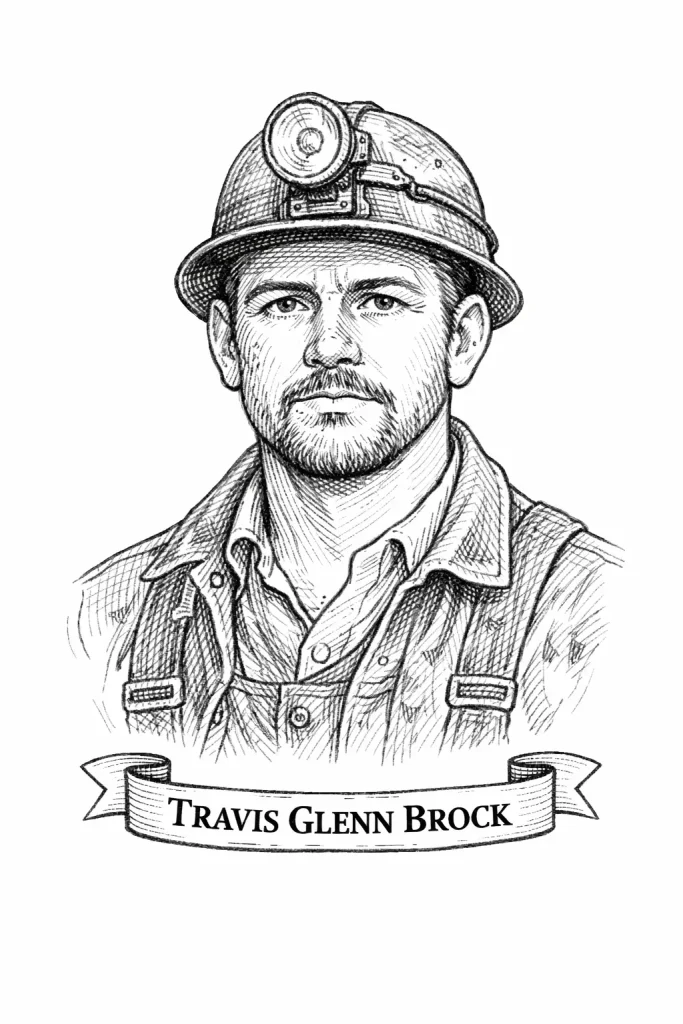
On a winter morning in 2010, deep under Leslie County, a young miner from Helton was doing the work he had learned as a teenager. He stood beside a remote controlled cutting machine in a crosscut of the Abner Branch Rider mine, trimming the mine floor and ribs so the crew could keep advancing. In seconds, a slab of rock weighing several tons broke from the pillar and pinned him to the ground. Rescue attempts came too late. The first coal mine fatality in Kentucky that year belonged to twenty nine year old Travis Glenn Brock.
For most people outside the mountains his name appears only as a line in accident reports and national lists. In Leslie County and neighboring Harlan County, though, Travis was a son, husband, father, and church member whose death shook a close knit community that had already given many lives to coal.
A coalfield childhood
Travis Glenn Brock was born on June 6, 1980 in Harlan County, Kentucky, to Darrell Glenn Brock and Linda Gross Brock. Obituary and funeral records describe him as a lifelong resident of the Helton area of Leslie County, a small community on Dry Fork where families with the Brock and Gross names have lived for generations.
Funeral home notices for his extended family give a sense of that network. When his grandfather A. M. Brock died, Travis appeared among the grandchildren listed in the Wolfe and Sons Funeral Home obituary, tying him to a larger Leslie County clan that had long worked and worshiped in the hollows around Helton.
Those same near primary sources sketch the outlines of his everyday life. They note that he loved the mountains and spent his free time outdoors, hunting and being with family. They place him as a member of Dry Fork Holiness Church, a small congregation that would later host his funeral, suggesting a life shaped by rural Pentecostal or Holiness traditions that are common in this part of the coalfields.
Most of all, the obituary emphasizes his role as a husband and father. Travis married Pamela Howard Brock, and together they had a son, Travis Jager Brock. Guestbook entries on the online memorial pages remember him as a quiet, kind young man who doted on his child and who was proud of his work underground.
A younger generation of coal miners
By the time he was twenty nine, Travis had already spent about a decade working in the mines. The federal investigation into his death notes that he had ten years of mining experience and was working as a continuous miner operator, one of the more demanding and highly trained jobs on a section crew.
The Abner Branch Rider mine where he worked was operated by Bledsoe Coal Corporation, a subsidiary of Richmond based James River Coal Company. It was a drift mine on the Hazard No. 4 Rider seam in Leslie County, employing roughly sixty miners on a continuous miner section.
Like many younger miners in eastern Kentucky, Travis worked with remote controlled machinery rather than with the older cutting and loading systems of his grandparents’ era. A continuous miner operator walks alongside or just behind the machine, guiding it by remote control as its rotating drum bites into the coal face. After the coal falls, shuttle cars or a conveyor carry it away, and roof bolters follow behind to secure the top and ribs. It is skilled work that asks a miner to watch the machine, the geology, and the people around him all at once.
January 22, 2010 at Abner Branch Rider Mine
On the morning of January 22, 2010, Travis reported for the day shift at Abner Branch Rider. According to the Mine Safety and Health Administration investigation and later trade press accounts, he was operating a Joy 12CM remote controlled continuous miner in a bolted crosscut between the No. 2 and No. 3 entries. He was not cutting fresh coal at the face but trimming and cleaning the mine floor and ribs so the crew could keep the section in shape.
At about 9:15 a.m., a large slab of rock and coal suddenly broke away from the right hand pillar rib. Investigators later estimated that the block had been more than six feet high and over nine feet wide before it fractured. Its pre break weight was about 9.3 tons. The falling rock struck Travis and pinned him to the mine floor. Coworkers and mine rescue personnel tried to free and revive him, but he died underground of his injuries.
The type of failure that killed him is known in mining as a rib roll. A rib is the wall of coal and rock that forms the side of an entry or crosscut. When stress builds up or geology changes, part of that wall can suddenly shear off and topple into the opening. A contemporary blog post by Kentuckians for the Commonwealth, written the day of the accident, explained to readers that a rib roll happens when a coal pillar, weakened by a rock seam or other defect, gives way along its side, sending tons of material into the entry.
In the hours and days after the accident, brief news items around the state reported that a twenty nine year old miner from Helton had been killed by a rock fall at the Abner Branch mine in Leslie County. They identified him by name, gave his age, and noted that he had been operating a continuous miner when the corner of a roof pillar collapsed.
Investigation, citations, and a pattern of violations
The full story of what happened in the Abner Branch Rider mine only emerged months later, when MSHA released its detailed investigation. That report, summarized in trade press coverage, painted a troubling picture. An analysis using the ARMPS program, which evaluates pillar stability in retreat mining, showed that the pillars in the section where Travis died had a stability factor far below the level recommended by federal researchers. Inspectors found loose ribs and other hazards that should have been detected and corrected in pre shift examinations. They also found that parts of the mine did not comply with the approved roof control plan, including entry and intersection widths that were too wide for the conditions.
MSHA concluded that the fatal accident occurred because the operator failed to provide proper rib support in Travis’s working place and failed to conduct adequate pre shift and on shift examinations. Bledsoe Coal was cited for multiple violations, including failures related to roof control and examinations. The company revised its roof control plan, instituted new procedures for posting exam results where miners could see them, and installed roof bolting equipment with rib bolting capacity in an effort to address the hazards identified by federal officials.
State regulators also responded. In July 2010 the Kentucky Office of Mine Safety and Licensing director warned in a widely reported statement that four miners had already died in underground collapses that year, including Travis at Abner Branch, and that inspectors were meeting miners at the portals to stress the importance of watching roof and rib conditions.
By late 2010, Abner Branch Rider had been placed on notice for a potential pattern of significant and substantial violations under federal law. In a 2012 decision, a Federal Mine Safety and Health Review Commission administrative law judge upheld eighteen contested citations at the mine, fifteen of them classified as significant and substantial. Based on that record, MSHA formally placed Bledsoe Coal’s Abner Branch operation under a pattern of violations designation, one of the strongest enforcement tools available to the agency.
In the years that followed, state sanctions lists and federal reports continued to carry the name of the mine and the fatality in their tables, reminders that enforcement actions and legal proceedings had flowed from what happened to a single miner on a January morning.
Lawsuit, headlines, and national lists
For Travis’s family, the consequences of the accident went beyond regulatory language. In 2011 the Lexington Herald Leader reported that his widow filed a wrongful death lawsuit against Bledsoe Coal and its parent company James River Coal, alleging that a massive block of rock fell from a mine wall because the companies failed to maintain a safe workplace underground. Other news stories revisited his death when new citations were issued at Abner Branch, using his name to anchor discussions of mine safety in Leslie County.
Outside Kentucky, his name appears in national documents that try to make sense of the deadly year 2010 became in the coalfields. The United Mine Workers of America’s report on the Upper Big Branch disaster, Industrial Homicide, includes an appendix listing forty eight coal miners killed in the United States that year. On that list, just above the cluster of names from Upper Big Branch, is an entry that reads: “Travis Brock 1 22 10 29 Abner Branch Bledsoe Coal Corp.”
For historians of mining, that appearance shows how an eastern Kentucky fatality on a nonunion section was part of a larger national pattern, one in which roof and rib falls, methane explosions, and equipment accidents combined to make 2010 the deadliest coal mining year in nearly two decades.
Funeral on Dry Fork and local memory
At home in Leslie County, the response was more intimate. Walker Funeral Home in Hyden handled arrangements for “Mr. Travis Glenn Brock,” giving his full dates, naming his parents, wife, and son, and noting his membership in Dry Fork Holiness Church and his work as a coal miner for Bledsoe Coal. The funeral was held at Dry Fork Holiness Church, and he was buried in the Gross Cemetery at Helton, a family graveyard on the hillside above the community where he had lived.
Online guestbooks attached to the funeral home and Legacy.com notices are filled with short entries from relatives, coworkers, and friends. Some recall hunting trips and family gatherings. Others simply say that he was a good man taken too soon, promising prayers for his wife and young son. The tone is one of grief, but also of the particular solidarity that exists in coalfield communities where almost every family knows the risk that miners take when they go underground.
In later stories about mine safety in Kentucky, reporters and advocates sometimes mention his death alongside other collapses in western and southeastern Kentucky, using his name as a marker of the human cost behind statistics. A 2010 Associated Press story on mine collapses quoted state officials who wanted no more names added to that year’s tally.
Why Travis Brock’s story matters
For Appalachian historians, the life and death of Travis Glenn Brock connects several important threads. His biography highlights a younger generation of miners who grew up after the great union battles of the mid twentieth century yet still depended on underground coal work in small communities like Helton. His ten years of experience as a continuous miner operator show how quickly young men in the coalfields are expected to shoulder responsibility at the face.
The Abner Branch Rider accident itself illustrates how modern mining technology does not eliminate older hazards. Rib rolls and roof falls remain deadly, especially when geology is complex or when production pressure and poor examinations allow dangerous conditions to go uncorrected. The subsequent MSHA investigation and the pattern of violations case against Bledsoe Coal show how regulators tried to respond by tightening roof control plans and using new enforcement tools.
At the same time, his story reminds readers that behind every enforcement docket and national report is a particular life. Travis was not only a “fatality” or “case.” He was a husband who loved his wife Pamela, a father who left behind a son, a church member whose congregation mourned him, and a grandson whose name appears in family obituaries alongside elders who had lived their whole lives in Leslie County.
To remember Travis Glenn Brock is to remember that the coalfields of eastern Kentucky in the early twenty first century were still places where a young man could walk into a mine before daylight and not come home. It is also to insist that those names on national lists belong to real communities and real stories, rooted in hollows like Helton and churches like Dry Fork, where families still carry the grief long after the headlines fade.
Sources & Further Reading
Walker Funeral Home, LLC. “Travis Glenn Brock Obituary, January 22, 2010.” Walker Funeral Home (Hyden, KY). https://www.walkerfuneralhomesllc.com/obituaries/5751751 Walker Funeral Home
Lexington Herald-Leader. “Travis Brock Obituary.” Legacy.com, January 25, 2010. https://www.legacy.com/us/obituaries/kentucky/name/travis-brock-obituary?id=14206100 Legacy
Find a Grave. “Travis Glenn Brock (1980–2010).” Find a Grave Memorial 151908012. https://www.findagrave.com/memorial/151908012/travis-glenn-brock Find A Grave
Wolfe & Sons Funeral Home. “A.M. Brock Obituary.” Wolfe & Sons Funeral Home, February 26, 2011. https://www.wolfeandsonsfh.com/obituaries Wolfe & Sons Funeral Home
Wolfe & Sons Funeral Home. “Darrell Glenn Brock Obituary, May 25, 2011.” Wolfe & Sons Funeral Home. https://www.wolfeandsonsfh.com/obituaries/darrell-brock Wolfe & Sons Funeral Home
Mine Safety and Health Administration. “Underground Coal Mine – Fatal Rib Roll, Bledsoe Coal Corporation, Abner Branch Rider Mine, Fatal Coal Accident Report, January 22, 2010 (FTL10C02).” U.S. Department of Labor, 2010. https://www.msha.gov/sites/default/files/Data_Reports/Fatals/Coal/2010/ftl10c02.pdf Mine Safety and Health Administration
Mine Safety and Health Administration. “Coal Mine Fatality – Rib Roll Accident Claims Life of Continuous Mining Machine Operator, Kentucky 2010 (Fatalgram C-02).” U.S. Department of Labor, 2010. https://www.msha.gov/sites/default/files/Data_Reports/Fatals/Coal/2010/FABC2010.pdf Mine Safety and Health Administration
Mine Safety and Health Administration. “Coal Mining: Preliminary Accident Reports, Fatalgrams and Fatal Investigation Reports, 2010.” U.S. Department of Labor. https://www.msha.gov/data-reports/fatality-reports/search?field_fatals_year_value=2010&tid=All&tid_1=All Global Energy Monitor
Federal Mine Safety and Health Review Commission. “Secretary of Labor, Mine Safety and Health Administration (MSHA) v. Paul Bentley, Employed by Bledsoe Coal Corporation.” Decision of Administrative Law Judge, Docket KENT 2013-307, November 5, 2013. https://www.fmshrc.gov/sites/default/files/decisions/alj/ALJ_11052013-KENT%202013-307_1.pdf Mine Safety Review Commission
Kentucky Office of Mine Safety and Licensing. “Sanctions List.” Kentucky Energy and Environment Cabinet, March 14, 2019. https://eec.ky.gov/Natural-Resources/Mining/Mine-Safety/Documents/SANCTIONS%20LIST.pdf Kentucky Energy and Environment Cabinet
Mine Safety and Health Administration. “MSHA Issues Potential Pattern of Violations Letters to 4 Mines.” U.S. Department of Labor News Release, November 28, 2012. https://www.dol.gov/newsroom/releases/msha/msha20121128 DOL
National Institute for Occupational Safety and Health. “Mining Feature: Rib Falls – A Major Ground Control Issue.” Centers for Disease Control and Prevention. https://www.cdc.gov/niosh/mining/Features/ribfall.html CDC Archive
U.S. House of Representatives, Committee on Education and the Workforce. “Report on the Upper Big Branch Mine Disaster.” Committee Staff Report, 112th Cong., 2nd sess., 2012. https://edworkforce.house.gov/uploadedfiles/03.27.12_roberts_2.pdf Education & Workforce Committee
Governor’s Independent Investigation Panel. The April 5, 2010, Explosion: A Failure of Basic Coal Mine Safety Practices. Report to the Governor on the Upper Big Branch Mine Disaster. West Virginia Office of the Governor, May 2011. https://onlabor.org/wp-content/uploads/2016/05/giip-massey-report.pdf OnLabor
United Mine Workers of America. Industrial Homicide: Report on the Upper Big Branch Mine Disaster. Triangle, VA: United Mine Workers of America, 2011. https://www.umwa.org/files/documents/134334-Upper-Big-Branch.pdf administrativelawreview.org
Matetic, John M., ed. “Mining Accident News No. 1002.” NIOSH Office of Mine Safety and Health Research newsletter, January 2010. https://miningquiz.com/pdf/Newsletters/MA-1002.pdf Appalachianhistorian.org
Lovan, Dylan. “Kentucky Officials Warn Over Mine Collapses.” Insurance Journal, July 8, 2010. https://www.insurancejournal.com/news/southeast/2010/07/08/111393.htm Insurance Journal
Pentz, Kevin. “Kentucky’s First Mine Fatality, and Hopefully Our Last.” Kentuckians for the Commonwealth Blog, January 21, 2010. https://kftc.org/blog/kentuckys-first-mine-fatality-and-hopefully-our-last KFTC 40th Anniversary
Schmidt, Donna. “Miner Killed in Kentucky Rib Roll.” MiningMonthly, January 25, 2010. https://www.miningmonthly.com/safety/news/1131430/miner-killed-kentucky-rib-roll Mining Monthly
Schmidt, Donna. “MSHA Cites Operator for Abner Branch Death.” MiningMonthly, June 8, 2010. https://www.miningmonthly.com/markets/international-coal-news/1201205/msha-cites-operator-for-abner-branch-death Mining Monthly
Schmidt, Donna. “US Coal Fatalities in 2010: Part 1.” MiningMonthly, January 2011. https://www.miningmonthly.com/safety/news/1182312/us-coal-fatalities-in-2010-part-1 Mining Monthly
“MSHA Encourages Roof, Rib Exams in Rib Fall Safety Spotlight.” MiningMonthly, October 2010. https://www.miningmonthly.com/safety/news/1193773/msha-encourages-roof-rib-exams-in-rib-fall-safety-spotlight Mining Monthly
“Leslie Co. Miner Dies in Rock Fall.” Lexington Herald-Leader (Kentucky.com), January 22, 2010. https://www.kentucky.com/news/state/kentucky/article43984807.html Kentucky
Cheves, John. “Four Citations Issued against Leslie Mine Where Worker Killed.” Lexington Herald-Leader (Kentucky.com), November 10, 2015. https://www.kentucky.com/news/state/kentucky/article43984945.html Institute of Quarrying
“Federal Citations Against Mine Where Man Killed.” WAVE 3 News (Louisville, KY), June 9, 2010. https://www.wave3.com/story/12607745/federal-citations-against-mine-where-man-killed/ https://www.wave3.com
“Further Citations Issued at Mine Where Leslie County Man Killed.” EKB News (East Kentucky Broadcasting), June 10, 2010. https://www.ekbtv.com/news/further-citations-issued-at-mine-where-leslie-county-man-killed/article_0f63f20e-2264-5fb2-8285-63b55fde8545.html ekbnews.blogspot.com
Spencer, Naomi. “Harlan, Kentucky Mine Worker Killed, Three Injured in Separate Accidents.” World Socialist Web Site, November 24, 2010. https://www.wsws.org/en/articles/2010/11/kent-n24.html congress.gov
Author Note: Writing about Travis Brock means honoring a younger generation of Leslie County miners and the families who loved them. I hope this piece keeps his name present in conversations about coal, safety, and memory in eastern Kentucky.