
Appalachian History Series – Winchester City Hall: The Tower on Wall Street
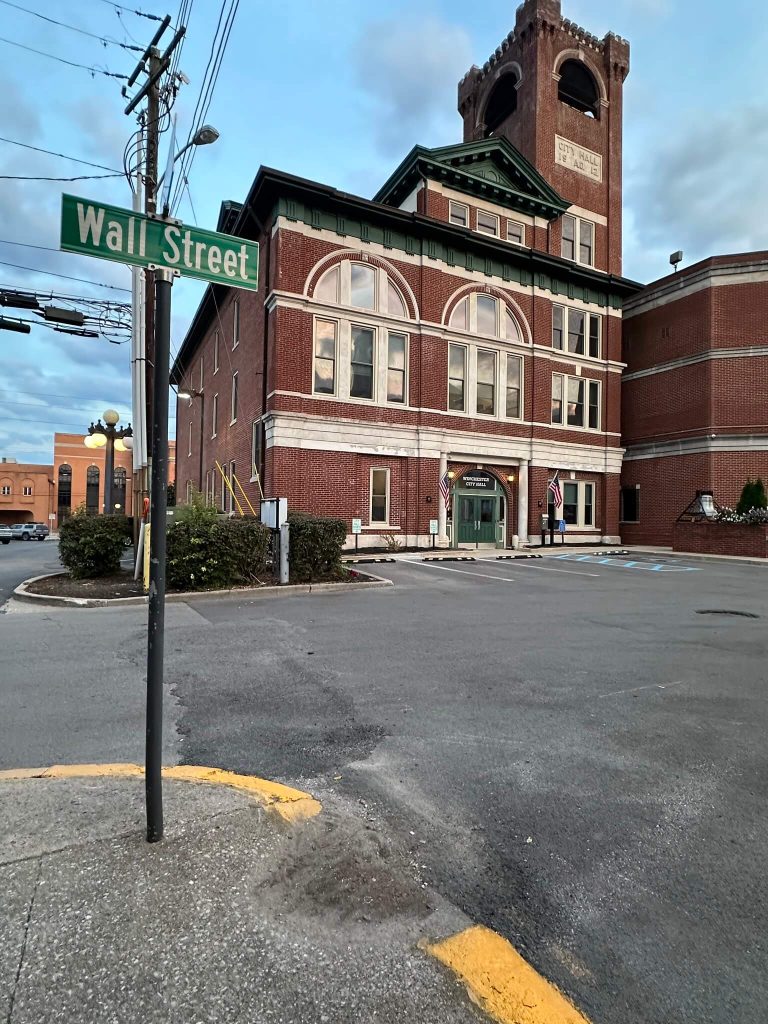
If you walk up Wall Street from Lexington Avenue and stop between the courthouse lawn and the high wall of the Brown Proctor Hotel, Winchester City Hall still commands the block. The brick mass and square tower rise just north of where the old Clark County jail once stood, facing the courthouse across a narrow street that has been the county’s governmental spine for more than a century. The building’s tower, with its arched openings and battlements, makes it a landmark from several blocks away. It is one of the clearest pieces of evidence that, in 1912, Winchester and Clark County chose to create a formal civic campus on the west side of the courthouse square.
City Hall is more than a picturesque backdrop for modern ribbon cuttings and city meetings. It is a product of early twentieth century reform and civic boosterism, the point where older courthouse town patterns met newer ideas about professionalized police and fire protection, city management, and downtown planning. Its story runs from nineteenth century atlases and fire insurance maps to twenty first century revitalization plans and High Side streetscape projects that still treat Wall Street as the center of public life.
A courthouse square and a government street
Long before the present City Hall rose along Wall Street, the intersection of Court Street, Main Street, and the courthouse square defined Winchester’s public core. The 1877 atlas of Bourbon, Clark, Fayette, Jessamine and Woodford Counties plotted a compact grid of streets around the courthouse, with public buildings and commercial houses clustering at the square. That plate, reprinted and made available through the Clark County Public Library’s local history program, shows Wall Street already functioning as an important edge of the square even though the current city hall did not yet exist.
By the late nineteenth century, Sanborn Fire Insurance maps added a new layer of detail to that picture. Sanborn sheets for Winchester from 1886, 1890, and 1895, now accessible through the Library of Congress and via the Clark County Public Library’s digital links, recorded individual buildings, their construction materials, and their uses. Researchers can track the courthouse, earlier jail structures, nearby engine houses, and small municipal offices around the square and along Wall Street, providing a before image of the block where City Hall and the 1912 jail would later appear.
These maps, paired with county deed books and tax records for the lots fronting Wall Street, allow historians to follow how the city and county gradually assembled an administrative block. Clark County deeds and order books, preserved on microfilm and through FamilySearch, document ownership and transfers of the parcels that became the site of the combined jail and city hall. Local directories and newspapers housed in the Clark County Public Library’s local history and genealogy room fill in daily life around the square, from merchants and hotels to the early offices of the Winchester Sun.
A 1912 building campaign on Wall Street
The current city hall belongs to a coordinated burst of courthouse square construction in 1912. On the southwest corner of the square, the Clark County Winchester Jail went up that year, a two story brick building designed to echo Spanish Colonial Revival forms with a tile roof and curving dormers. Just north of it, the City of Winchester built a new City Hall, giving the town an explicitly modern municipal building beside its long standing courthouse. The National Register nomination for the Winchester Downtown Commercial District, prepared in the early 1980s, treats this Wall Street cluster as the city’s administrative heart.
Council minutes and city orders from the early 1910s, preserved today in the city clerk’s office and later entries summarized in financial audits, show the city investing in new public works, utilities, and buildings in the years just before and after 1912. The same period saw prominent downtown construction like the Brown Proctor Hotel, the McEldowney Building, and the Parrish and Bradlee building that became home to the Winchester Sun. City Hall belongs in that wave of projects, an assertion that Winchester intended to remain a modern county seat with professional offices clustered close to the courthouse instead of scattering them piecemeal through downtown.
An eclectic tower for a growing city
Architecturally, Winchester City Hall does not match the courthouse that anchors the center of the square, nor is it a simple utilitarian box. The National Register nomination describes the building as an eclectic mixture of classical and medieval features. The main facade carries a full Doric entablature and pediment, classical elements that tie it visually to banks and fraternal halls downtown. Above that formal base, the corner tower is pierced with round arched openings and capped with machicolations and crenellations more reminiscent of a fortified tower than a small Kentucky city office building.
Seen from the courthouse lawn, this combination gives City Hall a slightly theatrical presence. It signals authority through its classical cornice and pediment while allowing the tower to stand out as a kind of civic emblem. A 2013 news release from Superior Home Improvements, a local roofing and remodeling firm that installed a new shingle roof on the building, underscores how that tower defines the skyline. The company described City Hall as a widely known landmark that can be spotted from a distance by the large bell tower rising above its roof, a detail that echoes the way older residents remember downtown before more recent infill and parking lots.
Photographs in Eastern Kentucky University’s digital collections and in the Clark County Public Library’s local history room show the building over several decades. Black and white images from the mid twentieth century capture City Hall with a more intact setting, flanked by the 1912 jail, older commercial houses, and the courthouse, its tower still holding the bell that once pealed out over Wall Street.
Fire engines, police offices, and a working municipal building
Winchester’s decision to erect a new city hall was closely tied to fire protection. In the late 1800s the city’s fire department operated from a small engine house on Fairfax Street, completed in the 1880s and later converted to a restaurant and office space. A plaque and narrative now displayed at the Engine House Deli site explain that a 1909 fire in an adjacent building forced the department into temporary quarters behind the courthouse until City Hall was ready. The walking tour brochure produced by the Winchester Clark County Tourism Commission notes that when the new City Hall opened, the city’s police and fire departments were both housed inside the structure.
For much of the twentieth century, City Hall functioned as a combined office building and service station. The tower housed the bell, the bays and ground floor contained city offices and apparatus spaces, and upstairs rooms provided additional office space and meeting rooms. Sanborn maps from the early twentieth century, when paired with city directories, document the slow thickening of public and quasi public uses around the building as electric utilities, banks, and professional offices filled in the surrounding blocks.
The tourism walking tour brochure, updated around 2015, summarizes the building’s mid to late twentieth century evolution. It records that the police and fire departments remained in City Hall until the late 1970s. After those departments moved to newer facilities, the city renovated the structure so that the first and second floors could hold a broader range of city offices. In the early 1990s, the bell was removed from the tower and set at ground level in front of the building, turning it into a street level monument rather than leaving it overhead.
Today, city contact listings and commission meeting notices still identify 32 Wall Street as the address for city hall and the meeting place for public hearings, planning commission sessions, and city commission votes. The building’s offices support everything from finance and planning to the city manager’s operations, while the commission chambers provide a formal room for local government proceedings.
A changing streetscape around the tower
City Hall has never stood alone. Wall Street forms the west edge of the courthouse square and the setting of the city’s administrative buildings, and the National Register nomination emphasizes this relationship. The 1912 jail at the southwest corner of the square, with its red tile roof and arcaded porch, complemented City Hall to the north and helped complete the administrative block. To the northwest, the Parrish and Bradlee building at 20 Wall Street, a large brick commercial structure designed by John W. Crone, introduced an arcade that visually frames part of the streetscape. Together with the McEldowney Building on nearby Cleveland Avenue and the courthouse, these structures created a dense civic and commercial core.
Harry Enoch’s local history piece “The Parking Lots of Winchester, part two,” published by WinCity Voices in 2023, charts what happened to some of these neighbors. For the jail, the story is stark. Enoch notes that the 1912 jail, a house like structure that cost twenty two thousand dollars to build and was itself listed on the National Register, was demolished in 1993. A new Clark County Detention Center opened in 1992, and efforts to find a new use for the old jail were judged impractical. The county razed the building the next year to create a parking lot for City Hall.
The loss of the jail broke the original 1912 visual pairing on Wall Street. Where photographs once showed two substantial brick public buildings stepping up from the corner toward the courthouse, modern views show City Hall standing alone above a flat expanse of asphalt. Enoch’s article treats that parking lot as one of several examples in Winchester where parking replaced significant historic structures, a reminder that City Hall’s survival has depended on decisions that did not always favor its neighbors.
Preservation, repairs, and the downtown master plan
Despite the clearance of adjoining buildings, City Hall itself has remained in active use and has benefited from targeted preservation work. The 2013 roofing project by Superior Home Improvements is one example. The firm’s account of the job explains that crews installed a new shingle roofing system over several weeks in June, treating the work as a way to care for a widely recognized landmark building in the heart of town. Projects like this, less dramatic than demolitions and new construction, are part of why the brick walls and distinctive tower remain in service today.
At the planning scale, the 1982 National Register listing of the Winchester Downtown Commercial District created a framework for thinking about City Hall not only as a functioning office building but also as a contributing structure in a larger historic environment. In 2017, the city formally accepted a new Downtown Master Plan, and city financial reports note that it helped guide the creation of downtown development funds and later Tax Increment Financing discussions. Although the plan is focused heavily on Main Street and the High Side, it rests on the premise that older buildings like City Hall and the courthouse remain anchors for new investment and design.
Recent newsletters and city publications about the Main Street High Side Project, a multi year effort to improve sidewalks, accessibility, and streetscape design along the terraced blocks of downtown, continually present Wall Street and the courthouse square as a short walk from the renewed high side. City Hall sits just off the project focus area yet benefits from the same vision of a walkable, attractive historic downtown.
City Hall in the twenty first century
In addition to routine meetings and administrative work, City Hall has continued to host new forms of civic engagement. A 2024 feature on WinCity Voices, reprinting Winchester Sun coverage of the inaugural Mayor’s Think Tank, places the gathering in City Hall and notes that the building has long been a site of important community meetings. The Think Tank brought together local residents, business people, and students to discuss strategies for retaining young people and encouraging local opportunity, a contemporary echo of the early twentieth century belief that public buildings should stand at the center of community life.
Commission agendas, grant program announcements, and planning hearings flowing through the building in recent years range from downtown revitalization funds to infrastructure projects and High Side construction updates. In these documents and news stories, City Hall’s address appears almost as shorthand for the local government itself. It is the place where floodplain map repositories are kept for public inspection, where tax increment financing hearings take place, and where residents still walk in to pay bills, ask questions about zoning, or speak before the city commission.
For visitors, the building is now a stop on the Winchester Downtown and Historical Walking Tour, listed as Stop 13 at 32 Wall Street. The brochure highlights its 1912 construction date, combination of styles, historic role as home to the police and fire departments, and the relocation of the bell to ground level in the 1990s. Standing in front of that bell and looking up at the tower, a visitor can see both the physical survival of an early twentieth century municipal building and the scars left by the demolitions and parking conversions that reshaped nearby lots.
Reading the building through its sources
Winchester City Hall’s story is unusually well documented for a small Kentucky city hall. Primary and near primary sources create a layered record. Fire insurance maps and the 1877 county atlas capture the evolution of the courthouse square and the Wall Street block that became the administrative core. Deeds, tax records, and city orders, accessible through the Clark County Public Library and the Clark County clerk, trace the city’s acquisition and use of the property. Local newspapers from the Winchester Sun and its predecessors, preserved on microfilm and in a digital archive, reported on construction, dedications, renovations, fires, and demolitions around the building.
The National Register nomination for the Winchester Downtown Commercial District gives City Hall an architectural and historical frame, describing its eclectic mixture of classical and medieval details and situating it among nearby banks, hotels, and office blocks. The downtown walking tour brochure distills much of this material into a short narrative for visitors and adds late twentieth century details like the move of the bell and the departure of police and fire services. Contemporary pieces on the jail’s demolition, the roofing project, the Mayor’s Think Tank, and the High Side project show how the building’s meaning continues to evolve as the city changes around it.
Taken together, these sources present Winchester City Hall as both artifact and workplace. It is a piece of 1912 civic architecture that reveals how a Kentucky county seat imagined good government in brick and stone, and it is still the place where residents climb the steps on Wall Street to argue over budgets, hear about downtown projects, or take part in new experiments like the Mayor’s Think Tank. The tower on Wall Street is not only a backdrop for historic photographs but also a living part of how Winchester conducts its public business.
Sources & Further Reading
Bedford, A. Goff. Land of Our Fathers: A History of Clark County, Kentucky. Vol. 1. [Clark County, KY]: A. Goff Bedford, 1958. https://www.worldcat.org/title/land-of-our-fathers-a-history-of-clark-county-kentucky/oclc/21997982 eBay
Bedford, A. Goff. History of Clark County, Kentucky: The Proud Land. [Place of publication not identified]: A. Goff Bedford, 1983. https://www.worldcat.org/title/history-of-clark-county-kentucky-the-proud-land/oclc/11494021 Google Books
Beers, D. G., and D. G. Beers & Co. Atlas of Bourbon, Clark, Fayette, Jessamine and Woodford Counties, Ky. Philadelphia: D. G. Beers & Co., 1877. https://www.loc.gov/item/2005627107/ The Library of Congress+1
Clark County (Kentucky). Clerk of the County Court. Deeds, 1793–1902; Indexes, 1793–1959. Microfilm. Winchester, KY: Clark County Courthouse; filmed by the Genealogical Society of Utah, 1959–1988. https://www.familysearch.org/search/catalog/426412 FamilySearch+1
Clark County Public Library. “Local History & Genealogy.” Clark County Public Library website. Accessed January 1, 2026. https://www.clarkbooks.org/local-history-geneology CCPL
Clark County Public Library. “Winchester Maps of the Past.” Clark County Public Library website. Accessed January 1, 2026. https://www.clarkbooks.org/winchester-maps-of-the-past CCPL+1
Clark County Public Library. “Digital Archives of the Winchester Sun 2010–2017.” Digital Archives of Clark County Public Library. Accessed January 1, 2026. https://clarkcounty.advantage-preservation.com/ clarkcounty.advantage-preservation.com+1
Collins, Lewis. Historical Sketches of Kentucky: Embracing Its History, Antiquities, and Biographical Sketches of Its Leading Citizens. Maysville, KY: L. Collins, 1847. https://archive.org/details/historicalsketch00coll NPGallery
Eastern Kentucky University. “Fire Station and City Hall at Winchester, Kentucky.” In Robert F. Collins Papers, 1847–1988, Clark County Homes and Buildings series. EKU Digital Collections. https://digitalcollections.eku.edu/items/show/73428 EKU Digital Collections+1
Enoch, Harry. “The Parking Lots of Winchester, Part Two.” WinCity Voices, July 11, 2023. https://www.wincityvoices.org/the-parking-lots-of-winchester-part-two/ WinCity Voices
Enoch, Harry. “1954 Was a Year of Progress in Winchester.” WinCity Voices, August 26, 2025. https://www.wincityvoices.org/1954-was-a-year-of-progress-in-winchester/ WinCity Voices
Kentucky Heritage Commission and Clark County Historical Society. Survey of Historic Sites in Kentucky: Clark County. Frankfort: Kentucky Heritage Commission, 1979. https://npgallery.nps.gov/NRHP/GetAsset/b58f834f-6aa3-4b27-8835-a2bf4f4e8043 (bibliography reference) Google Books+1
National Park Service. “Winchester Downtown Commercial District.” National Register of Historic Places Inventory Nomination Form. Washington, DC: U.S. Department of the Interior, 1982. https://npgallery.nps.gov/GetAsset/b58f834f-6aa3-4b27-8835-a2bf4f4e8043 NPGallery+1
Perrin, W. H. Kentucky: A History of the State. Louisville: F. A. Battey and Co., 1887. https://archive.org/details/kentuckyhistoryo00perr NPGallery
Sanborn Map Company. Sanborn Fire Insurance Map from Winchester, Clark County, Kentucky. Washington, DC: Sanborn Map Company, 1895. Library of Congress Geography and Map Division. https://www.loc.gov/item/sanborn03263_003/ The Library of Congress+1
“Survey of Historic Sites in Kentucky, Clark County.” Kentucky Heritage Commission and Clark County Historical Society excerpted and discussed in “Where in the World: Gone but Not Forgotten, 2 Elm Street.” Visit Winchester KY blog, August 30, 2015. https://visitwinchesterky.com/where-in-the-world-gone-but-not-forgotten-2-elm-street/ NPGallery+1
Superior Home Improvements. “Superior Home Improvements Completes Roofing Project at Winchester City Hall.” Superior Home Improvements news release, July 2, 2013. https://superiorhomeimprovementsky.com/superior-home-improvements-completes-roofing-project-at-winchester-city-hall/ Superior Home Improvements+1
“The Winchester Sun.” Wikipedia, last modified October 2024. https://en.wikipedia.org/wiki/The_Winchester_Sun Wikipedia
The Winchester Sun. The Winchester Sun Commemorative Edition: 1878–1978. Winchester, KY: The Winchester Sun, 1978. Available in the Clark County Public Library Local History Room; cited in National Park Service, “Winchester Downtown Commercial District,” NRHP Nomination Form. https://npgallery.nps.gov/GetAsset/b58f834f-6aa3-4b27-8835-a2bf4f4e8043 NPGallery+1
“Local Historian Discusses Legacy of Winchester’s Master Builder.” The Winchester Sun, January 17, 2022. Access via Winchester Sun archive and Clark County Public Library microfilm. https://www.winchestersun.com/2022/01/17/local-historian-discusses-legacy-of-winchester-master-builder/ Winchester Sun+1
Visit Winchester KY. “Downtown Walking Tour.” Visit Winchester KY website, with downloadable walking-tour brochure including entry “32 Wall Street – City Hall.” https://visitwinchesterky.com/directory/downtown-walking-tour/ and https://visitwinchesterky.com/wp-content/uploads/WinchesterWalking2015.pdf Visit Winchester KY+1
Visit Winchester KY. “Tour Stop #13—City Hall.” Visit Winchester KY website. https://visitwinchesterky.com/directory/city-hall/ Visit Winchester KY
Winchester–Clark County Tourism Commission. Downtown Walking Tour. Winchester–Clark County Tourism Commission, ca. 2015. PDF brochure. https://visitwinchesterky.com/wp-content/uploads/WinchesterWalking2015.pdf Visit Winchester KY+1
“Winchester, KY – Official Website.” City of Winchester website. Accessed January 1, 2026. https://www.winchesterky.com/ Winchester KY
Winchester, Kentucky. “Agendas & Minutes” and “City Commission.” City of Winchester website. Accessed January 1, 2026. https://www.winchesterky.com/AgendaCenter and https://www.winchesterky.com/297/City-Commission Winchester KY+1
WinCity Voices. “Inaugural Mayor’s Think Tank Takes Place at Winchester City Hall.” WinCity Voices, February 13, 2024. https://www.wincityvoices.org/inaugural-mayors-think-tank-takes-place-at-winchester-city-hall/ WinCity Voices
“Downtown Master Plan – Winchester, KY.” City of Winchester and Kentucky League of Cities, 2017. Planning document PDF. https://winchester.klc.org/wp-content/uploads/sites/25/2019/01/winchester-downtown-master-plan-2017.pdf City of Winchester+1
“High Side: Activation of the Elevated Sidewalks.” City of Winchester Main Street Projects page. https://www.winchesterky.com/582/High-Side-Project Winchester KY+1
Author Note: I wrote this piece to trace how one brick building on Wall Street became a long running stage for Winchester’s public life. The next time you are downtown, I hope you will pause at City Hall’s tower and imagine the fire engines, jail wagons, and council debates that once crowded this same block.