
Appalachian Churches Series – Louisa Primitive Baptist Church of Millard: From Louisa Fork to the Adkins Family
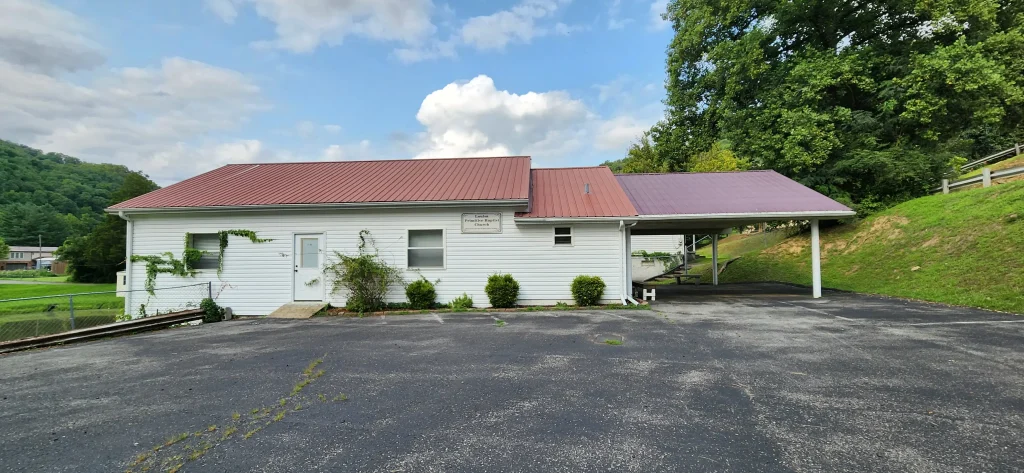
On Rocky Road at Millard, just outside Pikeville, Louisa Primitive Baptist Church stands against one of the steep green hillsides that define Pike County. The present building is modest, with white siding, a red metal roof, and a broad covered entrance beside the meetinghouse. There is no towering steeple or elaborate facade. A small sign identifying Louisa Primitive Baptist Church is about the only announcement a traveler needs.
Its appearance fits a religious tradition that has never depended much upon elaborate church buildings. For generations, Primitive and Old Regular Baptist congregations across the central Appalachian mountains gathered in simple meetinghouses where the emphasis rested on preaching, prayer, singing, fellowship, and the church community itself.
Behind the present building, however, lies a history that is considerably more complicated than its quiet appearance suggests. Louisa Primitive Baptist Church is traditionally dated to 1825, and a modern Primitive Baptist directory still identifies the congregation with that year. Nineteenth-century Baptist histories confirm that a church called Louisa Fork belonged to the group of eastern Kentucky congregations associated with the creation of the New Salem Association in 1825. Yet another important body of evidence connects the present church at Millard to the Adkins family and to an “arm” of Raccoon Creek Baptist Church established around 1851.
The two stories do not fit together perfectly. That uncertainty is not a reason to discard either tradition. Instead, it gives Louisa Primitive Baptist Church one of the more interesting early church histories in Pike County. The surviving evidence suggests that there was unquestionably a Louisa Fork congregation in the region by 1825 and that a Baptist congregation associated with the Adkins family was established at Millard about a generation later. Whether the latter represented a continuation, reorganization, relocation, or separate congregation that eventually inherited the older name remains an open historical question.
Louisa Fork and the New Salem Association of 1825
The earliest firm documentary trail begins with the New Salem Association.
The FamilySearch Library catalogs the Minutes of the … Annual Session of the New Salem Association of Old Regular Baptist of Jesus Christ beginning with the first annual session in 1825. Copies of New Salem materials are also preserved among the Elder Walter L. Akers Old Regular Baptist Research Collection at Berea College. Most important for future research on Louisa are copies of association minutes covering 1825 through 1969, notes on individual New Salem churches, ordination records for elders and deacons, correspondence covering the nineteenth century, and papers associated with Elder James Dixon and the study of the association’s early history.
John H. Spencer, writing in his 1886 A History of Kentucky Baptists, identified eight churches involved in the constitution of New Salem Association in 1825. They were New Salem, Mud, Sand Lick, Stone Coal, Union, Owen Fork, Raccoon, and Louisa Fork. Frank M. Masters repeated substantially the same account in his twentieth-century history of Kentucky Baptists.
Materials derived from the old association minutes add an interesting distinction. A history based in part upon the Dixon and Akers compilation of Burning Springs and New Salem records states that New Salem, Mud, Stone Coal, Owen Fork, and Union had been dismissed from Burning Springs to form the new association. Raccoon and Louisa Fork, according to that account, were then received when the new association met in 1825. If that reading of the original minutes is correct, Louisa Fork was already an organized church when it joined New Salem.
That makes 1825 much more than a date preserved by modern church tradition. There really was a congregation called Louisa Fork in the earliest history of New Salem Association.
What remains uncertain is whether that Louisa Fork church can be followed in an unbroken documentary line to the present Louisa Primitive Baptist Church at Millard.
The Problem With the 1825 Date
The difficulty appears when the Adkins family enters the story.
Joseph T. Daniels’s 1988 book, Adkins of Eastern Kentucky and Surrounding Areas, preserves detailed family information concerning Winston Adkins and his sons Peter and Joseph. Daniels reported that all three appear in the records of Raccoon Creek Baptist Church in 1848. They later obtained church letters and, about 1851, carried them to the “river” at Millard, where they helped establish a branch, or “arm,” of Raccoon Creek Baptist Church.
An arm was essentially an extension of an established congregation. Members living some distance from their home church could begin meeting in another community with the authorization of the parent church, and that group could eventually become an independent congregation. Similar arrangements appear repeatedly in the histories of eastern Kentucky Baptist churches. The Pike County Historical Society’s account of Old Union Regular Baptist Church, for example, describes the use of an arm in the organization of another early Pike County congregation.
Daniels’s account is therefore entirely plausible within the Baptist practices of the time. The problem is chronology.
Peter Adkins was born March 12, 1834. He could not possibly have established a church in 1825. His brother Joseph was younger still. The Raccoon Creek records cited by Daniels place the family there in 1848, more than twenty years after Louisa Fork appeared among the churches associated with New Salem.
There are several possible explanations. The 1825 Louisa Fork church may have declined and later been reorganized. The Millard arm may have absorbed members or traditions from an older Louisa congregation. The church may have moved or changed its associational relationship. It is also possible that later generations joined the histories of two related congregations under the Louisa name.
Until the earliest New Salem minutes and surviving Raccoon Creek church books are compared year by year, it would be too strong to claim that the exact relationship has been proven.
What can be said with confidence is that Baptist worship associated with the Louisa name was present in the New Salem network by 1825, while the history of the church at Millard becomes much clearer beginning around 1851.
Winston, Peter, and Joseph Adkins
The Millard story centers on one of Pike County’s extensive early families.
Winston Adkins was born in 1804 and settled among the valleys draining toward the Russell Fork and Big Sandy River. His sons included Peter, born in 1834, and Joseph, born in 1839. Daniels’s research states that Winston and both sons belonged to Raccoon Creek Baptist Church in 1848. Traveling to worship would have required crossing the difficult mountain country between their homes and Raccoon Creek, most likely by horseback or on foot.
Around 1851 the three obtained letters from Raccoon Creek and helped establish the new arm at Millard. Daniels described the meetinghouse as a log structure at the mouth of Biggs Branch, sometimes rendered Briggs Branch, near the location later occupied by the Pollyanna drive-in theater.
The site was credited to Peter Adkins. Daniels also believed Peter probably contributed considerably to constructing the building. The first meetinghouse was a world apart from the white-sided church standing on Rocky Road today. It was made from logs and contained a fireplace at one end, the sort of practical mountain meetinghouse that served both the spiritual and physical needs of worshippers gathering through eastern Kentucky winters.
Peter eventually became an ordained Old Regular Baptist minister as well as a farmer. His life carried him beyond Pike County for periods of time, including residences in Washington and Texas, before he returned to Kentucky and settled in Letcher County. Yet his association with the Millard church remained an important part of the family account preserved by Daniels.
Was the Church Named for Louisa Belcher?
One family tradition recorded by Daniels suggested that the Louisa Church might have been named in honor of Peter Adkins’s wife, Louisa Belcher.
It is an appealing story, but the dates make it difficult to accept as an explanation for the original Louisa Fork name.
Louisa Belcher was born in 1838 and married Peter Adkins in 1858. A Louisa Fork church was already recorded in connection with New Salem Association in 1825, thirteen years before Louisa Belcher was born.
It remains possible that a later Millard congregation or building took Louisa’s name independently of the older Louisa Fork church. It is equally possible that the similarity of the names encouraged later generations to connect the two stories. Without an early church minute explicitly explaining the name, the tradition should be preserved as family history rather than treated as established fact.
That distinction matters because Louisa Primitive Baptist Church deserves a history based not only on tradition, but on what the surviving records can actually demonstrate.
The Old Log Church at Biggs Branch
The picture Daniels left of the Millard congregation is unusually vivid.
The original church stood on land associated with Peter Adkins at Biggs Branch. There was no large sanctuary, paved parking lot, electric lighting, or modern road leading worshippers to the door. The members belonged to families scattered along creeks, river bottoms, and hollows, and church attendance required deliberate travel through the mountains.
The meetinghouse itself was little more than a log church warmed by its fireplace. Yet buildings like it became important centers of community life. Baptisms, funerals, church business, preaching meetings, communion seasons, and disputes all passed through them.
The Louisa congregation apparently experienced its share of the latter.
Daniels preserved the story of a remarkable confrontation in which two preachers, identified as Joe Slone and Tom Conway, became involved in a fight around the preaching stand. Local people turned the episode into what became known as the “Conway Song.” The verses, reportedly composed by members of the Justice family living nearby, transformed a church quarrel into local folk memory. Peter Adkins even appears in the song’s narrative attempting to pray while chaos unfolded around him.
The episode is humorous at a distance, but it also reveals something important about nineteenth-century mountain churches. They were not institutions separated from everyday community life. Their congregations contained neighbors and relatives who farmed together, married into one another’s families, argued, reconciled, disciplined members, and returned the next month to worship in the same room.
A Church Lot Protected in a Deed
Perhaps the most intriguing piece of the Adkins tradition concerns the land itself.
Around 1880 Peter Adkins sold his Pike County property and moved his family to Letcher County. Daniels reported that when the land on Biggs Branch was conveyed, Peter specifically excepted the church building, its lot, and an additional six feet around it from the transaction for as long as the church remained active.
If located in the Pike County deed books, that provision would provide one of the strongest primary documents connecting the Adkins family to the congregation. Pike County’s surviving deed records extend back to 1820, making it possible to search Peter Adkins’s conveyances from the period surrounding 1880 and identify the exact language used to protect the meetinghouse.
The story also carries a fitting symbolism. Peter could leave Pike County and sell the surrounding acreage, but the little patch occupied by the church was supposed to remain outside the sale for as long as people continued gathering there.
The New Salem Tradition
Louisa’s history also belongs to the larger story of the New Salem Association and the development of Old Regular Baptist religion in central Appalachia.
The Kentucky Historical Society describes New Salem, formed in 1825 from eight eastern Kentucky churches, as one of the foundational institutions in the history of the Old Regular Baptists. Over the nineteenth century these churches developed a religious culture emphasizing local congregational authority and older forms of worship while resisting many institutions embraced by larger Protestant denominations.
In 1875 the New Salem Association formally declared opposition to organizations such as missionary societies, Bible and tract societies, Sunday-school unions, and Masonry. Spencer reproduced the substance of that declaration in his 1886 history. Such decisions helped define a religious tradition that remained deliberately separate from the modernization taking place in many American churches.
Howard Dorgan’s scholarly study, The Old Regular Baptists of Central Appalachia, later documented how these churches preserved distinctive forms of preaching, singing, fellowship, association meetings, and church government throughout Kentucky, Virginia, and West Virginia. The survival of congregations in places such as Pike County was therefore part of a broader Appalachian religious culture rather than an isolated local development.
The terminology changed across generations. Records may describe churches and associations as Baptist, United Baptist, Regular Baptist, Old Regular Baptist, Regular Primitive Baptist, or Primitive Baptist depending upon the period, affiliation, and theological disputes involved. Louisa’s history crosses that complicated religious landscape, which is why later labels should not automatically be projected backward onto every generation of the congregation.
Louisa Church Through the Twentieth Century
The surviving newspaper and family evidence shows that Louisa Church remained part of life around Millard long after the log meetinghouse disappeared.
In 1984 the Lexington Herald-Leader reported that funeral services for William Coleman, formerly of Pike County, would be conducted at Louisa Primitive Baptist Church in Millard. The notice is brief, but it independently places an active congregation under that name at Millard during the late twentieth century.
Another member of the Coleman family provides an even stronger example of continuity. Eugene Coleman, born in Pike County in 1932, died in 2019. His obituary described him as a lifelong member of Louisa Primitive Baptist Church. His funeral was conducted by Primitive Baptist ministers, another reminder that these churches remained bound closely to family life from baptism through burial.
The congregation is not merely a historical survivor. In September 2024, Cristal Leigh Worrix and her two sons were baptized together and became members of Louisa Primitive Baptist Church of Millard, according to her obituary later that year. More than a century and a half after the Adkins family reportedly carried their letters from Raccoon Creek toward Millard, another family was still entering the congregation through baptism.
The Church on Rocky Road Today
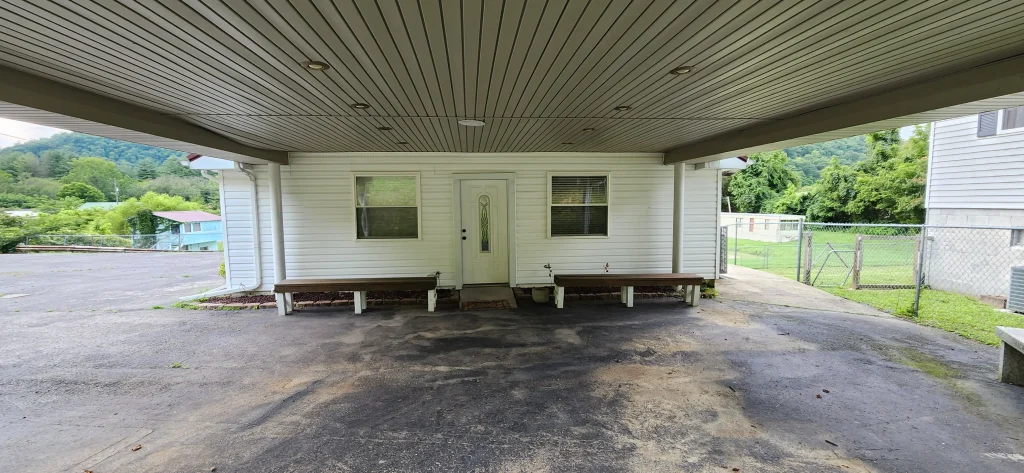
The building seen today on Rocky Road bears little resemblance to the log church described in the Adkins family history. The accompanying photographs show a practical mountain church surrounded by pavement, houses, steep slopes, and thick summer forest. Its architecture is simple, with the sanctuary and adjoining spaces appearing to have grown through additions and renovations rather than according to a single grand design.
That simplicity is part of the story.
The modern Primitive Baptist directory continues to list Louisa Primitive Baptist Church at 16 Rocky Road in Pikeville and assigns the congregation the traditional founding date of 1825. It also lists regular worship services, evidence that Louisa remains a functioning church rather than simply a historic building carrying an old name.
Standing there today, it is difficult to imagine the earlier church at Biggs Branch, its log walls and fireplace, worshippers arriving from the surrounding creeks, Peter Adkins in the pulpit, or the extraordinary quarrel that became a local song. Harder still is imagining the earlier Louisa Fork congregation whose name entered the Baptist record in 1825.
Yet all of those fragments belong to the same larger history of faith along the upper Big Sandy.
An Unfinished History Worth Preserving
Louisa Primitive Baptist Church illustrates both the richness and the difficulty of writing Appalachian local history.
One set of records takes the Louisa name back to the organization of New Salem Association in 1825. Another places Winston Adkins and his sons at Raccoon Creek in 1848 and credits them with establishing an arm at Millard about 1851. Family history remembers Peter Adkins donating land and helping build a log church. A deed reportedly protected the church lot when he left Pike County. Newspapers and obituaries then carry Louisa Primitive Baptist Church through the twentieth century and into the present.
What is missing is the documentary bridge connecting every one of those points.
That bridge may still exist. Berea College preserves copies of New Salem minutes reaching back to 1825, along with notes on the association’s individual churches and nineteenth-century correspondence. FamilySearch catalogs the association minute series. Original Raccoon Creek records could clarify exactly what happened when the Adkins family obtained their letters around 1851, while Pike County deed books may contain Peter Adkins’s remarkable reservation of the church property.
Until those records are examined together, the most responsible conclusion is also the most interesting one. Louisa Primitive Baptist Church preserves an 1825 tradition that is supported by the documented existence of a Louisa Fork church, while the history of the present Millard congregation can be traced much more clearly to the Adkins family and the Raccoon Creek arm of about 1851.
Either way, the little church on Rocky Road represents nearly two centuries of Baptist history in Pike County. Its story reaches from log meetinghouses and horseback journeys to paved roads and modern baptisms, while generations of mountain families continued gathering under the Louisa name.
Sources & Further Reading
New Salem Association of Old Regular Baptist of Jesus Christ. Minutes of the Annual Session of the New Salem Association of Old Regular Baptist of Jesus Christ. Paintsville, KY: New Salem Association of Old Regular Baptists of Jesus Christ, 1825–. FamilySearch Library. https://www.familysearch.org/tl/search/catalog/172333
Berea College Special Collections and Archives. “New Salem Association: Copies of Meeting Minutes 1825–1969.” Series 6, Box 25, Folder 12. Elder Walter L. Akers Old Regular Baptist Research Collection, BCA 0159-SAA 161. https://bereaarchives.libraryhost.com/repositories/2/top_containers/89228
Berea College Special Collections and Archives. “Notes on New Salem Association Correspondence between 1825 and 1889.” Series 6, Box 25, Folder 3. Elder Walter L. Akers Old Regular Baptist Research Collection, BCA 0159-SAA 161. https://bereaarchives.libraryhost.com/repositories/2/top_containers/89228
Berea College Special Collections and Archives. “1842 New Salem Association Letter to Paint Union Association with Transcription.” Series 6, Box 25, Folder 4. Elder Walter L. Akers Old Regular Baptist Research Collection, BCA 0159-SAA 161. https://bereaarchives.libraryhost.com/repositories/2/top_containers/89228
Berea College Special Collections and Archives. “Notes on New Salem Association Churches.” Series 6, Box 25, Folder 5. Elder Walter L. Akers Old Regular Baptist Research Collection, BCA 0159-SAA 161. https://bereaarchives.libraryhost.com/repositories/2/top_containers/89228
Berea College Special Collections and Archives. “New Salem Association Ordination: Elders and Deacons.” Series 6, Box 25, Folder 6. Elder Walter L. Akers Old Regular Baptist Research Collection, BCA 0159-SAA 161. https://bereaarchives.libraryhost.com/repositories/2/top_containers/89228
Berea College Special Collections and Archives. “New Salem Association: Various Minutes and Notes.” Series 6, Box 25, Folder 7. Elder Walter L. Akers Old Regular Baptist Research Collection, BCA 0159-SAA 161. https://bereaarchives.libraryhost.com/repositories/2/top_containers/89228
Berea College Special Collections and Archives. “List of Officers of the New Salem Association 1825–1995.” Series 6, Box 25, Folder 8. Elder Walter L. Akers Old Regular Baptist Research Collection, BCA 0159-SAA 161. https://bereaarchives.libraryhost.com/repositories/2/top_containers/89228
Berea College Special Collections and Archives. “Various Papers Related to New Salem Association, Elder James Dixon, Dexter Dixon.” Series 6, Box 25, Folder 9. Elder Walter L. Akers Old Regular Baptist Research Collection, BCA 0159-SAA 161. https://bereaarchives.libraryhost.com/repositories/2/top_containers/89228
Pike County (Kentucky). Clerk of the County Court. Deeds, 1820–1902; Index, 1820–1970. Microfilm of original Pike County land records. FamilySearch Library. https://www.familysearch.org/en/search/catalog/results?count=20&query=%2Bauthor_id%3A1239468416
Spencer, J. H. A History of Kentucky Baptists from 1769 to 1885, Including More Than 800 Biographical Sketches. Vol. 2. Cincinnati: Printed for the Author, 1886. https://encompass.eku.edu/books/5/
Masters, Frank M. A History of Baptists in Kentucky. Louisville: Kentucky Baptist Historical Society, 1953. https://repository.sbts.edu/handle/10392/6812
Daniels, Joseph T. Adkins of Eastern Kentucky and Surrounding Areas. Naples, FL: J. T. Daniels, 1988. https://openlibrary.org/books/OL2131024M/Adkins_of_eastern_Kentucky_and_surrounding_areas
Dorgan, Howard. The Old Regular Baptists of Central Appalachia: Brothers and Sisters in Hope. Knoxville: University of Tennessee Press, 1989. https://utpress.org/9781572331600/the-old-regular-baptists-of-central-appalachia/
Dorgan, Howard. Giving Glory to God in Appalachia: Worship Practices of Six Baptist Subdenominations. Knoxville: University of Tennessee Press, 1987. https://dots.lib.utk.edu/?q=biblio%2Fgiving-glory-god-appalachia-worship-practices-six-baptist-subdenominations
University of Pikeville. Frank M. Allara Library. “Special Collections & Archives.” University of Pikeville. https://www.upike.edu/library-services/
KYGenWeb. “Religion: Old Regular Baptist Records.” Floyd County, Kentucky Genealogy. Includes research guidance for New Salem Association records and identifies collections at Berea College and the University of Pikeville. https://www.kygenweb.net/floyd/records/religion/index.html
Kentucky Historical Society. “The Old Regular Baptists.” Kentucky Chronicles, vol. 4, no. 4. Kentucky Historical Society. https://history.ky.gov/khs-podcasts
Old School Primitive Baptist Churches. “Kentucky.” Entry for Louisa Primitive Baptist Church, Pikeville, Kentucky, traditionally dated 1825. https://pbdirectory.org/Kentucky.htm
Pike County Historical Society. “A Brief History of Old Union Regular Baptist Church.” Pike County Historical Society. https://pikecountykyhistoricalsociety.com/a-brief-history-of-old-union-regular-baptist-church/
Lexington Herald-Leader. “William Coleman.” 1984, B7. Transcription hosted by Genealogy Trails, Pike County, Kentucky. https://genealogytrails.com/ken/pike/obits_01.html
Thacker Memorial Funeral Home. “Eugene Coleman Obituary.” October 2019. https://www.thackermemorial.com/obituaries/Eugene-Coleman?obId=28363150
J. W. Call and Son Funeral Home. “Cristal Leigh Worrix Obituary.” December 4, 2024. https://www.jwcallfuneralhome.com/obituaries/Cristal-Leigh-Worrix?obId=33960682
Association of Religion Data Archives. “Old Regular Baptists (1825–Present).” U.S. Religion: Group Profiles. https://www.thearda.com/us-religion/group-profiles/groups?D=610
Author Note: I photographed Louisa Primitive Baptist Church at Millard while researching the deep Baptist history of Pike County and the upper Big Sandy Valley. Its story is especially fascinating because surviving records preserve both an 1825 Louisa Fork tradition and a later connection to the Adkins family and Raccoon Creek Church, leaving an important historical question still open.