
Appalachian Churches Series – Cedar Grove Old Regular Baptist Church of Jesus Christ in Elkhorn City, Kentucky
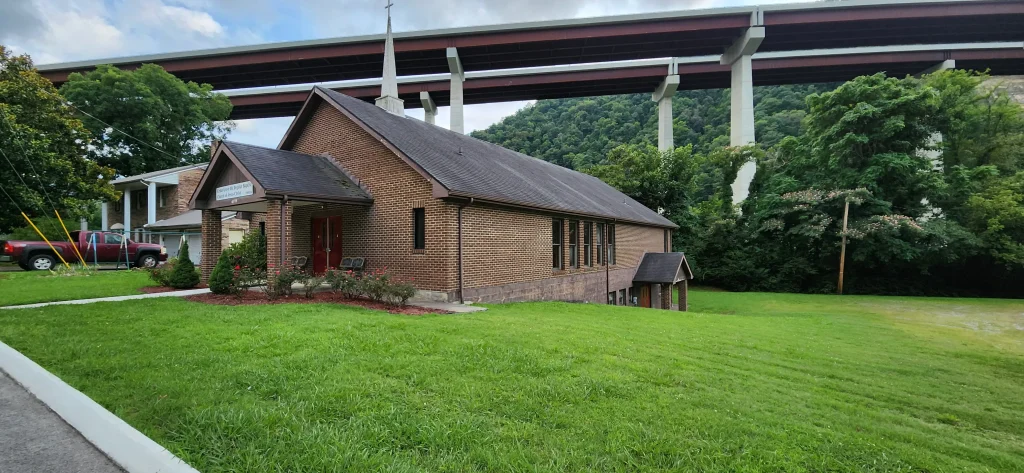
Along Kentucky Highway 80 near Elkhorn City stands a red-brick church whose surroundings tell two very different stories about Pike County. Cedar Grove Old Regular Baptist Church of Jesus Christ sits against a steep green mountainside while a massive modern highway viaduct rises above and behind the sanctuary. The concrete bridge belongs to a transformed Appalachian landscape, but the congregation below it reaches back to a time before the Civil War.
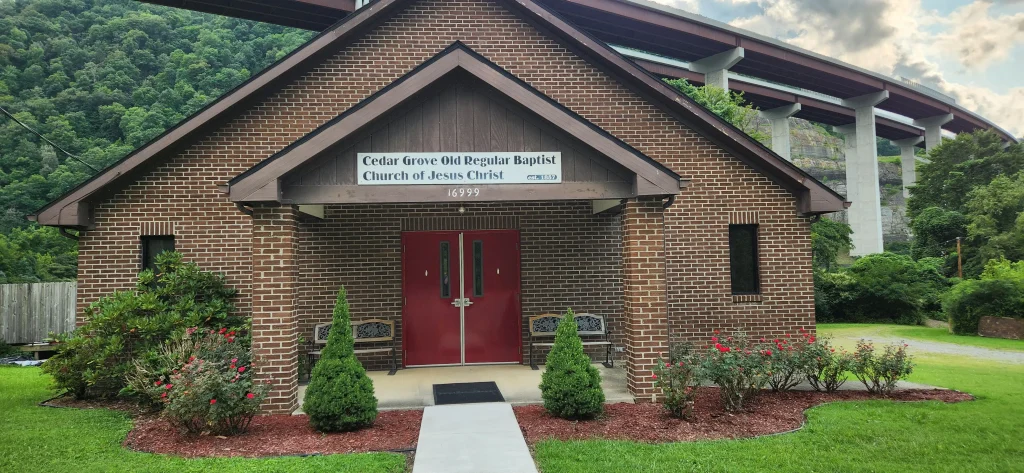
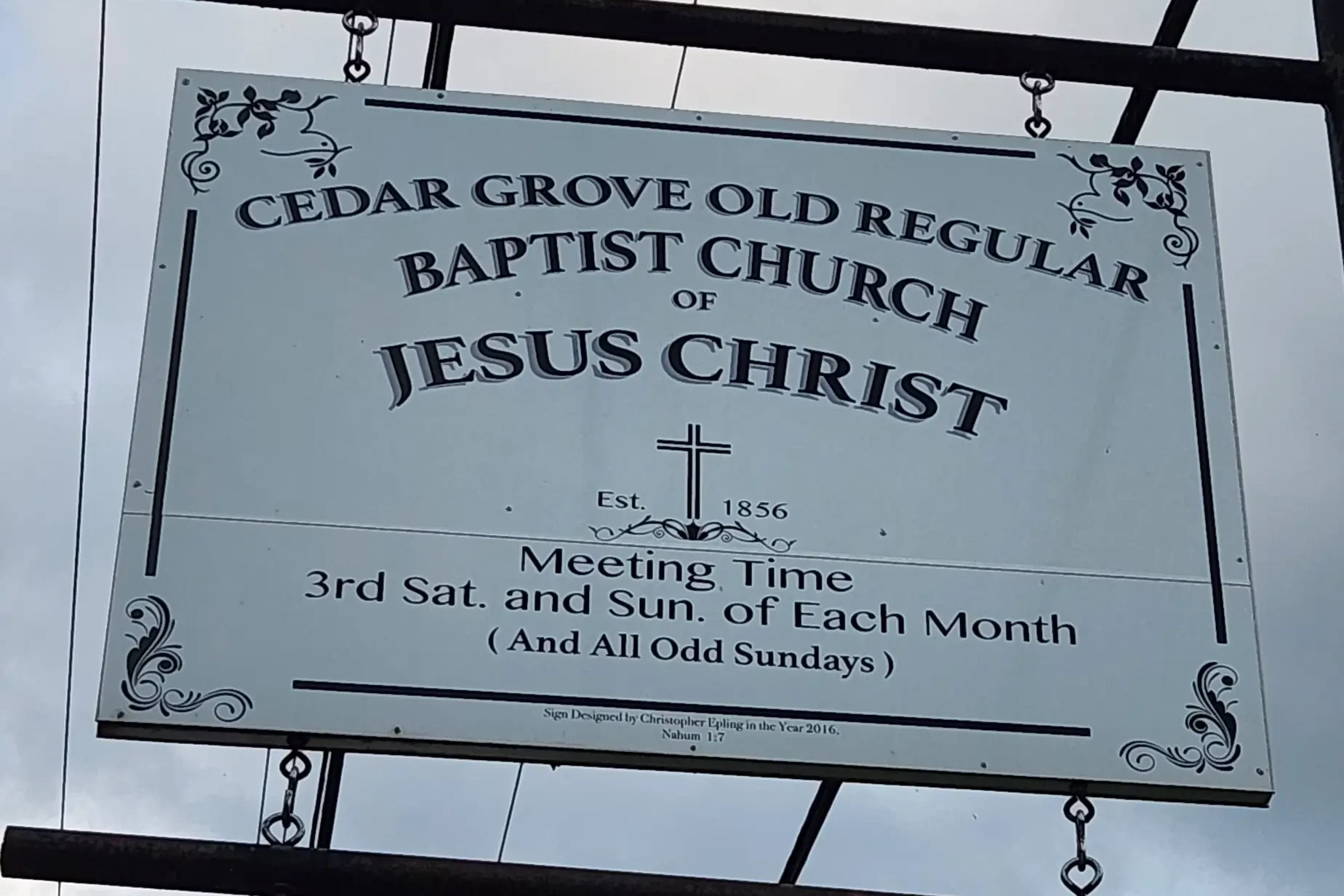
Even the signs at Cedar Grove hint at the difficulty of reconstructing the earliest years of a rural mountain church. The large roadside sign identifies Cedar Grove as established in 1856. The smaller sign above the church entrance gives 1857. No surviving constitution record has yet been located that settles that one-year difference. What has been found, however, is more important than either modern sign. A first-person account written by an early minister places Cedar Grove in Pike County before the formation of the Union Association in 1859, providing strong documentary evidence that this congregation was already worshiping in the mountains of eastern Kentucky during the 1850s.
Two Dates on the Church
For congregations whose history stretches deep into the nineteenth century, an exact founding date can be surprisingly difficult to establish. Church records were carried from house to house, association minutes were printed in small numbers, meetinghouses burned or disappeared, and memories that were obvious to one generation were not always written down for the next.
Cedar Grove presents exactly that kind of problem. The congregation today publicly remembers its beginning as either 1856 or 1857, depending upon which sign is consulted. Both dates are plausible in light of the documentary evidence, but neither should yet be treated as conclusively proven.
The safest historical statement is that Cedar Grove existed before the end of 1859. That alone places the congregation in a very different Pike County from the one surrounding it today. There were no coal towns lining the valleys, no paved highways crossing the mountains, and certainly no concrete bridge towering above the church. The communities along the forks of the Big Sandy were connected by rough roads, trails, streams, family relationships, and churches that often served scattered populations living miles apart.
Cedar Grove emerged from that world.
Elder Lewis Edwards and the Earliest Known Record
The strongest evidence for Cedar Grove’s early existence comes from Elder Lewis Edwards, a nineteenth-century Baptist minister whose own life carried him through the churches of southwestern Virginia and eastern Kentucky.
In 1893, near the end of his life, Edwards wrote an autobiographical account from Sand Lick in Dickenson County, Virginia. He described his ministry in a sequence of congregations, including Sand Lick, Union, Mount Pleasant, and Johnson’s Bottom. He then remembered that “the Cedar Grove church in Pike County, Kentucky” called upon him and that he took care of the church. Edwards further recalled that members were received and baptized during the period in which he ministered among those congregations.
The order in which Edwards told the story is critical. Only after describing his service to Cedar Grove did he write that the Union Association was constituted and that he became its first moderator. Independent nineteenth-century Baptist historian John H. Spencer dated the formation of the Union Association to 1859.
That sequence makes Edwards’s memoir the most important evidence yet found for Cedar Grove’s beginnings. He was not a later historian attempting to reconstruct a church he had never known. He was a minister who said that Cedar Grove called him to serve it.
His account does not tell us whether the church was organized in 1856, 1857, or some other year in the 1850s. It does tell us that Cedar Grove was already an organized body capable of calling a minister before the Union Association came into existence.
The Union Association Takes Shape
The creation of the Union Association provides another useful marker in Cedar Grove’s story.
Spencer wrote that the Union Association of Regular Baptists was constituted in 1859 from nine churches that had been dismissed from the New Salem Association. Together those churches contained 284 members. By 1871, seven of the association’s churches were in Pike County, two were in Letcher County, and three were in Virginia, showing how naturally these religious connections crossed county and state lines in the central Appalachian mountains.
A denominational history based upon the older records identifies the nine churches involved in the 1859 organization as Thornton, Bethel, Elkhorn, Sulphur Spring, Pound Fork, Holly Creek, Union, Cloe, and Raccoon. Elder Lewis Edwards was among the ministers appointed to the presbytery for organizing the new association.
Cedar Grove is noticeably absent from that list.
That does not contradict Edwards’s recollection. Instead, it reveals something more complicated about the church’s early history. Cedar Grove apparently existed before the Union Association, but it was not one of the nine congregations presently identified as the association’s founding churches. It may have entered the Union Association sometime after the organization of 1859.
Determining exactly when that happened will require examination of the surviving nineteenth-century association minutes.
Cedar Grove in the 1901 Union Association Minutes
By the beginning of the twentieth century, there is no ambiguity about Cedar Grove’s connection to the Union Association.
The 42nd annual meeting of the Union Association of Old Regular Baptists was held with Thornton Church at Sergent, Kentucky, on September 20 and 21, 1901. J. C. Swindall served as moderator and J. B. Phipps as clerk. The surviving transcription of the minutes names the representatives from the association’s churches one congregation at a time.
For Cedar Grove, the delegates were G. W. Potter and E. Belcher.
The association reported a total membership of 651 that year. Cedar Grove therefore appears not merely as a church name remembered by an elderly minister, but as an active congregation sending its own representatives into the formal business of the Old Regular Baptist association.
Those two names also connect the institutional record to the families who shaped the religious communities around Elkhorn City. Potter and Belcher are names that continue to appear in the later history of Cedar Grove and the surrounding region. It would take genealogical research to establish relationships between particular individuals, but the recurrence of the surnames across more than a century is striking.
Sarah Ratliff, John O’Quinn, and the People Behind the Minutes
Association minutes can look dry when reduced to dates, delegates, and membership totals, but Old Regular Baptist records often contain something far more personal. Memorials written after the deaths of members preserve fragments of ordinary lives that might otherwise have disappeared entirely.
Sarah Ratliff was born June 29, 1843. According to a memorial preserved in the Union Association material, she joined the Old Regular Baptist Church around 1901, was baptized by Brother Enoch Belcher, and “attached herself to the Cedar Grove Church.” She died on March 26, 1931.
That brief record reaches across three generations of Cedar Grove’s history. Sarah had been born well before the church’s remembered founding in the 1850s. She lived through the Civil War, the growth of eastern Kentucky’s coal industry, and the enormous changes that came to Pike County during the early twentieth century. Yet one of the details the church considered worth preserving after her death was the congregation to which she had belonged.
Another memorial tells the story of John W. O’Quinn, born in 1843. O’Quinn had belonged to Johnson Bottom Primitive Baptist Church of the Washington Association before leaving amid a doctrinal disagreement and transferring his membership to Cedar Grove Old Regular Baptist Church. The memorial described him as a firm believer in salvation by grace.
O’Quinn’s story is useful because it shows that membership in these churches was not simply determined by geography. Questions of doctrine, fellowship, preaching, and church order mattered deeply. A person might withdraw from one congregation and carry a letter to another when differences became impossible to reconcile.
Cedar Grove was part of that larger religious world, one in which small mountain churches debated theology with an intensity easily overlooked when their history is reduced to picturesque buildings and old photographs.
The Old Regular Baptist Tradition in Central Appalachia
Cedar Grove cannot be understood apart from the Old Regular Baptist tradition that developed across eastern Kentucky, southwestern Virginia, and neighboring parts of Appalachia.
Scholar Howard Dorgan devoted years of fieldwork to Old Regular Baptist congregations, describing a religious culture preserved through preaching, singing, baptism, communion, foot washing, association meetings, memorials, and strong relationships among churches. His work emphasized that these congregations were not simply remnants of an earlier Appalachian society. They were living religious communities that deliberately maintained ways of worship and fellowship carrying deep meaning for their members.
Deborah Vansau McCauley’s broader history of Appalachian religion likewise placed mountain congregations within the larger development of American Protestantism rather than treating them as isolated curiosities. Churches in Appalachia responded to national theological movements, doctrinal controversies, migration, economic change, and modernity while still retaining distinctive local traditions.
Cedar Grove’s records fit that pattern. Ministers crossed county and state lines. Members transferred between churches. Congregations sent delegates to associations. Memorials recorded the lives of the dead. Families returned to the same religious fellowship across generations.
The church building was important, but Cedar Grove was never merely a building.
An Archive Scattered Across the Mountains
Much of Cedar Grove’s history still waits inside association minute books.
Berea College’s Elder Walter L. Akers Old Regular Baptist Research Collection is particularly important. The collection contains nine linear feet of Baptist historical material, including Old Regular Baptist association minutes, religious publications, and Akers’s research papers. It is open for research through Berea College Special Collections and Archives.
The Union Association holdings include minute books from 1883, 1889, 1898, 1905, 1911 and 1912, 1916, 1918, and many later years stretching into the twenty-first century. Berea also holds material containing queries, resolutions, and requests presented to the Union Association from 1900 through 1990.
Those early volumes are especially significant for Cedar Grove. Since the church is documented in Edwards’s account before 1859 and is firmly represented in the Union Association by 1901, the 1883, 1889, and 1898 minutes may narrow the gap and reveal ministers, delegates, membership figures, disciplinary matters, deaths, or other details presently unknown.
The New Salem records are equally important because the Union Association emerged from New Salem in 1859. Somewhere in these surviving books may be the missing link between Cedar Grove’s first organization and its later place within the Union Association.
From an Earlier Cedar Grove to Highway 80
The most dramatic chapter in Cedar Grove’s recent history may be visible simply by standing in front of the church.
The current building is at 16999 Kentucky Highway 80 East near Elkhorn City. A Kentucky Power filing submitted to the Kentucky Public Service Commission identifies an active account under the abbreviated name “Cedar Grove Bap Ch” at exactly that service address. The utility’s records show contact with the account in October 2018.
There is strong evidence that the building had previously served a different Appalachian congregation.
Saint Francis of Assisi Catholic Church in Pikeville records that Father Terrence Hoppenjans established Saint Joseph the Worker Mission in Elkhorn City in 1985. The mission remained part of the Catholic presence in Pike County until November 28, 2015, when Bishop John Stowe canonically suppressed it.
Directory records place Saint Joseph the Worker Mission at 16999 Kentucky Highway 80 East, the same address at which Cedar Grove was receiving electrical service by 2018 and the same number displayed today above Cedar Grove’s front entrance.
Taken together, these records strongly suggest that Cedar Grove moved into the former Saint Joseph the Worker Mission building sometime after the Catholic mission closed in late 2015 and before the 2018 utility record. A Pike County deed or property transfer record is still needed before the exact transaction and date can be stated as fact, but the address trail is unusually persuasive.
It also helps explain why a congregation dating to the 1850s occupies a building that is obviously much newer than the church itself.
The result is a remarkable piece of Appalachian religious continuity. A building once used by a Catholic mission now appears to serve an Old Regular Baptist congregation whose origins reach back more than a century before that mission was created.
Behind it, the elevated highway sweeps across the valley on enormous concrete supports. The scene captures almost the entire story of modern Appalachia in a single view: an old mountain congregation, a reused church building, changing transportation routes, and a religious tradition still gathering beneath infrastructure that its founders could never have imagined.
Cedar Grove Into the Twenty-First Century
Cedar Grove’s modern history remains connected to the same kinds of family and community relationships that appear in the old association records.
When Nancy Belle Adkins Belcher died in 2009, her obituary identified her as a member of Cedar Grove Old Regular Baptist Church. Visitation and funeral services were held at Cedar Grove, with Jerry Overstreet, Larry Puckett, and Phillip Hines officiating. She was buried at Potter Cemetery in Elkhorn City.
Fifteen years later, the church again appeared prominently in the obituary of her daughter, Debra Kay Swiney. Swiney, who died in 2024, was described as having been a member of Cedar Grove Old Regular Baptist for 43 years, placing the beginning of her membership around 1981. Visitation was held at the church over two evenings, followed by her funeral there and burial at Potter Cemetery at Little Beaver.
Those records are modern, but they echo the nineteenth and early twentieth-century association memorials. Cedar Grove continues to function not only as a place for Sunday worship but as a place where families gather at death, where ministers preach over generations of members, and where the church becomes part of how a community remembers its people.
The roadside sign photographed at the present church also preserves the old pattern of meeting by particular Saturdays and Sundays of the month. In an era when most churches organize worship around a standardized weekly schedule, Cedar Grove’s posted meeting times still reflect a form of church life that has long characterized Old Regular Baptist congregations.
The Question of 1856 or 1857
For now, the precise founding year should remain an open historical question.
The roadside sign says 1856. The building sign says 1857. Neither has yet been supported by a surviving original constitution, church book, or deed found during this research.
Yet the difference of one year should not obscure what the documentary record does establish.
Elder Lewis Edwards personally remembered serving Cedar Grove before the Union Association was organized. The Union Association was constituted in 1859. Therefore, Cedar Grove was already functioning as a church by the late 1850s. By 1901 it was sending G. W. Potter and E. Belcher as delegates to the Union Association. Later memorials preserve Cedar Grove members such as Sarah Ratliff and John W. O’Quinn. Twentieth and twenty-first-century records show the congregation continuing through later generations.
Whether a future discovery proves 1856 or 1857, the larger historical conclusion is already secure. Cedar Grove is a pre-Civil War Pike County congregation.
Why Cedar Grove Matters
Cedar Grove’s history is valuable precisely because it is not the history of a famous cathedral, a wealthy institution, or a nationally known minister. It is the story of the kind of small mountain church through which much of Appalachian religious life was actually lived.
Its earliest surviving story appears in the memories of a traveling nineteenth-century preacher. Its people emerge from association minutes and memorial notices. Its denominational connections stretched from Pike County into Letcher County and across the Virginia line. Its members carried familiar eastern Kentucky surnames, buried their dead in nearby cemeteries, and returned to the same religious fellowship across generations.
The physical church changed. The surrounding landscape changed even more. Coal development, automobiles, new highways, population shifts, and enormous construction projects reshaped the valleys around Elkhorn City. Even the building now occupied by Cedar Grove appears to represent another chapter in that transformation, with evidence pointing toward its earlier life as Saint Joseph the Worker Catholic Mission.
Yet the congregation itself reaches back beyond all of it.
Standing beneath the modern highway, Cedar Grove Old Regular Baptist Church of Jesus Christ remains connected to a religious community that Elder Lewis Edwards knew before 1859. Nearly everything surrounding the church would be foreign to the people who first gathered at Cedar Grove in the 1850s, but the name, the congregation, and the tradition survived.
That continuity is what makes Cedar Grove more than another church beside a mountain road. It is a surviving piece of Pike County’s antebellum religious history, still carrying a story that began before the Civil War and continues in the same Appalachian mountains today.
Sources & Further Reading
Edwards, Lewis. “Life and Experience of Elder Lewis Edwards.” Written at Sand Lick, Dickenson County, Virginia, August 1, 1893. Edwards Genealogy. Accessed July 27, 2026. https://edwards-family.us/elder-lewis-edwards
Union Association of Old Regular Baptists. “Minutes of the 42nd Annual Meeting,” Thornton Church, Sergent, Kentucky, September 20–21, 1901. Wise County VAGenWeb, Old Regular Baptist records. Accessed July 27, 2026. https://usgenwebsites.org/vagenweb/wise/orbcwise2.html
Union Association of Old Regular Baptists of Jesus Christ. Minutes of the Union Association of Old Regular Baptists of Jesus Christ, 82nd Annual Session. 1941. Geneanet Library. https://en.geneanet.org/library/doc/5572208/minutes-of-the-union-association-of-old-regular-baptists-of-jesus-christ-annual-session-no-82-1941
Berea College Special Collections and Archives. Elder Walter L. Akers Old Regular Baptist Research Collection. BCA 0159-SAA 161. Berea, KY. Accessed July 27, 2026. https://bereaarchives.libraryhost.com/repositories/2/resources/549
Berea College Special Collections and Archives. “Old Regular Baptist Associations.” Series 1, Elder Walter L. Akers Old Regular Baptist Research Collection, BCA 0159-SAA 161. Accessed July 27, 2026. This series includes Union Association minutes from 1883 forward and is one of the strongest collections for extending Cedar Grove’s documentary history. https://bereaarchives.libraryhost.com/repositories/2/archival_objects/93115
Berea College Special Collections and Archives. “New Salem Association, 1859, 1877, 1889–1891.” Series 1, Box 5, Folder 1B, Elder Walter L. Akers Old Regular Baptist Research Collection, BCA 0159-SAA 161. Accessed July 27, 2026. https://bereaarchives.libraryhost.com/repositories/2/top_containers/89233
Berea College Special Collections and Archives. New Salem Baptist Church Records. BCA 0248 SAA 171. Records dated 1872–1893. Berea, KY. https://bereaarchives.libraryhost.com/repositories/2/resources/396
Dixon, Dexter, and Walter Akers, comps. Minutes of the Burning Spring Association of Baptist, 1813–1824, and Minutes of the New Salem Association of Old Regular Baptist, 1825–1983. 2 vols. Pikeville, KY: New Salem Association of Old Regular Baptists, 1983. Bibliographic record reproduced in scholarly research. https://dl.tufts.edu/downloads/cv43p8290?filename=2f75rm414.pdf
Spencer, J. H. A History of Kentucky Baptists from 1769 to 1885. Vol. 2. Cincinnati: Published for the Author, 1886. Eastern Kentucky University, Encompass Digital Collections. https://encompass.eku.edu/books/5/
Spencer, J. H. “Union Association of Regular Baptists.” In A History of Kentucky Baptists, vol. 2. Cincinnati, 1886. Baptist History Homepage. This section dates the Union Association to 1859 and describes its early Pike and Letcher County presence. https://baptisthistoryhomepage.com/spencer.ky.bap.v2.sect15.html
Perrigan, Rufus. History of Regular Baptists and Their Ancestors and Accessors. Haysi, VA: Author, 1961. Bibliographic information and denominational context reproduced by Encyclopedia.com. https://www.encyclopedia.com/religion/encyclopedias-almanacs-transcripts-and-maps/calvinist-missionary-baptist
Yonts, Wesley. History of Old Time Baptists in America. Utica, KY: McDowell Publications, 1988. https://www.baptistboard.com/threads/history-recommendations.7621/
Dorgan, Howard. The Old Regular Baptists of Central Appalachia: Brothers and Sisters in Hope. Knoxville: University of Tennessee Press, 2002. https://utpress.org/9781572331600/the-old-regular-baptists-of-central-appalachia/
Dorgan, Howard. Giving Glory to God in Appalachia: Worship Practices of Six Baptist Subdenominations. Knoxville: University of Tennessee Press, 1990. https://utpress.org/9780870496660/giving-glory-to-god-in-appalachia/
McCauley, Deborah Vansau. Appalachian Mountain Religion: A History. Urbana: University of Illinois Press, 1995. https://www.press.uillinois.edu/books/?id=p064142
Wicks, Sammie Ann. “Life and Meaning: Singing, Praying, and the Word among the Old Regular Baptists of Eastern Kentucky.” PhD diss., University of Texas at Austin, 1983. Ann Arbor, MI: University Microfilms International, 1983. https://ci.nii.ac.jp/ncid/BA21351426.amp?l=en
Radecki, Patricia Marie. “The World in the Text and the Text in the World: A Study of Old Regular Baptist Discourse.” PhD diss., University of Michigan, 1991. Deep Blue, University of Michigan. https://deepblue.lib.umich.edu/items/23ec9b05-31d2-47c9-ba9c-773814c5fef7
Saint Francis of Assisi Catholic Church. “Our Story.” Pikeville, Kentucky. Includes the establishment of Saint Joseph the Worker Mission in Elkhorn City in 1985 and its suppression in 2015. Accessed July 27, 2026. https://stfrancispikeville.org/our-story
Kentucky Public Service Commission. Kentucky Power Company. Meeting Results with General Service Customers. 2018. Includes Cedar Grove Baptist Church as an active account at 16999 KY Highway 80 East. https://psc.ky.gov/pscecf/2017-00179/lmscott%40aep.com/12202018034825/Closed/KPCO_Meeting_Results_with_GS_Customers.pdf
Lucas & Son Funeral Home. “Nancy Belle Belcher.” Obituary, June 25, 2009. Documents Belcher’s membership and funeral at Cedar Grove Old Regular Baptist Church. https://www.lucasandsonfh.com/obituaries/989502
Bailey Funeral Home. “Debra Kay Swiney.” Obituary, March 31, 2024. Documents Swiney’s forty-three years of membership and funeral services at Cedar Grove Old Regular Baptist Church. https://www.baileyfuneralhomeinc.com/obituaries/debra-swiney
Bailey Funeral Home. “Bobby Ray Belcher.” Obituary, July 29, 2024. Identifies Belcher as a retired coal miner and member of Cedar Grove Old Regular Baptist Church. https://www.baileyfuneralhomeinc.com/obituaries?page=11
Kentucky Historical Society. “Church Files List.” Kentucky Historical Society Library Collection. The church files contain correspondence, clippings, and in some cases copies or transcriptions of original church records. Accessed July 27, 2026. https://www.kyhistory.com/digital/collection/LIB/id/1232/
University of Pikeville. “Frank M. Allara Library, Special Collections & Archives.” Pikeville, Kentucky. A particularly important local repository for Pike County and Old Regular Baptist research. Accessed July 27, 2026. https://www.upike.edu/library-services/
Pike County Property Valuation Administrator. “Real Property.” Pikeville, Kentucky. Useful for identifying the present church parcel, improvements, ownership information, and working backward through the deed chain. Accessed July 27, 2026. https://pikekypva.com/real-property/
Kentucky Secretary of State. “Business Entity Search.” Frankfort, Kentucky. Useful for locating corporate filings, officers, organization dates, amendments, and documents filed under the Cedar Grove church name. Accessed July 27, 2026. https://sosbes.sos.ky.gov/bussearchnprofile/search.aspx
Author Note: Cedar Grove is one of those mountain churches whose history survives in association minutes, family memorials, photographs, and records scattered across several archives. I wrote this article to bring those pieces together and preserve the story of a Pike County congregation whose roots reach into the 1850s.