
Appalachian Churches Series – First Christian Church of Pikeville, Kentucky
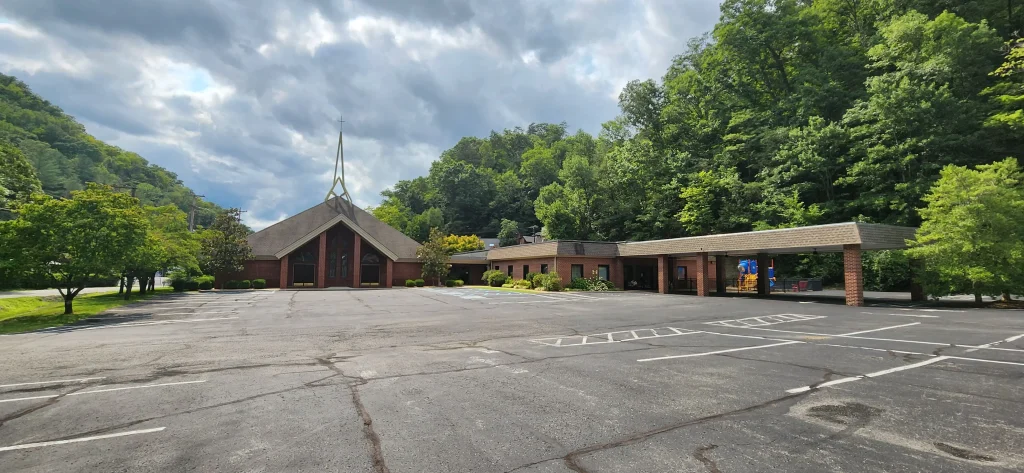
Along Chloe Road in Pikeville, a red brick church sits beneath the steep green hills that rise almost immediately behind it. A tall, narrow steeple reaches above the sanctuary, while a covered walkway stretches across the adjoining church complex toward a playground. On the wall near the entrance, a bronze plaque gives two dates that summarize more than a century of congregational history: “Established 1883” and “Dedicated July 1983.”
Those dates mark two very different moments in the life of First Christian Church of Pikeville. The first belongs to a much smaller Pikeville, when the congregation began without a church building of its own. The second belongs to the modern city, when the congregation dedicated the Chloe Road church that serves as its home today.
Between those dates lies a history connected to some of Pikeville’s early families, the growth of Scott Avenue, a remarkable local benefactor named Kentucky Sowards, public education, the fight against adult illiteracy, and the larger religious movement known today as the Christian Church (Disciples of Christ).
First Christian Church remains part of that denomination today. The congregation describes itself as the only Disciples of Christ congregation in Pike County and the surrounding counties, and it explicitly connects its religious identity to its Appalachian home.
The Disciples Come to Pikeville
The religious tradition behind First Christian Church had particularly deep Kentucky roots before a congregation ever appeared in Pikeville. The Christian Church (Disciples of Christ) developed from religious movements associated especially with Barton W. Stone in Kentucky and Thomas and Alexander Campbell in Pennsylvania and western Virginia. Stone’s followers and the Campbell movement formally united in Kentucky in 1832, sharing a desire to reduce denominational division and emphasize the practices and teachings of the New Testament.
By the later nineteenth century, churches belonging to this broad Restoration or Stone-Campbell tradition had spread through Kentucky, including its eastern mountains.
Pikeville’s congregation dates its beginning to 1883. The strongest surviving local account appears in the Pike County Historical Society’s Pike County, Kentucky 1821-1980: Historical Papers Number Four. That volume reproduces a “Brief History of the First Christian Church” and states that Pikeville’s first Christian Church congregation was organized after a meeting conducted in the public school by a Kentucky evangelist identified as the Reverend Mr. Petty.
That detail is important because the congregation did not begin with a sanctuary or a large institutional structure. Like many Appalachian churches, it began with people gathering where space was available.
The local history names the charter members as J. M. Scott and his wife, L. J. Williamson and his wife, J. H. Rutroff, Henry Sowards, Morgan Sowards and his wife, R. M. Ferrell, Charles Gardner and his wife, Henry Reothford and his wife, David Steel, Eliza Steel, Mary Leslie, Mat Amick, William Sowards, Kentucky Scott, and Silas Scott and his wife. Several of those surnames were already deeply connected to the civic and commercial development of Pikeville.
Kentucky Sowards and the First Church
One name stands above almost every other in the story of the church’s early property: Kentucky Sowards.
She appears in the church’s history under several surnames because she married several times during her long life. The Pike County Historical Society identified her variously as Kentucky Sowards, Kentucky Scott, Kentucky Ferrell, Kentucky Salyers, and Kentucky Powers. She was a daughter of Lewis and Ollie Morgan Sowards and belonged to a family that controlled substantial land around early Pikeville.
The Sowards family’s connection to the physical development of Pikeville was extensive. County records summarized by the historical society show the family conveying large tracts inside and around the growing town during the nineteenth century. Kentucky herself participated in numerous land transactions. One recorded transaction dated March 30, 1884, transferred a large Pikeville tract from Kentucky Sowards Ferrell to L. J. Williamson, one of the men associated with the new Christian congregation.
The church’s own history makes her contribution even clearer.
Although the congregation was organized in 1883, a simple “boxed and stripped” church building was erected in 1887. Six years later, on August 11, 1893, Kentucky Ferrell formally deeded a church lot to L. J. Williamson, J. H. Rutroff, and J. M. Scott as trustees of the Christian Church of the City of Pikeville. The deed specified that the property was to be used for public worship.
The historical account also says Kentucky later gave the congregation the brick building that became its church home. Another section of the same Pike County volume describes her generosity even more directly, stating that she gave land and built the First Christian Church on Scott Avenue.
Her connection to the streets around the church was personal as well. The historical society reported that Scott Avenue was named for her first husband, William Scott, while Kentucky Avenue was named for Kentucky herself. She was also associated with the organization of the First National Bank of Pikeville and conveyed property used by that institution. The same woman therefore appears repeatedly in the surviving record of Pikeville’s transition from a small mountain courthouse settlement into a more substantial commercial town.
The Church on Scott Avenue
By the 1890s, the Christian Church was more than a Sunday meeting place. It had become part of Pikeville’s social life.
One unusually vivid glimpse survives from September 8, 1897, when J. M. Bowling and Daisy Thornbury were married inside the Christian Church. An account preserved by the Pike County Historical Society described the church as elaborately decorated with ferns, autumn leaves, and flowers. Mrs. Louisa Steele directed the decorations with assistance from several Pikeville women, and the writer remembered a large audience filling the building.
At eight o’clock, Mendelssohn’s wedding march sounded from the church organ. Children participated in the procession, young men and women moved through the aisles, flower girls scattered blossoms before the bride, and the couple met at the altar before Reverend C. Reynolds. The account is valuable for reasons beyond the wedding itself. It allows us to picture the interior life of the congregation only fourteen years after its organization. There was an organ, an altar, decorated aisles, a substantial audience, and enough space for one of Pikeville’s elaborate public social events.
It also shows how quickly a congregation that began with a meeting in a public school became woven into the life of the town.
R. B. Neal and the Mountain Ministry
One of the more unusual ministers connected to First Christian Church was Robert Burns Neal.
Neal was already a veteran Disciples minister and religious writer when he came to Pikeville around 1908 or 1909. Historian Hans Rollmann’s study of Neal places him at First Christian Church for approximately four years and notes his strong interest in education in the Kentucky mountains. Neal promoted Morehead Normal School, an institution connected at the time with Disciples mission work and a predecessor of today’s Morehead State University.
Pikeville became more than the location of Neal’s pulpit. It also became the address printed on his religious publications.
Surviving copies and catalog records show that Neal published The Sword of Laban from Pikeville during this period. The New York Public Library preserves an incomplete microfilm run from 1909 through 1912, while the William Mitchell Paden Papers contain a February 1909 issue specifically identified as having been published at Pikeville. Neal also launched another paper, The Highlander, there in 1910.
His writings dealt heavily with religious controversy, but Neal’s Pikeville years also belonged to a wider movement among Disciples who viewed education as part of their Appalachian mission. In that sense, his ministry fits a pattern that appears repeatedly in the history of First Christian Church. The congregation was a house of worship, but its doors also opened onto questions of education and community improvement.
Cora Wilson Stewart and the Fight Against Illiteracy
That connection became especially visible in 1916.
On February 11 of that year, the Big Sandy News published an account of Cora Wilson Stewart discussing illiteracy at First Christian Church. Morehead State University’s Moonlight Schools Collection preserves the newspaper article and identifies the Pikeville church as the location of Stewart’s appearance.
Stewart had begun the Moonlight Schools movement in eastern Kentucky in 1911 as an effort to teach adults to read and write. The movement spread well beyond Rowan County and eventually became one of the best known educational reform campaigns associated with early twentieth-century Appalachia.
Her appearance at First Christian Church places the Pikeville congregation directly within that history.
It is easy to overlook what a church building could mean in a mountain county before modern civic centers, conference halls, and sprawling educational campuses. Churches provided some of the few indoor spaces large enough for lectures, public meetings, weddings, musical programs, educational campaigns, and discussions that extended beyond the ordinary worship service.
The Scott Avenue Christian Church was one of those places.
From the Old Church to Chloe Road
The congregation remained associated with its Scott Avenue history for generations, but Pikeville changed dramatically during the twentieth century. Roads widened, neighborhoods developed, the city’s commercial center expanded, and institutions that had begun within a few blocks of the courthouse increasingly moved outward.
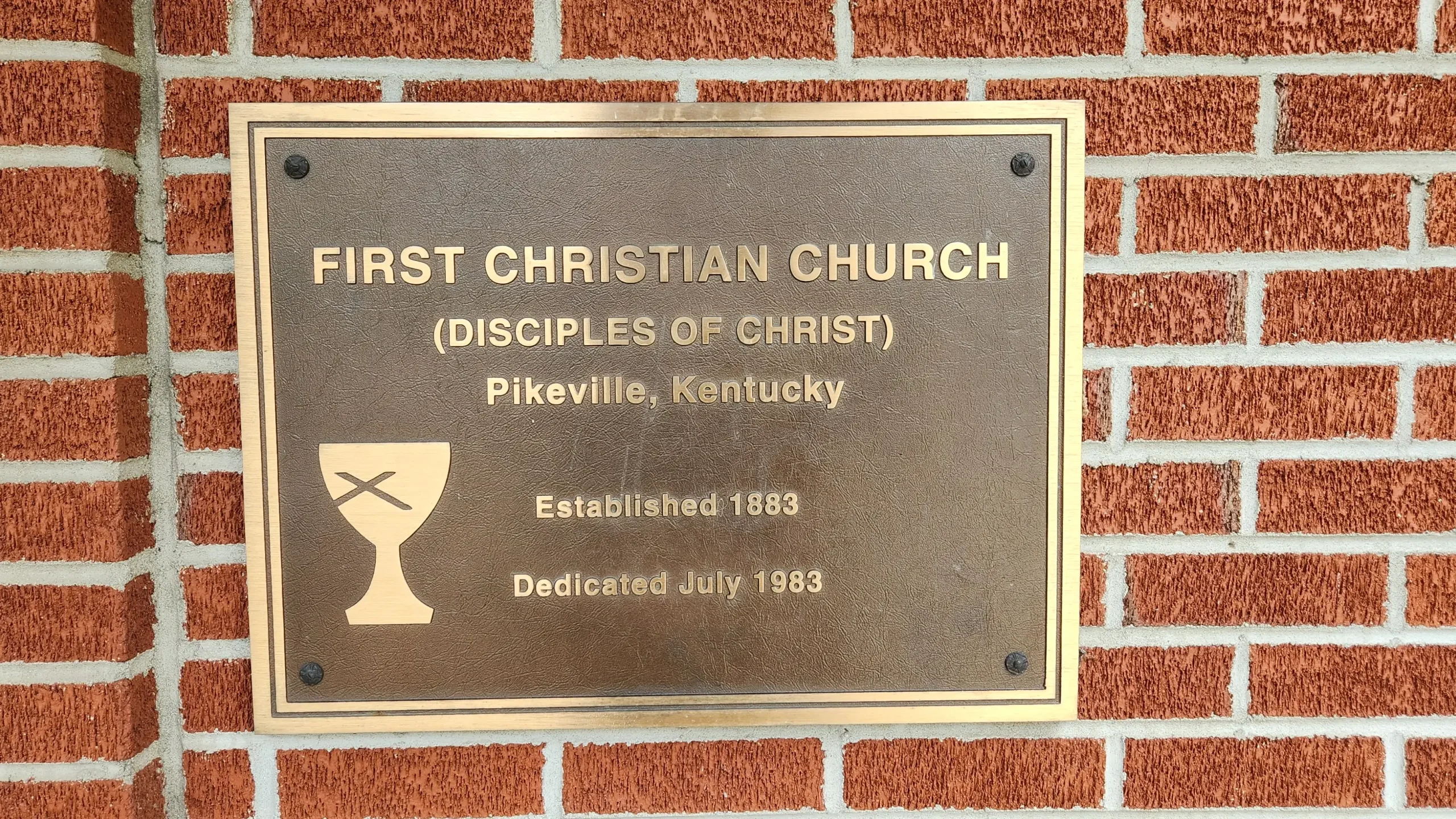
The photographs taken at today’s First Christian Church preserve the clearest visible marker of the congregation’s next major chapter. The bronze plaque identifies the church as First Christian Church (Disciples of Christ), Pikeville, Kentucky, states that it was established in 1883, and records the dedication of the present church in July 1983.
That means the dedication occurred exactly a century after the congregation’s founding year.
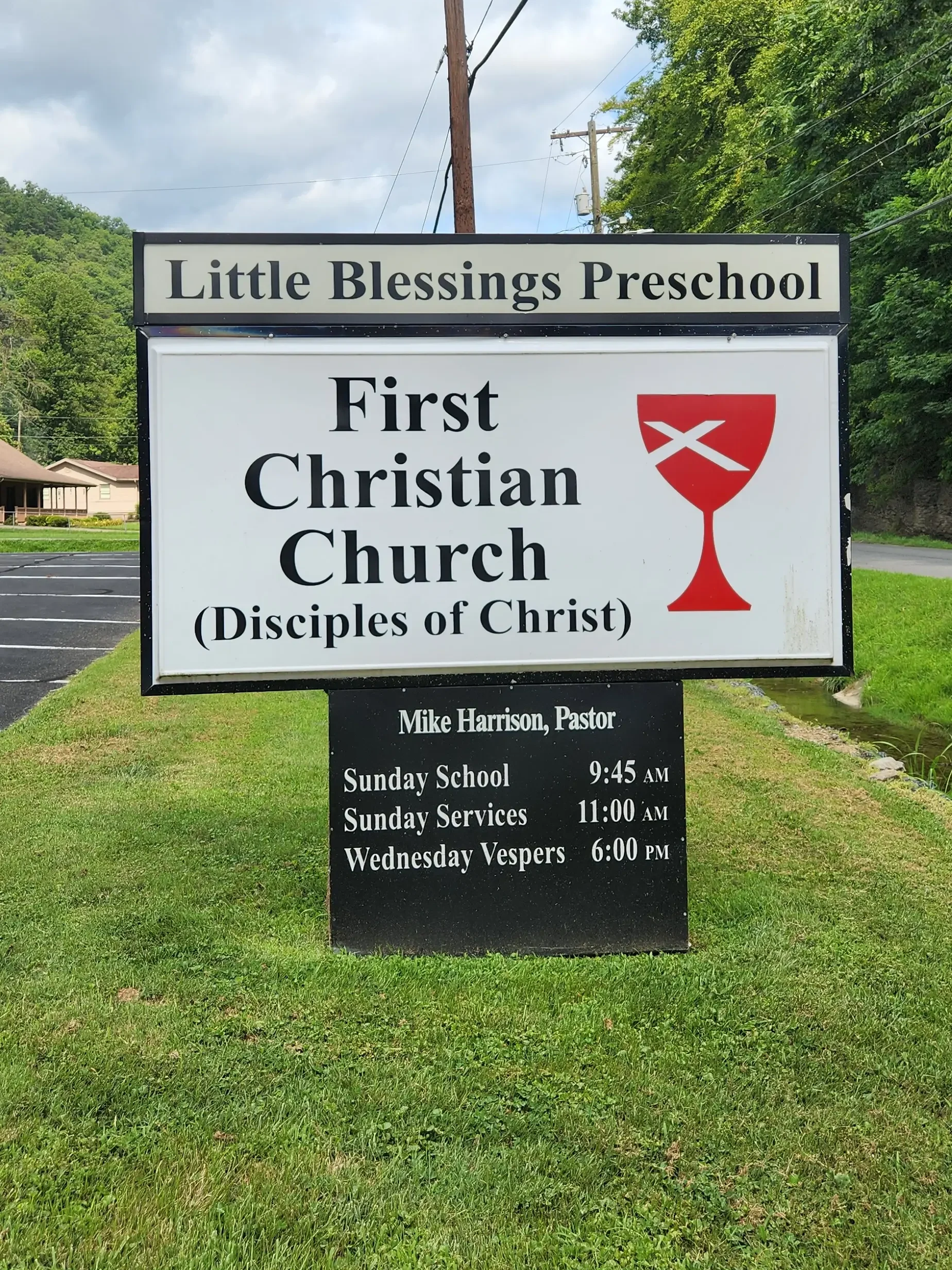
The modern church stands at 313 Chloe Road. A 2023 church newsletter confirms the Chloe Road address and identifies the building as First Christian Church (Disciples of Christ).
Architecturally, the church belongs to a very different Pikeville from the small Scott Avenue congregation of the late nineteenth century. The main sanctuary is faced in red brick and centered beneath a steep roof and modern steeple, while adjoining wings provide space for education, offices, gatherings, and children’s activities. Yet the chalice bearing the cross of St. Andrew remains prominently displayed, connecting the modern building to the Disciples tradition. The denomination explains that this chalice symbolizes the central place of the Lord’s Supper in Disciples worship, while the St. Andrew’s cross recalls the Scottish Presbyterian background of the Campbell tradition.
Little Blessings and a New Generation
The children’s playground beside the church represents another chapter in that long connection between religion and education.
First Christian Church opened Little Blessings Preschool in September 2002. According to the congregation’s own history of the program, the preschool was created for three and four year old children and combined early educational preparation with social development and religious instruction.
In some ways, that ministry brings the church’s history full circle.
The congregation itself began after an evangelistic meeting held in a public school in 1883. Decades later, the church hosted Cora Wilson Stewart while she campaigned against illiteracy. In the twenty-first century, education became part of the church property itself through a preschool.
The settings changed, but education remained close to the congregation.
A Church Serving Pikeville
First Christian Church’s modern work also continues the older Appalachian pattern of using the church building as a community gathering place.
The congregation describes its monthly community dinner as one of its largest missions, opening the church to people seeking food and fellowship and providing groceries to households that need additional assistance. Its ministries have also included support for United Helping Hands and Habitat for Humanity.
That work is not limited to the church’s own description. Kentucky’s reentry resource materials list First Christian Church at 313 Chloe Road as a Pike County food resource, noting the monthly meal and grocery distribution. The University of Pikeville has likewise included the church among local food and emergency resources available to the community.
The congregation today describes itself as composed of people from different backgrounds and emphasizes an open Lord’s Table, theological diversity, and the freedom of individual members to study scripture and reach conclusions in fellowship with others. Those ideas reflect the larger Disciples heritage that originated in the American religious movements of the early nineteenth century.
More Than a Century Between Two Plaques
The history of First Christian Church of Pikeville cannot be reduced to the age of its present building.
Its story begins with an evangelist named Petty speaking inside a public school in 1883 and with a small collection of Pikeville families deciding to establish a congregation. It continues through the construction of a simple church in 1887, Kentucky Ferrell’s 1893 property gift, elaborate weddings in the 1890s, the ministry and publishing work of R. B. Neal, and Cora Wilson Stewart’s appearance during Kentucky’s campaign against adult illiteracy.
Then came another church home, decades of services that remain scattered through Pikeville newspapers and denominational records, and eventually the move to Chloe Road.
When the present building was dedicated in July 1983, the congregation had reached its hundredth year. The church that visitors see today therefore represents only the most recent portion of a much older story.
The strongest thread through that history may be continuity rather than architecture. Pikeville changed around the congregation. The early town became a regional center, Scott Avenue changed, automobiles replaced the world of horses and riverboats, and the old church gave way to a larger modern complex beneath the mountains on Chloe Road.
Yet First Christian Church remained.
More than 140 years after a small group gathered following a meeting in a Pikeville schoolhouse, the red chalice still marks a Disciples congregation in Pike County, carrying forward a history that began with some of the families who helped build the town itself.
Sources & Further Reading
May, Eldon J., Ruth May, Claire Kelly, Dorcas Hobbs, and Leonard Roberts, eds. Pike County, Kentucky, 1821–1980: Historical Papers Number Four. Pikeville, KY: Pike County Historical Society, 1980; revised 1984. https://archive.org/details/pikecountykentuc04maye
Roberts, Leonard, Anna Forsyth, Frank Forsyth, Dorcas Hobbs, and Claire Kelly, eds. Pike County, 1822–1977: Historical Papers Number Three. Pikeville, KY: Pike County Historical Society, 1978; revised 1984. https://archive.org/details/pikecounty18221903robe
May, Eldon J., Dorcas Hobbs, Claire Kelly, and Ruth May, eds. Pike County, Kentucky, 1821–1987: Historical Papers Number Six. Pikeville, KY: Pike County Historical Society, 1987. https://archive.org/details/pikecountykentuc06maye
Howson, Embrey Bernard. A History of the First Christian Church of Pikeville, Kentucky. Center for Restoration Studies, Abilene Christian University Special Collections. The ACU collection specifically catalogs Howson’s church history, making this one of the most important church-specific sources for further research. https://blogs.acu.edu/specialcollections/2019/02/04/on-the-shelf-new-items-added-to-center-for-restoration-studies-collections-january-2019/
Pike County (Kentucky). Clerk of the County Court. Deeds, 1820–1902; Index, 1820–1970. Salt Lake City: Genealogical Society of Utah, microfilm of original Pike County records. FamilySearch Catalog. The series includes the period of the congregation’s 1893 property conveyance. https://www.familysearch.org/search/catalog/111955
The Big Sandy News. Louisa, KY, 1885–1929. Chronicling America, Library of Congress. The digitized run contains 1,489 issues and is one of the strongest newspaper collections for early twentieth-century Pikeville research. https://www.loc.gov/chroniclingamerica/lccn/sn83004226/issues/
Big Sandy News. “Mrs. Cora Wilson Stewart Discusses Illiteracy.” February 11, 1916. Moonlight Schools Collection, Camden-Carroll Library, Morehead State University. The archival description specifically identifies First Christian Church as the location of Stewart’s discussion. https://scholarworks.moreheadstate.edu/moonlight_schools_collection/125/
Library of Congress. “The Pike County News (Pikeville, Ky.), 1926–1949.” Directory of U.S. Newspapers in American Libraries. Holdings include copies preserved at Pikeville-area repositories and the University of Kentucky. https://www.loc.gov/item/sn85052041/
Library of Congress. “The Pikeville Daily News (Pikeville, Ky.), 1949–1954.” Directory of U.S. Newspapers in American Libraries. https://www.loc.gov/chroniclingamerica/lccn/sn85052043/
Library of Congress. “Appalachian News-Express (Pikeville, Ky.), 1979–Current.” Directory of U.S. Newspapers in American Libraries. https://www.loc.gov/item/sn83008583
Disciples of Christ Historical Society. “In-Person Research and Remote Research Services FAQ.” The Society preserves congregational records, regional records, clergy papers, periodicals, reference files, and other Stone-Campbell Movement materials. https://discipleshistory.org/in-person-research-and-remote-research-services-faq/
Christian Church (Disciples of Christ), Office of the General Minister and President. Year Book Records, 1906–1975. GEN-00006. Disciples of Christ Historical Society Manuscript Collection, Bethany, WV. The collection includes historical sketches, photographs, congregational data correspondence, and other denominational records. https://discipleshistory.as.atlas-sys.com/repositories/2/resources/68
Disciples of Christ Historical Society. “Spencer: The Archival Collections Catalog.” Bethany, WV. This database provides access to finding aids for congregational, personal, regional, and denominational collections. https://discipleshistory.as.atlas-sys.com/
Christian Church (Disciples of Christ). “Annual Year Book Connects Disciples Congregations and Ministries.” January 30, 2019. The denomination explains that its Year Books contain congregational membership, financial, ministerial, and institutional data useful for reconstructing individual church histories. https://disciples.org/congregations/annual-year-book-connects-disciples-congregations-and-ministries/
Christian Church (Disciples of Christ). “Disciples of Christ Historical Society.” Official denominational description of the Society and its historical archives and Stone-Campbell Movement collections. https://disciples.org/ministries/disciples-of-christ-historical-society/
First Christian Church of Pikeville. “First Christian Church of Pikeville.” Pikeville, KY. Official congregational website. https://fccpikeville.org/
First Christian Church of Pikeville. “What We Do.” Pikeville, KY. The congregation identifies itself as a Christian Church (Disciples of Christ) congregation and emphasizes its Appalachian identity and Pike County ministry. https://fccpikeville.org/what-we-do
First Christian Church of Pikeville. “Little Blessings Preschool.” Pikeville, KY. The church records the preschool’s opening in September 2002. https://fccpikeville.org/little-blessings-preschool
City of Pikeville. “Historic Preservation Board.” City of Pikeville, Kentucky. Includes records, forms, and photographs associated with the Scott Avenue Historic District and other historic areas of Pikeville. https://pikevilleky.gov/pikeville-historic-preservation-board-2/
City of Pikeville. “Agenda/Minutes.” City of Pikeville, Kentucky. Municipal commission and board records useful for tracing property, street, infrastructure, zoning, and institutional changes involving historic Pikeville. https://pikevilleky.gov/agendaminutes/
National Park Service. “Scott Avenue Historic District, Pikeville, Kentucky.” National Register of Historic Places. Listed 1984. https://www.nps.gov/state/ky/index.htm?program=all
Disciples of Christ Historical Society. Christian Standard Index, 1866–1966. The index contains numerous references to Robert Burns Neal, his mountain work, and Disciples activity in Pike County and eastern Kentucky. https://digitalcommons.discipleshistory.org/files/Christian%20Standard%20Index%201866%20-%201966.%20Volume%205_%20Nations%20through%20S.pdf
Kurfees, M. C. “The Passing of R. B. Neal.” Gospel Advocate, October 8, 1925. Reproduced by the Restoration Movement historical archive. The obituary documents Neal’s ministry and notes that his work extended into Pike County. https://www.therestorationmovement.com/_states/kentucky/neal.html
Author Note: This article follows First Christian Church from its 1883 beginnings through its Scott Avenue years and the 1983 dedication of its Chloe Road home using local histories, land records, newspapers, denominational archives, and photographs. Readers with old church bulletins, photographs, membership records, or memories of the Scott Avenue congregation can help preserve more of this Pikeville story.