
Appalachian History Series – The 1929 Beschman (Putney) Lookout Tower of Harlan County
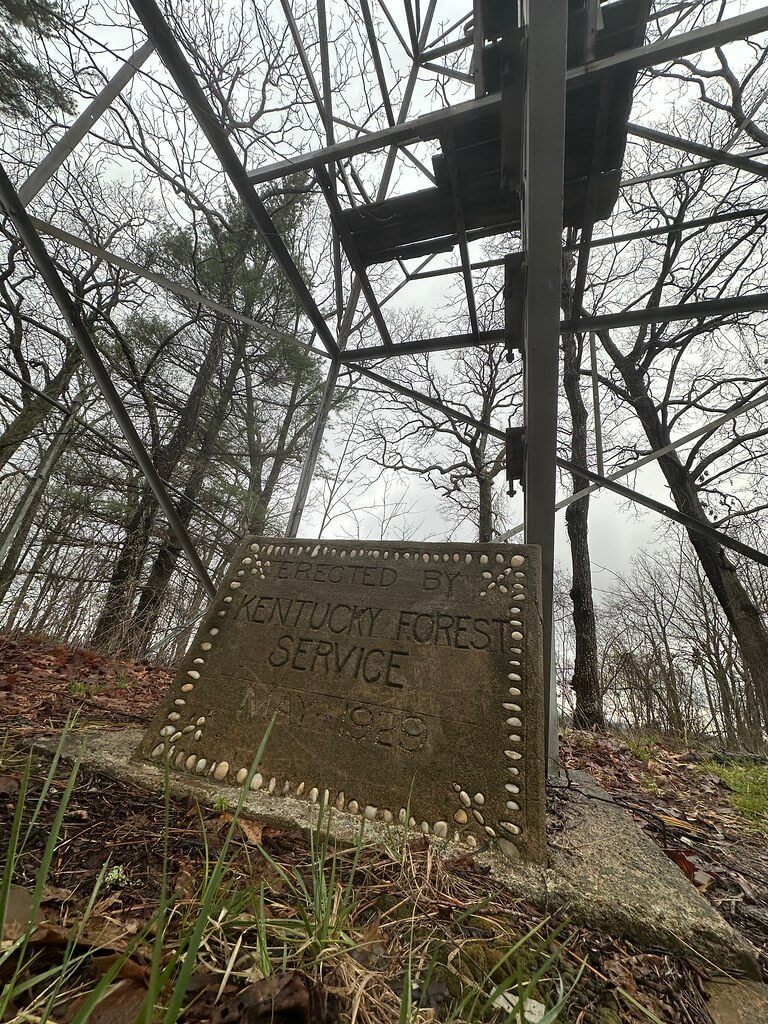
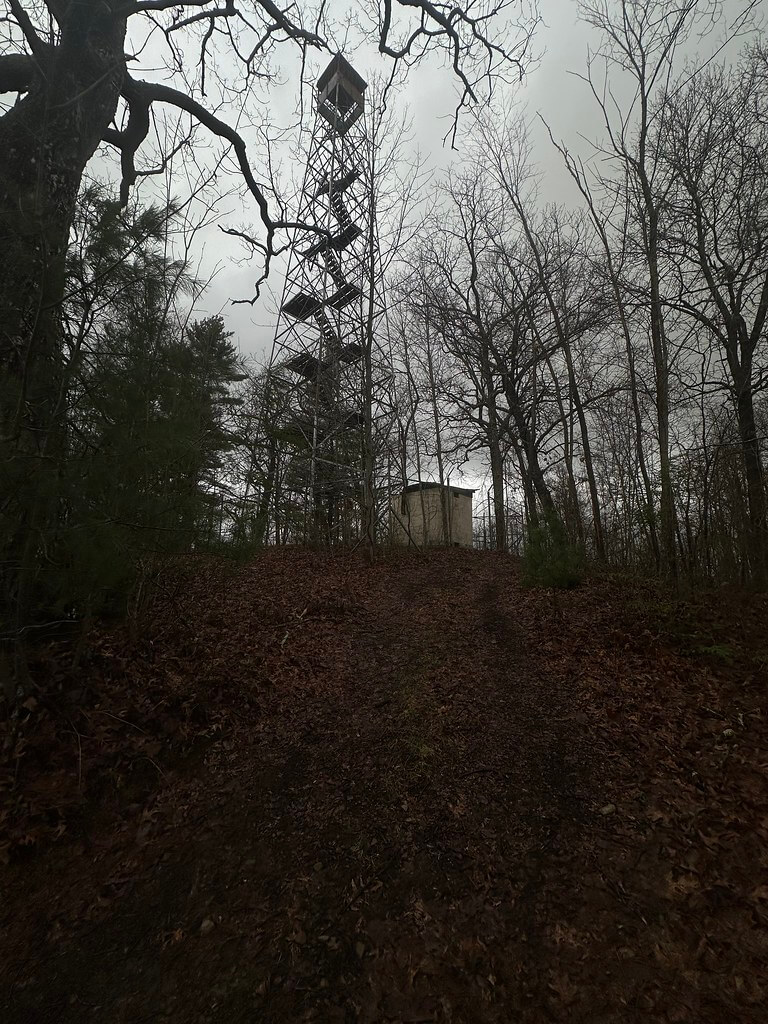
High on the crest of Pine Mountain in Harlan County, a steel fire tower still rises above the woods of Kentenia State Forest. Known locally as the Putney Fire Tower and identified on modern maps as the Beschman Lookout Tower, the structure is one of the surviving reminders of an era when men watched the Appalachian Mountains for the first thin columns of smoke that could signal a forest fire.
For years, the history of the tower has been tangled by conflicting dates and by its association with the Civilian Conservation Corps. Some accounts placed its construction in the late 1930s and connected it directly to the CCC camp at Putney. The surviving evidence, however, tells an older story. Kentucky Division of Forestry records state that the Putney, or Berkman, Tower was erected in May 1929 and stood one hundred feet tall. A contemporary newspaper notice from that same month reported state foresters working on a one hundred-foot steel lookout tower on Pine Mountain opposite Putney. Seven years later, a Civilian Conservation Corps newspaper referred casually to the “existing tower at Putney.” Taken together, those sources make a 1929 construction date considerably stronger than the later dates that have sometimes been repeated.
The Civilian Conservation Corps would become enormously important to the tower, the surrounding forest, and the Putney forestry complex, but the lookout appears to have already been standing when the New Deal transformed Pine Mountain into a much more developed fire protection landscape.
Kentucky’s First State Forest
The history of the Putney tower begins with the forest around it.
In 1919, the Commonwealth acquired land on the south side of Pine Mountain from the Kentenia Cantron Corporation. The property became Kentenia State Forest, Kentucky’s first state-owned forest. Today it survives in several tracts spread across Pine Mountain in Harlan County, with the largest accessible from the Little Shepherd Trail along the crest.
Its creation came during an important period in Kentucky conservation. The state had established a formal Board of Forestry only a few years earlier, while Harlan County had already become one of the early centers of organized forest protection. State forestry histories record that the first Forest Protection Association in Kentucky was organized in Harlan County, where participating landowners paid an assessment to support fire protection across a growing area of mountain forest.
The need was difficult to ignore.
Pine Mountain Settlement School records preserve particularly vivid evidence of the fires that swept these mountains during the early twentieth century. In 1922, the Harlan Daily Enterprise reported on a major forest fire around the school that burned approximately four thousand acres. Leon F. Deschamps, the school’s forester, estimated the losses at $12,000 and described damage not only to standing timber but to young trees, leaf litter, humus, and the soil itself.
Students helped fight the fires. Pine Mountain records preserve accounts from boys who spent twenty, thirty, and in some cases forty hours raking fire lines, setting controlled backfires, and trying to stop flames that repeatedly crossed their defenses. Lucretia Garfield, a teacher and granddaughter of President James A. Garfield, joined students in petitioning Kentucky’s governor for stronger forest protection in Harlan County.
Before steel towers watched Pine Mountain, people sometimes climbed trees or high ridges simply to determine where the smoke was coming from. One Pine Mountain student remembered Deschamps climbing a tree to locate a distant fire during the 1922 emergency.
The Putney tower would provide a much more permanent solution.
A One Hundred Foot Tower Above Putney
On May 23, 1929, the Advocate Messenger of Danville reported that G. Y. Bell, assistant state forester, and S. D. Suiter, district forester, were engineering the construction of a one hundred foot steel lookout tower on top of Pine Mountain opposite Putney.
The report fits almost perfectly with the later official history of Kentucky’s lookout towers. Jennifer Turner of the Kentucky Division of Forestry wrote that agency records document three Kentucky towers erected during the 1920s. Among them was the Putney, or Berkman, Tower in Harlan County, erected in May 1929 and standing one hundred feet tall on Kentenia State Forest.
That detail is important because it moves the construction of the Putney tower several years before the creation of the Civilian Conservation Corps in 1933.
From its position on Pine Mountain, the lookout gave state foresters the elevation they needed to search a wide area for smoke. Fire towers were designed around visibility. An observer in the cab could scan the surrounding mountains and, with specialized fire-finding equipment and reports from other towers, estimate the position of a fire before crews were dispatched into terrain where travel could be slow and difficult.
Putney therefore belonged to an early generation of Kentucky fire towers, built when state forestry agencies were experimenting with a more organized system of detection and suppression.
The Evidence That Settles the Date
The strongest evidence against a 1939 construction date comes from a source created before 1939 ever arrived.
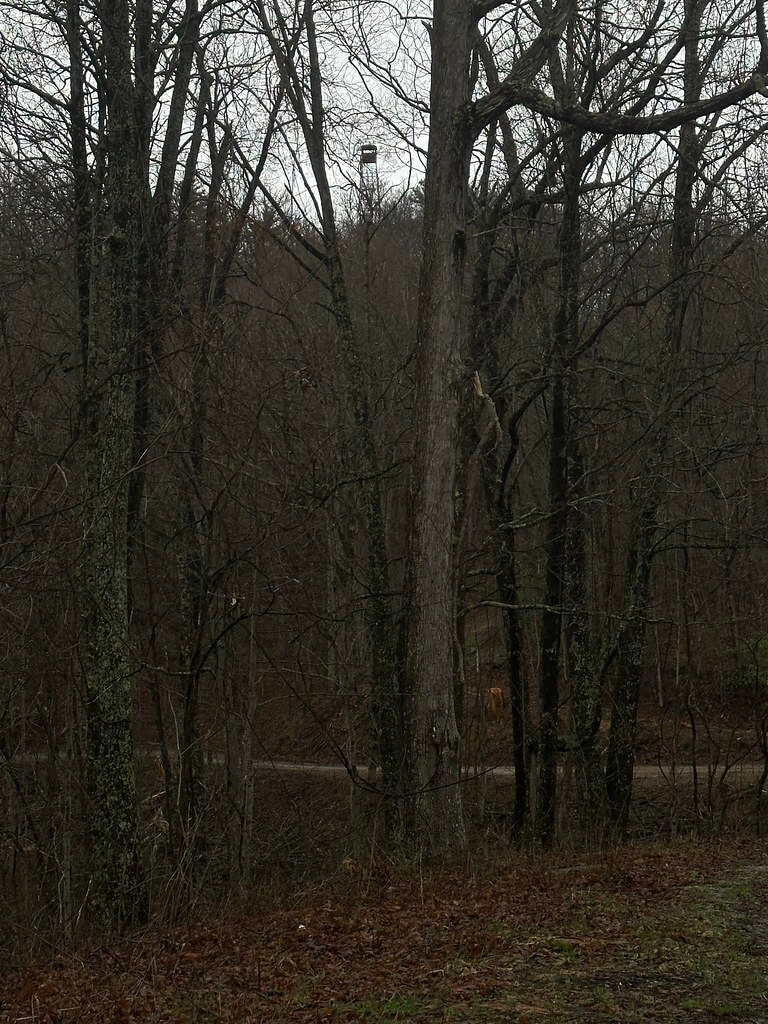
On July 4, 1936, the Civilian Conservation Corps newspaper The Cloverleaf discussed plans for a proposed tower on Little Black Mountain in Harlan County. The proposed location was valuable partly because observers there could coordinate sightings with another lookout. The newspaper specifically said that triangulation with the “existing tower at Putney” would be possible.
That sentence is difficult to reconcile with the idea that the Putney tower was first constructed in 1939.
It also complements the 1929 evidence unusually well. In May 1929, a contemporary Kentucky newspaper reported construction of a one-hundred-foot tower opposite Putney. Kentucky Division of Forestry records independently identify the Putney tower as a one-hundred-foot structure erected in May 1929. Then, in July 1936, a CCC publication referred to a Putney tower as already existing.
There is a conflicting piece of later evidence. A caption in the Pine Mountain Settlement School collections states that fire towers were not available until after 1937 or 1938. The same collection contains valuable original material, but that retrospective caption cannot outweigh the contemporary and official evidence showing a tower at Putney years earlier.
Unless an undiscovered document eventually demonstrates that the 1929 tower was dismantled and replaced with another structure during the late 1930s, the best supported interpretation is that the surviving Putney tower originated with the Kentucky Forest Service in 1929 and was later incorporated into the much larger CCC fire protection system.
The Civilian Conservation Corps Comes to Putney
Although the CCC apparently did not originate the Putney tower, its influence on the landscape surrounding it was enormous.
Camp S-53 was established near Kentenia State Forest in May 1933. Company 512 worked in Harlan County on forest conservation, fire suppression, road construction, truck trails, telephone systems, forestry improvements, and fire tower-related projects. The Kentucky Historical Society’s Civilian Conservation Corps newsletter collection preserves The Wildcat and The Wildcat Weekly from Company 512 at Putney, providing an unusually detailed archival record of the men and projects associated with the camp.
The Kentucky Heritage Council’s study of New Deal construction in eastern Kentucky describes a coordinated system rather than isolated structures. Towers had to be reachable. Reports had to travel quickly. Rangers had to know where smoke was located, and crews had to have roads or trails that could move men closer to the fire.
Company 512 helped make that system possible around Kentenia.
The Pine Mountain Settlement School collections associate the Putney forestry complex with tower work, tower trails, telephone lines, forest roads, and other fire control improvements. The Putney Ranger Station was begun in January 1937 and became an important headquarters for forestry operations in the area.
The result was something much larger than the tower alone. The steel lookout on the ridge became one point in a network connecting observers, rangers, roads, trails, telephone lines, equipment, and firefighting crews across the mountain.
The CCC did not need to have erected the tower for its work to have transformed the way the tower functioned.
A Tower Becomes Part of Pine Mountain Life
Putney Tower was built for forest protection, but to students at nearby Pine Mountain Settlement School it became something more.
By the 1940s, the tower was deeply connected to Mountain Day, one of the school’s outdoor traditions. Students left the campus and made the long hike across the mountain to the lookout, where the practical structure of the Kentucky forestry system became a destination for recreation and education.
A 1944 report from the director of Pine Mountain Settlement School described nearly everyone at the school taking part in Mountain Day, except for the fire crew and two adults. Their destination was Putney Tower, approximately fourteen miles round trip, followed by dancing after they returned.
The school’s student publication Conifer described the same tradition in 1944. Its account remembered the Mountain Day journey to Putney Tower as exhausting but joyful, leaving students with weary bodies and happy memories.
Ray Banks, a Pine Mountain student, gave an even more personal description in a December 1944 letter. He remembered going to Putney Tower for dinner and participating in contests involving the identification of trees and flowers, imitating bird calls, and sketching. The tower had become an outdoor classroom as much as a forestry installation.
The tradition continued after the war.
The November 1948 issue of The Pine Cone included several accounts of Mountain Day. Walter Blackson wrote about the traditional hike to Putney Tower, while Birdie Miniard, who remained behind to help at the hospital, described watching the hikers through a telescope and communicating with them using a reflector. Other students filled the following page with their own memories of the day.
These accounts give Putney Tower something many surviving fire towers lack. They document not just the structure, but the human experience surrounding it.
Photographs From the Top of Pine Mountain
The Pine Mountain archives also preserve photographs that allow the tower’s working years to be seen rather than merely reconstructed from written records.
Images from the 1940s show students and staff visiting the Putney Fire Tower during Mountain Day. A photograph attributed to the Birdena Bishop collection, dating from around 1947, looks outward from the top of the tower toward the surrounding Pine Mountain landscape.
Dorothy Nace’s color slide collection contains photographs identified as “View from Putney Tower, Fall 1949” and another from October 1949. These images demonstrate the commanding view that made the ridge so valuable for fire observation in the first place.
From that height, an observer was not simply looking down at one forest. Pine Mountain stretched outward in long ridges and deep drainages, precisely the kind of terrain where a small fire could remain invisible from the valleys below.
The lookout converted elevation into information.
The Rangers Who Watched the Mountain
The tower was only as effective as the forestry organization supporting it.
William Hayes, who worked with the Kentucky Division of Forestry in the Kentenia unit at Putney, left behind records and photographs that help reconstruct the daily work of mid-century forestry. A March 27, 1960 article in the Harlan Daily Enterprise described the many responsibilities associated with the Putney forestry operation. Hayes and his wife Fern participated in seedling distribution, public education, equipment repair, weather observation, mapping forest fires, tracking the area’s burn index, and distributing daily information about fire danger.
Those duties show how much the work had evolved beyond simply sitting in a tower and waiting for smoke.
Fire protection required knowledge of weather, forest conditions, equipment, geography, communications, and the behavior of fire itself. The tower remained an important set of eyes above the forest, but it belonged to a professional system increasingly supported by trained foresters and improved communications.
A photograph in the Pine Mountain collections identifies Putney Tower in Kentenia State Forest around 1963, providing evidence that the structure remained part of the forestry landscape more than three decades after its construction. The research material also identifies a 1968 Harlan Daily Enterprise feature involving Ed Smith, described as a ranger at the Putney fire tower, suggesting that the lookout remained connected to active forestry work well into the 1960s.
Berkman, Beschman, and the Tower’s Changing Name
The structure’s name creates another small historical puzzle.
Kentucky Division of Forestry records call it the Putney “Berkman” Tower. Modern United States Geological Survey mapping identifies the site as the Beschman Lookout Tower. Local residents and hikers have commonly referred to it simply as the Putney Fire Tower.
The similarity between Berkman and Beschman naturally raises questions about whether the names became altered through transcription, mapping, or local usage over the decades.
There is also a possible human connection. Pine Mountain records identify H. W. Berkman as a forestry supervisor associated with later work on Pine Mountain. That makes it tempting to conclude that the tower’s Berkman name honored him.
The surviving evidence located so far does not prove that connection, however. Until a contemporary forestry document explicitly explains the name, it is safer to treat Berkman, Beschman, and Putney as names found in different parts of the historical record rather than claiming with certainty how one developed from another. The official forestry history’s use of “Putney (Berkman) Tower” nevertheless establishes that Berkman is not simply a recent spelling variation.
From Working Lookout to Historic Landmark
Fire towers gradually became less essential as forestry technology changed. Radios improved communication. Aircraft could cover enormous areas. Modern weather information and fire detection systems made it possible to monitor forests without maintaining an observer high above the ground throughout the fire season.
Many Kentucky towers disappeared.
Putney survived.
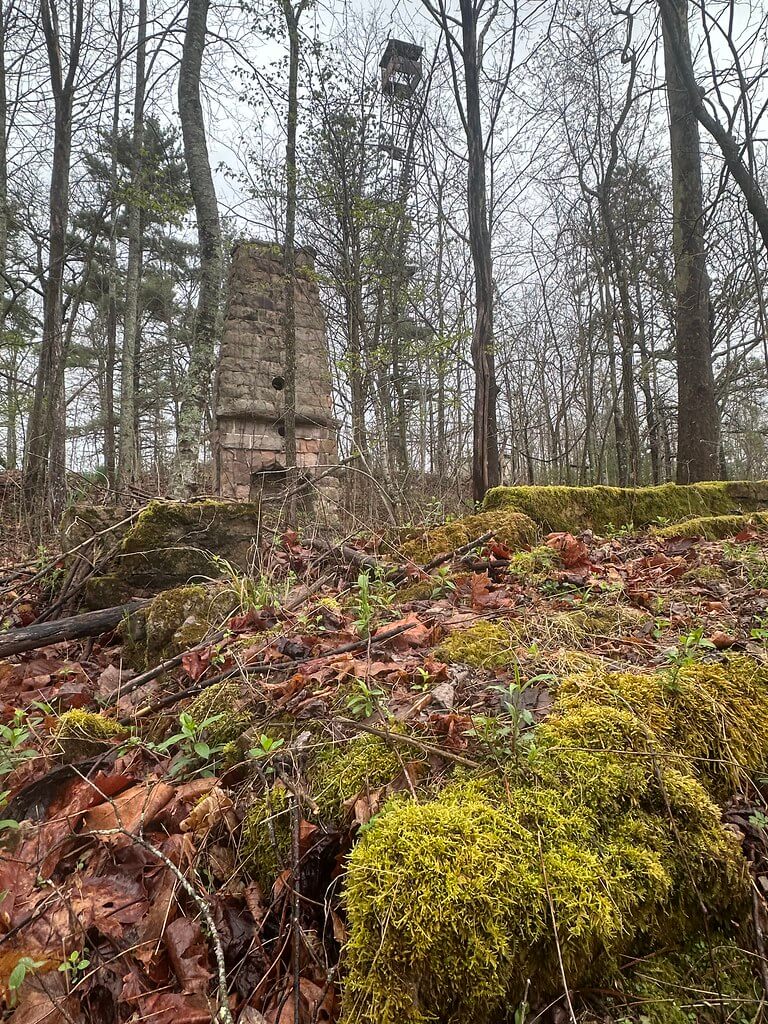
Modern photographs show the steel framework still rising above the forest, though the structure has suffered from age, weather, deterioration, and the loss of portions of its stairs and wooden surfaces. The tower should be treated as a historic structure rather than a safe observation platform. Visitors can appreciate it without attempting to climb deteriorated stairs or improvised ladders.
Its survival is remarkable partly because so much of the world built around it has changed.
The observer who once watched for smoke is gone. The telephone systems and CCC work camps belong to history. The students who climbed Pine Mountain on Mountain Day grew old. The forestry service adopted new technology, and the landscape that once required a person in a steel cab could increasingly be watched from aircraft, radios, weather stations, and computerized systems.
Yet the tower remains.
What the Putney Tower Represents
The Beschman, Berkman, or Putney Lookout Tower is more than an abandoned steel structure on Pine Mountain.
Its history reaches into some of the earliest organized conservation efforts in Kentucky. It stands within the Commonwealth’s first state forest and in a county that played an important early role in forest fire protection. Its construction followed years in which students, foresters, and residents sometimes fought mountain fires with little more than hand tools, backfires, and endurance.
The evidence now places the tower firmly within that early period. The Kentucky Forest Service erected it in 1929, before Franklin Roosevelt entered the White House and before the Civilian Conservation Corps existed. The CCC later surrounded it with the infrastructure of the New Deal, improving the roads, trails, telephone systems, ranger facilities, and fire control network that made organized forestry increasingly effective across Harlan County.
Pine Mountain Settlement School then gave the tower another life in the historical record. Students walked fourteen miles to reach it, ate meals there, studied trees and birds, communicated across the mountains with reflected light, photographed the view, and remembered the journey decades later.
That combination of state conservation, New Deal development, education, recreation, and community memory makes Putney Tower unusually valuable.
Many abandoned structures survive because nobody bothered to remove them. This one survives with a documented story.
Nearly a century after Kentucky foresters raised a one-hundred-foot tower above Putney, its steel frame still stands on Pine Mountain. The forests below have changed, the methods used to protect them have changed, and the people who once climbed into the lookout cab are gone.
The tower remains above them all, one of Harlan County’s last physical reminders of the time when protecting the mountains meant putting a watchman high above the trees and asking him to keep his eyes on the horizon.
Sources & Further Reading
Turner, Jennifer L. “A History of Kentucky’s Fire Lookout Towers.” Land, Air & Water, Winter 2016. Kentucky Division of Forestry. https://eec.ky.gov/Land%20Air%20Water/Winter%202016.pdf
Kennedy, Rachel, and Cynthia Johnson. The New Deal Builds: A Historic Context of the New Deal in East Kentucky, 1933–1943. Frankfort: Kentucky Heritage Council and Kentucky Transportation Cabinet, 2006. https://heritage.ky.gov/Documents/NewDealBuilds.pdf
Kentucky Historical Society. Civilian Conservation Corps Camp Newsletters, 1934–1941. MSS 218. Kentucky Historical Society Digital Collections. https://www.kyhistory.com/digital/collection/LIB/id/2156/
Pine Mountain Settlement School Collections. “Putney Forestry Station, Putney, Kentucky.” https://pinemountainsettlement.net/built-environment/putney-forestry-station-putney-kentucky/
Pine Mountain Settlement School Collections. “Forests and Fires.” https://pinemountainsettlement.net/dancing-cabbage-patch-xii-forests-fires/
Pine Mountain Settlement School. Conifer. 1944. Pine Mountain Settlement School Collections. https://staging.pinemountainsettlement.net/?page_id=9629
Blackson, Walter. “Mountain Day.” The Pine Cone 13, no. 2 (November 1948). Pine Mountain Settlement School. https://pinemountainsettlement.net/publications/pine-cone-index/pine-cone-1948-november/
Miniard, Birdie. “The Day I Was Left Behind.” The Pine Cone 13, no. 2 (November 1948). Pine Mountain Settlement School. https://pinemountainsettlement.net/publications/pine-cone-index/pine-cone-1948-november/
Banks, Ray. Letter, December 21, 1944. Ray Banks Student Records. Pine Mountain Settlement School Collections. https://pinemountainsettlement.net/biography-a-z/ray-banks-student/
Pine Mountain Settlement School. “1944 Director’s Reports and Letters to the Board of Trustees.” Pine Mountain Settlement School Collections. https://pinemountainsettlement.net/governance-directors-annual-reports-to-bot-guide/governance-1944-directors-reports-and-letters-to-bot/
Nace, Dorothy. “View from Putney Tower, Fall 1949” and “View from Putney Tower, Oct. 1949.” In Dorothy Nace Color Slide Photographs of Pine Mountain Settlement School and Area, 1945–1956. Pine Mountain Settlement School Collections. https://pinemountainsettlement.net/biography-a-z/dorothy-name-staff/dorothy-nace-color-slides-of-pmss-1949-1956/
Pine Mountain Settlement School Collections. “William Hayes, Student, Staff, Board, Part 2.” Includes forestry records and photographs relating to the Putney Ranger Station and Putney Tower. https://pinemountainsettlement.net/biography-a-z/william-hayes-student-staff-and-board-part-1/william-hayes-student-staff-board-part-2/
Turner, Jennifer L. “From Hiking to Horseback Riding: Visitors to Kentenia State Forest Take in Scenic Views, Get an Education.” Land, Air & Water, Spring 2015. Kentucky Division of Forestry. https://eec.ky.gov/Land%20Air%20Water/Spring%202015.pdf
Kentucky Energy and Environment Cabinet, Division of Forestry. “Kentenia State Forest.” https://eec.ky.gov/Natural-Resources/Forestry/ky-state-forests/Pages/Kentenia-State-Forest.aspx
Kentucky Energy and Environment Cabinet, Office of Kentucky Nature Preserves. “Kentenia State Forest.” https://eec.ky.gov/Nature-Preserves/Locations/Pages/Kentenia.aspx
Kentucky Department of Fish and Wildlife Resources and Kentucky Division of Forestry. Kentenia State Forest. Frankfort, KY: Commonwealth of Kentucky. https://eec.ky.gov/Natural-Resources/Forestry/Documents/KenteniaStateForest_ALL.pdf
United States Geological Survey. Nolansburg Quadrangle, Kentucky. 7.5-Minute Series. Reston, VA: U.S. Geological Survey, 2013. https://prd-tnm.s3.amazonaws.com/StagedProducts/Maps/USTopo/PDF/KY/KY_Nolansburg_20130312_TM_geo.pdf
United States Geological Survey. Nolansburg, KY-VA. Historical Topographic Map Collection. Reston, VA: U.S. Geological Survey. https://store.usgs.gov/product/348127
Harr, Michael. “Putney (Beschman) Lookout Tower.” Kentucky Hiker, September 10, 2020. https://www.kentuckyhiker.com/latest/2020/9/10/putney-beschman-lookout-tower
Pine Mountain Settlement School Collections. “Little Shepherd Trail.” https://staging.pinemountainsettlement.net/?page_id=34170
Pine Mountain Settlement School Collections. “Birdena Bishop Correspondence I, 1940–1946.” https://pinemountainsettlement.net/biography-a-z/birdena-bishop/birdena-bishop-correspondence-i-1940-1946/
Pine Mountain Settlement School Collections. “William Hayes, Student, Staff, and Board.” Records relating to the Kentucky Division of Forestry, Kentenia State Forest, Putney Ranger Station, and forest fire protection. https://pinemountainsettlement.net/biography-a-z/william-hayes-student-staff-and-board-part-1/william-hayes-student-staff-board-part-2/
Kentucky Historical Society. The Wildcat and The Wildcat Weekly. Company 512, Civilian Conservation Corps, Putney, Kentucky, 1934–1939. Civilian Conservation Corps Camp Newsletters, MSS 218. https://www.kyhistory.com/digital/collection/LIB/id/2156/
Civilian Conservation Corps. The Cloverleaf. Louellen, Kentucky, 1935–1937. Civilian Conservation Corps Camp Newsletters, MSS 218, Kentucky Historical Society. https://www.kyhistory.com/digital/collection/LIB/id/2156/
Author’s Note: This article revisits the history of Putney Tower using Kentucky forestry records, contemporary newspapers, CCC documents, maps, photographs, and Pine Mountain Settlement School archives. The surviving evidence strongly supports May 1929 as the tower’s construction date, correcting the later date that has sometimes been associated with the structure.